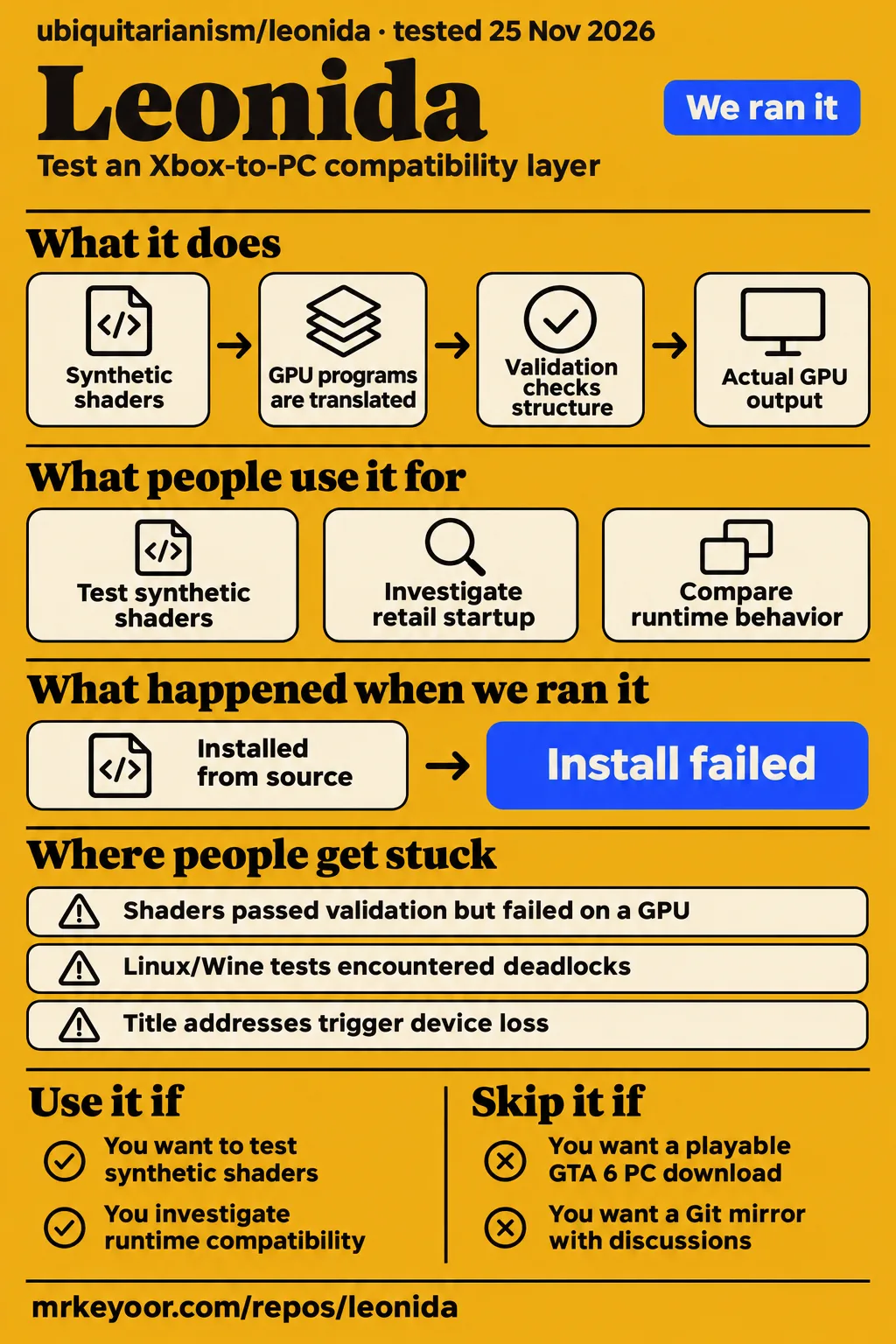
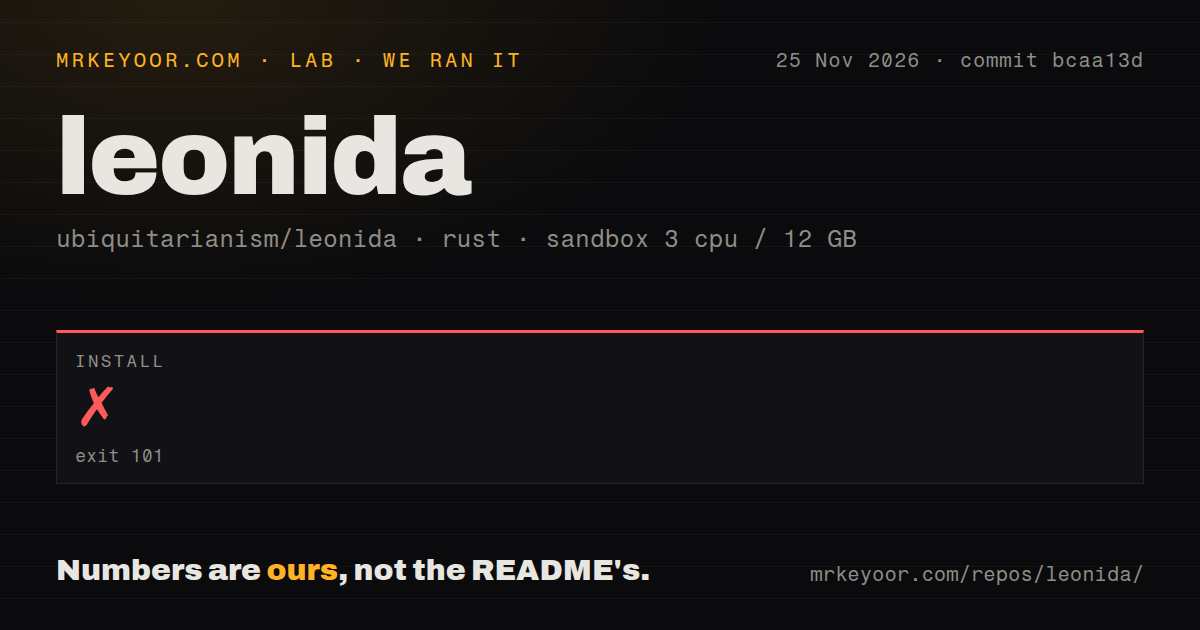
Our Leonida install failed after 6 seconds while Cargo was fetching a dependency, with “No space left on device” in the log. Use the continuation if you want to investigate graphics translation or Windows-runtime compatibility; skip it if you want a playable GTA 6 PC download. The project's own README says nothing is playable yet.
What people use leonida for
Contributors use Leonida to test individual pieces of an Xbox-to-PC compatibility layer, including work that needs no game files. Those are useful engineering tasks in their own right. They also give you a better way to assess the continuation than counting startup videos: ask which component someone exercised, on which revision, and what happened afterward.
- Mby159 tested synthetic shaders on an AMD Radeon 780M. In issue #14, the contributor reports successful translation and validation alongside GPU execution failures. Synthetic shaders are small, purpose-written programs that isolate graphics behavior. They let contributors compare expected output with actual output without loading the game.
- DadaCap investigated retail-package startup on Windows 11 with an RTX 5080. In issue #1537, raising both memory limits bypassed an initial device-loss failure, then the title hit its hang watchdog. A watchdog detects a program that stops making progress. Disabling that watchdog later exposed another device loss.
- rocobalt1 patched the console command-list interface. Issue #523 documents startup moving beyond the original interface failure, with independent reproduction by other contributors. A later main-branch check reports both the interface correction and the slot-signature correction already present. That makes this a fix to learn from, rather than a patch to apply blindly.
- PierreEbele compared Linux/Wine runtime behavior with a native Windows cross-check by robot00f. Issue #1150 distinguishes host limitations from runtime bugs and reports no ctest hangs in the Windows cross-check. Wine runs Windows programs on another operating system, adding a compatibility layer that can change the failure you see.
If you want to contribute without handling game assets, the computed-EXEC issue explicitly describes a CPU-only route using hand-written fixtures. Start with a small reproducible behavior and an expected result. That gives a maintainer something more useful than another claim that the game “almost boots.”
What happened when we ran it
Our November 25, 2026 install at commit bcaa13d failed with exit 101 after 6 seconds in the Rust subproject at runtime/xma_decoder/. Our measurement setup recorded 3 CPUs, 12 GB RAM and image label lab-rust:1. That label identifies the configured image, not the actual Rust or operating-system version.
| What our sandbox recorded | Result |
|---|---|
| Install target | runtime/xma_decoder/, the XMA2 decoder subproject |
| Install | Failed, exit 101, after 6 seconds |
| Failing operation | Cargo fetching xma from omonkeyz/xbox-emulator |
| Pinned dependency revision | 27122f7dfcceb9a899555362ee0dde2d530e033c |
| Log error | Could not write docs/img/progress.svg: “No space left on device” |
| Checkout scan | 2,754 files, about 810,810 source lines, 47.7 MB |
| Repository signals | 6 CI workflow files, a tests directory, no Dockerfile |
Cargo began by updating the Xbox-emulator Git repository. It then failed to write a file inside its dependency checkout under /work/home/.cargo/git/checkouts/. The log names a filesystem write failure. It gives us no successful decoder installation and no basis for calling the decoder defective. The configured RAM allowance is not a measurement of free disk space.
A separate container attempt failed its safety step because none of compose.yaml, compose.yml, docker-compose.yaml or docker-compose.yml existed. “Unsafe repo” was that runner's label for failing its Compose requirement, not a finding of malicious code. Its summary says “deployed with its own docker compose”, which conflicts with the detailed failure. We treat the blocked step as the result, rather than claim a working deployment. The teardown record reports success.
The Rust target is only one part of this repository. GitHub identifies Python as the primary language, and the README describes a multi-stage workflow around the game package, shaders and runtime. A failed dependency checkout in the audio-decoder directory cannot answer whether the complete port boots.
Where people get stuck: old reports can hide completed fixes
Issue #15 remains open even though later contributors report the computed-EXEC correction working on main. EXEC selects which GPU lanes, the parallel workers within a shader, should execute an instruction. The original bug enabled an entire half-wave where individual bits should have selected individual lanes. Reading only the issue title would leave you with the wrong diagnosis.
| Report | What changed | How to use it |
|---|---|---|
| #15, computed EXEC | PR #24 landed; later contributors report both computed-EXEC and image-atomics guard checks passing | Read the later comments before reopening the original defect |
| #31, TFE image loads | Closed; an Intel Arc A770 retest after the #892 merge reports the fixtures passing | The final commenter attributes the earlier mismatch to fixture expectations |
| #523, command-list interface and slot signature | whoalin1 reports both corrections present on main at b4b7756e8 | Compare your revision before applying the old local patch |
| #1537, title-memory limits | Higher limits bypassed particular failures; later runs hit hangs or another device loss | Treat the switches as a diagnostic workaround |
| #1150, Windows tools launched from Linux | robot00f reports a Wine launcher in PR #1219; a later reply says actual Wine execution still needs checking | Separate launcher logic from an end-to-end Linux result |
The TFE thread is particularly instructive. superartyom first described an NVIDIA result as proof of a translator bug, then corrected that interpretation after discussion of the fixtures' expected output. A repeatable mismatch proves that two results differ. Establishing which one is wrong takes another step. The Arc retest kept the same machine and driver while changing the revision, giving readers a narrower and more useful comparison than a blanket warning about Intel GPUs.
Shader validation leaves retail startup as a separate task
In issue #31, translated shaders passed spirv-val but still failed when executed on a GPU. SPIR-V is an intermediate graphics-program format used by Vulkan; its validator checks program rules, not whether the pixels or returned values match the console. superartyom reports both successful validation and incorrect GPU output in the same experiment.
Read compatibility claims in stages: translation produces a program, validation checks its structure, synthetic execution checks a defined behavior, retail startup exercises the title, and gameplay requires the world to render and respond. Evidence at one stage should not be promoted to the next. The current README says the story load reaches the world phase while no first world frame has been confirmed.
For a useful hardware report, record the operating system, driver, GPU, revision and fixture together. Mby159's Radeon results, the Arc follow-up, and PierreEbele's Wine report each describe different combinations. The Wine discussion includes sparse-mapping teardown deadlocks and DXGI faults that became debugger hangs. Timeouts made some failures observable; that reporting technique is different from repairing their underlying cause.
There is also graphics work beyond the original shader corpus. Rain156's coordination entry identifies pipeline-library programs still needing exact translations, with a possible container-based route for stages that have valid DXBC data. The relevant question is which programs the current runtime needs, rather than whether one earlier translation dashboard reached completion.
Source reviews do not certify a download
Etoile-Bleu's leonida-reviews tracks scoped pull-request reviews, and its definition of “clean” explicitly excludes a safety guarantee. The table records the reviewed commit and flags changed pull requests. A clean result for an earlier diff is a reason to inspect that review's scope, date and commit, not permission to trust an unrelated installer.
HW Busters reports fake installers and paid fake development builds using the project's name. Those reports concern impersonating downloads. They do not identify the continuation's source tree as malware. Keep those two questions separate when assessing risk: what a particular code review examined, and whether a downloaded executable came from that code at all.
The continuation's README says it ships no game, keys or executable and does not decrypt protected files. It also tells you to keep locally generated game-derived files private. In the coordination thread, Tyrannys reports that first-run keyboard-pad settings can send keys typed in other windows to consent pages and opens PR #1612. That is a concrete input-handling concern; a “done” entry means a pull request was opened under the thread's rules, not that it merged.
Keeping Git history does not keep the discussion
The continuation restored old pull-request code as draft branches, while leaving the discussions behind. Issue #17 explicitly says only code was copied. It also says the drafts were not merged into main and their CI was cancelled. If you pick up a restored branch, its existence is preservation of work, not acceptance of that work.
The practical contribution route runs through coordination issue #1608, which continues #14 after its comment cap. Existing claims still stand. Look up the earlier claim and open pull requests before starting, then keep the same work identifier in your pull request. The thread's distinction between claiming work, posting a finding and opening a PR helps explain why an entry marked “done” can still need review.
Issue #1185 discusses Forgejo, Radicle and separate exports of issue and PR metadata. NinsonD and robot00f describe overlapping exporter work, making the coordination problem visible inside the proposed solution. A normal Git mirror preserves commits; it doesn't preserve the conversation that explains why a patch was rejected or which hardware exposed a regression.
The public API reported a November 25, 2026 push when we checked the continuation. Taken with the dated fix reports, that supports ongoing work. It says nothing about how long a particular host will remain available or how quickly a new contributor will receive help.
Leonida vs the alternatives people search
Remote Play from an owned console answers a different need from native PC execution: it puts the console session on your PC screen. SixShore describes it as the supported viewing route. Decide whether you want to play a game or help build a compatibility layer before choosing between them.
| Choice | Why consider it | Decision boundary |
|---|---|---|
| Official console release | SixShore identifies PS5 and Xbox Series X/S as the released platforms | Choose an official console route if playing is the immediate goal |
| Console Remote Play | SixShore describes streaming from a console you own | Requires that console; it is not native PC execution |
| Wait for an official PC version | SixShore's November 25 report says Rockstar has not announced one | No confirmed timetable in that report |
| Another unofficial effort such as Victory | TweakTown says a tracker ranks it furthest along using largely self-reported progress | That ranking is no independent gameplay comparison |
| Forgejo or Radicle for contributor hosting | Contributors in #1185 propose them as alternatives to dependence on GitHub | A hosting choice, not an alternative game runtime |
The first three rows follow SixShore's November 25 account; the Victory row follows TweakTown's account of the tracker; the hosting proposals come from contributors in #1185.
For a browser experiment, bridge-mind/leonida describes a separate Three.js sandbox with generated assets. Its controls belong to that project. Searches for “Leonida map,” “Leonida vs Los Santos” or “Leonida vs Florida” ask about places or map comparisons, not the compatibility of ubiquitarianism/leonida; autocomplete mixes these queries with repository navigation. “Leonidas I” is another name in that mixed search list, not a component of this port.
What the other reviews get wrong
Tom's Hardware's description of GTA 6 “running” on PC needs the narrower startup context in TweakTown's reporting. TweakTown describes opening and first-time setup footage, with no playable areas. The continuation's own README now gives the more useful engineering boundary: story loading reaches a world phase, with playability still absent.
HW Busters says the best result was a black screen and no menu. That differs from TweakTown's report of later opening and setup footage. Neither account supports buying or downloading a playable PC release. HW Busters also says no public GitHub DMCA notice existed, whereas SixShore's November 25 article reports a November 24 Take-Two notice processed against the repository network. That is a later publication's account of the notice, rather than our inspection of the underlying document.
Tom's Hardware attributes the Discord removal to Rockstar. TweakTown attributes that accusation to the developer and says Rockstar has not commented publicly. A reported copyright action on GitHub does not independently identify who removed a Discord server.
Finally, “Leonida is gone” collapses the original project's shutdown into the continuation's status. Restored branches in #17 and later main-branch checks in #523 document continuing work. Tom's Hardware's expected early-2027 PC window also goes beyond SixShore's report that no official PC version has been announced. Use the dated claim and its scope rather than carrying a headline forward as a status page.
Questions people ask
Leonida Continued is the ubiquitarianism/leonida continuation of the original Xbox-to-PC GTA 6 project, and its README says nothing is playable yet.
What is the Leonida GTA 6 PC-port project?
The README describes loading the console's x86-64 CPU code natively and replacing console system interfaces. GPU programs are translated for Vulkan. “Leonida GTA” and “Leonida project” in this review refer to that compatibility effort.
Where is Leonida's GitHub repository?
Leonida GitHub, Leonida project GitHub and Leonida GTA 6 GitHub searches should distinguish ubiquitarianism/leonida from the original ItsNotRexed/Leonida. The continuation names the original author and preserves attribution in its README.
What happened to Leonida's Discord and GitHub communities?
TweakTown reports the original Discord and GitHub disappearing and the lead developer quitting. The continuation's README links its own Discord and Telegram. An old Leonida Discord invite and the continuation's community are different destinations.
Is the community actually porting the leaked GTA 6 build to PC, and what does that mean for preservation?
TweakTown describes an effort based on the leaked Xbox build. Preserving contributor work is separately documented in #17's restored branches; preserving source history does not turn it into a playable release.
Can buying the Xbox version let me run its files on my PC?
The documented input is an Xbox Series 1.0.2.1 package already readable on disk; purchase alone does not meet that requirement. The README requires the package already readable on disk and says nothing here decrypts or bypasses protection. It supplies neither the game nor the keys.
Does DRM change the legality of reverse engineering or recompilation?
SixShore reports Take-Two's copyright and terms-of-service objections. That is a report of the company's position, not a court ruling or a country-specific legal opinion. Ownership and a source-code licence do not answer every permission question.
Is there an official indication of a GitHub takedown, or is migration precautionary?
SixShore reports a public notice dated November 24. The question in #1185 reflects contributors discussing what they knew while considering a host change; it should not override a later dated report.
Should Leonida move to a different Git host?
Contributors propose independent Forgejo instances and Radicle in #1185. My recommendation is to preserve discussion metadata and attribution alongside any repository mirror, because #17 documents precisely what a code-only transfer lost.
How can contributors preserve issue and PR discussions when mirroring the repository?
#1185 describes separate API exports for comments, reviews and contributor attribution. The thread contains proposals and overlapping implementations, rather than proof that a complete discussion archive has been secured.
How do contributors avoid duplicating work in the continuation?
#1608 tells contributors to check earlier claims and open PRs, then claim an identifier before starting. Its “done” convention records an opened pull request. Look for the merge and follow-up result separately.
Should title-memory overflow use a safe dummy range, higher default limits, or both?
#1537 records that question and higher-limit workarounds; #1608 describes a claimed scratch-window fallback. Those are different interventions. The workaround results do not decide the correct permanent design.
Can the Linux test helper invoke Windows executables through Wine automatically?
robot00f reports implementing PE detection, Wine routing and a missing-loader skip in PR #1219. A later reply still asks for an actual Wine run, and the continuation coordination thread contains overlapping work on that helper.
What we have not tested yet
Our run establishes a failed dependency checkout in the Rust audio-decoder subproject, not a complete build or gameplay result. We have not tested a supported full Windows setup, a repaired decoder install, retail world rendering, controller behavior or sustained play. We have no frame-rate, latency, comparative GPU-performance or production-reliability measurements. The image label alone does not establish runtime versions, and the conflicting container summary does not establish a successful deployment.
The contributor reports are revision-specific. We have not reproduced their shader outputs, Wine failures, memory-limit experiments or later fixes. The open graphics-translation findings, safe overflow fallback and first-run input-focus change need current-code and runtime checks before being called resolved. The proposed archives need a completeness check that includes reviews and attribution, not just commits.
We have not independently inspected the reported DMCA notice, audited the continuation for malicious code, or checked a playable release from another unofficial project. The YouTube entries have no usable transcripts, and the Bilibili search results supply titles rather than demonstrations we can assess. A title claiming rapid progress is not a recorded outcome. For a contributor's next experiment, a pinned revision, a synthetic fixture and the actual GPU output would close a more useful gap than another startup headline.