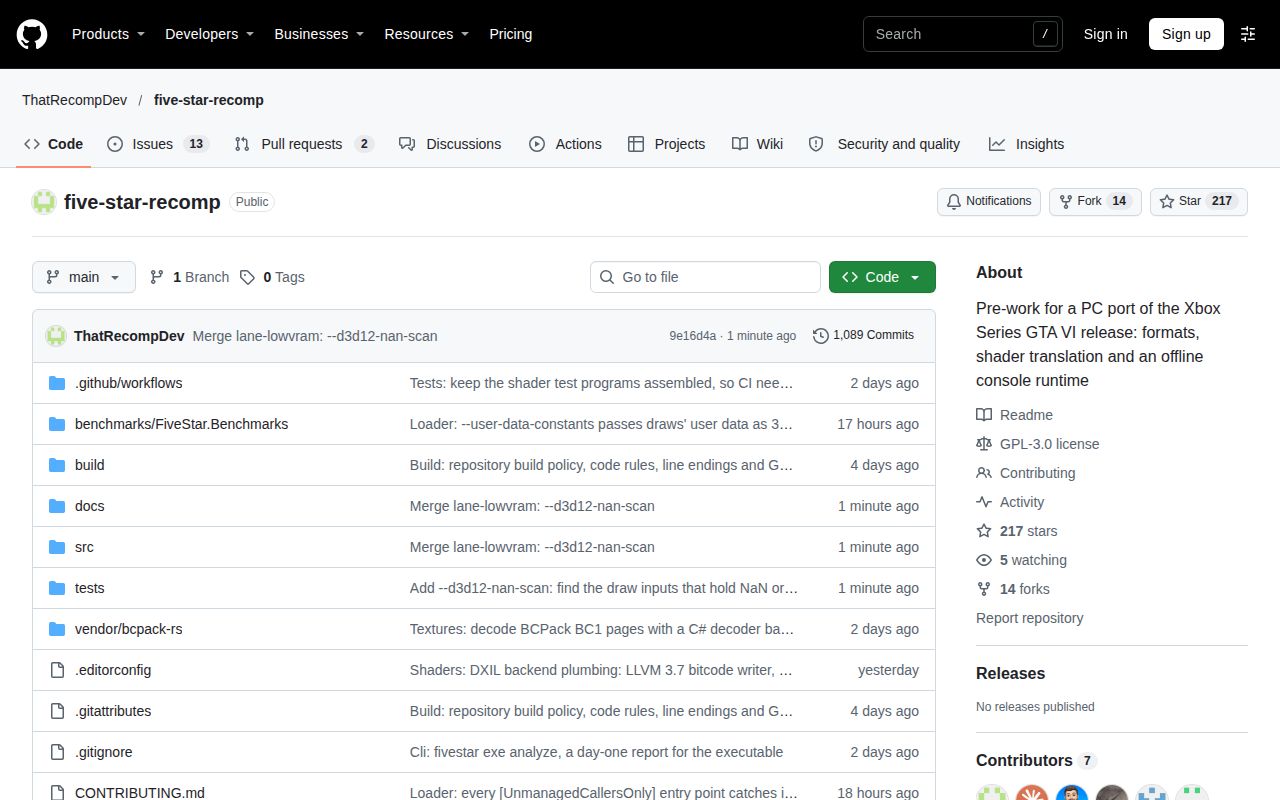
Short answer: follow the engineering, skip the playable-port promise
Five Star Recomp reports an opening cutscene with art, dialogue and sound, but its status page still describes incomplete world rendering and GPU hangs. Use it if you want to contribute to console compatibility or investigate translated shaders. Skip it if you want to play GTA VI on your PC: the author's own status report describes a red-only composite and empty world buffers.
That leaves a research review, with contributor observations clearly attributed below, rather than a hands-on recommendation. The useful question is whether the failure you want to investigate matches work someone has already isolated. A black picture with working audio, an AMD compiler exhausting memory and a warm-up exception are different starting points.
What people use five-star-recomp for
The author reports reaching the opening cutscene, while contributors use their own dumps to investigate specific rendering and memory failures. These are the most useful examples of what you could work on, because each names an observer and an outcome.
| Person and task | What happened | What you can learn from it |
|---|---|---|
| The project author: boot through first-run setup | Reports saved settings, story loading and opening-cutscene art, dialogue and sound; world rendering is incomplete. | Follow boot progress separately from the rendering milestones in the author's status page. |
| danik1222: run an owned dump on an RTX 3060 and i7-4770 | Build 880e616 restored booting and cutscene audio, but the picture stayed entirely black. | A working loader can still leave you without a usable image, as danik1222 reports in issue #13. |
| marquezinii: compare physical NVIDIA hardware with WARP | An RTX 5070 exposed mesh hangs and other discrepancies that the software renderer missed; the maintainer merged the mesh fix. | Hardware comparison finds faults hidden by a software reference, as issue #9 documents. |
| RubAway: inspect shader buffer addressing | Identified a missing soffset range check; the maintainer measured hardware behavior, corrected the translator and closed the issue. | A small, specific translator investigation can produce a confirmed correction, as issue #3 shows. |
| Sr-0w: investigate AMD pipeline memory | Reported opening credits after changes, but the large ActivateProbes pipeline still exceeded the later isolated memory limit. | Getting farther into boot and solving the worst compiler case are separate results in issue #19. |
For a prospective contributor, RubAway's report is the strongest model to copy. It identifies an addressing rule, names the affected shader family and lets the maintainer check the proposed explanation against real hardware. You can offer that kind of bounded investigation without promising to solve the whole port. The maintainer's response also matters: they corrected their earlier recollection of the hardware rule rather than leaving the original explanation in place.
What happened when we ran it
We did not run five-star-recomp at df27359 on November 25, 2026: our sandbox had no supported C# ecosystem and the repository had no Dockerfile. The recorded configuration was 3 CPUs and 8 GB RAM, with image listed as n/a. Those are lab configuration facts, not the project's hardware requirements.
| Lab item | Recorded result | What it means |
|---|---|---|
| Repository checkout | df27359 | Identifies the checkout assessed by the lab. |
| Execution | NOT RUN: no supported ecosystem, language C#; no Dockerfile | No installation, build, test or gameplay result was produced. |
| Sandbox configuration | 3 CPUs, 8 GB RAM; image n/a | Actual runtime and operating-system versions need raw toolchain logs. |
The separate automated safety check also failed because no recognized Compose file existed. Its wording is unsafe repo, followed by a compose file is required. That is the harness's admission rule, not a finding that the project's code is unsafe. The associated teardown record says ok.
One automated run label claims deployment through the project's own Docker Compose. That label conflicts with both the failed admission check and our explicit not-run result. It cannot support a deployment story. There is no measured first boot, screenshot or successful game task to describe here, and treating the label as execution would turn a rejected attempt into a fictional test.
Where people get stuck: booting, pixels and GPU hangs need different fixes
danik1222's RTX 3060 report shows a boot crash resolved while the black picture persisted. That makes issue #13 more useful than a simple compatible-or-incompatible GPU list: it follows the same machine through successive barriers.
The newer loader initially ended with 0xE0434352 after section-heap allocation failed. A contributor traced the unlogged managed exception to a texture upload buffer allocation. Catching and logging that failure let boot continue, but the machine then hit an int3 assertion and command list Close failed: 0x8007000e. A later change opened memory windows only as needed and restored booting. The contributor could hear the cutscene. The picture stayed black.
| Symptom and reporter | What the investigation found | Resolution shown in the thread |
|---|---|---|
danik1222: 0xE0434352 at boot |
Texture-upload allocation failure escaped as an exception after the memory budget was consumed. | Exception handling removed that crash; lazy section windows later restored boot on the reported system. Issue #13. |
| danik1222: black cutscene with audio | More section-window room failed to restore pixels; reducing reserved headroom introduced allocation failures. | Picture problem still open in the discussion. Issue #13. |
| marquezinii: RTX 5070 mesh programs hang | An unnecessary phase barrier in optimized compiler output triggered the reported hangs. | Maintainer confirms the fix merged; other rounding and lane discrepancies remain open. Issue #9. |
| AMD reporter: retired textures cause device removal | GPU fault diagnostics named textures already released by the registry. | Placed textures became the default, and the maintainer closed this issue after later boots passed the old failure point. Issue #23. |
RubAway: warm-up throws no loader runtime is active |
Cost logging requested a game runtime while running without an active game. | A locally applied guard passed the previously fatal pipelines; no merge confirmation appears in the thread. Issue #32. |
A larger pagefile was already present on the RTX 3060 machine. Working-set trimming also failed to change the section-heap budget, according to danik1222. Treating every out-of-memory message as a request for more swap would miss the particular allocation path this report isolates. The thread distinguishes the Windows commit limit from the budget used to open those heaps.
There is another reason to read follow-ups. In issue #9 the maintainer first suspected that different loop-guard exits explained later hangs, then explicitly withdrew that explanation. The continuing failures involved indirect mesh dispatches across several shader families. The earlier merged mesh fix resolves the named component failure, not every subsequent GPU hang.
AMD pipeline compilation hurts before you get a complete picture
Sr-0w reports that CS_ScreenProbes_ActivateProbes still exceeded a 48 GB private-memory limit on an RX 7800 XT system with 64 GB RAM. That is the latest isolated result in issue #19, after changes had already reduced the generated program. It is a contributor's memory observation, not our lab measurement or a universal minimum requirement.
This is a different stage from translating a shader. Translation produces a PC GPU program; the driver must still create a pipeline it can execute. A project can finish the former and fail the latter on a particular graphics card. Sr-0w's report makes the distinction practical: the machine reached opening credits after changes, yet an isolated attempt at the large pipeline still crossed its memory cap.
The maintainer introduced optional --host-pipelines to put large driver compilations in a separate loader process. A crashed or exhausted host then leaves a stand-in pipeline rather than taking the game down. The author reported driver-cache reuse on NVIDIA and asked for AMD confirmation. The thread ends without that AMD confirmation. Choose this path as fault containment for an investigation, with the understanding that a surviving process can still be missing the GPU work it wanted to execute.
A warm-up wait can be correct even when nothing is compiling
RubAway corrected the apparent scheduler deadlock in issue #32: another local model server held about 48 GB RAM, leaving less free physical memory than the compiler's 4 GB reserve. The reporter's follow-up identifies budget waiting as the cause, while keeping the separate runtime-logging crash open.
That distinction changes your next action. If the log says System.InvalidOperationException: no loader runtime is active, the proposed guard addresses a code path that assumes a running game. If it says driver compiles 0 running, 5 waiting, inspect available physical memory before calling it a deadlock. The reporter had first connected the two symptoms, then found that the idle compile host was behaving as designed under memory pressure.
The local guard let warm-up pass the pipelines that previously caused the exception. The later comment says freeing the competing RAM should let work proceed, but stops short of reporting a completed warm-up. That is the useful stopping point for the recommendation: distinguish the exception from budget waiting, and retain each outcome separately in a bug report.
The loader supplies an offline user, not Xbox services
The runtime documentation describes an offline user named Player and token requests that fail with a network-unreachable result. The loader change also documents unavailable store operations. A simulated signed-in state inside the game is no evidence of an authenticated Xbox services session.
The README says the repository includes no game files, keys or extracted data, and targets your own Xbox Series 1.0.2.1 dump. It lists the .NET 10 SDK, dxc for shader work and PC GDK checks through fivestar doctor. BCPack tables are supplied separately by the user for complete texture decoding. These are documented prerequisites, rather than an installation route reproduced by our lab.
The README estimates one to several hours and over 100 GB free for preparing a dump. Those are upstream planning estimates, not measured setup costs from us. The documented command resumes unfinished work and exposes status, which is useful when you want to preserve a preparation attempt rather than start it again. The code is GPL v3 or later; its license does not supply the game content the commands expect you to own.
five-star-recomp vs XCL, dxc and the texture paths
XCL is an adjacent compatibility project, while dxc is a shader compiler used within this kind of investigation. Neither comparison gives you a measured GTA VI gameplay winner. An XCL user's contribution to issue #2 explicitly says it is a comparator, with no Five Star Recomp reproduction claimed.
| Choice | Why you would consider it | What the comparison actually supports |
|---|---|---|
| Five Star Recomp or XCL | Investigate a GTA VI-focused toolkit, or compare console compatibility behavior with another implementation. | Issue #2 exchanges debugging observations across projects; it is not a head-to-head playability test. XCL comparison. |
| Project DXIL backend or dxc | Use the project's default compilation path, or its retained compiler fallback when investigating generated output. | The README claims faster compilation for its backend; this says nothing about gameplay speed. Backend description. |
| Placed or committed textures | Keep the new default for the reported retired-texture failure, or use --committed-textures to compare behavior. |
The AMD reporter avoided the earlier texture device removal; unrelated mesh hangs remained. Texture comparison. |
XCL's README describes running owned Xbox Series games through independently implemented system libraries and translated GPU code. It covers a broader compatibility target than this GTA VI toolkit. That makes it relevant if your work concerns shared console APIs, though issue #2's black-window observation cannot diagnose a Five Star Recomp failure by itself.
Microsoft's DirectX Shader Compiler compiles HLSL into GPU intermediate formats. It is an alternative compiler path for shader work, not a replacement loader for the game. For graphics contributors, that narrower comparison is often the actionable one: changing the compiler path can help isolate an output-dependent failure without changing the whole compatibility layer.
What the other reviews get wrong
The allgtavi project listing calls the method static recompilation, while the project's README says the original x86-64 CPU code runs as-is. The allgtavi overview therefore needs the distinction made in the project's own explanation: console services are replaced and GPU shaders are translated.
Its November 23 technical-test entry also describes a translated-shader test frame, an earlier milestone than the project's later setup-screen and cutscene reports. That dates the listing. It does not independently corroborate the author's newer rendering claims. PortWatch's November 24 tracker patch explicitly labels the progress self-reported, rather than a captured independent gameplay result.
PortWatch also removed its shader-count mismatch blocker. Its correction explains that archive records and native GPU programs are different units. Counting different objects is not evidence that extraction lost programs. A tracker percentage or a label such as Main menu should therefore send you to the described milestone, rather than substitute for it.
What the README gets wrong
The README's running instructions still say the game does not get past its first screens, despite its own earlier cutscene description. Its graphics table also retains corrupted game memory as the story-load blocker, whereas the status page reports that translator bug fixed and story loading completed.
There is a similar rendering mismatch. The README says lighting and composition do not reach the screen; the wiki describes a subsequent full-screen composite, still red-only. Even the wiki contains descriptions of geometry reaching the G-buffer, the intermediate image buffers a renderer uses, alongside later text about empty depth and world buffers. Read those as conflicting status descriptions, not synchronized proof that a complete scene renders correctly.
For a contribution, record the commit and the exact visible result you are chasing. Otherwise you can spend time fixing a blocker the author already moved past, or mistake a partial image for the finished rendering path. The later mesh-hang follow-ups show why a corrected old blocker and an unresolved new one can coexist.
Questions people ask
Yes, the maintainer welcomes contributions, but asks contributors to coordinate so several people do not pursue the same goal. Issue #1 records that request, and the README points to CONTRIBUTING.md.
Is five-star-recomp accepting contributions, and how can I contact the maintainer to help?
Yes. The maintainer says they would love help in issue #1. Start in that public discussion and read the README's contribution instructions. The discussion does not specify a separate private contact channel, so a public, narrowly scoped offer is the supported route rather than an invented email address or chat invitation.
How can contributors divide work without duplicating effort?
Agree on a named investigation before starting. In issue #9, the maintainer takes the wave32 pixel cases and marquezinii takes the FMA/rounding pair. That is an actual division of work. A bounty board is suggested in issue #1, but the exchange does not show an operating board you can claim a task from.
Does build 880e616 restore booting on the RTX 3060 system?
Yes: danik1222 reports that 880e616 boots on the RTX 3060 system with 15.6 GB RAM, without the earlier managed exception or failed heap. The same report says the screen stays black and cutscene audio plays. This answer is about that contributor's machine, not a general RTX 3060 compatibility certification.
Does the failing low-memory boot log a missing upload buffer before the int3 fault?
No: danik1222 explicitly reports no matches for slot 148, upload buffer or AllocateUpload in the checked log. The nearby reported failure is a command-list close returning 0x8007000e. Issue #13 therefore does not support repeating the earlier missing-upload-buffer hypothesis as an observed log line.
Does AMD's driver cache carry over pipelines compiled in a separate host process?
AMD cache carry-over is unanswered in issue #19. The author reports checking that behavior on NVIDIA and explicitly requests an AMD run. The separate-process option is documented there, but the requested AMD outcome is absent. Do not turn the NVIDIA observation into an AMD cache promise.
Can CS_ScreenProbes_ActivateProbes now compile on an RX 7800 XT, and how much memory does it require?
Sr-0w's latest report says it still cannot complete within a 48 GB private-memory cap on the reported 64 GB RX 7800 XT system. The isolated attempt in issue #19 establishes that exceeded limit, not the eventual memory needed for success. Smaller generated DXIL did not resolve the reported driver-memory failure.
What we have not tested yet
Our lab has no supported-environment installation, build, test-suite result, game boot or gameplay capture for df27359. We have not measured preparation time, disk consumption, frame rates, memory use, shader correctness or security properties ourselves. The sandbox's missing ecosystem and Dockerfile explain why execution stopped; they do not show that the project is broken on its intended Windows environment.
The author and contributors provide useful engineering reports, but this review has no independent reproducible demonstration of playable GTA VI gameplay. The video records contain no usable transcripts, and the Bilibili search results concern unrelated similarly named material, so none supplies an attributed game demonstration. The X post concerns recompilation generally rather than a run of this project. No hands-on screenshots accompany the stopped lab attempt.
A useful next lab run would retain the exact commit, owned-dump version, GPU and driver, then capture the visible world and controls alongside logs. It should report skipped or stand-in pipelines separately from completed work. Until that exists, use the contributor threads to select a concrete engineering task; a boot counter alone cannot tell you whether the picture is usable.