Short answer: treat Hookshot as an experiment you build yourself
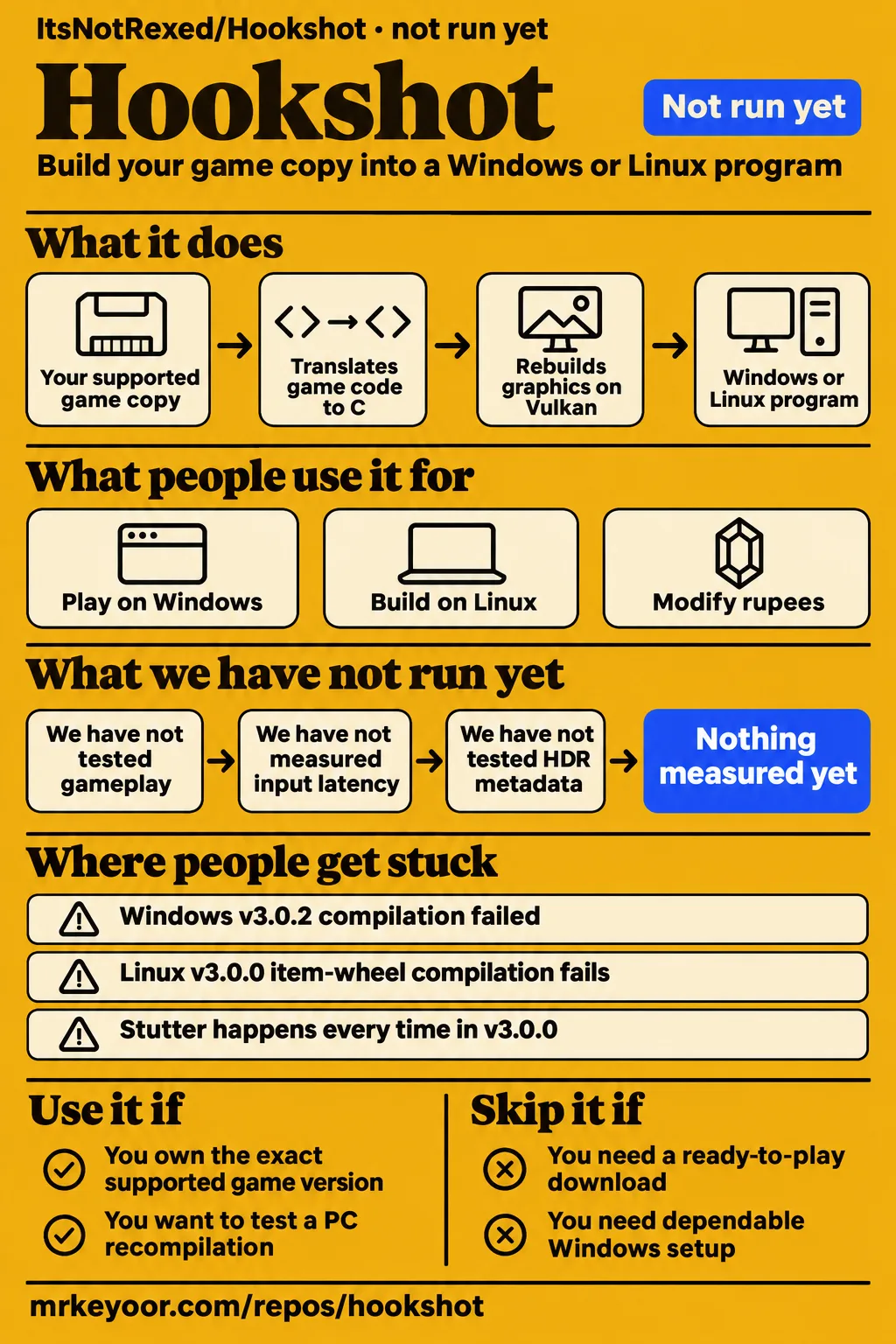
ItsNotRexed/Hookshot is an experimental PC recompilation for owners of the supported Switch 2 Ocarina of Time remake. Use it if you meet the project's requirements and want to contribute useful test reports. Skip it if you need a ready-to-play download or dependable Windows setup: the current Hookshot README requires local building from your own copy, and issue #14 records a Windows v3.0.2 compiler failure.
The README describes Hookshot as a static recompilation. It translates the game's code to C, compiles a Windows or Linux program, reimplements console system software and rebuilds the graphics on Vulkan. This identifies the project more clearly than the name alone. Operation Rainfall's 2019 Hookshot review concerns Tuwi Michael Nannings's puzzle game, while Matrix Hookshot connects chat rooms to external services. Their capabilities and reviews concern different software.
What people use Hookshot for
Hookshot users report native gameplay, Linux AppImage builds and Windows Builder attempts, with different outcomes for each release. The older README describes starting-area gameplay on one PC; the current README describes reports from more PCs and locations. The issue trail adds concrete examples of users reaching a build error or experiencing stutter. Those accounts help identify a relevant route and version before downloading a Builder.
| Who tried it | What they did | What happened |
|---|---|---|
| The project author | Ran the recompilation on a Ryzen 5 7600X and RTX 4060 Ti 16 GB | The older README describes testing mostly in the starting area and reaching Kokiri Forest gameplay. |
| The CachyOS reporter and commenter staticnom | Used the Linux AppImage with a .nup game file | They reported the item-wheel compilation problem; the maintainer reported a v3.0.1 fix. |
| The Windows user in issue #4 | Played v3.0.0 on an RTX 3060 12 GB, i5-12400F and 16 GB RAM | The user reported stutter every time, with frame generation and HDR off. |
| The Windows Builder reporter in issue #14 | Tried to build v3.0.2 from a .nup | The compiler stopped with a clang frontend failure. |
Bilibili creator 上弦月001's Hookshot 3.0.2 video title claims smooth running and a rupee modification feature. The current README separately lists rupees among the Debug tab's tools. These are two different kinds of evidence: a creator's description of a video and the project's description of a feature. The build reports above provide the more relevant starting point for someone deciding whether their first installation is worth attempting.
What happened when we ran it
Our November 25, 2026 sandbox attempt lasted five seconds and ended in a failed clone. The recorded measurement says that git clone failed, and the checkout log names files it could not write. Five seconds is the total attempt duration, not installation or build time. The recorded configuration allocated 3 CPUs and 8 GB RAM; the image was n/a and the commit was unknown.
The checkout log names threading.c, threading.h, xxhash.c and xxhash.h under third_party/zstd/lib/common. Its final message stops at “unable to writ”. That gives the failure a specific location without identifying a cause. The useful consequence is straightforward: this attempt stopped while obtaining the repository, before a supported installation could begin. A compiler crash reported by another user belongs to a later stage and a different execution.
| Question | Answer | Verdict | Why |
|---|---|---|---|
| Did clone and checkout complete? | No; the clone step failed with unable-to-write errors. | Failed | Files under third_party/zstd/lib/common could not be written. |
| Did the attempt reach build, tests or gameplay? | The harness records installation, build and test as null after clone_failed. | Stopped before installation | The five-second total describes the sandbox attempt. |
| Did cleanup complete? | The teardown record says teardown: ok. | Completed | Cleanup has its own recorded outcome. |
A separate hands-on summary describes a Docker Compose deployment with ports bound to 127.0.0.1. That summary conflicts with the failed-clone step and the harness status. We use the specific checkout log and clone_failed result to describe our run. The Docker sentence is a conflicting record, rather than evidence that Hookshot reached a running container or game window.
Requirements: match the game version before downloading
The current README requires program 0400486024DEC000, update v131072, build e0f3ccfa. It states that other versions do not work and accepts a .nup, a .nx made from one, or romfs and exefs folders. These are the project's documented prerequisites, separate from our sandbox configuration. Owning a copy is only the first requirement; its program, update and build identifiers must match.
The README specifies 64-bit Windows 10 or 11, or 64-bit Linux with glibc 2.35 or newer. The Linux AppImage requires AVX2. It says Windows and source builds can produce a game for a CPU without AVX2, with lower speed. For graphics, it requires Vulkan 1.3 and mesh shaders with an up-to-date driver, listing NVIDIA RTX 20 series or newer, AMD RX 6000 series or newer, and Intel Arc. Cards without mesh shaders are described as unsupported.
The project requires 16 GB RAM or more and about 60 GB free while building, preferably on an SSD. It recommends 8 GB VRAM or more and directs cards with less VRAM toward lower Quality presets. The README also says the Builder brings its own compiler and tools and needs an internet connection for downloading. These requirements belong in a build-readiness decision before any assessment of graphics options, release channels or video demonstrations.
Where people get stuck: match the version and the error
The maintainer reports fixing the v3.0.0 Linux item-wheel compilation failure in v3.0.1. In issue #2, ItsNotRexed attributes the failure to Windows-only drawing calls in vk_wheel.cpp and says Linux now uses the bundled font. The error, explanation and reported fix form a version-specific trail. Issue #14 instead records a clang frontend crash in the Windows v3.0.2 Builder.
| Symptom | Whose report | Documented next step or outcome |
|---|---|---|
| Linux compilation stops in vk_wheel.cpp with Windows identifiers | Issue #2, including staticnom's CachyOS report | Maintainer reports a v3.0.1 fix and instructs users to update through the AppImage, keeping saves and settings. |
| Another v3.0.0 AppImage fails in vk_wheel.cpp | Issue #5's reporter | The research synthesis records closure with the same maintainer-reported fix. |
| Windows v3.0.2 reports clang frontend command failed due to signal | Issue #14's Windows Builder reporter | The recorded issue is open. |
| Stutter happens every time with frame generation and HDR off | Issue #4's RTX 3060 user | The recorded issue is open with zero comments. |
Issue #5's compiler output includes CreateCompatibleDC, SelectObject and undeclared font constants. Those details fit the maintainer's Windows-only drawing explanation. Older errors have a separate history: the unofficial status guide attributes a Windows game-file search hang fix and a Linux missing-compiler fix to v2.3.1. An error involving an unresponsive drive, missing stdio.h or vk_wheel.cpp therefore calls for a different release trail.
Frame pacing questions start with the reported revision
Issue #6 discusses v3.0.1 / main at a2b7f97 through source reading. Its author describes a 240 Hz VRR display with 2x frame generation and a desired cap of 112 real frames, or 224 shown. The issue says HOS_FPS_MAX accepts caps from 61 to 1000 while the menu offers fixed choices. That is a specific configuration question rather than a general recommendation to select the largest frame-rate option.
The same issue raises questions about AMD Anti-Lag markers, HDR metadata and cloth timing. Its stated revision matters because a file or menu can change between releases. For practical reporting, the current README asks users to walk through the same spot twice after shader preparation, keep resolution, upscaler and cap unchanged, and turn frame generation off for the comparison. It also distinguishes an ordinary comparison log from a separate profiling run that adds work.
Your game files and the download channel are separate responsibilities
The README says the repository contains no game, keys or executable. It requires your own copy and says generated code, caches, saves and the resulting program stay on your PC. Its instruction not to share those generated files is explicit. A release download supplies the building machinery; the documented workflow then reads your game and writes the result into the destination you choose.
The current README acknowledges antivirus detections and denies that its release file is a Trojan. It also directs readers to the project's Releases and says releases list checksums in SHA256SUMS. These are the project's download and security statements. Its own warning about copies from elsewhere makes the source of a download part of the installation decision, separate from whether a video shows a working game.
On November 25, 2026, the recorded GitHub latest-release response identified v3.0.2, published November 21. The release response lists Windows Builder and Linux AppImage assets. The current README also contains Forgejo release links, while the older status guide describes earlier unavailable GitHub addresses and a Forgejo outage. Those are observations of particular addresses and release routes at different times, rather than one continuous hosting result.
Hookshot vs Longshot, Lichii, Fritchii and Triforce
The comparison guide separates static recompilation from emulation and leaves its frame-rate cells empty. Its project table distinguishes the two execution approaches, while the status guide separates maintainers and update channels. That makes the comparison useful for choosing a project to investigate. A launcher, support tracker and release route are concrete differences a user encounters before reaching a common gameplay scene.
| Alternative | What the checked pages say | When to investigate it |
|---|---|---|
| Lichii and Fritchii | The comparison guide places them in the emulator group. | You want to investigate emulation alongside recompilation. |
| NX2navi / Triforce | The comparison synthesis identifies NX2navi as another recompilation; the status synthesis reports its merger with Triforce. | You want another recompilation lineage and its release route. |
| Longshot | The status guide distinguishes its maintainers, releases and support from Hookshot. | You want to assess a separately maintained continuation. |
| Ocarina Reborn | The status synthesis identifies a separate Windows community tree. | You are investigating another Windows project. |
The status guide says Hookshot, Longshot and Ocarina Reborn have different maintainers, release channels and support discussions. It warns against treating a fork as a drop-in rename and recommends a separate save backup before changing anything. That is the useful distinction for Hookshot vs Longshot: the update source and support ownership change with the project. A similar name does not identify the same release or reporting destination.
Outdated claims, corrected
The unofficial Hookshot GitHub status guide gives conflicting Forgejo status results: its analysis records a table value of 200 and a narrative result of HTTP 521. Its historical GitHub-unavailability account also differs from the November 25 GitHub responses. The status guide's hosting claims should therefore be read with their observation date and exact address attached, rather than substituted for the later release response.
Bilibili uploader 青衣_A advertises Hookshot 3.0.2 with a perfect-stability claim in the download video's title. The Windows v3.0.2 compiler failure in issue #14 contradicts an unconditional promise covering setup. Similarly, the troubleshooting guide's first-visit shader explanation sits alongside issue #4's recurring-stutter report. The current README now separately discusses NVIDIA stutter on repeated starts and a shader-cache setting.
Issue #15 also needs a project correction: soczek187 explicitly says its discussion concerns Leonida, another Rexed project. The thread's final clarification names Leonida after another commenter asks what the discussion has to do with Ocarina of Time. Keeping that attribution prevents a conversation about another repository from becoming an explanation of Hookshot's hosting history.
FAQ
Hookshot's documented starting point is your own supported game copy and a local Builder run. The current README describes Windows Builder and Linux AppImage installation, including game selection, destination, language and building. The questions below focus on that project and its release trail. Here, Hookshot means ItsNotRexed's Ocarina of Time recompilation, distinct from the puzzle game and Matrix bot with the same name.
Where is the GitHub repository for the Ocarina of Time Hookshot project?
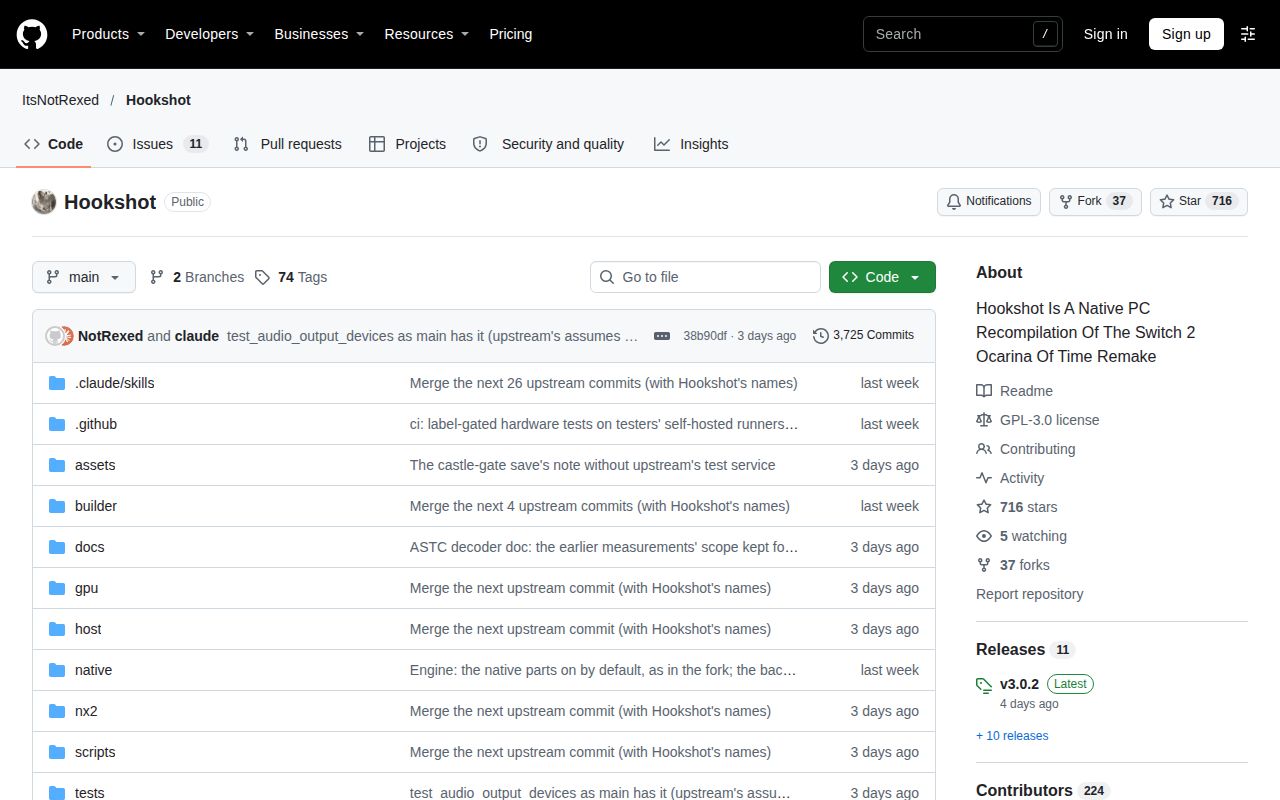
The repository is ItsNotRexed/Hookshot on GitHub. The November 25 record includes its public README and a latest-release response naming v3.0.2. An older README is recorded under TomShafford/Hookshot, with a narrower gameplay account and older build instructions. For installation, the current project README describes the supported game identifiers and the Windows and Linux routes.
How do I use Hookshot?
The current README says to select your supported game files, choose a destination and language, and build locally. On Windows it directs users to HookshotBuilder.exe; on Linux it directs them to the AppImage. After building, the launcher provides Play and Update. The README's update instructions say saves and settings are kept and recommend copying saves elsewhere first. The Builder checks the game's version before building.
How do I compile Hookshot v3.0.2 myself?
Hookshot v3.0.2 has Windows Builder and Linux AppImage assets in the recorded release response. The v3.0.2 release endpoint identifies those downloads, while issue #14 records that version failing in Windows Builder. The current README supplies the game identifiers and requirements. A useful error report preserves the Builder version and complete compiler output, so a frontend crash can be distinguished from a game-version rejection or the older Linux drawing error.
How does Hookshot compare with Longshot?
The status guide describes Hookshot and Longshot as projects with different maintainers, release channels and support discussions. Its migration advice warns against treating a fork as a drop-in rename. Choose according to the project and update route you intend to follow, and keep a separate save backup before changing sources. The comparison table above also distinguishes recompilation projects from the emulator group.
Does Hookshot 3.0.2 run smoothly, and can it modify rupees?
The current README lists rupees among the Debug tab's tools, and 上弦月001's video title claims smooth Hookshot 3.0.2 gameplay with a rupee modification feature. The Bilibili listing attributes that claim to the creator, while the README documents the Debug tools. For reported smoothness problems, issue #4 records recurring stutter on v3.0.0 with frame generation and HDR already disabled.
Has Hookshot been removed, and is there a better alternative?
The November 25 GitHub records include a readable README and a latest-release response naming v3.0.2. The older status guide describes earlier hosting disruption and separate project routes. Longshot, Triforce and Ocarina Reborn appear in its comparison synthesis. Their separate maintenance routes give readers alternatives to investigate; the recorded comparison page leaves performance cells empty rather than ranking them by speed.
Where can I download Hookshot 3.0.2, and are claims of perfect stability supported?
The recorded GitHub v3.0.2 release response lists HookshotBuilder.exe and the Linux AppImage. The current README directs readers to the project's own Releases and checksum list. A perfect-stability promise conflicts with the open Windows v3.0.2 compiler report. That report concerns building, so it should stay attached to the setup decision rather than become a claim about every successful gameplay session.
What we have not tested yet
Our checkout failure left installation, compilation, tests and gameplay untested. The five-second attempt supplies no installation or build duration, and its unknown commit supplies no exact-version execution result. The image label supplies no operating-system or toolchain version. The sandbox's 8 GB RAM allocation was below the README's 16 GB requirement. The checkout log does not establish why file writes failed, and teardown success does not establish game compatibility.
The older README's one-PC starting-area account and the current README's broader player reports are project accounts, not our reproduced compatibility results. We have no complete-game run, controlled alternative benchmark, measured input latency, HDR metadata validation or cloth-simulation result. Issue #6's cap, Anti-Lag, HDR and cloth observations come from source reading; neither their proposed effects nor the frame-cap workaround were tested here. The maintainer-reported Linux fix has no reporter retest in the recorded thread, and the Windows compiler report has no documented successful retry.
Offline Builder behavior remains unanswered because Fnrs-Wlan retracted issue #8 without documenting a procedure. The Bilibili evidence consists of listings rather than usable transcripts or independently checked downloads; the YouTube entries offer no usable walkthrough transcript. These records provide no independent malware clearance, legal cause for an outage or demonstrated safe migration between projects. The next useful lab attempt must complete checkout, record its revision and toolchain, and reach a repeatable scene on the target PC.