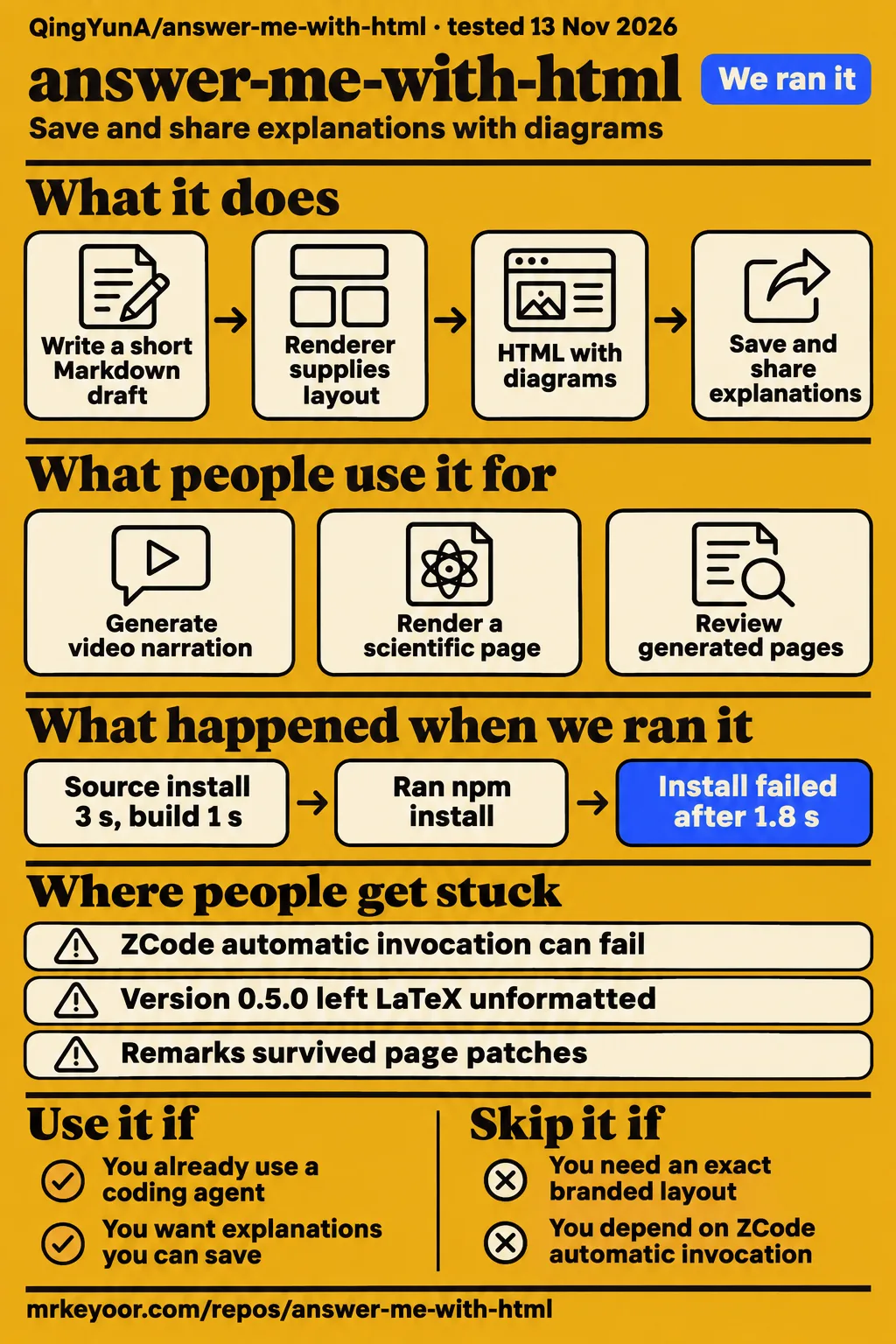
Our source checkout of answer-me-with-html installed in 3 seconds and built in 1 second, but its test command exited 1 after 88 seconds. Try it if you already use a coding agent and want explanations you can save as visual pages. Skip it if you need an exact branded layout or depend on automatic invocation in ZCode. Those are different needs from getting a diagram beside an explanation, which is where this project makes sense.
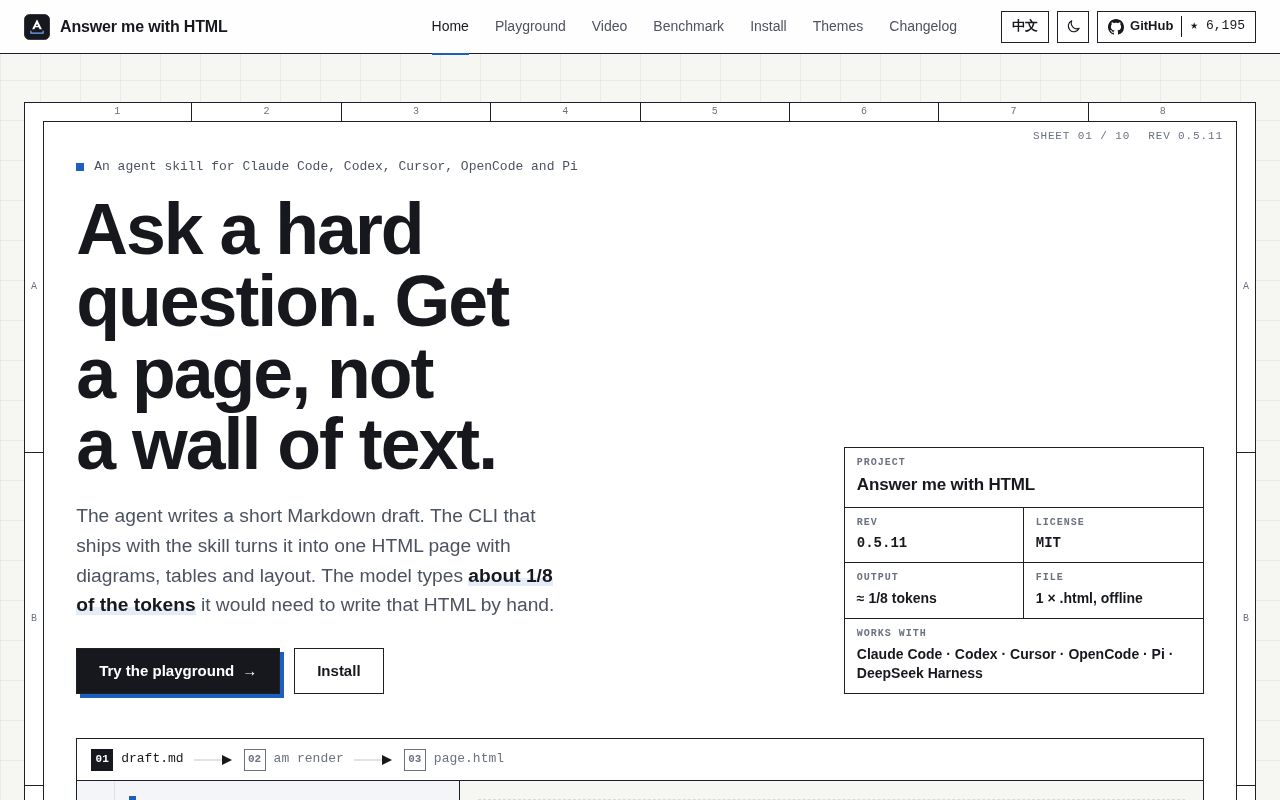
For readers searching qingyuan/answer-me-with-html, the GitHub repository reviewed here is QingYunA/answer-me-with-html. The answer-me-with-html skill has the model write a short Markdown draft, then passes that draft to its bundled renderer. The renderer supplies the HTML, layout and diagrams. That division is the reason to consider it: fewer generated presentation details to wait for and inspect. It doesn't make the underlying answer more accurate. The upstream README explains the workflow and provides an English installation route.
What people use answer-me-with-html for
The concrete reports cover narrated videos, scientific explanations and reviewing generated pages, with different outcomes for each.
| Who used it | What they did | What happened |
|---|---|---|
| Project author QingYunA | Compared short drafts with directly generated HTML | The author's benchmark reports less generated output and shorter waits, discussed below. Official benchmark |
| GitHub user Ayyoub96 | Connected Kokoro-FastAPI for video narration | Ayyoub96 confirmed Kokoro narration worked without code changes on am 0.5.0. Issue #150 |
| Reporter of issue #175, with Codex assistance | Generated a Chinese scientific explanation with inline and block LaTeX | The reporter found raw formulas in the generated HTML on version 0.5.0. Issue #175 |
| Maintainer QingYunA | Installed the upstream plugin in DeepSeek Harness | The maintainer confirmed a clean DSH 0.2.0-rc.2 installation listed the skill without a warning. Issue #193 |
| Reporter of issue #213 | Left remarks, then had an agent patch the page | The reporter found that remarks survived page patches in localStorage. Issue #213 |
The Kokoro report is particularly useful because the original request asked for a new backend. The maintainer explained that the existing local backend already accepts an OpenAI-compatible speech server. Ayyoub96 tried that route and reported success. If you want local narration, start with that documented interface before looking for a special Kokoro mode. This is a user's working configuration, separate from our source-build results.
The math report shows why generating a file is an incomplete acceptance check. The CLI completed, yet the body still contained dollar delimiters and TeX commands. A scientific explanation needs readable formulas alongside the diagrams. The reporter checked the HTML source and explicitly stopped short of a browser visual assessment. The maintainer later described a main-branch implementation using Temml to produce offline MathML.
What happened when we ran it
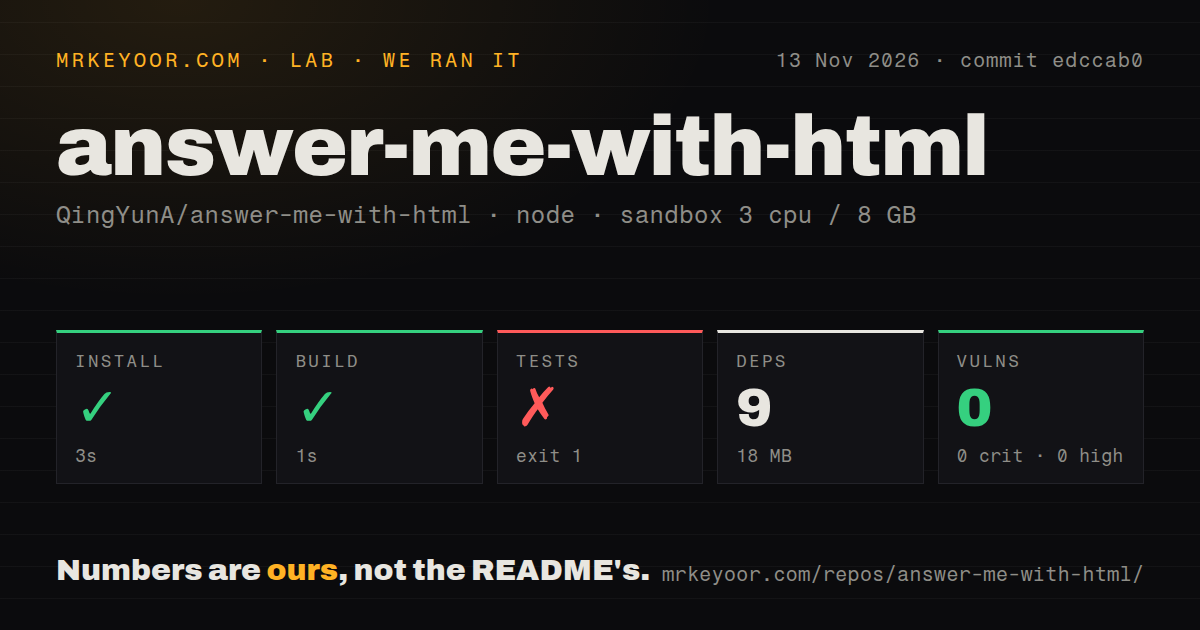
Our November 13 source run at commit edccab0 installed in 3 seconds and built in 1 second, while tests failed with exit 1 after 88 seconds.
| Source-checkout measurement | Recorded result |
|---|---|
| npm install | Succeeded in 3 seconds |
| Build | Succeeded in 1 second |
| Tests | Failed, exit 1, after 88 seconds |
| Recorded dependencies | 9, occupying 18 MB |
| npm audit | 0 known vulnerabilities across the recorded severity categories |
| Checkout | 405 files, approximately 55,408 source lines, 7.2 MB |
| Repository signals | 5 CI workflow files, a tests directory, no Dockerfile detected |
The sandbox configuration records 3 CPUs, 8 GB RAM and image label lab-node:22. That label identifies the configured image, not the actual Node or operating-system version. The source checkout was small enough that installation and building were brief in this environment. The failed test command is the reason we would run the full checks again before modifying or redistributing the renderer.
The supplied test tail contains passing entries for WebM structure, time-ordered blocks and narration handling, plus skipped browser/video cases. It does not show the failing assertion. A trailing label such as ok 1585 is not a complete passing-test count, and the skipped Hebrew MP4 and chapter-strip checks are not successful exports. Nothing in this excerpt identifies a package or environment cause for the exit status.
A separate quickstart attempt hit npm E404 for answer-me-with-html@latest and stopped at installation. Its finding record points to npm's debug log, and its teardown record says cleanup succeeded. The failed package-install record and the stopped-run finding describe this separate attempt. It used the same commit prefix in an unprivileged container with 2 CPUs and 4 GB RAM, according to the run record.
That E404 has a specific explanation in the installation documentation: this is distributed as a bundled skill, and the README says there is no npm-install step for users. Installing dependencies inside a cloned source tree and requesting a same-name published npm package are different operations. The successful source install cannot rescue the wrong distribution route, and that wrong route cannot establish that rendering is broken. The install guide explicitly covers this 404.
Where people get stuck: the host can hide a working skill
ZCode can list the skill correctly while truncating the description the model receives, so discovery alone is an inadequate installation check.
In issue #113, the reporter describes ZCode 0.16.9 cutting the injected description at about 250 characters. Concrete trigger scenarios fall beyond that cut. The maintainer confirmed the host behavior and closed the local issue as upstream, pointing to zai-org/feedback#580. That closure records responsibility, not a shipped repair.
| Symptom | What the record says | Action or resolution |
|---|---|---|
| DSH installs a dependency but never lists the skill | Earlier upstream packaging lacked DSH bundle registration | The maintainer says changes #198 through #200 shipped DSH support and corrected update instructions. #193 |
| DSH marketplace demands a missing index.js | The hub assumed a JavaScript entry for a patch-only bundle | Install through the DSH command line. The maintainer points to hub PR #182 for the upstream fix. #209 |
| A command resolves to /scripts/am.mjs | A host leaves the Claude-specific directory placeholder unresolved or empty | Substitute the actual absolute skill directory and check that scripts/am.mjs exists. Host-path instructions |
| Instructions appear twice | Both the skill and same-name plugin are installed | Keep one installation method per agent. The guide says to report duplicates rather than automatically remove either copy. Install guide |
| A kv block silently becomes one column | A fractional cols value reaches CSS repeat() | Use whole numbers. The contributor opened #303 to reject numeric fractions while keeping existing fallbacks. #280 |
The two DSH problems deserve separate rows. Missing bundle registration was a real packaging gap. The later marketplace complaint invented an entry-file requirement for a package that declares no JavaScript entry. Adding an arbitrary index.js would answer the wrong diagnosis. The useful first question is which installer produced the error, followed by whether an older skill copy is shadowing the plugin.
For maintainers, issue #167 describes Windows symlink permissions breaking shared test setup. QingYunA says PR #277 merged fixture changes that isolate symlink creation, skip Windows EPERM and guard teardown. It was a test-fixture defect, not evidence of a server vulnerability. Issue #74 separately records Chrome cleanup and startup flakiness. These reports give useful debugging history, but neither explains our failed command without the missing failure log.
Eightfold output reduction bought a smaller billing reduction
The author's current benchmark reports 4,893 versus 612 output tokens and median waits of 31 versus 12 seconds for directly generated HTML and the skill, respectively.
The official page describes three topics with three runs each, using Claude Sonnet 5.5 in a plain Claude Code setup. Its cost comparison is $0.091 versus $0.077 per answer, reported as 15% cheaper. These are author measurements of answer generation, separate from our install, build and test timings. They support trying the workflow when you regularly wait for a model to generate presentation code.
The README explains the smaller billing change: each turn also reads the system prompt, question and conversation. Reducing CSS and SVG output leaves those input costs in place. Judge the saving against the agent session you actually pay for. A long conversation, different model or different tool setup changes the bill even if the renderer continues to save output tokens.
Popularity answers another question. The GitHub metadata returned 6,303 stars and a last push of November 11, 2026. The pack also contains a maintainer's successful theme-submission exercise in issue #255. Stars show attention, and that exercise shows the submission workflow ran. Neither tells you how many teams kept using generated pages after the first week.
Where it hurts at volume: pages and review marks accumulate
Always-on mode adds pages for routine conclusions, and the README says those files accumulate under ~/.answer-me-with-html/.
The current rule is opt-in and renders routine pages without popping them open. That suits someone collecting technical notes, but it also creates a housekeeping decision. Keep it off initially if your agent mostly answers short command questions. The default examples already distinguish a complex TCP explanation from a one-line ls answer. Turning every conclusion into an artifact only helps if you later read or reuse those artifacts. The README's always-on section explains the rule and cleanup command.
Remarks created another form of accumulation: reviewers could finish a repair and still see old marks. The maintainer says PR #275 merged Clear all remarks with a second click within four seconds. It removes live marks and stored marks for deleted blocks while keeping panel comments and ask answers. That distinction matters during repeated review: clearing stale annotations should not throw away the decisions you still need. Issue #213 records the problem and resolution.
Security: offline output still carries your source draft
The README says generated pages embed their source Markdown and that file-backed code blocks refuse files outside the selected folder and files holding keys.
The single HTML file is convenient to share, but the embedded draft belongs in your sharing decision. If an explanation includes internal architecture or code, inspect the content before sending it outside the team. Offline viewing means the finished page needs no CDN or web fonts, according to upstream. It does not make an agent's model calls or an optional cloud narration provider local. The README documents these output properties.
Our npm audit reported zero known vulnerabilities. That is a dependency-advisory result, not an assessment of generated scripts, browser isolation or the accuracy of the file restrictions. For narration, the Kokoro thread distinguishes a server you run yourself from system speech and ElevenLabs. Choose that service deliberately if the narration contains private material, rather than treating every voice option as the same data path.
English documentation exists, and language support has specific boundaries
The README provides English documentation and says Chinese, English and Japanese receive their own buttons and fonts, while other languages use English buttons.
English readers can follow installation and the TCP example without translating the main guide. Some detailed reports, including the LaTeX and ZCode threads, contain Chinese descriptions followed by English maintainer replies. Read the environment and resolution separately when using those reports: a Chinese scientific-page failure on 0.5.0 is evidence about that rendering case, not proof that English explanations fail. The language description is upstream documentation rather than our multilingual rendering assessment.
answer-me-with-html vs Archify, GenUI and direct HTML
Choose answer-me-with-html for a whole saved explanation from a short draft, and compare alternatives by where you want to read and revise the result.
| Alternative | Reason to choose it | Decision against answer-me-with-html |
|---|---|---|
| Direct model-generated HTML | You want control over a bespoke interface or branded layout | The model generates the presentation too, the work the skill delegates to its renderer. Workflow comparison |
| Markdown or a short chat reply | The answer is a command or a brief instruction | Keep the answer in the conversation instead of opening a page. Upstream examples |
| Archify | You want interactive diagrams or its documented explainer workflow | Archify now documents whole-page explainers with tables, code and diagrams. Current Archify README |
| dsh-genui | You want interactive components inside DeepSeek Harness replies | dsh-genui documents components rendered inline alongside the model's text. Current dsh-genui README |
The supplied comparison calls Archify a single-diagram alternative. Its current README now includes an explainer mode, so that distinction is too narrow for a purchase-style decision. Compare the editing and reading experience on the same explanation. GenUI presents a clearer placement choice: inline conversation components versus a file you open separately. None of these choices requires assuming a measured speed or quality winner among the competing projects.
What the other reviews get wrong
Several write-ups confuse saved output tokens with saved money, or describe an older installation workflow.
The LinkedIn headline promises 7x cost savings, while its own post says the price is roughly the same. The current official benchmark reports 15% lower cost in its particular setup. Use the billing figures for a cost claim and the token figures for an output claim. The LinkedIn record preserves that contradiction.
SkillsLLM's comparison says neither project includes a SKILL.md file. The supplied versioned and main-branch skill files directly contradict that statement. The Hermes news headline says visual explainers are 87% faster, whereas the current official 31-to-12-second comparison is about 61% less elapsed time. The news extract supplies no method for its different percentage. SkillsLLM comparison, versioned skill file, Hermes headline.
PyShine advises installing a companion always-on plugin. The current README instead documents a global rule in the agent's rules file, off by default. The installation guide also overstates the skills installer as the only route: the README supplies a manual folder-copy option. These are practical corrections because mixing old and current instructions can leave duplicate installations. PyShine's older workflow and the installation guide should be read against the current README.
Questions people ask
Kokoro has a confirmed user report, while the ZCode and DSH answers depend on the host and installation route.
Why does answer-me-with-html fail to trigger automatically in ZCode?
Issue #113 attributes the failure to ZCode truncating the injected description at about 250 characters. The skill can still appear in the available-skills list. The maintainer left the wording unchanged to avoid affecting other hosts and referred the problem upstream. Look at the description actually reaching a conversation, not just the listing command. ZCode report.
Can answer-me-with-html render inline and block LaTeX in one offline scientific explainer?
The maintainer says #178 added inline and block math to main using Temml-generated MathML, preserving offline output. The original 0.5.0 report found raw TeX. Select a revision containing that implementation and inspect a representative formula, especially when a scientific handout depends on correct notation. Math report and maintainer response.
Can I use Kokoro for video narration without adding a new backend?
Ayyoub96 confirmed the existing local backend worked with Kokoro-FastAPI without code changes. In this interface, local means an OpenAI-compatible speech server, not the operating-system voice. The report names Linux, Node v22.14.0 and am 0.5.0, so it provides a concrete configuration to follow. Kokoro confirmation.
How can I clear all remarks after the agent patches a page?
The merged Clear all remarks action requires a second click within four seconds. It clears stored marks for missing blocks as well as visible marks, while retaining panel comments and ask answers. That is the behavior the maintainer reports for PR #275. Remarks resolution.
How do I install and update answer-me-with-html in DeepSeek Harness?
Use dsh plugin --profile web add github:QingYunA/answer-me-with-html, substituting your actual profile. The maintainer says DSH installs now receive an update command derived from their profile and package path. Check for an older skill copy shadowing the plugin, and use the command-line route for the hub's false missing-entry complaint. DSH support, marketplace workaround.
Should fractional kv column counts produce an error or be rounded?
The maintainer chose an explicit whole-number error for numeric fractions. Contributor PR #303 follows that decision and preserves existing safe fallbacks. Use integer column counts in your drafts rather than relying on silent browser fallback to a single column. Fractional-column discussion.
What we have not tested yet
We have not measured comprehension gains, sustained team use, page-generation latency or billing savings ourselves. The benchmark belongs to the author. Our source checks do not establish the quality of a rendered explanation, and the npm-package attempt ended before producing one. The pack contains no completed known-answer session or lab screenshots, so there is no visual or answer-accuracy score to report.
The source-test failure needs the complete log before it can be diagnosed. We have not reproduced the host-specific fixes, local speech setup, browser exports, multilingual layout or security restrictions. The math thread says the implementation would ship in the next release without naming that release. The fractional-column extract confirms an opened PR, not its merge. The DSH hub fix and Chrome timeout proposal also lack completion evidence in their supplied extracts. None of those records supports a blanket claim that all closed reports are fixed in every installed version.
Setup ease, support quality and production maturity remain unassessed as ratings because the run covered source preparation and an unsuccessful package route rather than a supported agent installation and sustained use. Documentation receives 4/5 on a disclosed editorial scale: 1 means instructions omit the working route, 3 means a documented route has material gaps, and 5 means the instructions cover the needed routes without the contradictions found here. The README covers plugins, manual copying, output and cleanup, but the install guide's exclusive-route wording and host exceptions keep it below 5. That judgment rates the instructions, not adoption.
For your first evaluation, install one way in the agent you already use and ask for the README's TCP explanation. Read the saved page, inspect its embedded source, then try one of your own explanations. Keep it if that artifact is worth opening again.