Choose an ANOLISA component before adopting the collection
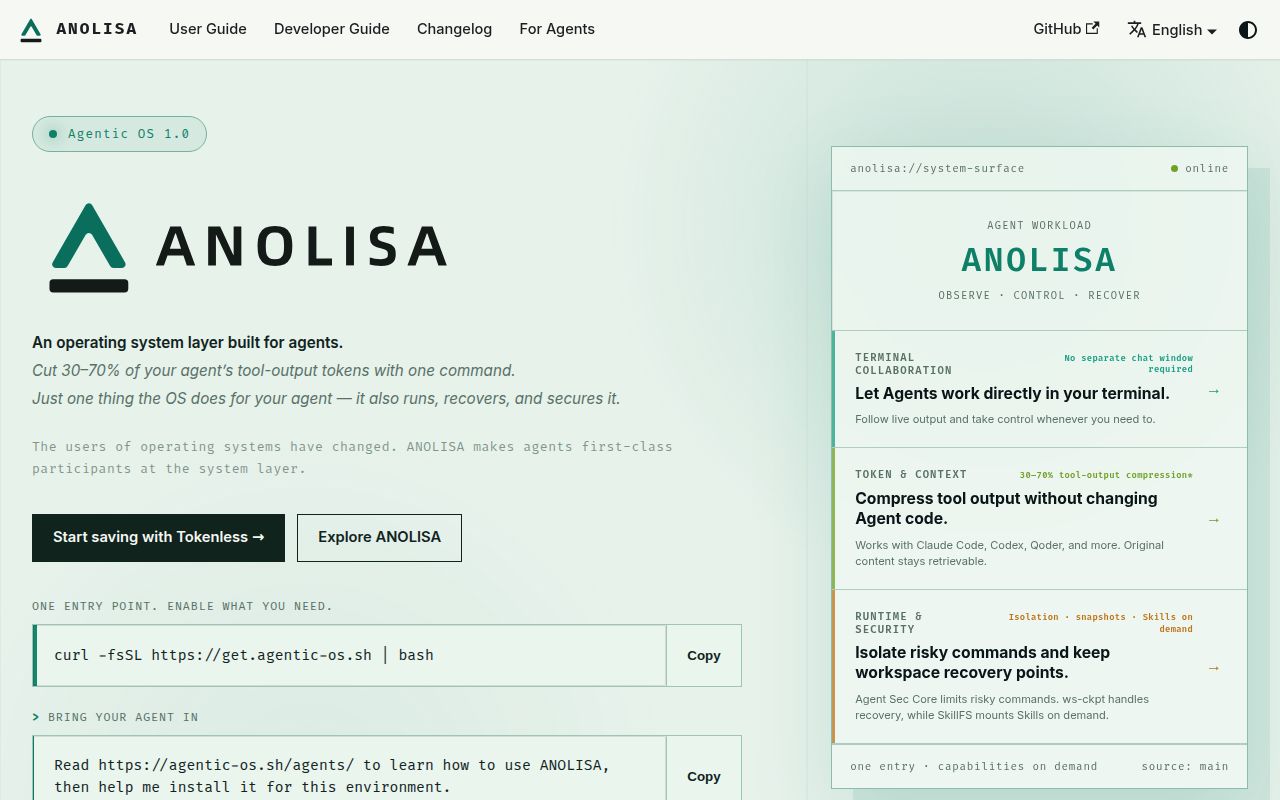
ANOLISA lets you add tool-output compression to Claude Code without replacing your agent framework. That's its most approachable starting point: the README shows enabling the Token-less adapter, restarting Claude Code, and inspecting local statistics. The repository also contains a terminal assistant, persistent memory, workspace recovery, and agent tracing. Each capability has its own purpose. You need a specific problem before you need this whole collection.
Our measured path was much narrower: the Python project under benchmark/claweval-runner/, inside a checkout containing 6,665 files and roughly 1,967,683 source lines. GitHub identifies Rust as the repository's primary programming language. Both facts can be true because the lab ran a component. Its successful build doesn't verify the terminal, kernel tracing, or security runtime, and its failed tests don't establish that every other component is broken.
What happened when we ran it
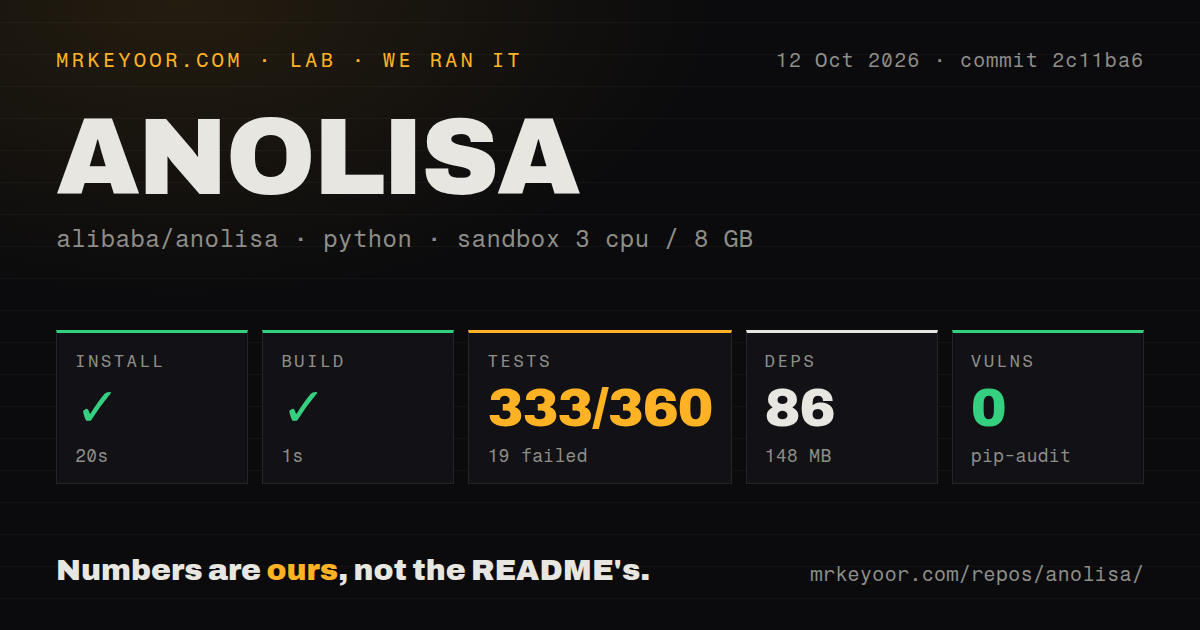
Our run installed the ClawEval runner at commit 2c11ba6 in 20 seconds and built it in 1 second on October 12, 2026. Installation added 86 packages and occupied 148 MB. The fresh Debian container used Python 3.12 with uv, 3 CPUs, and 8 GB of RAM. It had no secrets or elevated privileges. Pip-audit reported 0 known vulnerabilities for the environment we measured.
The test command failed with exit code 1 after 10 seconds. The supplied results report 333 passed, 19 failed, 32 skipped, and 8 collection/setup errors. One environment assertion says claw-eval/config.yaml does not exist. A sandbox-discovery diagnostic says the MCP process exited immediately. Its stderr is truncated in the supplied tail, so the reason for that exit isn't established by the evidence available here.
Several schema-related failures report ModuleNotFoundError for mcp.server.fastmcp, with messages identifying MCP 2.x. Those failures concern parameter schemas and handler creation, including typed arrays and optional values. The log supports an import-compatibility problem in the measured environment. It doesn't justify blaming every failure on that import, or claiming that changing a package version would make the complete run pass. The missing configuration is a separate visible finding.
The runner needs Docker, OpenClaw, and explicit model configuration
The runner README at the measured commit describes an OpenClaw gateway and a running Docker daemon as prerequisites. Its setup script retrieves pinned claw-eval sources, configures the gateway, and prepares task fixtures. Model configuration requires a key. Run and batch commands need an explicit configuration argument unless the model and judge environment variables are exported. Copying a short task command alone doesn't provide that environment.
The 20-second package install and 1-second build therefore cover only part of getting a useful evaluation running. Documentation says the model-configuration step is skipped when its key is unset, and that the generated configuration file is not loaded automatically. Our no-secret sandbox found that file missing. Those facts describe the boundary clearly without proving exactly which setup actions preceded the assertion. Plan for a configured gateway and model access before expecting graded agent tasks.
Compression statistics don't establish lower total bills
Token-less removes redundant tool schemas and response fields before the model reads them, according to the README. Dropped array items remain accessible through retrieval markers. That mechanism gives you something concrete to evaluate: whether an agent can still recover the details its task needs. The project itself warns that savings on tool responses do not equal savings on the entire session bill. Keep that qualification beside any advertised percentage.
Our 148 MB runner environment supplies no independent evidence for Token-less savings or agent task quality. A useful trial would compare the same representative tasks with compression enabled and disabled, then inspect incorrect answers and recovered details alongside usage. That's a recommendation for your evaluation, not work our sandbox performed. Install the compression component independently if that is the problem you're trying to solve, and leave unrelated system components out of the first trial.
Kernel tracing and filesystem tools need host capabilities
The installation guide checks eBPF for AgentSight, FUSE for SkillFS, and btrfs for workspace checkpointing. Several components require explicit system scope and sudo. AgentSight's documented resident service runs as root, and installing it does not start collection automatically. These requirements rule out treating the full product as an ordinary library you can drop into an unprivileged container or restricted developer laptop.
Pip-audit's 0 known vulnerabilities applies to the measured Python environment. It cannot certify a root tracing service or prove that a signed skill is safe to execute. The README describes skill-drift detection and blocking findings, useful controls whose effectiveness needs separate examination. Pick the component whose privileges your team can support. A developer who only wants cleaner tool output shouldn't have to approve kernel observation to try it.
October activity shows maintenance across separately released tools
The repository's last push was October 16, 2026. GitHub showed 625 stars and 1,574 open issues and PRs, and the latest release was AgentSight v0.14.1 that day. The requested alibaba/anolisa address now redirects to agentic-os-org/ANOLISA. Recent issue 7994 reports earlier-round tool results being assigned to the wrong exported step in AgentSight, with an open fix proposed. That concerns tracing, separately from our Python runner failures.
RTK is worth comparing for command-output compression. Langfuse fits application tracing and evaluation, while Inspect provides a dedicated framework for model evaluations. None replaces every ANOLISA component. For this repository, start with the smallest capability you can assess against your own workload. If the ClawEval runner is the attraction, get a configured task producing a trace you can inspect before treating its score as evidence about your agent.