One skill, despite the plural name
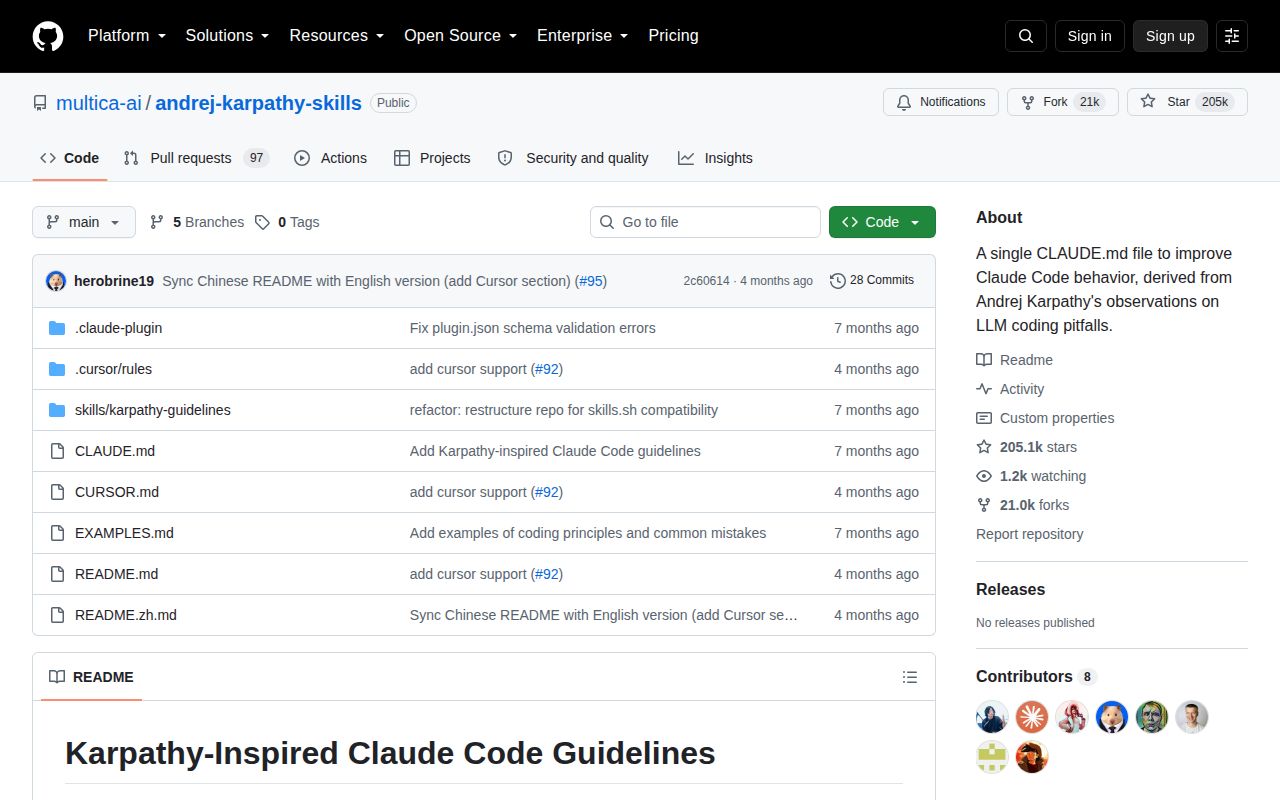
andrej-karpathy-skills is much smaller than its name suggests. The reviewed commit contains one behavioral skill expressed in several formats: a root CLAUDE.md, a Claude Code plugin, a Cursor rule, and a SKILL.md. All of them carry the same four ideas. The agent should state assumptions, choose the simplest sufficient code, touch only lines connected to the request, and define checks that show whether the work succeeded.
That narrow scope is the appeal. There is no orchestration layer, model gateway, memory service, or configuration language to learn. You can read the entire operative skill in a few minutes and decide which sentences belong in your project. For teams burned by agents that rewrite adjacent code or invent requirements, the instructions address recognizable failure modes in plain language.
The tradeoff is equally plain. Instructions change tendencies, not capabilities. A sentence telling an agent to stop when confused cannot guarantee that it notices its own confusion. The repository offers useful before-and-after examples, but those examples explain intent rather than prove a repeatable improvement on real codebases.
What the four rules do well
The strongest rule is surgical changes. It tells the agent to match existing style, leave unrelated dead code alone, and remove only the unused pieces created by its own edit. That is more actionable than a vague request to keep a patch clean. A reviewer can inspect a diff and ask whether every changed line traces back to the request.
Simplicity gets similarly concrete treatment. The file rejects speculative features, abstractions used once, and configuration nobody requested. Its test asks whether a senior engineer would call the result overcomplicated. The wording is subjective, but the surrounding examples make the intended behavior clear: solve the present problem, then refactor when a real second use appears.
The goal-driven section converts broad requests into observable outcomes. A bug fix should begin with a reproducing check, then end with that check and the existing suite passing. A refactor should preserve behavior before and after. This is familiar engineering discipline, packaged as agent instructions. It can improve the conversation even when the agent already knows how to write the code.
Think before coding needs more judgment. Asking for clarification is useful when a request has materially different interpretations. It is annoying when the answer is obvious from the repository. The README acknowledges this by saying the guidelines favor caution over speed and that trivial edits do not need the full process. Teams will still need to tune that balance for unattended jobs.
What happened when we ran it
Our lab used commit 2c60614 in a fresh, unprivileged Debian container with 3 CPUs, 8 GB RAM, and no secrets. We did not run the project. GitHub identifies no primary language, and the commit has no Dockerfile, so the runner found no supported ecosystem. There is therefore no install, build, or test result to treat as a pass or failure.
That outcome matches the repository's shape. It is instruction text and packaging metadata rather than an executable program. The useful evaluation is behavioral: install the rules in a representative project, give the same agent the same tasks with and without them, and compare assumptions, diff scope, complexity, and verification. This repository did not supply that measured evidence in the commit we reviewed.
Installation deserves a manual check
The per-project route is easy to understand. Put the supplied text in CLAUDE.md, or merge it with the file you already have. Cursor users copy the committed .mdc rule into .cursor/rules; inside this repository, that rule uses alwaysApply: true. The separate Cursor guide also explains that Cursor does not read the Claude plugin metadata by default.
The advertised Claude Code marketplace route is less settled. The README at 2c60614 tells users to add forrestchang/andrej-karpathy-skills, although the repository now lives under multica-ai. Open pull request 195 proposes replacing those old owner references. Open pull request 176 says the marketplace manifest also needs schema changes for the two-command installation flow. We did not test that flow, so copy the file directly or inspect the current manifest before rolling it out.
License signals also disagree. The README, plugin manifest, and skill frontmatter declare MIT, yet the reviewed tree has no top-level license file and GitHub's repository record reports no detected license. That may be acceptable for a personal experiment. A company that will copy the text into many private repositories should get the license position clarified first.
Activity is high, maintenance is slow
The default branch was last pushed on April 20, 2026. Pull requests were still being updated in August, including proposals for benchmarks, installation repairs, multi-agent guidance, and expanded tool support. GitHub reports 126 open issues and pull requests together, while its search returns no open issues, so the visible queue is pull-request work rather than a backlog of reported defects.
That combination suggests strong contributor interest and slow integration. There is no latest tagged release returned by GitHub, and the plugin manifest remains at version 1.0.0. Popularity does not resolve the practical questions in open changes: stale paths, manifest shape, licensing, and evaluation are exactly the details a team needs before standardizing a rule across projects.
Where it fits
This skill is best treated as a readable starting policy. Try it in one repository where overengineering or broad diffs are already visible, keep the clauses that correct observed behavior, and add project-specific rules for tests, architecture, and allowed tools. Compare actual patches before expanding its use.
Choose a larger workflow such as Superpowers when you want prescribed planning, debugging, and review procedures. Choose this repository when four compact constraints are enough and you prefer to own the final instruction text yourself. Its content is sensible. The unresolved packaging and missing evaluation mean the safest adoption path is still a manual, scoped trial.