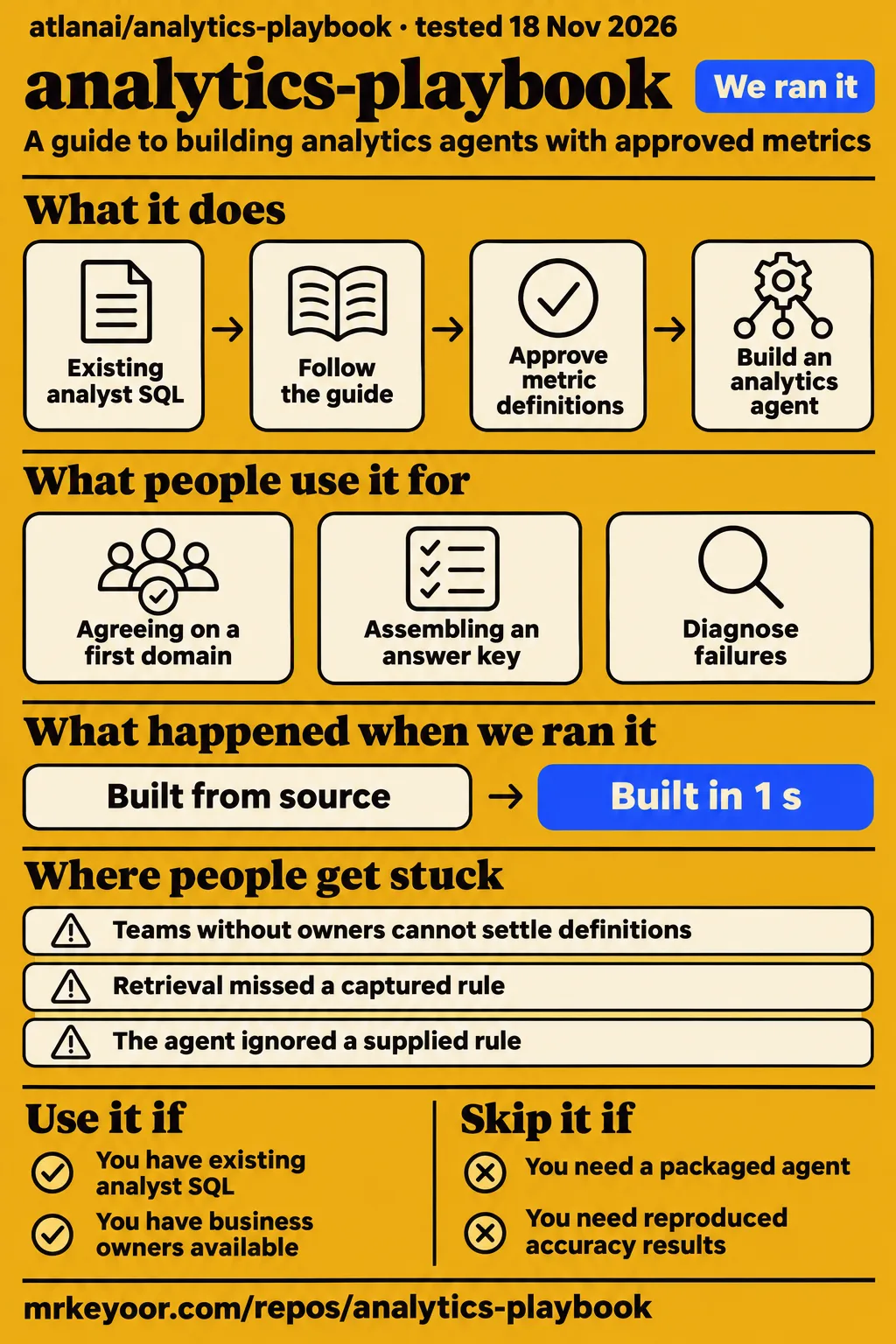
Our sandbox installed analytics-playbook in 7 seconds and built it in 1 second. Read it if you're responsible for making an analytics agent agree with the business's numbers. Skip it if you want a packaged agent you can point at a database and deploy. Atlan supplies an English guide, checklists and an implementation method; your team supplies the working system and the people who decide what each metric means.
The distinction matters before you spend an afternoon following the wrong setup path. This repository's main deliverable is a book about analytics agents. Its central recommendation is worth taking seriously: decide what a correct answer is before you improve the agent, then inspect the actual SQL when it gets that answer wrong. The README makes evaluation and metric ownership part of the work, rather than leaving them until after a convincing demonstration.
What you can do with analytics-playbook
You can use Atlan's chapters to organize an analytics-agent project around business questions, approved metrics and release gates. The README divides answers into a governed lane, where an approved metric supplies the number, and an exploratory lane, where the agent writes SQL grounded in trusted previous queries. That gives a sponsor a useful question to ask: which answers are allowed to be exploratory, and which must reproduce a definition someone owns?
The reading routes are practical. A sponsor gets the method and evaluation rationale; a builder gets the evaluation, metrics and retrieval chapters; a delivery lead gets the phases and ongoing operating loop. I would start with the route for your actual job. Reading every architecture chapter won't settle a disagreement between Finance and Sales about which deals count toward pipeline. The route through the guide should lead to a decision your team can make.
What people use analytics-playbook for
Atlan presents the playbook for internal teams, implementation partners and forward-deployed engineers building analytics agents. Those are the intended uses described by its authors. The supplied community research contains no attributable account of someone completing this repository's method, so the useful examples here come from the documentation, with that boundary attached.
One application is agreeing on a first domain. Another is assembling a private answer key from questions the business already asks. The later chapters explain how to turn previous analyst SQL into metrics and diagnose failures from traces. These are concrete working tasks, with written artifacts a team can review. They also explain why a developer working alone may get less value from the book: a metric definition can require an owner with authority to settle competing meanings, rather than another change to a prompt.
What happened when we ran it
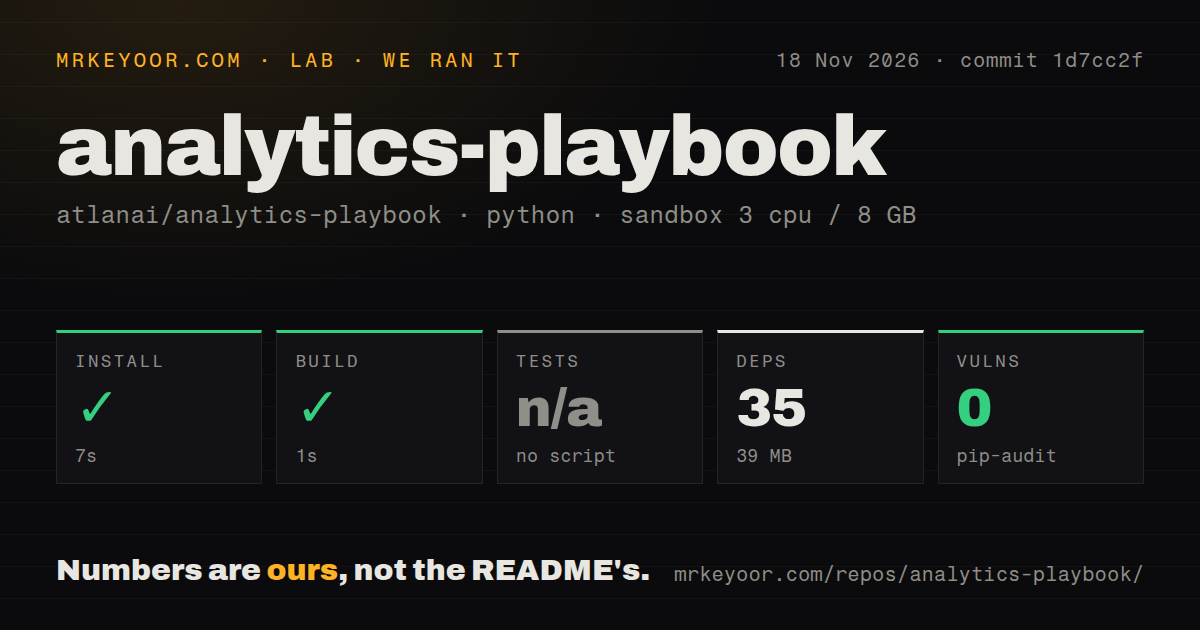
Our November 18, 2026 sandbox run at commit 1d7cc2f completed installation in 7 seconds and the build in 1 second; the separate hands-on deployment check stopped at its Compose requirement.
| Repository check | Our recorded result | What it tells you |
|---|---|---|
| Installation | Succeeded in 7 seconds | The recorded dependency installation completed |
| Dependencies | 35 recorded, 39 MB on disk | This is the measured installed footprint |
| Build | Succeeded in 1 second | The recorded build step completed |
| Tests | No tests script or target; skipped | There is no passing-suite result from this run |
| pip-audit | 0 known vulnerabilities | The recorded dependency audit reported none |
| Repository scan | 194 files, about 1,878 source lines, 143 MB checked out | Source and checkout size are different measurements |
| Project signals | 2 CI workflow files, no Dockerfile, no tests directory | These are scan findings, not CI execution results |
The configured sandbox had 3 CPUs and 8 GB RAM. Its image label was ghcr.io/astral-sh/uv:python3.12-bookworm; actual runtime and operating-system versions require the raw toolchain logs. The harness classified the ecosystem as Python, while GitHub lists HTML as the repository's primary language. Neither label changes what the README offers: a published guide with build code. Our successful checks support the narrow finding that this checkout installed and built in the recorded environment.
The deployment record needs a closer reading. The hands-on safety step failed because none of compose.yaml, compose.yml, docker-compose.yaml or docker-compose.yml existed. Its wording calls this an "unsafe repo," but the stated reason is a rule requiring a Compose file. That is a restriction of this deployment harness. It supplies no diagnosis of a vulnerable application.
A separate run summary says the project was deployed with its own Docker Compose. That sentence conflicts with the failed safety step, so it cannot serve as evidence of a running service. The teardown record says "teardown: ok." There is no recorded question, answer or screenshot to tell as a successful application session. Installing the book's dependencies and deploying an analytics agent are different tasks.
Where people get stuck: agreeing on the answer
The guide's first substantial dependency is organizational: someone must decide which business answer is correct. In Phase 0, Atlan asks the team to choose a bounded domain, name the owners, write the success bar and prove access before starting the build phases. I'd treat that as the entry requirement. A sponsor who cannot name an owner for pipeline will have trouble approving a pipeline metric, however good the SQL looks.
The evaluation chapter adds another demanding requirement: the answer key stays away from the people building context. Its Phase 1 instructions draw questions from existing business work and keep sealed answers out of what the agent sees. That is useful discipline for anyone tempted to tune a prompt until a familiar demonstration works. It also means somebody must maintain the evaluation separately from the material used to answer questions.
For debugging, the guide offers a useful distinction between a rule that was never captured, a captured rule that retrieval missed, and a supplied rule the agent ignored. The corresponding work changes: settle a definition, repair retrieval, or enforce the approved calculation. Read those as diagnostic instructions, rather than reports of three bugs we encountered. The research pack has no target-repository user incident that would support a conventional list of errors and confirmed fixes.
Atlan's accuracy figures describe its own warehouse
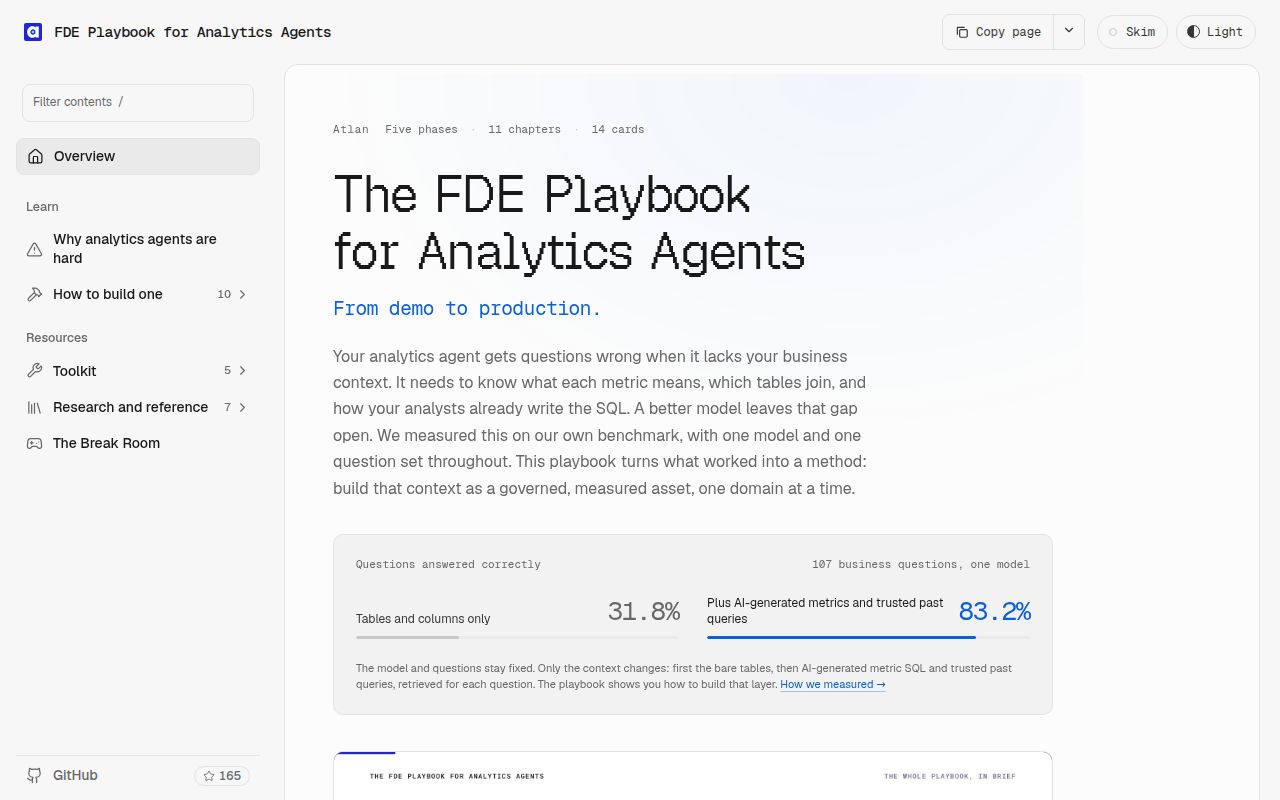
Atlan reports evaluating 107 real questions from its own go-to-market warehouse; those are upstream results, separate from our installation and build checks. The results chapter says the shipping configuration missed 18 questions, comprising 17 wrong answers and one refusal. The remaining errors deserve as much attention as the headline improvement. A metrics layer can contain the relevant rule and still produce a wrong answer when the agent adapts a query.
The more useful lesson is how Atlan handles variation. It says the same setup moved by six questions between two runs and treats small differences cautiously. I would use that to shape your own acceptance criteria: preserve the questions and configuration, repeat the run, and inspect what changed. A score from one private warehouse gives you a method to examine, not a forecast for your company's data.
Atlan also discloses that it sells a context-layer product and that its systems generated the benchmark context. That relationship belongs next to the results, because the publisher is evaluating a method connected to its own commercial work. The README says the method can be built without Atlan. Read the evidence and the implementation effort together before deciding whether to build those parts yourself or buy them.
Security work starts with access and traces
Phase 0 requires working access and a trace export before the improvement loop begins. Those requirements deserve a security review in your implementation: warehouse permissions, query history and recorded tool calls can each expose business information. The book's checklist is a starting point for identifying those surfaces. It doesn't decide which employees or outside partners should be able to read your company's records.
The practical tradeoff is visible in the method itself. Debugging needs enough detail to see which context arrived and which SQL ran. Your deployment needs a deliberate policy for storing that detail and giving reviewers access. Ask the platform owner to settle that policy while the domain owner settles the metric. Our dependency audit's clean result concerns known package vulnerabilities; it supplies no evidence about the permissions of an analytics system you build from the book.
Analytics-playbook vs MetricFlow and Cube Core
MetricFlow and Cube Core are implementation projects to evaluate when you need a semantic layer; analytics-playbook explains a delivery method. They can therefore sit alongside the book rather than replace it. The distinction prevents a misleading comparison between a guide's quick build and the effort of configuring a running data service.
| Choice | What its own documentation describes | Choose it for |
|---|---|---|
| analytics-playbook | A phased method covering evaluations, metrics, context and handover | Organizing the work and agreeing on release evidence |
| MetricFlow | Metric definitions compiled into SQL | Implementing metric logic with a dbt project |
| Cube Core | Metrics and access rules exposed through SQL, REST and GraphQL APIs | Providing a semantic layer to downstream applications |
MetricFlow describes itself as a query-compilation and SQL-rendering library that requires a working dbt project and adapter. Choose it when that implementation model matches the stack you already operate. The relevant question is whether its metric definitions can express your rules, not whether the playbook's documentation is easier to read.
Cube Core describes a headless semantic layer with metrics, dimensions, joins and access rules defined in code. Evaluate it when downstream applications need those definitions through APIs. That creates a service to configure and operate. Reading Atlan's release gates may help you decide what evidence that service and its consuming agent should produce, but the book doesn't supply the service itself.
These are scope comparisons, with no measured winner for speed, answer quality or operating cost. I would settle the delivery method and the implementation choice separately: a team can agree on sealed evaluations before it chooses a metric engine, and choosing an engine won't settle a disputed business definition.
Similar names lead to unrelated resources
The supplied search records include a Medium publication and Windsor.ai tutorials, both separate from Atlan's repository. The Analytics Playbook on Medium describes coverage of SQL, Excel, dashboards, reporting and analyst careers. Windsor.ai's learning hub describes connecting business data to AI assistants through Windsor.ai. Their titles explain why they appear in name-based research; their content supplies no user outcome for this repository.
The same boundary applies to the videos and social results in the supplied research. They don't identify a user running atlanai/analytics-playbook. Importing their deployment stories would create apparent community evidence where there is only a shared phrase. For this project, follow the owner name and the Atlan guide link before borrowing advice, interpreting an error or assigning credit for a result.
Questions people ask
Yes, the guide can be followed without buying Atlan: its README explicitly says the method can be built without the company's product. The following are first-time-reader questions answered by the project documentation, rather than a claim about how often people search for them.
Is this tied to a product?
Atlan sells a context-layer product built around the method, and its systems produced the benchmark context. The README's FAQ discloses both facts and says everything described can be built without it. That leaves you responsible for implementing the necessary evaluation, metric and context machinery if you take the independent route.
Will the numbers transfer to my warehouse?
The README says your numbers will be your own. Treat the results as a reason to test the approach on questions your business has already answered. Preserve the distinction between an upstream accuracy experiment and our successful repository checks; neither gives you an answer-quality result for your warehouse.
How long does it take?
The README's estimate is roughly two weeks for Phase 0 followed by four build phases often taking a week each, with access and security review affecting the schedule. That is the author's delivery estimate. Our 7-second installation measures dependency setup for one checkout, a much smaller task than implementing the method with a team.
What we have not tested yet
We have not reproduced Atlan's warehouse benchmark, generated metrics from a company's query history, connected a context store to an agent, or checked its answers against a sealed evaluation. The run contains no answer latency, concurrency, warehouse-query cost or production-memory measurement. An 8 GB sandbox configuration is not an agent's memory requirement. Actual Python and operating-system versions also need the raw toolchain logs.
The supplied community records contain no attributable deployment report for this repository. We have not assessed maintainer response times, support capacity or adoption, and a last-push date alone would not answer those questions. The Compose summary conflicts with its failed safety step, so a working deployment is outside the demonstrated result. No screenshots or known-answer question records are supplied.
For a first evaluation of the method, choose one business question whose answer the responsible owner can defend. Keep its expected result separate from the agent's context, record the SQL the agent actually runs, and compare the decisions inside it with the owner's definition. That exercise is the next useful evidence, before committing to a broader analytics-agent rollout.