Cube Core gives many clients one definition of a metric
Cube Core sits between SQL data sources and the tools or applications that ask business questions. A team defines measures, dimensions, joins, and access rules in model code. Cube then exposes that model through SQL, REST, and GraphQL. A dashboard, embedded product screen, or AI agent can ask for the same metric without each client reimplementing its business logic. That is the useful part: consistency becomes a service with an API.
Our checkout at commit cfffdfe contained 5,449 files, roughly 657,145 source lines, and 75.2 MB before dependencies. The repository combines Node packages with a Rust-based CubeStore engine and monorepo tooling. This is enough code to deserve platform ownership, even though the first Docker command looks small. A semantic layer becomes part of the data contract, so changes to joins or measures can alter numbers across every downstream consumer at once.
The open-source edition stops before the dashboard
The README calls Cube Core headless. It provides the semantic layer, APIs, data-source connections, and a relational caching engine, but it does not ship a complete analytics user interface. Teams building embedded analytics may prefer that boundary because they control the product experience. A data group looking for analyst-ready exploration and dashboards will need to build or connect those surfaces, which changes the cost of adoption.
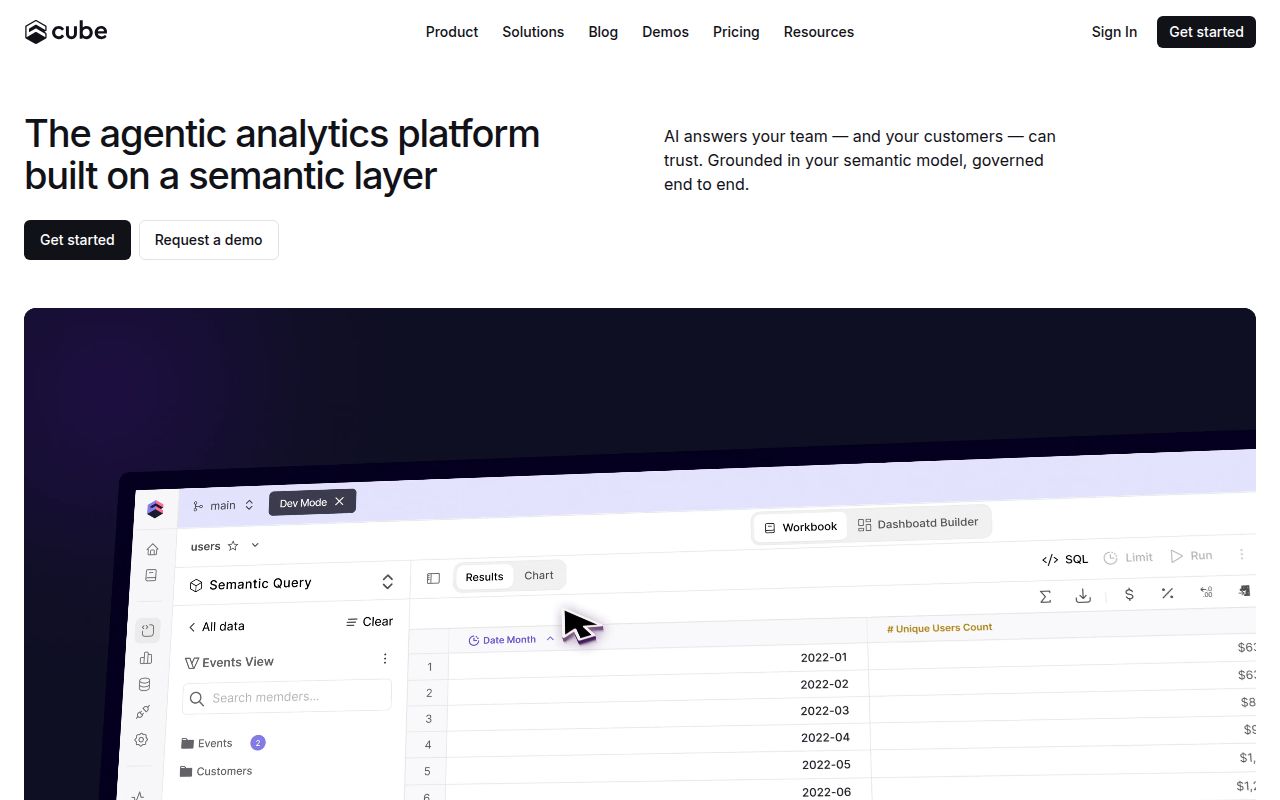
Cube's commercial product adds Analytics Chat, workbooks, dashboards, managed deployment, RBAC, multi-tenancy, and integrations with familiar office and BI tools. The model is compatible between Core and the paid product, according to the README. This is a clear division rather than a hidden limitation. Evaluate Core as infrastructure for other clients. If the organization really wants a finished BI workspace, compare the commercial offering with tools such as Lightdash and Metabase.
What happened when we ran it
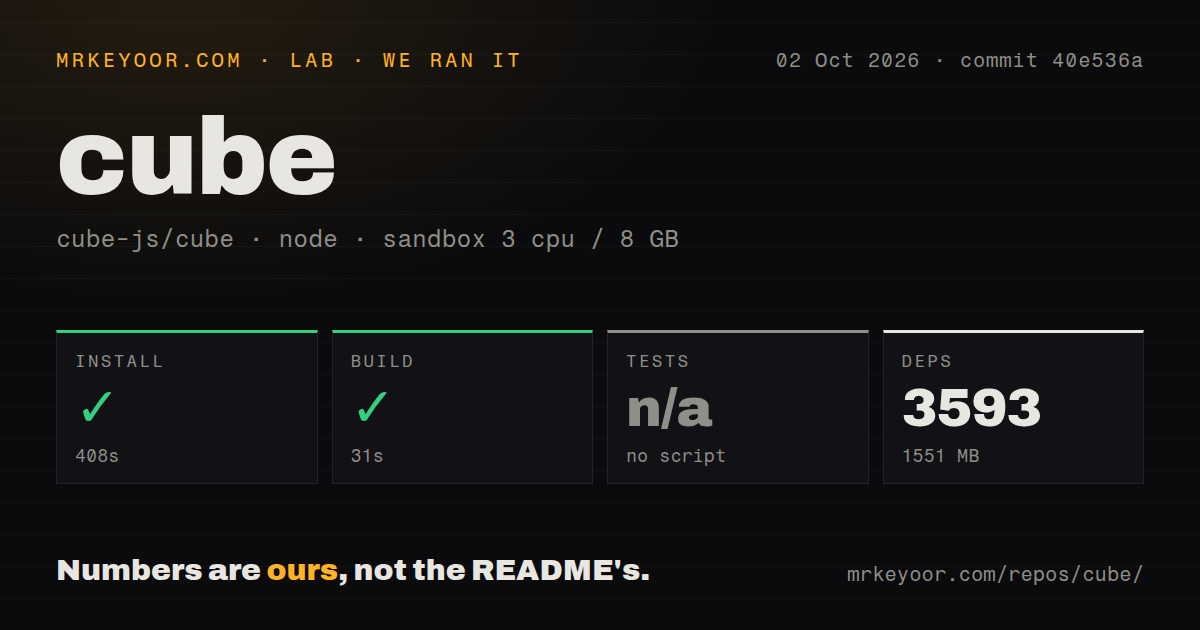
Our yarn install succeeded in 260 seconds in a fresh Debian sandbox with 3 CPUs and 8 GB of RAM. It added 4,062 packages and consumed 2,065 MB on disk. That dependency footprint is about 27 times the 75.2 MB checkout size. The install completed, so the weight is a planning fact rather than a failure: local environments, CI caches, and build workers need room for it.
The detected build succeeded in 16 seconds. Tests were skipped because the monorepo root did not expose a test script or target, and the checkout had no tests directory. Seventeen GitHub Actions workflow files show that upstream has automation, but our run did not produce a passing test result or test count. Teams should not turn the absence of a root command into an assumption that metric behavior has been verified for their models.
A useful acceptance suite should query known slices through the same APIs production clients use. Check totals across date ranges, joins that can multiply rows, access rules for different identities, pre-aggregation selection, and behavior after model edits. Our 16-second build proves that the detected build target completed at cfffdfe; it says nothing about whether a company's revenue or retention definition is correct. That responsibility stays with the adopter.
Current correctness reports deserve targeted tests
Issue 11545 reports roughly doubled results for a specific multi-stage measure over longer date ranges. Issue 11647 reports a DataFusion projection panic in CubeStore for a rolling-window rollup query. Another report says development mode's metadata endpoint can hang after a model edit once a query has run. These are specific configurations, not a claim that every query is wrong, but correctness failures are unusually expensive in a metrics layer because downstream clients may repeat the same answer confidently.
Version 1.7.26 was published on 2026-08-24, one day before this review. Its four bug fixes touch CubeStore planning flags, time shifts with pre-aggregations, parentheses in filter templates, and pre-aggregation references. That release activity shows maintainers working directly on query behavior. It also reinforces the need to pin versions and replay known-result queries during upgrades instead of accepting a successful container start as sufficient proof.
Data connections make production harder than the demo
The README's trial command maps ports 4000 and 15432, mounts a configuration directory, and enables development mode. After the browser opens, the real work begins: connect a SQL source, store its credentials, model the data, add access rules, decide which queries need pre-aggregation, and give downstream clients stable endpoints. Production needs development mode removed, secrets managed, configuration persisted, and query behavior observed.
Cube Core says it works with warehouses such as Snowflake, Databricks, and BigQuery, query engines including Presto and Athena, and application databases such as PostgreSQL. Breadth is useful only after testing the chosen driver. Issue 11622, for example, reports CubeStore web-identity credentials for S3 expiring after about 1 hour because refresh depends on the token file changing. An operator using that path should reproduce renewal before trusting unattended cache storage.
Active releases do not remove the need for ownership
The repository was pushed on 2026-08-25 and GitHub reported 1,139 open issues and pull requests. An issue-only search returned 723 open items. Those numbers indicate a busy project with a large support surface, not 1,139 confirmed bugs. The newest release arrived the previous day, and its fixes connect directly to active query and pre-aggregation work. This project is being maintained, but it is also changing quickly.
Cube Core is worth the effort when shared metric definitions prevent repeated modeling across several products. Our 4,062-package install and missing root test target make the operating contract plain: adopters need disciplined builds and their own data assertions. If one dashboard is the only consumer, a full BI tool is simpler. If APIs, embedded views, BI clients, and agents all need the same governed numbers, Cube's headless boundary can justify the extra service.