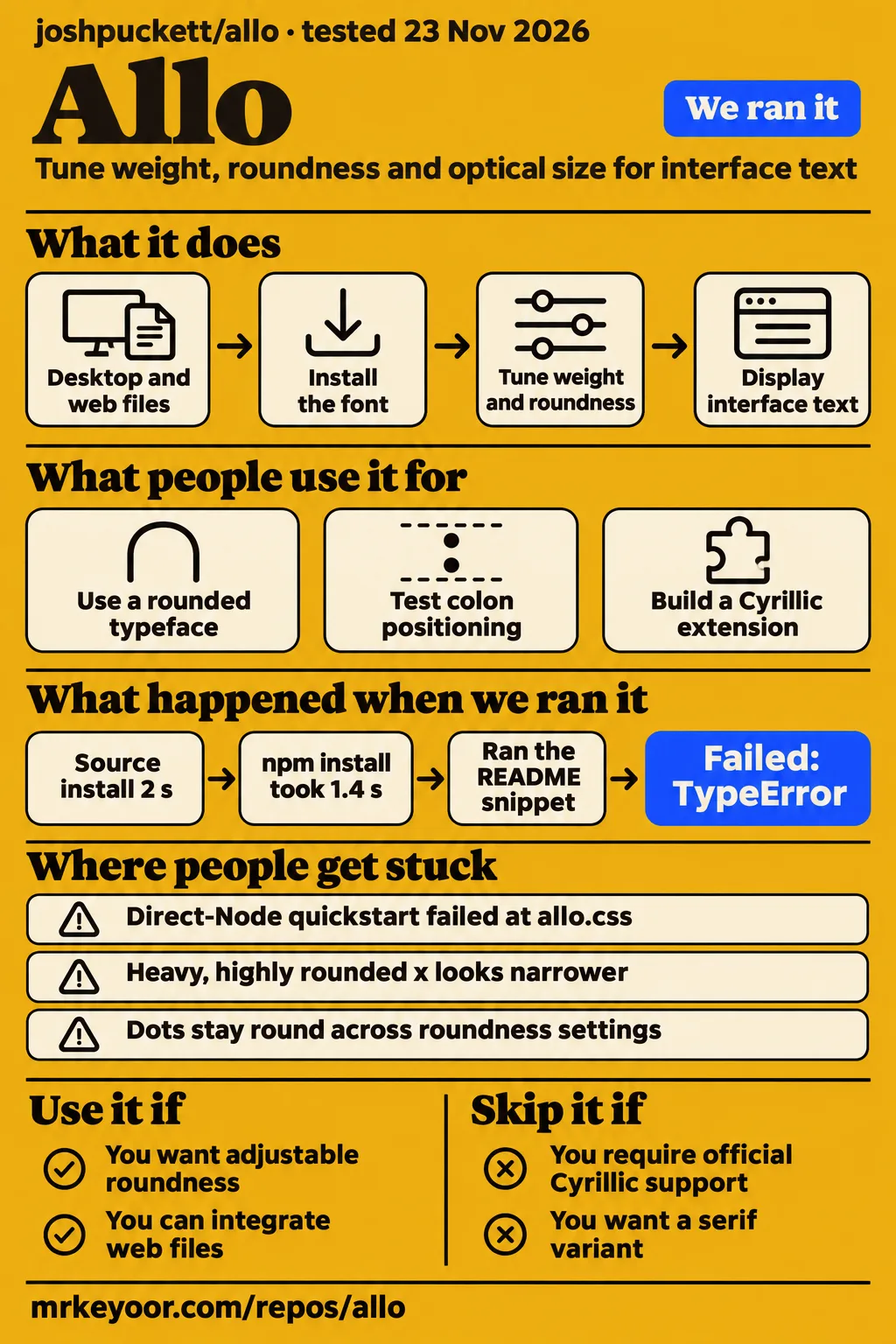
Short answer: choose it for adjustable interface type
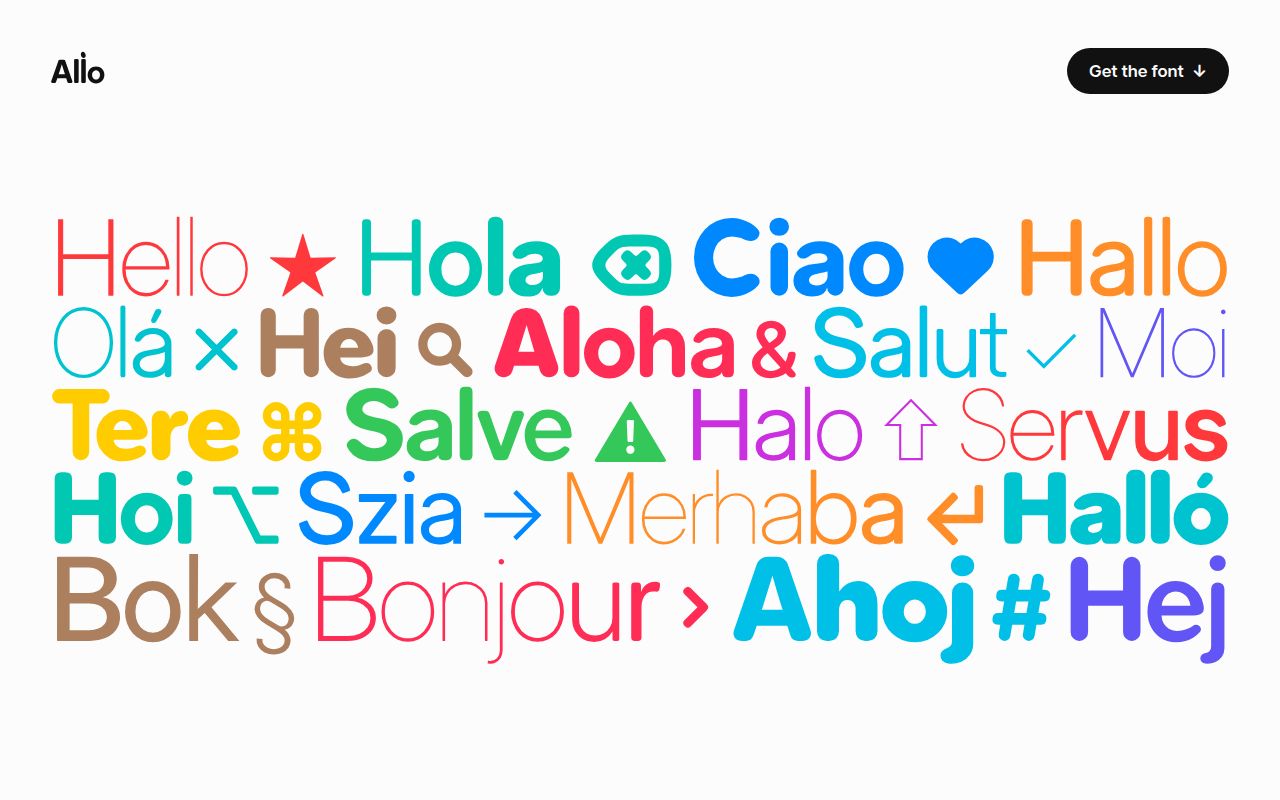
Allo v1.0.3 gives interface designers separate controls for weight, roundness and optical size. The Allo README describes a screen and interface typeface and supplies desktop and web files. The v1.0.3 release page identifies commit 60992c5 and describes the release as "Bug fixes." Josh Puckett's typeface is the Allo reviewed here, rather than another product sharing its name.
Choose Allo when adjustable roundness is part of your interface design. Choose another family when your requirements include completed official Cyrillic coverage, an official monospace Allo or a serif variant. Issue #12 lists Cyrillic as in progress, issue #1 puts Allo Mono on the author's future list, and issue #10 records his decision against a serif variant. These requirements lead to different font choices without needing a single numerical judgment about the design.
What people use allo for
Allo's issue discussions document a rounded-typeface preference, punctuation testing and an experimental Cyrillic extension. Each example identifies a person and a task: a reader choosing a rounded design, Puckett comparing released files with his website, and a contributor adapting glyphs from Inter. Together they give a prospective user concrete material to examine: ordinary interface text, punctuation beside capitals and the scripts an application needs.
- A reader in issue #2 called Allo their go-to rounded typeface while requesting missing Vietnamese characters. The preference and the character request describe the same person's experience.
- Puckett tested the variable and static 1.0 files in Figma on macOS while investigating colon positioning. He subsequently identified a bug in the website's type tester.
- Contributor ynckz built a Cyrillic proof of concept using Inter glyphs, describing Allo 1.0 instanced at optical size 14 and roundness 50, with Cyrillic glyphs at weights 400, 500 and 700.
The README's OpenType feature list supplies controls for comparing actual interface strings. Tabular figures address digit widths; fractions change number presentation; raised punctuation changes its relationship to capitals; and alternates change I, l, 1 and zero. Names, account numbers and punctuation therefore exercise different parts of the font. A comparison using those strings answers a more specific design question than a specimen containing only a short English heading.
What happened when we ran it
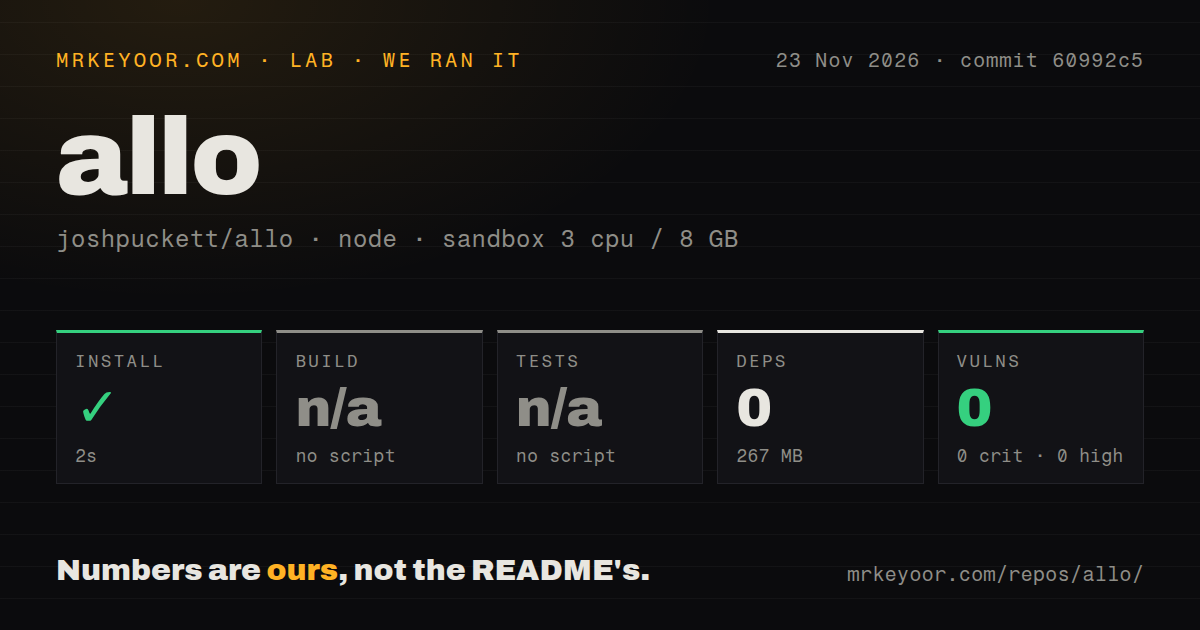
Our run installed the repository in 2 seconds; a separate quickstart failed when Node encountered allo.css. The repository harness checked commit 60992c5 on November 23, 2026, with 3 CPUs, 8g RAM and image lab-node:22. It recorded a successful npm install, then skipped build and tests because it found no matching script or target. The two jobs used different resources and recorded disk usage for different directories.
| Repository harness step or signal | Our recorded result |
|---|---|
| npm install | Succeeded in 2 seconds |
| Dependencies recorded | 0 |
| Installed disk footprint | 267 MB |
| Build | No build script or target found; skipped |
| Tests | No tests script or target found; skipped |
| npm audit | 0 known vulnerabilities: 0 critical, 0 high, 0 moderate, 0 low |
| Checkout | 50,227 files, about 391 source lines, 103.6 MB |
| Automation signals | 0 CI workflow files, no Dockerfile, no tests directory |
The separate quickstart used commit 60992c5e12a4, a fresh unprivileged container, 2 CPUs and 4 GB RAM, with no published ports or secrets. Its image label was also lab-node:22. The task selected the README's two-line JavaScript block from the Web section and ran it unedited through Node. That execution route is central to interpreting the recorded CSS-import error.
| Quickstart question | Answer | Verdict | Why |
|---|---|---|---|
| What task ran? | README Web JavaScript block, two lines, directly through Node | Direct-import task | The run record identifies the selected block and execution route |
| Did cloning complete? | Yes, in 7 seconds | Completed | The clone step records completion |
| Which package installed? | allo-font 1.0.3 in 1.4 seconds | Completed | The install log names the package and version |
| How large was node_modules? | 1.2 MB | Recorded | The installed-size step measures node_modules after installation |
| Were other packages installed? | 0 packages besides allo-font | Recorded | The dependency-count step reports zero others |
| Did the snippet complete? | Exit 1 after 0.1 seconds, ERR_UNKNOWN_FILE_EXTENSION for .css | Failed | The snippet log names /work/qs/node_modules/allo-font/allo.css; the snippet-failed finding records the same error |
| Did cleanup complete? | Teardown: ok | Completed | The teardown record reports success |
Where people get stuck: distinguish the tester from the font
Puckett diagnosed the colon mismatch as a website tester bug and the overlapping œ outlines as a font defect. The lowercase-x report concerns another condition: high roundness combined with heavy weight. Keeping the character, application and axis settings beside each report makes the troubleshooting history usable. A website text-entry problem, an overlapping outline and a changing glyph width each point to a different reproduction task.
| Symptom | Report or diagnosis | Recorded response or reproduction detail |
|---|---|---|
| Colon sits on the baseline in manually typed website text | Puckett compared static and variable 1.0 files in Figma in issue #4 | He identified a website tester bug and said he pushed a fix |
| œ has overlapping outlines in Chrome Canary on Linux | Puckett identified a font defect in issue #5 | He said the fix was going out in 1.0.1 |
| Heavy, highly rounded x looks narrower with larger side gaps | The reporter described the behavior in issue #11 | The reproduction sets Roundness to 100, selects Pangram and raises Weight to 900; it then compares Roundness 0 |
| Dots stay round across the roundness settings | The punctuation discussion in issue #16 asks whether their shape should follow ROND | Puckett agreed and promised a patch |
The contribution instructions request a screenshot and the text typed. In the colon investigation, Puckett also asked which file, operating system and application the reporter used. Those details belong with a rendering report because his comparison involved both the website and downloaded files in Figma. For an axis-dependent report such as lowercase x, the weight, optical size and roundness identify the design-space position being examined.
Vietnamese and Asturian additions were announced in 1.0.1
Puckett announced complete Vietnamese and Asturian support in Allo 1.0.1. His release announcement names both languages and numerous diacritic fixes. The earlier requests consequently have a release boundary: they document the characters people asked for before that announcement. Reading them alongside the named version avoids presenting a launch request as an unchanged description of the 1.0.3 download.
The Vietnamese request in issue #2 lists uppercase and lowercase accented characters and asks for enough coverage to use the font for Vietnamese typography. The Asturian request in issue #6 names underdotted H and L forms and superscript letters for ordinal abbreviations. These are specific character requirements: a specimen containing only unaccented Latin letters would exercise different glyphs from those identified by the requesters.
The full variable font and Friendly serve different choices
AlloVariableFriendly fixes roundness at 50, so ROND has no effect on that file. The README's web instructions describe Friendly as about half the size of the full variable webfont and name its family Allo Variable Friendly. Choose the full variable font when roundness changes are part of the design; Friendly implements the fixed setting described by its filename and documentation.
The full font's axis table gives optical size from 9 to 32, weight from 100 to 900 and roundness from 0 to 100. Their defaults are 14, 400 and 50. These axes control different aspects of the design, so a weight choice does not also specify roundness. The README describes Display at optical size 32 as tighter and says that below 14 only spacing changes.
The obliques are separate drawings, not a slant axis. The README's source description states that distinction, while its web instructions explain how to load them. The npm CSS includes obliques; self-hosting calls for an italic font-face declaration with the matching weight for each oblique file used. The desktop static and variable files also have separate family names, Allo and Allo Variable, allowing both families to be installed.
Allo vs Inter and Calistoga
Inter describes itself as a typeface designed for computer screens; Calistoga describes itself as a display typeface. The Inter README and Calistoga introduction establish those roles. Allo's README says it began from Inter 4.2, while Calistoga entered the Allo discussion through a request for a serif variant. These connections give a comparison a concrete starting point: screen text, adjustable roundness or a display design.
| Choice | Documented role or connection | When to consider it |
|---|---|---|
| Allo | Screen and interface type with adjustable roundness | You want to tune roundness alongside weight and optical size |
| Inter | Typeface designed for computer screens; Allo began from Inter 4.2 | You want to compare Allo with its starting family |
| Calistoga | Display typeface proposed as a serif reference in issue #10 | You want its display design rather than a future serif Allo |
Puckett declined the serif request in issue #10 because it falls outside Allo's intended character. Ynckz's Cyrillic experiment in issue #7 describes Inter's Cyrillic as about 4% lighter than Allo's Latin at the same weight. That observation belongs to the contributor's adaptation work. It explains a design-matching concern when combining the glyphs, rather than ranking the families for readability.
Installing, licensing and contributing
Allo's README documents npm installation, self-hosted WOFF2 files and desktop downloads under SIL Open Font License 1.1. Its license summary permits commercial use, modification and redistribution, while saying the fonts cannot be sold by themselves. The download instructions name Allo-1.0.3.zip and distinguish 18 static fonts, the variable TTF and the webfont directory. Desktop installation and web integration therefore start with different files from the release.
The Web section documents npm install allo-font and a JavaScript import, then gives a separate self-hosting route. The self-hosted declaration references AlloVariable.woff2, uses the Allo family name and declares weights 100 through 900. Its axis instructions use font-variation-settings for ROND because roundness has no dedicated CSS property. The same section distinguishes that configurable file from AlloVariableFriendly.woff2, whose roundness stays at 50.
For source generation, the build instructions require Python 3.9 or newer, create a virtual environment, install requirements.txt and run build.py. Contribution policy is separate: the README currently declines pull requests changing masters or font files and asks people proposing a new script to open an issue first. Its license permits modifying and shipping your own version, while the contribution instructions describe how the maintainer accepts upstream work.
FAQ
Official Cyrillic support is listed as in progress in issue #12. The discussion asks for basic Cyrillic across weights and styles, and one commenter says most of their work uses Cyrillic. Other questions concern a monospace family, language additions and particular glyph behavior. The answers below follow those requests, keeping the relevant version, character or axis setting beside each answer.
Does Allo support Cyrillic across every weight and style?
Issue #12 lists official Cyrillic support as in progress, with the first pass intended to cover the basic alphabet in every weight and style. The request names Russian, Ukrainian, Belarusian, Bulgarian, Serbian and Macedonian. It places localized Bulgarian and Serbian forms, along with extended Cyrillic for other languages, later in the proposed work. That is the official request's stated scope.
Is there a monospace version of Allo for coding?
Allo Mono is on the author's future list in issue #1. The requester wants fixed-width characters for editors, IDEs and terminals. The README separately lists tabular figures and character-disambiguation alternates, which address digit widths and selected letterforms. Those documented features answer narrower typography needs than the request for an entire monospace family. A commenter in the issue also points readers toward #14.
Does Allo include all the characters needed for Vietnamese typography?
Puckett announced complete Vietnamese support in 1.0.1 in his release update. The earlier issue #2 request identifies missing accented uppercase and lowercase forms and says adding them would make Allo usable for Vietnamese typography. The announcement supplies the version associated with the author's coverage claim, so the initial missing-character list should be read with that release history.
Does Allo support Asturian underdotted letters and superscript ordinal abbreviations?
Puckett's 1.0.1 announcement calls Asturian support complete. The preceding issue #6 request identifies underdotted H and L forms and superscript modifier letters for ordinal abbreviations. That distinction helps when choosing sample text: the request concerns particular encoded characters, including forms used for grammatical gender and number, rather than only the visual appearance of an ordinary Latin alphabet.
Why does the colon appear raised in Allo's specimen but sit on the baseline in the type tester?
Puckett identified a website tester bug and said he pushed a fix in issue #4. He reported that both variable and static 1.0 files raised the colon as expected in Figma on macOS. His reply separates the website's behavior from the released files and records the application used for comparison, which is why the file and application belong in a similar report.
Why does lowercase x become narrower and more loosely spaced at high roundness and heavy weights?
Issue #11 reports that lowercase x narrows as weight rises at high roundness while its advance width grows. Advance width is the space reserved before the next glyph begins. The reporter's reproduction sets Roundness to 100, selects Pangram and raises Weight to 900, then compares Roundness 0. The report describes larger side gaps and a pinched shape in the rounded, heavy setting.
Will Allo have a serif variant similar to Calistoga?
Puckett declined a serif Allo in issue #10, saying serif support falls outside the character and feel behind the project. The requester proposed Calistoga as a reference and expressed an intention to use Allo in a project or two. For someone choosing a display family now, the Calistoga project supplies an existing design to examine alongside Allo.
Should Allo's dots become square at ROND 0 and circular by ROND 50?
Puckett agreed that dots should follow ROND and promised a patch in issue #16. The discussion connects dot shape with the roundness axis, rather than treating every circular mark as independent of that setting. It also raises the relationship between dots and punctuation heads, giving designers a specific group of shapes to examine when comparing sharp and rounded designs.
Should comma and quotation-mark heads also become square at ROND 0?
The reporter asks whether comma and quotation-mark heads should become square at 0 in issue #16. The question notes that their heads stay round while their tips sharpen, so a square dot could sit beside a round punctuation head. Puckett's reply agrees that dots should follow ROND; the discussion's separate punctuation question identifies another design choice rather than a documented setting to enable.
How should a Cyrillic contribution be structured to work with Allo's source build and release process?
The contribution instructions ask people proposing a new script to open an issue first and currently decline pull requests changing masters or font files. Ynckz's issue #7 offers an experimental Cyrillic build and source contribution. For upstream work, discussion is therefore the documented first step. The README's source description also requires compatible points across masters, reflecting the multiple optical sizes, weights and roundness settings in the designspace.
What we have not tested yet
Our execution stopped before browser or desktop rendering, so it supplies no visual assessment of spacing, clipping, text quality, rendering speed or screen-reader behavior. The direct-Node CSS-import failure concerns that execution route, not a browser result. The Python generation workflow, font-file checksums and README reproducibility claim have not been assessed. The lab-node:22 label does not identify the actual runtime version, and the npm audit result covers neither font parsing nor Python dependencies.
The repository's 267 MB footprint and the quickstart's 1.2 MB node_modules measurement describe different jobs; their disk accounting has not been reconciled, and neither measures page transfer. Vietnamese and Asturian completeness is the author's announcement rather than our native-reader assessment. Our work includes no completed Cyrillic integration, assessment of the #14 reference, comparison of Allo, Inter and Calistoga on identical text, or independent production-outcome study.
The Cyrillic proof of concept contains three static weights and pins optical size at 14 and roundness at 50, as the contributor explains in issue #7. The readable issue #11 history contains the x report and reproduction steps, but no passage tying a correction to 60992c5 or confirming improvement. The v1.0.3 release note says only "Bug fixes." The dot-shape reply promises a patch rather than identifying a shipped release.
Rendered article layout, specimen images, related links, recommendation modules and template behavior also fall outside this text review. The next useful font evaluation is a rendered page that records exact files, application, axis settings and representative interface strings. That would address the rendering questions left open by the installation jobs while keeping the repository harness, direct-Node result and issue reporters' observations distinct.