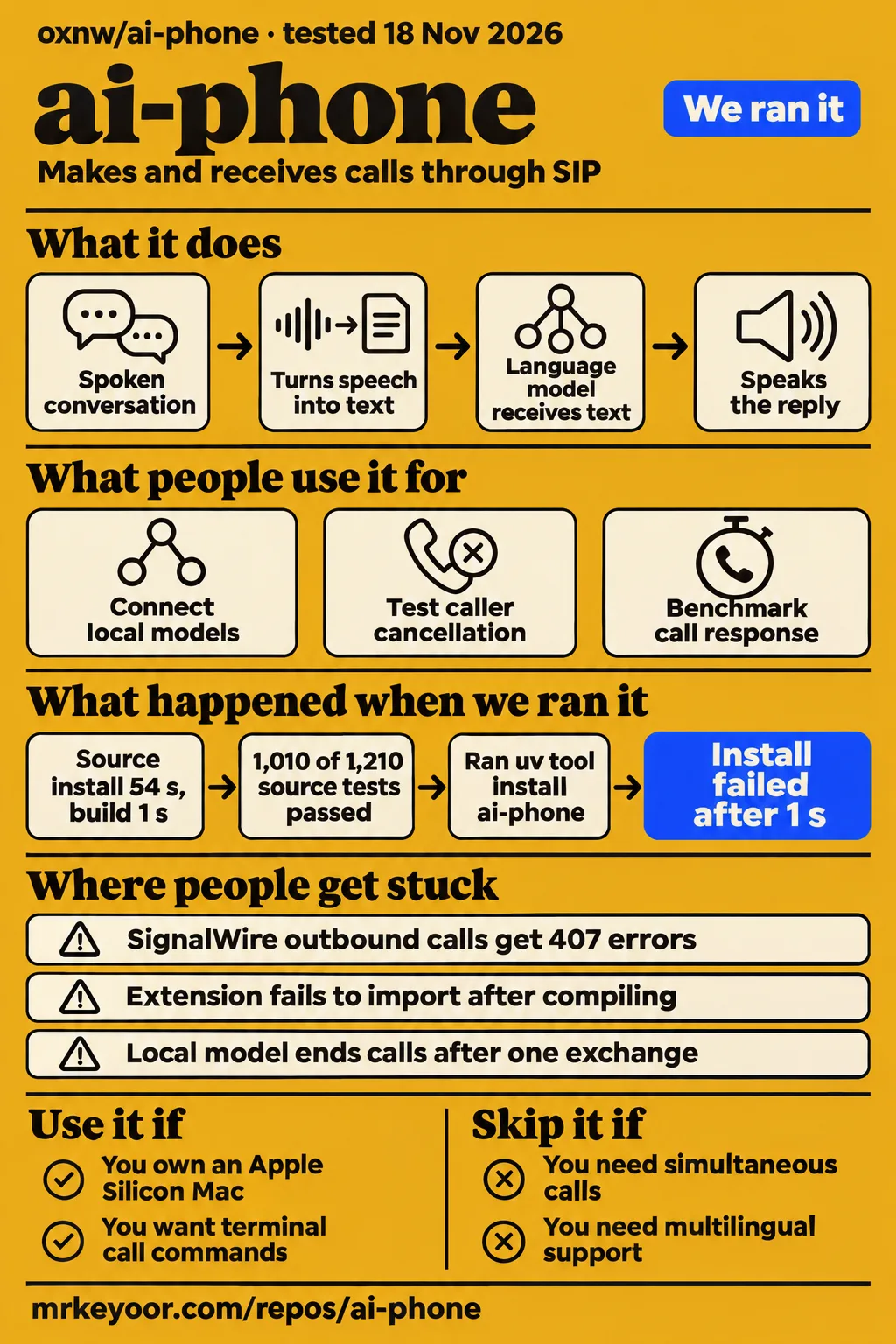
oxnw/ai-phone installed in 54 seconds in our sandbox, but its test command failed after 614 seconds. Use it if you own an Apple Silicon Mac and want to experiment with a phone agent you can control from a terminal. Skip it if you need several simultaneous calls, multilingual conversations, or an unattended business phone service with demonstrated operating history.
The appeal is specific: keep speech recognition and voice generation on your Mac, then choose where the conversation's text goes. The work is specific too: connect a SIP line, choose models, keep a daemon alive and understand what its transcripts retain. Our recommendation is to start with a local SIP conversation before attaching a number people depend on.
What people use ai-phone for
Maintainer oxnw reports a successful conversation between local models over US telephone numbers, including a SignalWire number. That is the clearest completed calling example in this research pack. The other useful reports concern the plumbing that keeps a telephone agent reachable.
| Who used it | What they did | Reported outcome |
|---|---|---|
| oxnw, the maintainer | Connected local models through US telephone numbers, including SignalWire | The call connected and the models held a conversation. SignalWire report |
| oxnw, the maintainer | Reproduced caller cancellation during answer, then exercised the merged fix | The same daemon survived cancellation attempts and answered the next call. Cancellation report |
| branigan, using Flash Telecom | Asked to use a SIP username in outbound identity | oxnw reported a fix and closed the issue after learning which provider was involved. Flash Telecom discussion |
The first example matters because it goes beyond registering an account. Registration can work while the outbound call fails, as the original SignalWire report demonstrated. The maintainer's later conversation supplies evidence that speech crossed the telephone connection. It is a useful interoperability result, and the source describes exactly how narrow that exercise was.
The documented interface supports incoming calls, outgoing instructions and relay control. In ordinary mode, you give the agent a task and receive the transcript when the call ends. In relay mode, another program can issue say, listen and hangup commands to control the conversation turn by turn. Every outgoing call starts with an AI disclosure. README and command examples
What happened when we ran it
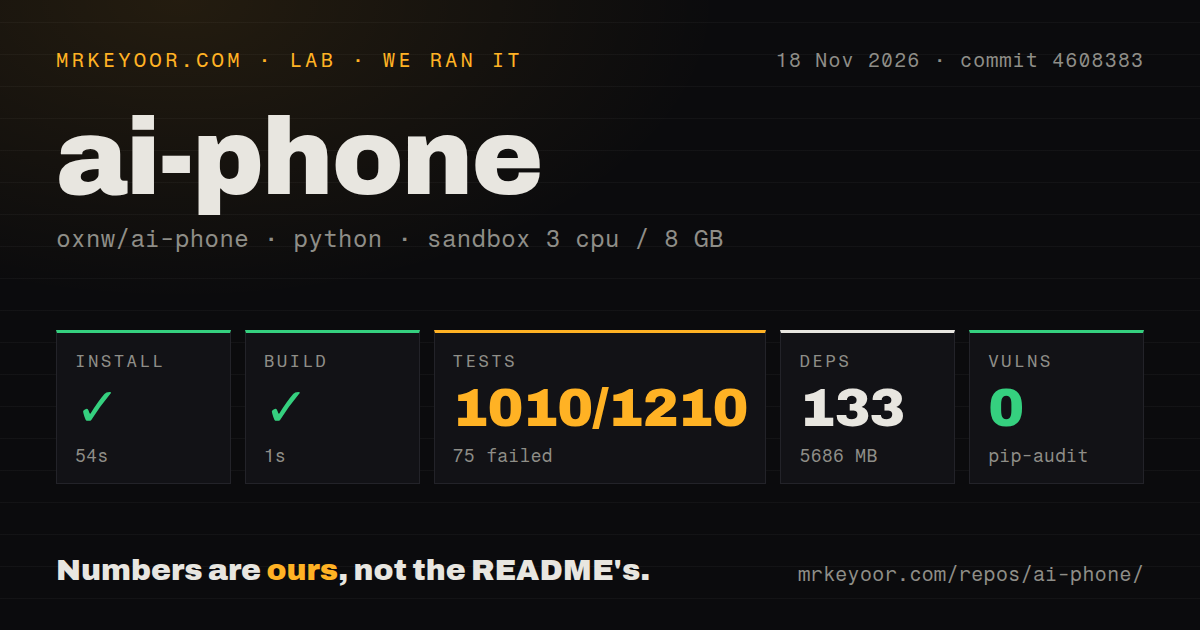
Our sandbox installed ai-phone in 54 seconds and built it in 1 second, then the test command failed with exit 1 after 614 seconds. The recorded checkout was commit 4608383 on 18 November 2026. It contained 234 files, approximately 41,325 source lines and 3.9 MB of checked-out files.
| Check | Our recorded result | What it tells you |
|---|---|---|
| Install | Succeeded in 54 seconds; 133 dependencies; 5,686 MB on disk | The dependency environment was much larger than the checkout. |
| Build | Succeeded in 1 second | The recorded build step completed. |
| Tests | Exit 1 after 614 seconds; 1,010 passed, 75 failed, 23 skipped, 125 collection/setup errors | The suite did not pass. |
| Dependency audit | pip-audit reported 0 known vulnerabilities | No known vulnerabilities were reported by that audit. |
| Repository signals | One CI workflow file, a tests directory, no Dockerfile | The scan found test infrastructure and no Dockerfile. |
The sandbox configuration recorded 3 CPUs, 8 GB RAM and image ghcr.io/astral-sh/uv:python3.12-bookworm. Actual runtime and operating-system versions require the raw toolchain logs. The image name alone supplies neither. The supplied summary labels the test total as 1,210; collection/setup errors are also reported separately, so we retain the categories rather than inventing a passing percentage.
The visible failure tail names terminal-setup cases, including cancelling with q, hiding secrets in a form, handling a failing validator, resizing the terminal and fitting narrow screens. Those entries report that async def functions are not natively supported. That tells us what pytest complained about. It does not identify the underlying environment or package cause, and it does not mean each named screen interaction failed during actual use.
There are two findings to carry into a decision: the checkout's installation and build completed, and the test command returned a failure. Neither result is a measured telephone conversation. The 5,686 MB figure describes our installed environment, so don't turn it into a model-memory requirement or a universal disk minimum.
Where people get stuck: call identity and native libraries
Issue #3 reports working SIP registration alongside rejected outbound calls because SignalWire expected the endpoint username in the From identity. That distinction is worth checking before repeatedly changing a password. The report describes fresh 407 authentication challenges even though the same credentials registered successfully. SignalWire issue #3
| Symptom and source | What the record says | Practical response and status |
|---|---|---|
| SignalWire repeats 407 challenges, issue #3 | Outbound From used a telephone number where the provider expected its endpoint username | oxnw added SignalWire support and reported a successful conversation. |
| Flash Telecom needs a username, issue #13 | branigan's provider did not accept the assumed number-based identity | oxnw reported merged support for username-based From identity, then closed the report. |
| A caller cancels while the daemon answers, issue #2 | The reporter saw the process exit, including a native PJSIP abort | oxnw reproduced it, merged race and cleanup handling, and reported that the daemon answered the next call. |
| The native extension compiles but will not import, issue #1 | The reporter's extension linked OpenSSL 3 while Homebrew pjproject required OpenSSL 4 | The reporter supplied a local workaround and warned against forcing version 4 on machines built against version 3. The issue is open. |
For the cancellation bug, the maintainer explains why checking whether a call is active was insufficient: cancellation could arrive between that check and answering. The merged handling also catches PJSIP_ESESSIONTERMINATED, creates records after successful answers and fixes queued native-call cleanup. This is stronger evidence than a closed label because the reply describes the repair and the subsequent-call exercise. Maintainer's cancellation follow-up
The OpenSSL report is a different class of problem. Its import error names _OPENSSL_sk_set_cmp_thunks; the reporter traced it to incompatible library linkage. Treat that diagnosis as applying to the reported Homebrew configuration. It is not an explanation for our sandbox's async-test failures. OpenSSL issue #1
Telnyx has another documented setup snag: some accounts mask existing SIP passwords in API responses. The usage guide says to finish number routing in the portal, then choose My own SIP trunk with the known username and password. That route avoids asking the setup tool to recover a password the provider will not reveal. Telnyx guidance
One Mac handles one English call at a time
The README supports English and one concurrent call, with macOS on Apple Silicon required for the computer running ai-phone. Callers can use other phones or SIP clients. Those are different compatibility questions: a Windows caller can reach the line without Windows being a supported host for the daemon. Platform and usage requirements
The README recommends 16 GB RAM for the default 4B model and 32 GB for 9B, with a smaller 2B choice for 8 GB systems. These are upstream recommendations, separate from our sandbox's configured memory. Even selecting a remote language model leaves the MLX speech backends on the Apple Silicon host.
Setup chooses incoming calls, outgoing calls or both. Receiving requires ai-phone run to stay running, and setup does not install a background service. For an outbound experiment, starting the process when needed is reasonable. For a number that people call while you're away, process supervision becomes part of the operating job. The one-call boundary is also a direct reason to choose another foundation when simultaneous callers are a requirement.
Local speech still sends audio through a telephone network
Speech recognition and synthesis stay local, while a remote language model receives call text, instructions and conversation history. An external agent's cloud provider also sees transcripts passed to it. Phone audio travels over SIP/RTP. Choose the brain with that whole path in mind. README privacy boundaries
The usage guide says setup saves configuration and secrets under ~/.ai-phone/, with the configuration and secrets files readable only by the user. It also separates carrier provisioning from the running daemon: buying or connecting a number contacts the carrier through setup or line commands. During a call, the documented network connections are SIP/RTP and, when configured, the brain endpoint. These are useful design statements, not a substitute for inspecting your own deployment. Usage and privacy documentation
Carrier charges and subscription limits still apply. A local language model changes where its input is processed, but it does not remove the telephone provider from a numbered call. Outgoing disclosure is a helpful default for a caller-facing system, and the README explicitly says it starts every outgoing call.
The published latency result missed its target
The project's 27 October 2026 local benchmark reports a 1.50-second median first-audible response under heavy memory pressure and says it missed the one-second target. That is an upstream measurement, not a result from our sandbox. It describes when the caller first hears the reply, rather than how long a complete answer takes. Published benchmark summary
The usage guide also separates initial and later turns for subscription brains. It reports 2.4 to 5.5 seconds on the first Claude turn and about 1 second afterward; its ChatGPT route reports 3.9 to 4.4 seconds initially and 1.1 to 1.9 seconds afterward. Those observations belong to the documented configurations. They are not a ranking of providers under a shared workload. Brain response-time table
For your own evaluation, listen for the pause after the caller stops speaking, especially at the beginning of a call. A later turn that feels quick does not tell you whether the first response feels awkward. Keep the model, speech backend, carrier route and memory conditions with any result you record, just as the project's benchmark names memory pressure.
ai-phone vs Pipecat and LiveKit Agents
Pipecat and LiveKit Agents are frameworks for building conversational applications, while ai-phone supplies a particular Mac-hosted phone daemon and command interface. Choose between owning this tool's operating constraints and designing more of the application yourself. Their documentation supports that distinction; the evidence supplies no head-to-head performance winner.
| Candidate | Documented approach | Pick it when |
|---|---|---|
| oxnw/ai-phone | Apple Silicon daemon, local speech, SIP lines and terminal call commands | You want this specific phone interface and can work within one English call at a time. |
| Pipecat | Python framework for voice and multimodal conversational agents | You want to compose the conversation pipeline and choose its services and transports. |
| LiveKit Agents | Server-based programmable participants, job scheduling and telephony integration | You want a voice application built around LiveKit sessions and its telephony stack. |
Pipecat's README describes modular pipelines, speech services and transport choices. That is attractive when the application is your product and you expect to write its behavior. ai-phone's command interface is the more direct starting point when the job is to give an existing shell-capable agent access to a telephone conversation.
LiveKit Agents' README documents scheduling, dispatch and making or receiving telephone calls through LiveKit's telephony stack. Its server model is a reason to investigate it for a shared application. Neither framework removes your responsibility for providers, credentials and conversation behavior, and this comparison makes no claim that either is cheaper or faster.
What the other reviews get wrong
The supplied search pages describe several unrelated products called AI Phone, so their translation, smartphone and business-answering claims cannot be assigned to oxnw/ai-phone. The AI Phone user guide concerns a translation app. Skimmer's guide describes a call-answering feature embedded in Skimmer. Neither describes this repository.
The pack's smartphone videos, X search results and Bilibili listings likewise supply no demonstrated use of oxnw's daemon. Borrowing their popularity or capabilities would give this project an adoption story the records do not contain. The useful community evidence here comes from the repository's issue discussions, including actual call reproductions and maintainer follow-ups.
A separate lab quickstart record also tried a package-registry installation and stopped because ai-phone was not found in that registry. Its error said the requirements were unsatisfiable. That failed recipe differs from the successful checkout installation measured above; the current README tells users to clone the repository and run its installer. Do not turn the registry result into a claim that the checkout cannot install.
Questions people ask
oxnw/ai-phone is an open-source phone agent for an Apple Silicon Mac, distinct from similarly named translation apps and AI smartphones. The questions below concern that repository's model choices, retained transcripts and reported telephone failures. Project identity and requirements
What is oxnw/ai-phone, and how does it differ from similarly named translation apps and AI smartphones?
It is a computer-hosted SIP phone agent with local speech recognition and synthesis. AI Phone at aiphone.ai is a translation application, and smartphone articles use the name for hardware features. Follow the repository owner, oxnw, when looking for this project's instructions. Repository, translation app
Does downloading a larger model make it ai-phone's default?
No: issue #5 says cached status and setup's RAM recommendation are separate decisions. Its example uses a 24 GB computer with only 9B cached: setup lists that download but recommends 4B. Existing catalog selections are retained. Runtime models.tier: auto has its own rule, choosing 9B at 32 GB or more and otherwise 4B. Model-selection documentation task
Does ai-phone discover models already downloaded by other tools?
It checks complete snapshots for relevant models in the configured Hugging Face cache; it does not scan every model on the computer or inspect Ollama's library, according to issue #5. In issue #7, contributor harisazharir-boop added offline cache-discovery coverage and a missing-weight-file regression fix. oxnw reviewed the change and reported green CI. Discovery scope, contributor follow-up
Where does ai-phone save transcripts, and what survives a restart?
Issue #6 identifies the default text turn log as ~/Library/Logs/ai-phone/turns.jsonl. The daemon retains the current call and last 20 ended call records in memory. Restarting forgets those records but leaves the disk log. The log stores transcribed or spoken text and timings, not an audio recording or every field of a completed call result. Transcript documentation task
How do I export a completed ai-phone call without placing another call?
Issue #6 gives uv run ai-phone listen --call <id> --json > call.json for a completed call whose ID is still retained. Listening to an active phone-agent call returns an error. The same record says status --last-call summarizes the turn log rather than exporting the full call result. Save the retained result before restarting if that is the artifact you need. Completed-call export
Why do SignalWire calls get 407 errors even though SIP registration succeeds?
Issue #3 traced that combination to outbound From identity: the endpoint username was required where ai-phone used a telephone number. Registration success therefore did not settle outbound authentication. oxnw later added SignalWire support and reported a successful model-to-model telephone conversation. The current guide documents account-based From identity. Original report, current trunk settings
Can I use my SIP username as caller ID without an E.164 telephone number?
Yes: the usage guide supports from_user: account for providers requiring the authenticated SIP username in outbound From, without a local telephone number. The provider controls the displayed caller ID. The separate number and caller-ID fields still require E.164 numbers when present. Issue #13 records the Flash Telecom request and oxnw's reported fix. Trunk identity, Flash Telecom report
Why does ai-phone end an inbound call after the first exchange?
Issue #4 reports a small local model emitting [END] during ordinary conversation, which the daemon obeyed as a request to hang up. The reporter's example asked a follow-up question while also emitting that marker. The issue is labelled closed, but the supplied extract ends without an implemented repair or a successful retest. Premature-hangup report
Can a caller hanging up during ringing crash the ai-phone daemon?
The reporter in issue #2 reproduced that crash during the answer race. oxnw says the merged fix handles the terminated-session error and native cleanup, and reports that cancellation exercises left the daemon able to answer the next call. That response documents a specific repair and follow-up outcome. Cancellation repair
Why does the PJSIP extension fail to import after compiling successfully?
Issue #1 reports an OpenSSL linkage mismatch in its Homebrew environment. The extension linked version 3 libraries while pjproject required version 4, producing a missing-symbol import error. The reporter's local workaround preferred installed version 4 but explicitly warned that forcing it would break environments whose pjproject used version 3. Native-library report
Can ai-phone run on Linux, Windows, or an Intel Mac?
The README explicitly says Intel Macs, Linux and Windows are unsupported. Its current speech backends use MLX on Apple Silicon even with a remote brain, so changing the language-model endpoint does not remove the host requirement. Callers themselves can use any phone or SIP client. Supported host and caller platforms
How much RAM does ai-phone need?
The README recommends 16 GB for the default 4B model and 32 GB for 9B, and offers a smaller 2B model for 8 GB systems. Those recommendations describe model selection on the supported Mac host. Our sandbox's configured 8 GB is a separate repository-run condition, not evidence of real-call performance at that capacity. Memory recommendations
What we have not tested yet
Our run covered repository installation, build, tests and a dependency audit, not a supported Mac deployment or a completed telephone task. We have not tested call audio, interruptions, local or subscription brains, transcript export, carrier billing or the library workaround. The audit's zero known vulnerabilities is not a security certification, and the missing raw toolchain logs prevent assigning actual runtime versions.
The project's README says long-running SignalWire registration and end-to-end agent acceptance checks remain pending. Its documented bidirectional calls involve US numbers. The research pack supplies no verified completed reservation, appointment or business deployment for this repository, and no comparison run against Pipecat or LiveKit. Flash Telecom's extract has no subsequent user confirmation; the premature-hangup extract has no demonstrated resolution.
The next useful evaluation is on an Apple Silicon Mac: record a full conversation, interrupt it, cancel during ringing, answer the next call and export its retained transcript before restarting. For a real phone number, add a sustained registration run on the intended carrier. Those results would answer whether the tool can own your line; a successful source build answers a smaller question.