Two local components give an AI control of Blender
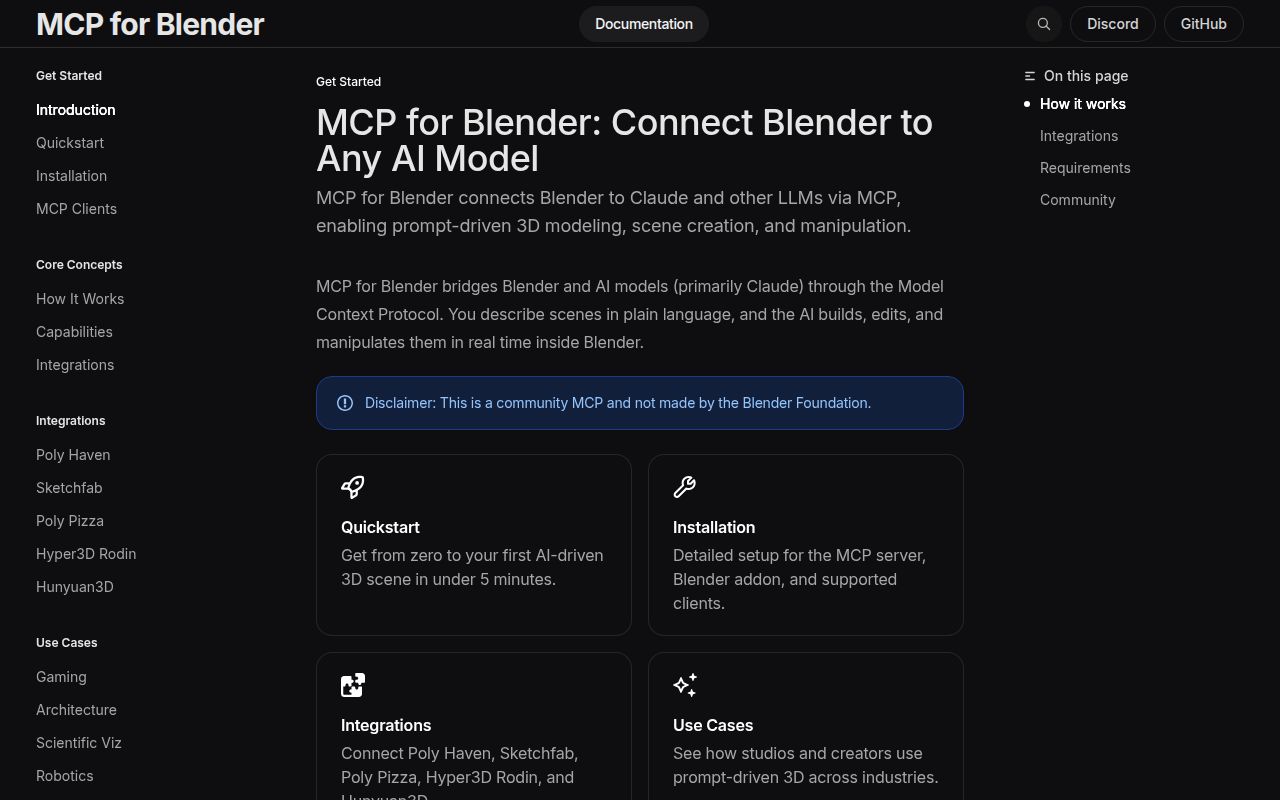
MCP for Blender joins 2 pieces: a Blender add-on opens a socket inside the application, and a Python MCP server translates client tool calls into Blender commands. Once connected, an AI client can inspect the scene, create and remove objects, change materials, export objects, and run Python. The old blender-mcp name now redirects to the renamed project, while existing configurations continue through a compatibility package.
This arrangement is more useful than a chat box that only suggests steps. The model can check object and scene data, act, and inspect the result through viewport feedback. Asset tools search Poly Haven, Sketchfab, and Poly Pizza. Hyper3D and Hunyuan3D add generated models. The quality still depends on the chosen model, prompt, scene state, and human review; the repository makes no measured claim that a prompt will produce production-ready geometry.
Safe mode blocks several high-risk Python operations
The default execute_blender_code tool can run arbitrary Python inside Blender. That grants access to the same application state and machine resources available to Blender itself. The README tells users to save their work before using it. Setting BLENDER_MCP_SAFE_MODE=1 adds script checks that block direct file access, launching other programs, network access, and persistence techniques while leaving common modeling, rendering, saving, and import or export work available.
The socket boundary also matters. It listens on localhost at port 9876 by default, with no authentication or encryption. Keep that default unless you can protect the route. The README recommends an SSH tunnel instead of pointing the server at a remote host. Issue 369 asks for a configurable add-on bind address because a second machine cannot currently connect without editing addon.py; the report also argues that localhost should remain the default.
What happened when we ran it
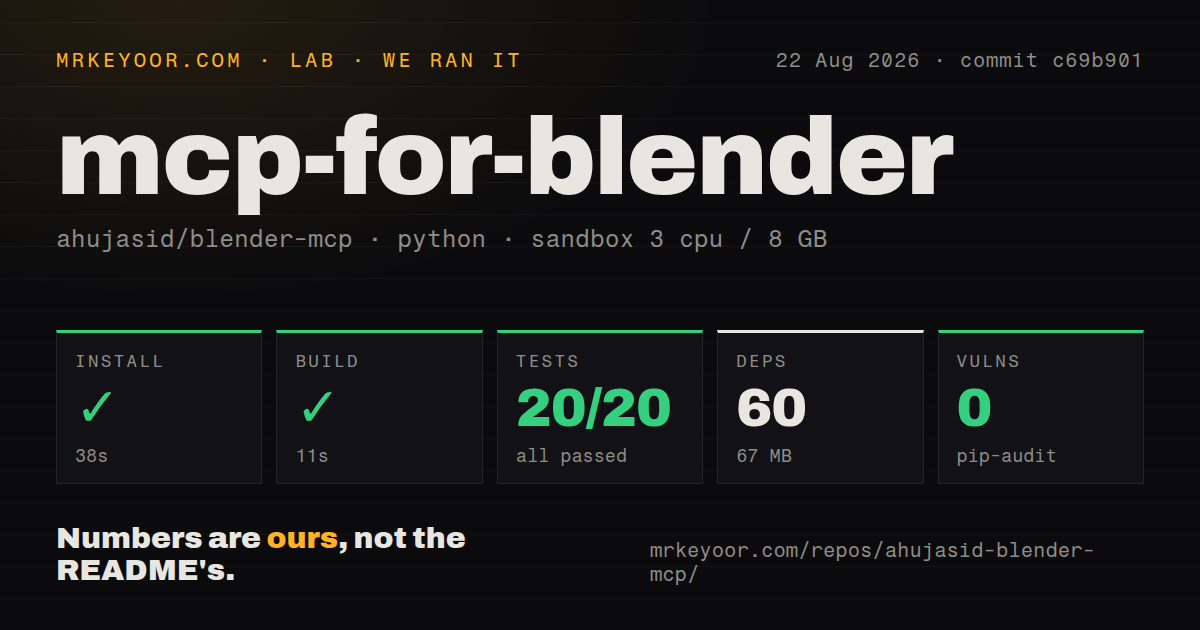
Our sandbox installed commit c69b901 in 38 seconds, adding 60 packages and using 67 MB on disk. The build completed in 11 seconds. Pytest then finished in 20 seconds with 20 passed and 0 failed. Pip-audit reported 0 known vulnerabilities in the installed environment. That is a clean repository result, and it makes a local trial easier to justify.
The checkout contained 25 files, roughly 11,975 lines of source, and occupied 1.1 MB before dependencies. It had a tests directory, but our scan found 0 CI workflow files and no Dockerfile at that commit. Those last 2 absences are maintenance signals, not failed runtime checks. The current documentation now includes a Docker route, so do not project the older checkout's file list onto the latest branch.
Version 2.0.3 keeps the old package name working
The current pyproject.toml identifies mcp-for-blender version 2.0.3 and requires Python 3.10 or newer. New users run uvx mcp-for-blender; the old uvx blender-mcp command remains a wrapper. Setup still has 2 moving parts: install the Python server into the MCP client, then install and enable the Blender add-on. The CLI can copy the bundled add-on and keeps a backup when it replaces an existing file.
Desktop clients sometimes cannot see the same PATH as a terminal. The guide shows how to supply the full uvx path and recommends pinning Python 3.11 when conda, pyenv, asdf, or a newer interpreter causes dependency trouble. It also warns against running more than 1 MCP server instance. These notes save real debugging time because a healthy server, a loaded add-on, and matching host and port settings must all be present.
Docker runs the MCP server, while Blender stays on the host
The documented container image holds only the MCP server. Blender continues to run on the desktop, and Docker must reach the add-on socket. Docker Desktop supplies host.docker.internal on macOS and Windows; Linux needs host networking with BLENDER_HOST=localhost. Open issue 372 reports that viewport screenshots fail when Docker connects to Blender on Windows, so that exact workflow needs verification before a team adopts it.
Optional assets bring separate accounts and license duties. Poly Haven needs no API key, while Poly Pizza, Sketchfab, Hyper3D, and Hunyuan3D can use stored credentials. About 69% of the Poly Pizza catalog is described as CC-BY, and the add-on stores attribution data on imported objects. Content telemetry is opt-in, but a smaller record containing an install ID, tool name, outcome, timing, versions, operating system, and timestamp is collected by default. DISABLE_TELEMETRY=true turns that off.
September activity is current, though no release tag exists
GitHub records a push on September 21, 2026, and an issue opened on September 23. The renamed repository had 29,219 stars and 33 combined issues and pull requests when fetched. GitHub returned no latest release, so package version 2.0.3 and commit history are better currency signals than a release page. The recent changes include safe-mode tightening and a Poly Haven fix, which shows maintenance around the parts users are likely to touch.
BlenderGPT is a simpler alternative for an OpenAI-specific prompt box inside Blender. Hunyuan3D 2 fits teams whose main task is generating an asset rather than editing a scene. Direct Blender Python wins when the operation must be repeatable and reviewed line by line. MCP for Blender sits between those choices: our 20 passing tests support a supervised trial, while arbitrary code execution and the unauthenticated socket rule out casual remote use.