Release v0.1.4 deploys 15 charts behind one product name
Release v0.1.4 publishes 15 component charts in a lockfile, including authorization, data migration, model management, retrieval, tracing, observability, sandboxing, and the backend. The deployment adds MariaDB, Redis, Kafka, OpenSearch, and ingress before those charts. BKN Foundry is therefore an enterprise data and agent platform, even though the root contains a small npm manifest that can make the checkout look like a documentation project.
The platform organizes a business around 4 concepts: data, logic, risk, and action. Context Loader retrieves evidence from that network, VEGA hides differences between data sources, Exec Factory invokes tools and MCP capabilities, BKN Safe applies permissions, and BKN Trace records why an action happened. The repository is backend-only. BKN Studio and the OpenBKN SDK, CLI, and agent skill are separate projects, so a clone does not give you the complete user experience.
What happened when we ran it
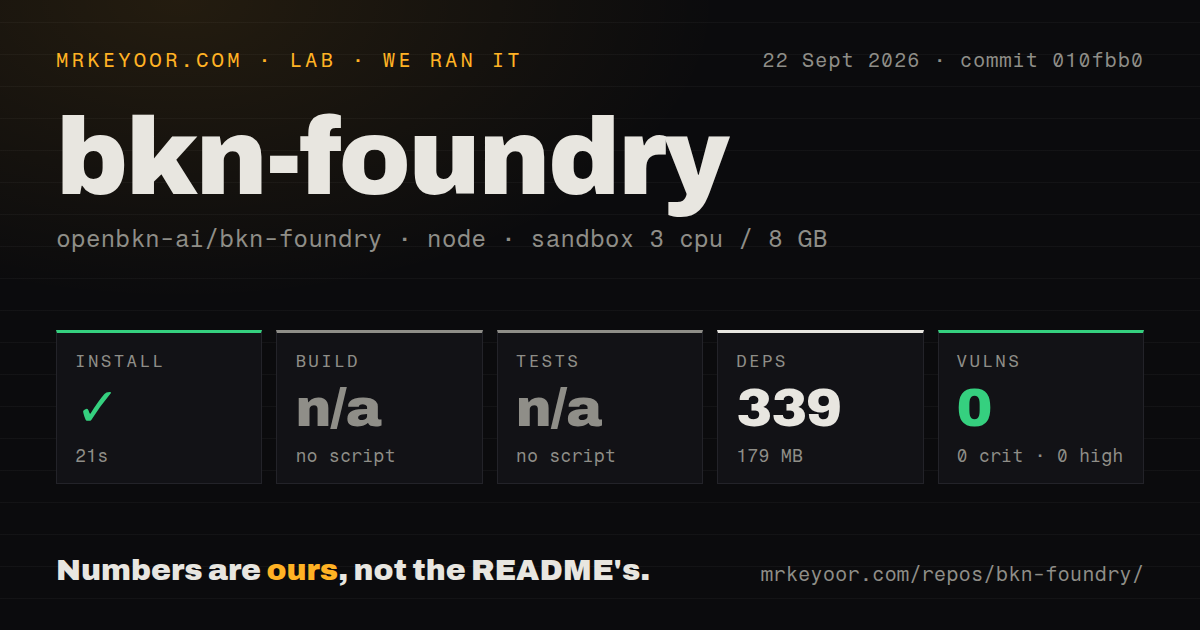
Our sandbox installed 339 npm packages in 21 seconds, with 179 MB on disk afterward. The root had no npm build script or test target, so the harness skipped both steps. Npm audit found 0 known vulnerabilities in that installed dependency tree. The checkout at commit 010fbb0 contained 4,518 files, roughly 868,065 source lines, and 68.7 MB before dependencies.
We also measured 48 CI workflow files, no root Dockerfile, and no tests directory. The root package.json identifies itself as bkn-foundry-docs and only defines commands for linting and rendering OpenAPI material. That explains the successful install and skipped product checks: our run exercised documentation dependencies, not the Go services, Python components, Helm charts, Kubernetes bootstrap, databases, models, or MCP endpoint. The 0-advisory result cannot be extended to those layers.
Production guidance starts at 16 cores and 32 GB RAM
The deployment guide lists 4 CPU cores, 8 GB RAM, and 200 GB disk as the minimum for testing and learning. Its production recommendation starts at 16 cores, 32 GB RAM, and 500 GB disk. Linux is the supported production target. A macOS path uses kind for local development, while Linux can use the default single-node kubeadm flow or an optional k3s route.
Host preparation is invasive. The quick start stops and disables firewalld, turns off swap, sets SELinux to permissive, installs containerd, and expects root or sudo. Installation then needs access to several package, image, and chart hosts. The optional preflight script can repair missing settings, but each fix should be reviewed on a real corporate host. A dedicated lab node is a safer first home than an existing shared cluster.
Version 0.1.4 requires migration reading before upgrade
Version 0.1.4 changed authorization and removed old paths, rather than only adding retrieval features. Normal users lost wildcard grants over catalogs, resources, and knowledge networks, making data-plane access deny by default until explicit grants are added. The release also renamed data_query to query_data, removed legacy data-view support, and dropped kafka-connect from the release lockfile. Existing deployments have work to do before restart.
The release notes also call for an idempotent Trace cleanup script and explain that the new IK-enabled OpenSearch image applies automatically only to fresh installs. Existing clusters need a StatefulSet rollout and a Vega restart to adopt it. With 15 charts and multiple stateful services, upgrading is a coordinated platform change. Pin the manifest, rehearse database and index recovery, and validate permissions with both administrators and ordinary users.
0 npm advisories do not cover 158 declared dependency alerts
Our npm audit reported 0 known vulnerabilities for the 339 packages it installed. On September 22, issue 1747 separately declared 72 open Python dependency alerts in infra/model-factory-base, while issue 1741 declared 86 across Decision Agent executor and memory components. Those issue totals describe a remediation backlog, without severity or proof of exploitability. They also show why the root npm result cannot stand in for a platform-wide security review.
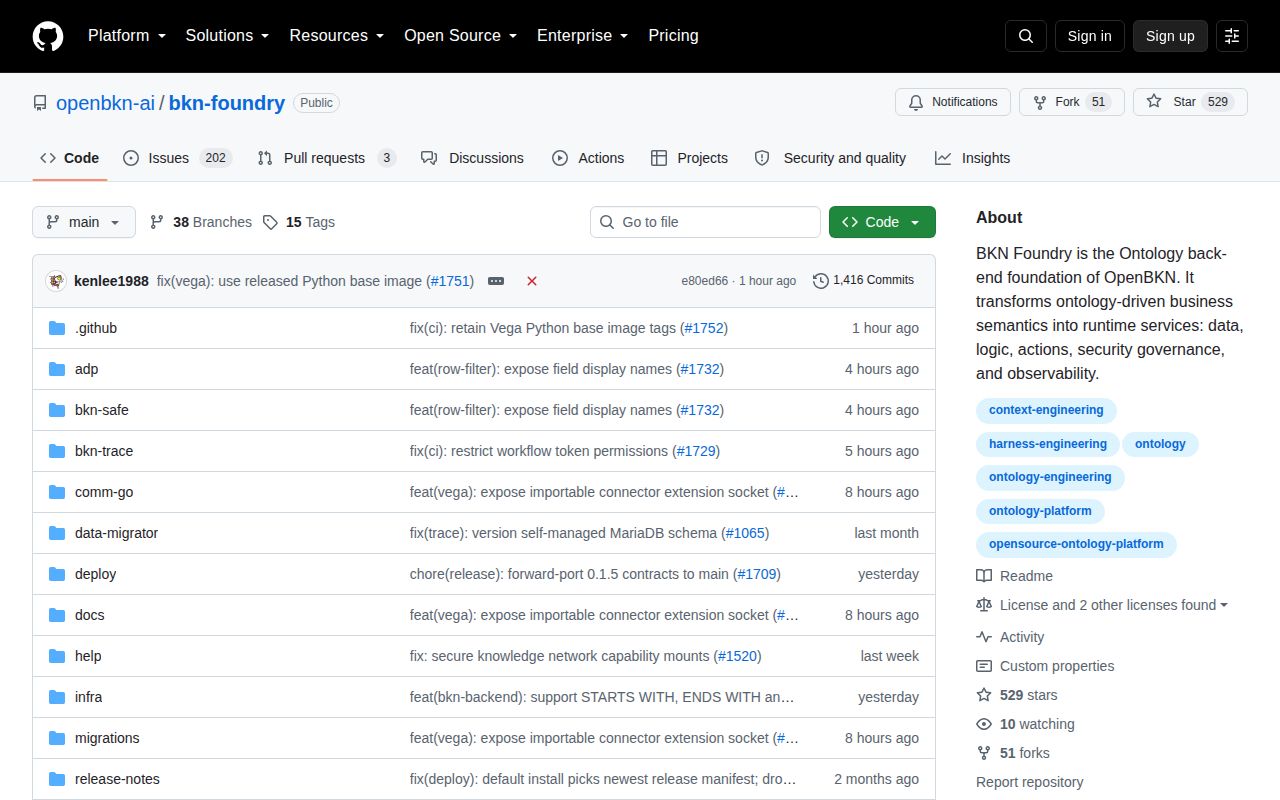
GitHub listed 205 combined open issues and pull requests, while an issue-only search returned 202 open issues. Several same-day tickets cover dependency alerts, untrusted CI checkout findings, secret-path logging, and a provider-host allowlist. The repository was pushed that day, so the backlog is active rather than abandoned. A buyer should ask which tickets affect the pinned v0.1.4 artifacts and require closure of relevant ones before exposing proprietary data or executable actions.
Apache 2.0 does not apply to every source file
BKN Foundry has a per-file licensing model. Code inherited from kweaver-ai/kweaver-core stays under Apache 2.0, while OpenBKN-authored files may use the OpenBKN License, a modified Apache 2.0 text. Mixed components require checking source headers. GitHub reports NOASSERTION, which is a fair warning that one SPDX label cannot describe the repository.
The modified license permits internal commercial use and customer-controlled implementations, but reserves named commercial entitlements and bars unauthorized shared or multi-tenant hosted services. It also restricts removing branding from applicable frontends or consoles without the matching commercial rights. Legal review belongs near the start of evaluation, especially for SaaS, managed-service, white-label, or multi-customer plans. An Apache-licensed dependency does not make the assembled platform uniformly Apache-licensed.
A 16-core host makes this a platform-team decision
The recommended 16-core, 32 GB, 500 GB production node is sensible only when the wider governance layer is the requirement. Cognee is a smaller starting point for persistent agent memory. GraphRAG is aimed at graph-based question answering over text and now describes itself as a research project in maintenance mode. Neo4j's LLM Graph Builder is useful when the immediate job is turning files into a graph you can inspect and query.
A BKN Foundry evaluation should start with one business object, one data source, one read action, and one blocked write action. Deploy the pinned 15-chart release on an isolated node, replace the default onboarding credential, test the chosen OAuth address, and compare trace records with the source data. Then restore the stateful services from backup. If that narrow path produces evidence your compliance or operations team needs, the platform has a reason to exist in your stack.