mrkeyoor.com_
Wed 23 Sept 06:49 UTC
AI Toolsevaluationupdated 23 Sept 2026

reverify review

The `codex-cli-portable-setup-kit` repository now redirects to Reverify, so the old name no longer describes the current English-documented project. Reverify is a Python CLI and MCP server that checks AI-generated claims against binaries or executable behavior, records evidence, and carries verified state into fresh agent sessions.

Verdict

Our Reverify run installed 36 packages in 17 seconds, built in 1 second, and reported 0 known vulnerabilities, but it skipped tests because no target was discovered. Trial it for authorized analysis where every claim can be independently inspected, especially through the CLI or MCP interface. Do not build an unattended trust gate on v0.11.0 until the vacuous-claim defect in issue 22 is fixed and verified in your own suite.

We ran it

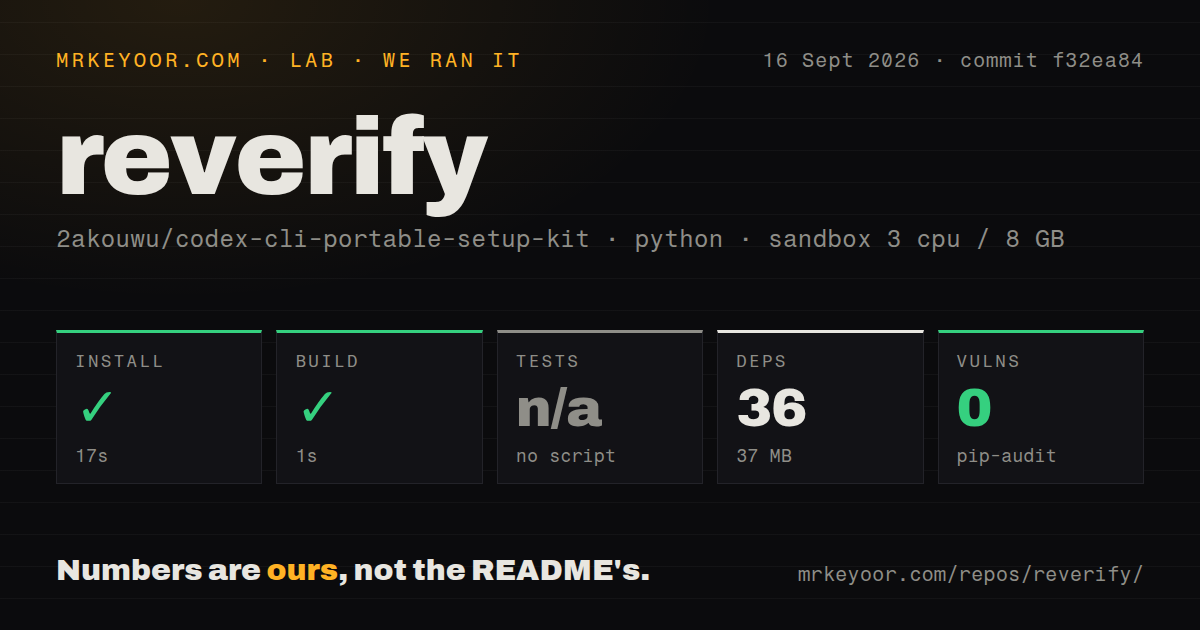
Lab card: what happened when we ran reverifyScreenshot of reverify (github.com/2akouwu/reverify)
Install✓ · 17s36 packages · 37 MB
Build✓ · 1s
Testsn/ano test script
Known vulns0(pip-audit)
Repo109 files~17,503 lines of source · 1.5 MB · 7 CI workflows

Answers from our run

Does reverify build from source?

Dependencies installed in 17 seconds (36 packages), and the build succeeded in 1 seconds. We cloned commit f32ea84 into a clean Debian container with 3 CPUs and no project-specific setup.

Does reverify have tests you can run?

Not through a standard command: the project exposes no test script or target that our harness could run.

Does reverify have known vulnerabilities in its dependencies?

pip-audit found none in the dependency tree at the time of our run.

Who should not use reverify?

Anyone who needs every VERIFIED result to be informative on current main: open issue 22 shows empty and all-wildcard claims receiving that verdict with positive weight.

What are the alternatives to reverify?

Ghidra, angr, Rizin. Our Reverify run installed 36 packages in 17 seconds, built in 1 second, and reported 0 known vulnerabilities, but it skipped tests because no target was discovered.

Setup4/517-second base install; optional engines and rollover add work
Docs5/5Detailed CLI, MCP, benchmark, rollover, and security documentation
Community4/51,240 stars, 240 forks, and active issue work after the last push
Maturity2/5Alpha package with a skipped lab suite and an open verifier defect

Who it’s for

Authorized reverse engineers who want an agent's binary claims checked against actual bytes.
Malware analysts, CTF players, and interoperability researchers working with PE, ELF, or Mach-O files.
Claude Code and Codex users who want a file-based handoff instead of a lossy context summary.
Python teams comparing a generated function with a reference implementation before accepting it.

Who it’s NOT for

Anyone who needs every VERIFIED result to be informative on current main: open issue 22 shows empty and all-wildcard claims receiving that verdict with positive weight.
Teams expecting a hands-off agent to solve loosely worded goals: issue 14 shows the orchestrator falling back to raw byte guesses and failing to finish an open-ended import goal.
Claude Code or Codex users who launch sessions normally and expect automatic replacement: the README says their hooks can write a handoff but cannot end the old session without the Reverify launcher or a configured successor.
Anyone analyzing software without permission: the security policy limits use to authorized research and explicitly excludes license bypass, malware deployment, and data theft.

Setup reality

Our sandbox installed commit f32ea84 in 17 seconds, adding 36 packages and using 37 MB. The build passed in 1 second. Pip-audit found 0 known vulnerabilities, but the harness found no test script or target, so tests were skipped rather than passed.

The base package needs Python 3.8 or newer and has no declared runtime dependencies. Capstone, Unicorn, LIEF, Z3, and angr are optional additions for deeper analysis. Core CLI and MCP checks need no model credential; agent-driven proposals can use Claude or an OpenAI-compatible endpoint and its matching credentials.

The checkout had 7 CI workflow files and no Dockerfile. reverify rollover install edits the settings of detected agent CLIs, disables their native compaction, and adds hooks, with backups and an uninstall path. Claude Code and Codex need the Reverify launcher or a successor setting for automatic fresh-session handoff.

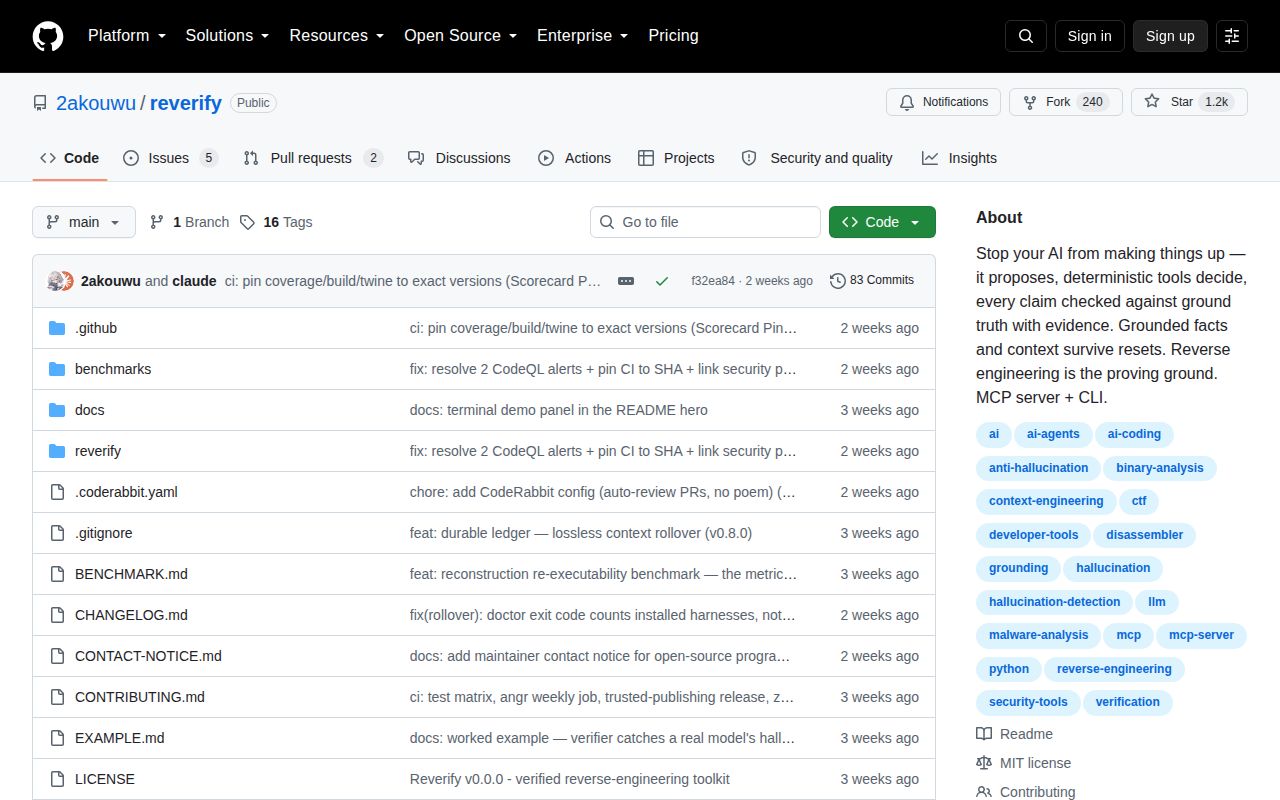
The old setup-kit URL now serves Reverify 0.11.0

GitHub returns a 301 redirect from 2akouwu/codex-cli-portable-setup-kit to 2akouwu/reverify. The current package is Reverify 0.11.0, a Python reverse-engineering and claim-checking toolkit, rather than a portable Codex CLI installer. That identity change matters if you found the project through an old link or name. The measured commit, f32ea84, is also current main, so our sandbox result applies to the code now behind the redirect.

Reverify gives an AI a constrained way to make claims about a binary or program. The model proposes a falsifiable statement, such as bytes at an offset, an imported function, a string, a disassembly sequence, or an expected register value. Deterministic code returns VERIFIED, REFUTED, or INCONCLUSIVE with observed evidence. A ledger stores accepted facts and known false claims by artifact hash so a later session can recover grounded state without trusting a prose summary.

Version 0.11.0 combines a CLI, MCP server, and optional engines

The base 0.11.0 package has no declared runtime dependencies and can parse common binary formats, scan patterns, disassemble supported instruction sets, emulate code, and compare Python or C behavior. Installing optional Capstone, Unicorn, LIEF, or Z3 backends replaces parts of the pure-Python path with mature engines. Angr is a separate extra for functions, call graphs, and cross-references. reverify backends reports which implementations are active.

The same operations are exposed through an MCP server, which makes the project usable from Claude Code, Cursor, and other MCP clients. Each verdict can include the artifact SHA-256, Reverify version, and judging engines. That receipt is more useful than a confident paragraph because another analyst can replay the claim. It still proves only the claim submitted. A narrow or empty assertion can produce a technically correct result while contributing little knowledge, which is why the open verifier defect matters.

What happened when we ran it

Our 3-CPU, 8 GB sandbox installed commit f32ea84 in 17 seconds. The install added 36 packages and occupied 37 MB, then the build succeeded in 1 second. Pip-audit found 0 known vulnerabilities. The harness discovered no test script or target, so it skipped tests. That is an absent result, not a passing suite, even though the repository contains CI and Python test modules.

We measured 109 files, about 17,503 source lines, and a 1.5 MB checkout. The repository had 7 CI workflow files and no Dockerfile. Under our test method, the package and build path are lightweight, while test behavior remains unverified by our run. We did not install the optional analysis engines, connect a model provider, feed it a private binary, or exercise rollover against a live agent session.

Open issue 22 makes some VERIFIED claims vacuous

Issue 22, opened on September 11, reproduces four assertion shapes that current main marks VERIFIED: an empty string, an all-wildcard pattern, zero expected bytes, and an empty instruction list. The report says these claims also receive positive information weight, letting a caller raise the grounded score without establishing a useful fact. Pull request 21 proposes returning INCONCLUSIVE and adds bounds protection for PE export parsing, but it had not merged when we fetched the repository.

This does not show that ordinary nonempty claims are broadly wrong. It does show that callers must validate claim shape before treating the verdict or information score as a gate. Open issue 14 exposes a second limit in the agent loop: one loosely phrased import goal led the model away from structured claim types into raw byte guesses and never finished. Pull request 19 adds guidance for those structured kinds, and it too remained open.

Rollover changes four agent configurations

Release 0.11.0 can install hooks for Claude Code, Codex, Gemini CLI, and OpenCode. It disables native compaction, writes a fixed handoff file, checks that file before issuing a receipt, and starts a clean session where the host or launcher allows it. The installer keeps backups and documents uninstall. This is a meaningful configuration change, so reverify rollover doctor belongs in setup and recovery checks.

Claude Code and Codex hooks cannot end an ordinarily launched session. Without the Reverify launcher or configured successor, the handoff can be written while the old context keeps growing. Gemini and OpenCode have different replacement paths. That uneven behavior is stated plainly in the README, but it makes the feature operational wiring rather than a universal drop-in fix for context compaction. Test the exact harness, launch mode, approval flow, and recovery path you use.

Seven open items keep this in alpha territory

GitHub showed 1,240 stars, 240 forks, and 7 combined open issues and pull requests. Main was last pushed on September 7, 2026, three days after the v0.11.0 release; new defect reports and proposed fixes continued through September 11. That is active issue work rather than abandonment. The package still labels itself alpha, and the unmerged verifier fix affects the central promise closely enough to outweigh the star count.

Reverify is worth a controlled trial if your work starts with a concrete artifact and you will read the evidence. Ghidra is the stronger choice for an analyst workbench, angr for symbolic exploration, and Rizin for a mature terminal framework. Reverify's distinct value is the claim receipt and persistent ledger around an AI agent. Keep human review in that loop until issue 22 is closed and your own nonempty, false, and malformed claims behave as expected.

Alternatives

ProjectWhat it isPick it when
Ghidra gh↗A mature reverse-engineering workbench with disassembly, decompilation, scripting, and collaborative analysis.pick this instead when a full analyst interface and decompiler matter more than an MCP claim-verification loop.
angrA Python platform for symbolic execution, control-flow recovery, and program analysis.pick this instead when path exploration and symbolic reasoning are the main job; Reverify can also use angr as an optional backend.
RizinA command-line reverse-engineering framework with analysis, debugging, and scripting tools.pick this instead when you want an established terminal toolkit without Reverify's agent ledger and rollover layer.

What people are saying

  1. [velocity-scout] 2akouwu/reverify
  2. [velocity-scout] 2akouwu/codex-cli-portable-setup-kit

Sources

  1. Original repository URL, now redirected to Reverify
  2. Reverify README
  3. Reverify v0.11.0 release
  4. Issue 22: vacuous claims marked VERIFIED
  5. Issue 14: open-ended goals miss structured claim kinds
  6. Reverify security policy

More ai tools reviews

course2md · interdimensional-game · shrimply · infinite-livestream · bkn-foundry · tokenizers · the whole board →