AgentScope combines an agent SDK with an application service
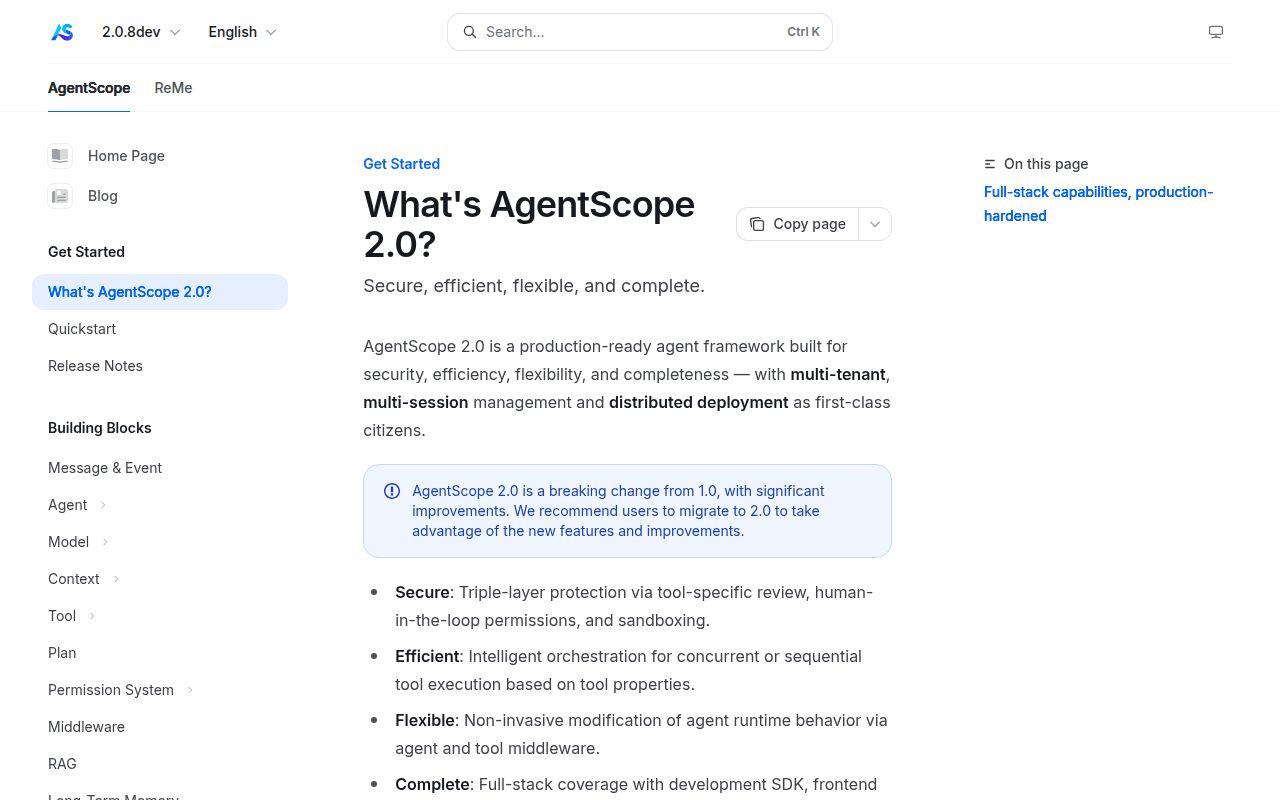
AgentScope starts with familiar pieces: a model, messages, tools, memory, and a reasoning loop. The scope quickly expands. Its service layer adds a FastAPI backend, browser interface, multi-user sessions, background work, scheduling, retrieval, and shared resources. A team can begin with a terminal agent and keep the same framework while adding an application around it. That continuity is the main reason to consider AgentScope over a narrow loop library.
The 2.0 README supports Python 3.11 or newer and lists model adapters for OpenAI, Anthropic, Gemini, DashScope, DeepSeek, Moonshot, xAI, and Ollama. Tooling includes Python functions, MCP servers, skills, shell access, file editing, and search. Context middleware can compact history and move large tool results out of the prompt. These are useful building blocks, but each one creates behavior that needs application-level tests.
Permissions and workspaces make dangerous tools less casual
The framework has permission checks, user confirmation, and a bypass mode. Its workspace choices range from local execution to Docker, Apple Container, Bubblewrap, E2B, OpenSandbox, Daytona, and Kubernetes. That matters when an agent can run a shell or edit files. A local workspace is fine for development; code from untrusted users or models belongs behind a boundary chosen for the threat model.
There is no repository Dockerfile in the 982-file checkout we measured. The README documents Docker and Kubernetes as workspace backends, which is different from shipping one container that defines the whole application. Production teams still need to package their service, select storage, manage worker processes, and decide which tools can reach the network or host filesystem.
The service handles sessions, while operators supply the infrastructure
AgentScope's service layer covers multi-tenancy, multi-session isolation, SQL and NoSQL persistence, scheduled tasks, and background execution. It also has a RAG service with blob storage and an index worker. This is enough structure to avoid writing every control-plane feature from scratch. It is also enough structure that adopting the project affects how the application stores state and runs jobs.
Version 2.0.7 was released on August 24, 2026. Its notes include fixes for session locking, index-worker cancellation, stateful MCP reconnection, stream closing, and workspace scheduling. Those fixes show the kinds of concurrency and lifecycle details the service owns. They also suggest reading release notes before every upgrade, because a service deployment touches more than the agent response loop.
What happened when we ran it
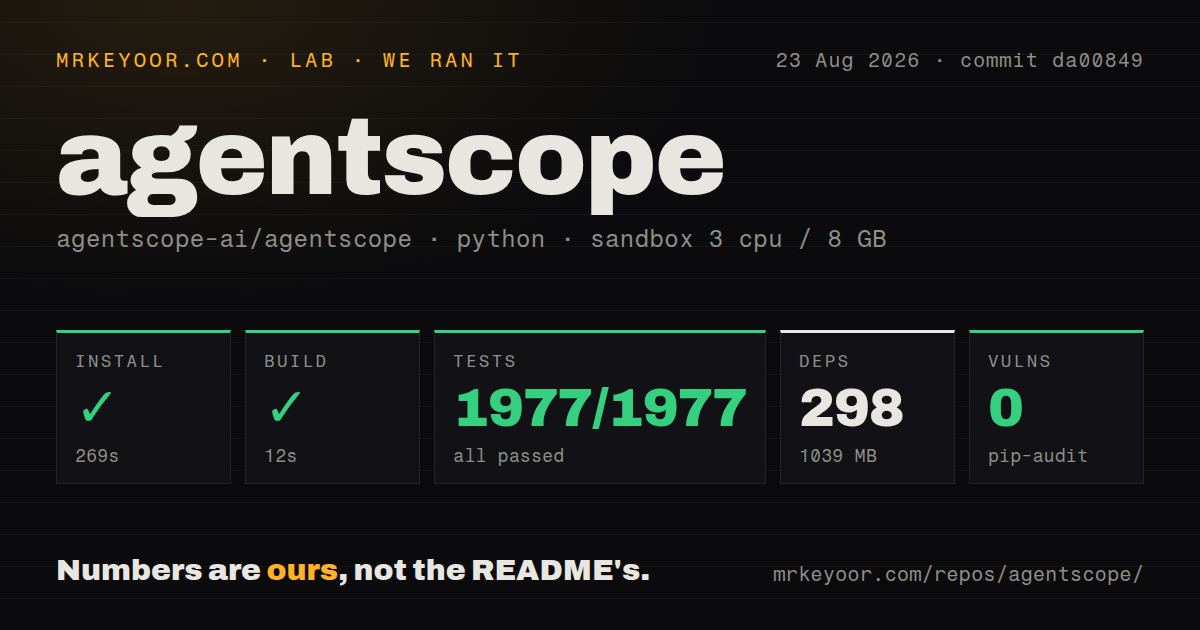
Our sandbox installed commit da00849 in 269 seconds. The source install added 298 packages and occupied 1,039 MB on disk. The build succeeded in 12 seconds, and pytest finished in 216 seconds with 1,977 passed, 0 failed, and 145 skipped. Pip-audit reported 0 known vulnerabilities in the installed environment.
Those results came from an unprivileged Debian container with 3 CPUs, 8 GB of RAM, Python 3.12, and no secrets. We did not call a hosted model, connect a database, start the Web UI, or provision a remote sandbox. The run proves that the checked-out code installs, builds, and clears its available suite in that environment. It does not measure agent accuracy, model latency, tenant isolation, or the safety of a chosen workspace.
The repository itself contained 982 files and about 223,112 lines of source in a 14.7 MB checkout. It had 9 CI workflow files and a tests directory. That test result deserves weight: 1,977 passing cases is stronger evidence than a polished quickstart. The 269-second install and 1,039 MB footprint deserve equal weight on CI runners and small development machines.
MCP and skill hubs reduce wiring but widen the trust boundary
AgentScope can connect agents to MCP servers and install skills from GitHub's MCP Registry or ClawHub. Resources can be shared at group or organization level, while workspaces can isolate execution. This gives an internal platform a central place to manage tools. It also means a bad server or skill can gain the permissions assigned to the agent, so catalog access and installation need review.
Release 2.0.7 fixed preservation of GitHub MCP environment inputs and reconnection for stateful clients. Open issue #2420 reports a separate compatibility problem: replaying reasoning data against one stateless OpenAI-compatible Responses gateway returns a 400 error. If an application relies on a non-OpenAI gateway, test multi-turn reasoning, streaming, tool calls, and reconnection with that exact provider.
Current bugs are specific enough to test before rollout
GitHub recorded a push on August 26, 2026, 29,688 stars, and 349 combined issues and pull requests when fetched. The current activity and August 24 release point to active maintenance. The combined count is not a defect count, and the open reports still give adopters a useful acceptance-test list.
Issue #2423 reports a Windows startup failure around asyncio.create_subprocess_exec. Issue #2430 reports that reply_stream() can emit no text events when a streaming model returns only a final response. Issue #2425 describes context compression aborting after a recoverable structured-output validation error. Teams using those paths should reproduce them against the current release rather than assuming a passing Linux suite covers their deployment.
Use it when the service layer saves more code than it adds
AgentScope is a serious candidate for a Python team that already knows it needs sessions, permissions, persistence, retrieval, MCP, and isolated execution. The documentation maps those parts clearly, and our 1,977-test pass gives the checked-out commit credible engineering evidence. The cost is a broad system: 298 installed packages before model-specific services, databases, and sandboxes enter the picture.
For a terminal helper or one workflow, that cost is hard to defend. For a multi-user agent product, the integrated service may replace months of glue code. Prototype the exact provider and workspace combination, budget the 1,039 MB environment, and keep provider compatibility plus Windows behavior in the release checklist.