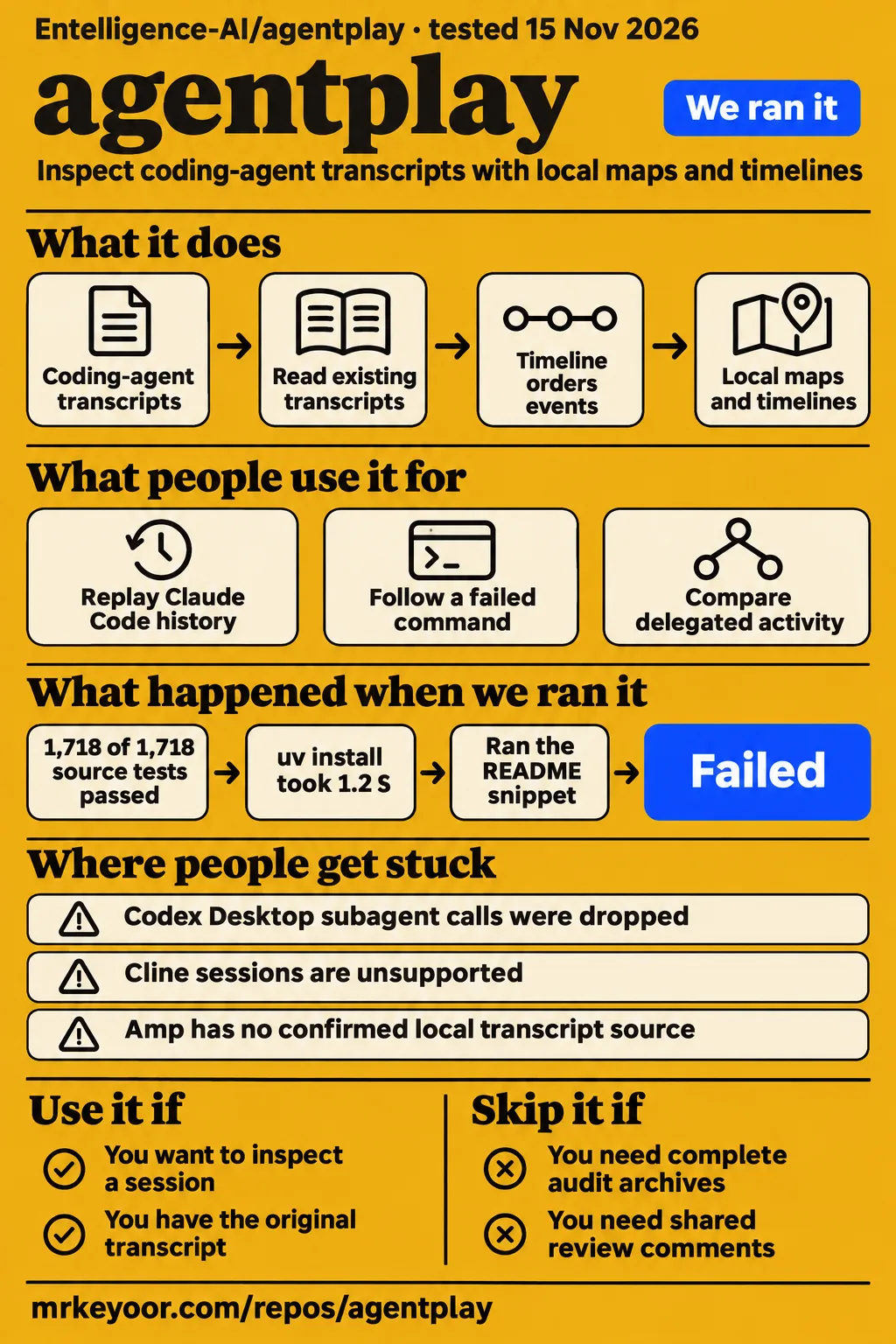
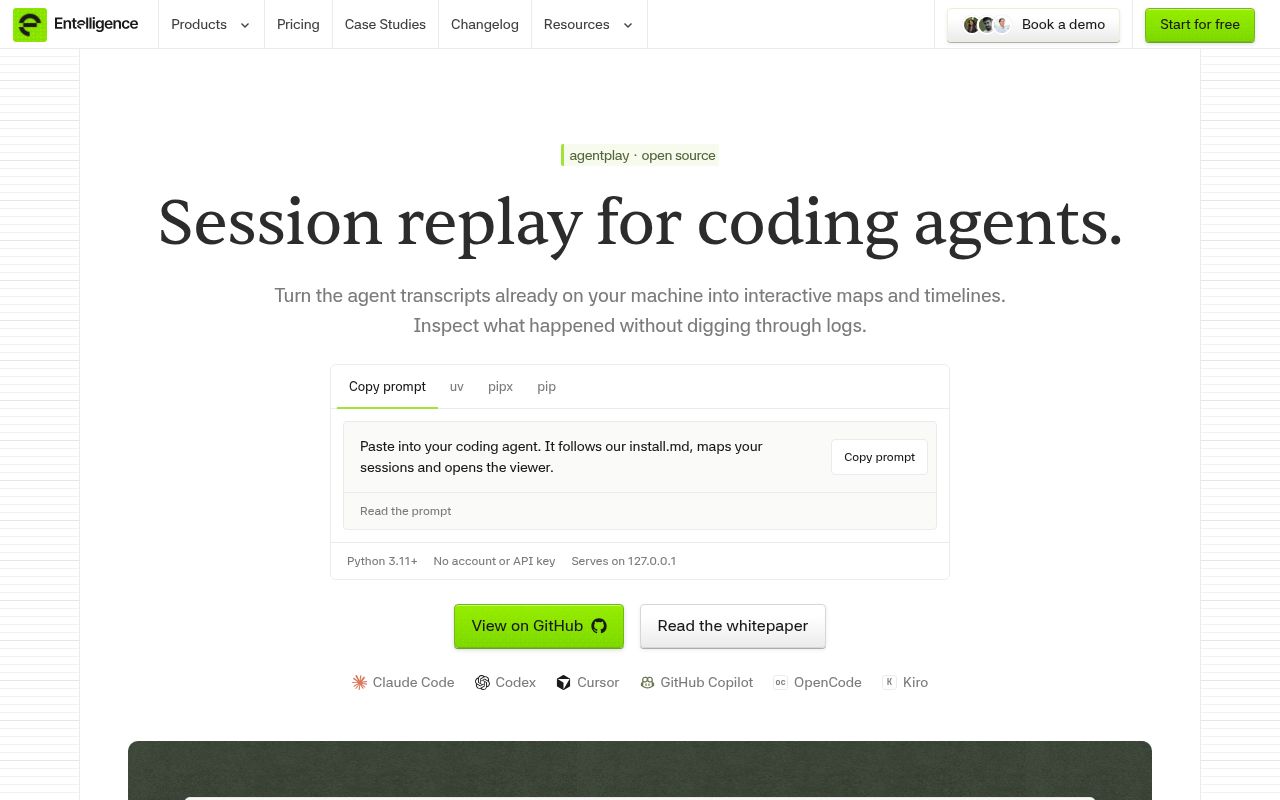
Entelligence's agentplay turns existing coding-agent transcripts into local maps and replay timelines. Our source run passed all 1,718 pytest tests. Use it to investigate recorded exploration, retries or delegation in a supported agent's history. Readers requiring complete audit archives or shared review comments should choose another workflow. The agentplay README describes the local viewer, its inputs and its separate hosted team edition.
Local replays explain the steps before an edit
Agentplay's map shows recorded files and tools, while its timeline orders exploration, edits, errors and outputs. The README documents filters for a task, model or subagent, plus shortcuts that jump to edits, errors, delays, outputs and retries. For a developer reviewing a particular change, those controls provide a way to follow the recorded sequence around a surprising edit without treating the final diff as the whole account.
Start with a session whose task and outcome you remember. The documented agentplay agents command lists detected sources; the viewer then lets you inspect a session and narrow its scope. Compare a retry or edit with its surrounding transcript events and final diff. This is a recommended evaluation task, drawn from the documented workflow and Entelligence's usage article, rather than a new task completed for this review.
Entelligence-AI/agentplay is the repository reviewed here. The supplied search evidence also contains wg5759's AgentPlay desktop workspace for links, media and documents, and AgentPlayDev's Hermes guide for a game skill named mmhk. Those are different projects. Check the owner before copying installation instructions: video editing and Hermes game commands belong to those other repositories, rather than this coding-agent replay viewer.
What people use agentplay for
The reporter of issue #49 compared Codex Desktop rollouts with their replay and reported missing activity. The supplied accounts also include a builder's explanation of the product's origin, a secondhand report about Claude Code history and a synthetic demonstration. Keeping those sources attached to their outcomes gives readers a more useful picture than presenting all four accounts as equivalent customer results.
- The reporter of Codex Desktop issue #49 reported six subagent rollouts losing 431 tool calls. They also reported dropped heading-led sessions and incorrect parent/subagent grouping. The supplied issue is closed.
- Builder adxtyahq wrote on X that the team tried LangChain, LangSmith and other tools to understand coding-agent behavior, disliked the experience and built agentplay internally.
- Koda's review describes a YouTube tester replaying their own Claude Code history and noticing sample data in the Review tab. Koda is the source for that account.
- The supplied Agentplay GitHub Explained video demonstrates the interface through a synthetic programming session in a fictional repository called acme-orders-api.
These accounts suggest two practical inspection tasks: follow the sequence around a failed command, or compare delegated activity with the source rollout files. The Codex report is especially useful because it identifies a discrepancy between recorded calls and displayed activity. The builder's account explains why the interface exists, while the synthetic walkthrough shows how its map and timeline are intended to work.
What happened when we ran it
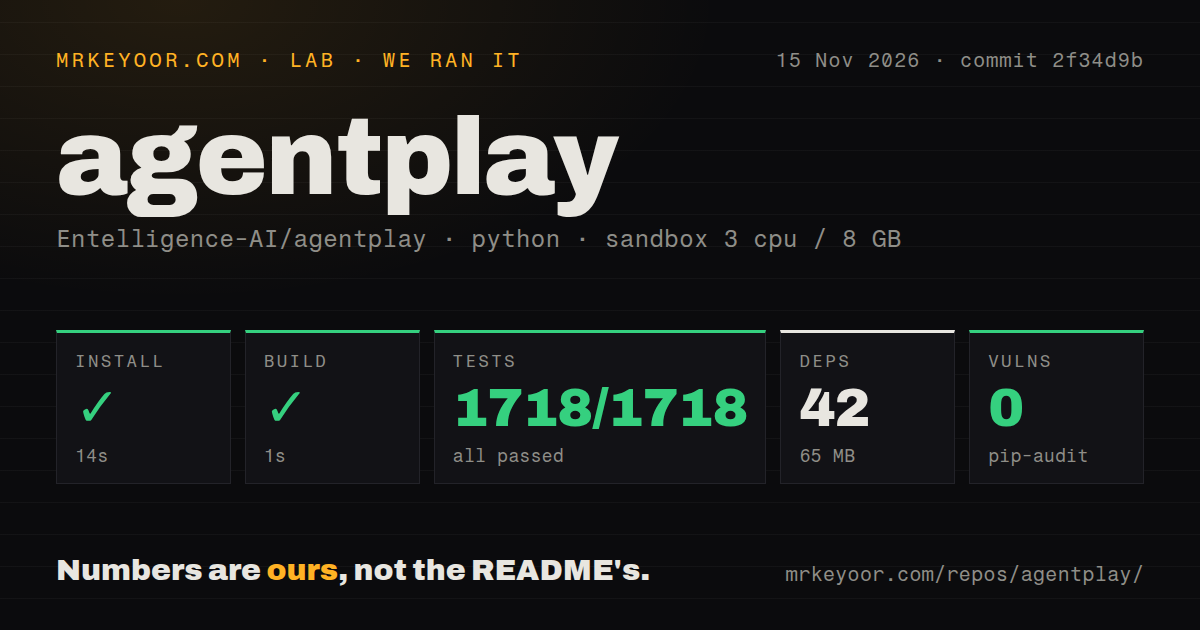
Our November 15, 2026 source run at commit 2f34d9b installed in 14 seconds, built in 1 second and passed 1,718 pytest tests in 32 seconds. The Python project lives under python/. Its recorded sandbox configuration specified 3 CPUs, 8 GB RAM and image label ghcr.io/astral-sh/uv:python3.12-bookworm. These figures describe our source checkout and its checks.
| Check in our source sandbox | Recorded result |
|---|---|
| Install | Succeeded in 14 seconds |
| Dependency record | 42 dependencies; 65 MB on disk |
| Build | Succeeded in 1 second |
| Tests | 1,718 passed, 0 failed of 1,718; 32 seconds |
| pip-audit | 0 known vulnerabilities |
| Checkout | 280 files; approximately 70,192 source lines; 3.6 MB |
| Repository signals | 2 CI workflow files; tests directory present; no Dockerfile detected |
The separate quickstart-lib run records checkout commit 2f34d9bafb44 and installation from PyPI in a fresh, unprivileged container. Its configuration specified 2 CPUs, 4 GB RAM, no published ports and no secrets. It installed agentplay 0.2.6. That package version belongs to the separate quickstart record; the source-run identity remains commit 2f34d9b.
| Separate quickstart step | Recorded result |
|---|---|
| Clone | Recipe quickstart-lib completed the step in 3 seconds |
| Install | uv pip install agentplay into a fresh virtual environment installed agentplay 0.2.6 in 1.2 seconds |
| Installed size | 2.6 MB in the virtual environment's site-packages |
| Dependency count | 0 packages besides agentplay installed |
| Python snippet | Failed: the README had no Python code block to run |
| Finding | no-snippet: the README had no Python code block to run |
| Teardown | ok |
The clone, installation, installed size and dependency count are separate observations from the source harness. The failed snippet step, no-snippet finding and successful teardown complete that record. The README's documented entry point is a shell command, so this correction preserves the failed recipe step rather than replacing it with an invented Python integration.
Where people get stuck: discovery and parser differences
The README documents agentplay agents for source discovery and environment variables for overriding transcript homes. Those are concrete starting points when an expected session is absent. The issue records then distinguish historical parser failures from feature requests and later implementation reports. Their statuses matter: an old issue body and its later comments can describe different states of the same feature.
| Reported problem | Supplied evidence | Practical next step |
|---|---|---|
| Codex Desktop calls or parent relationships missing | Issue #49 reports dropped calls and incorrect grouping; it is closed. The README documents parent folding. | Compare a known parent and its rollout files with the replay. |
| Home and End appear unsupported | Issue #28 has a later contributor report that merged PR #41 added both shortcuts, accessibility text and modifier-key coverage. | Read the later implementation comment. |
| Weekly totals require manual aggregation | Issue #63 is closed; the README documents stats, time filters and JSON output. | Use the documented stats command for index summaries. |
| Ranking sessions by cost is awkward | Issue #64 describes JSON and jq; the current README separately documents sorting before limiting. | Follow the current list sorting reference. |
| Gemini CLI is missing from an older list | Issue #21 is closed; the README lists its parser and transcript location. | Check source detection and the Gemini home setting. |
Issue #49 describes a subagent rollout containing agent messages and tool calls but no user-role message, with the generated session recording zero calls. That historical report explains why a sparse map could give a misleading account of delegated work. The current README says Codex Desktop subagent rollouts are folded into their parent session. Together, those records identify the specific behavior to compare against an original history.
Agent support gives different levels of detail
The README documents subagent lanes for Claude Code and Codex, while the other listed sources use a main lane only. Claude Code also includes hooks, compactions, stop reasons and latency. These are source-specific capabilities: someone investigating delegation should read the support table's lane and field descriptions rather than choose solely from the number of supported agent names.
The listed sources include Cursor, GitHub Copilot CLI and VS Code, OpenCode, Kiro, Gemini CLI, Antigravity CLI, Command Code and Goose. Their storage formats include JSONL, SQLite and other local stores. The README describes local, read-only copying and decoding for database-backed sources, and provides configurable locations. Its support table is the direct reference for matching a particular history to the parser that reads it.
Privacy depends on what you keep and what you share
The README separates exported maps, local index labels and optional email metadata into different data surfaces. Maps contain structural session information, including repository identity, relative paths, tools, models, timings and error classes. Local titles can use Claude Code's own title or the first 90 characters of a prompt. Optional signup sends an email address, event, random install identifier, version and time.
The documented sharing workflow writes a map with agentplay export and accepts it through agentplay import or a file dropped onto the replay page. The README recommends rebuilding public artifacts with --path-mode dirs_only and describes removing sensitive remotes. For local labels, --no-titles clears stored titles for sessions seen during that run. These controls act on different data, so select them according to the artifact or local display you are preparing.
agentplay vs claude-replay, CASS and Spotlight
Koda positions claude-replay for embeddable HTML, CASS for historical search and Spotlight for written session reports. The following table preserves those attributed recommendations. Agentplay's own README describes its map export/import workflow and places shared review comments in a separate hosted edition. That gives readers a workflow comparison without presenting the alternatives as products measured by our source harness.
| Alternative | Koda's description or the README's distinction | Consider it when |
|---|---|---|
| claude-replay | Koda describes self-contained, embeddable HTML replays. | A replay needs to live on a page or in documentation. |
| Coding Agent Session Search (CASS) | Koda describes terminal-based search across coding-agent histories. | Finding an old conversation is the main task. |
| Spotlight by Backplanes | Koda describes written reports for Claude Code and Codex. | Recurring written reports suit the workflow. |
| Entelligence hosted team edition | The README places trace-linked review comments and cross-engineer views here. | Shared review is the requirement. |
Koda's alternatives section supplies the first three descriptions. The agentplay README supplies the hosted-edition distinction. Agentplay's export/import route fits a handoff built around a particular structural replay file. Historical search, a recurring report and shared comments represent different tasks, so decide which output a colleague actually needs before selecting a viewer.
What the other reviews get wrong
The packaged tool requires Python 3.11 or newer; Node 22+ and pnpm belong to viewer development. An X post by kumard_3 presents Python and Node together, while the README separates packaged use from source development. Its documented packaged launch command is uvx agentplay@latest. That command selects the newest release rather than pinning the source commit measured here.
The later comment in Home and End issue #28 reports the shortcuts already implemented through merged PR #41. Reading only its original complaint would miss that update. Other promotional claims require the documented boundaries collected in the final section: the landing page's no-upload wording, promotion promising every call and subagent, and reassurance about sharing maps each need their accompanying data or coverage details.
Recent activity is clearer than release labels
The November 15, 2026 metadata snapshot records 369 stars, 24 open issues and pull requests combined, and a last push on November 11, 2026. Those are dated repository facts from the GitHub repository API. They describe attention and recent activity alongside the sampled parser, aggregation and shortcut work. The source harness separately identifies the checkout used for its passing Python checks.
Repository activity and issue implementation reports answer different adoption questions. A recent push dates repository changes; a contributor's comment can identify a particular merged feature; the README describes the current documented interface. Keep those observations separate when deciding whether a required parser or shortcut exists. Star counts are an attention signal, and the review's score notes therefore leave community adoption and support responsiveness unassessed.
Questions people ask
Agentplay is Entelligence's local coding-agent replay viewer, hosted at Entelligence-AI/agentplay. It reads existing transcripts and presents maps and timelines. The questions below come from the supplied synthesis and search intents, including project identity, local inspection, agent support and sharing. The README's installation and command reference answers the setup questions; the research records identify the other recurring questions.
What is agentplay, and which GitHub repository is the Entelligence project?
Entelligence-AI/agentplay is the repository for this map-and-timeline viewer, maintained under Apache License 2.0. The owner name distinguishes it from the supplied desktop-media workspace and Hermes game project. Use that full repository identity when searching for installation instructions or comparing capabilities. The agentplay README and license information identify the product reviewed here and explain its transcript-based workflow.
What did my coding agent actually do before producing its final change?
Agentplay displays recorded exploration, edits, commands, errors and retries in a map and timeline. The README documents task, model and subagent scopes, plus shortcuts for moving to particular event types. Entelligence's walkthrough describes this inspection use. A useful starting point is one surprising edit: follow its preceding events, then compare that sequence with the source transcript and final diff.
How can I audit coding-agent sessions locally?
The README documents uvx agentplay@latest with Python 3.11 or newer, without an account or API key. It also lists pipx run agentplay and pip install agentplay as packaged options. Run agentplay agents to list detected sources and use the documented home variables when transcripts live elsewhere. These are documented setup commands, rather than additional commands executed for this correction.
Which coding agents can agentplay read?
The README lists Claude Code, Codex, Cursor, GitHub Copilot CLI and VS Code, OpenCode, Kiro, Gemini CLI, Antigravity CLI, Command Code and Goose. Its table specifies source locations, subagent lanes and token fields for each. Consult that agent support table for the particular history you want to inspect, then use source discovery to see which locations the tool found locally.
How do I share a session with a teammate?
The README documents agentplay export for writing a map file and agentplay import for adding a received map to a local store. The recipient can also drop the file onto the replay page. The sharing instructions describe those recipient options, while the privacy section documents path modes and map contents. Inspect the resulting artifact before sending it, using the boundaries below.
What we have not tested yet
The supplied metadata does not establish the latest GitHub release status. Its null latest-release value is compatible with a failed lookup, so this review makes no claim about an endpoint response or the existence of a latest release object. The measured source identity is commit 2f34d9b; the separate PyPI quickstart installed 0.2.6. Neither record identifies the package version selected by a future @latest command.
Our source checks cover installation, build, pytest and the recorded dependency audit. They do not establish replay completeness, real-history viewer performance, privacy behavior or productivity gains. The separate quickstart stopped at a missing Python snippet and records no viewer crash or completed inspection task. The image label supplies no actual runtime or operating-system version. Windows, WSL, network traffic, deletion failure and the hosted edition received no hands-on evaluation in these records.
The historical Codex omissions remain attributed to issue #49; closure and current parent-folding documentation do not replace a regression replay of its fixtures. Koda's tester account is secondhand, the supplied video is synthetic, and the Review tab account concerns sample data. The builder's dissatisfaction with LangChain and LangSmith supplies no measured comparison. The evidence supplies no direct Reddit extracts, demonstrated gains in review speed or code quality, or matched-transcript tests of the alternatives.
Documented coverage boundaries also matter. Maps truncate at 20,000 events and transcripts over 512 MB are skipped. Antigravity's model is not recorded, and Goose skips hidden and subagent sessions. Whole-file writes can leave creation versus modification ambiguous. Cursor has no locally recorded billed usage, Kiro uses credits, and list-price estimates omit plan, enterprise and batch pricing. These documented limits qualify promotion promising an entire session and every call.
The supplied Cline, Roo Code, Aider, Windsurf and Amp parser requests remain open. Cline #23, Roo Code #24 and Aider #22 describe requested parsers; Aider discovery needs per-repository histories. Windsurf #26 requires establishing whether local data is readable. Amp #25 has no confirmed local transcript source. Assignment alone supplies no shipped parser evidence.
Exported maps omit prompt text, assistant responses, file contents and tool inputs or outputs, but retain repository names and remotes in every path mode. Local prompt-derived titles are separate, and --no-titles is per run rather than a saved preference. Optional email submission qualifies blanket no-upload wording; it sends signup metadata rather than session data. Disconnect sends one deletion request without retry, so failed delivery can leave an email on the remote list.
AGENTPLAY_NO_NETWORK and DO_NOT_TRACK disable optional signup, rather than guaranteeing isolation from every possible network interaction. The vendor article states that distinction explicitly. The hosted edition's price is absent from the supplied evidence, and shared review comments belong to that separate product. Keep the original transcript when assessing a disputed change: the map is a structural replay whose contents and coverage differ from the source history.