Agent of Empires manages agents; it does not provide one
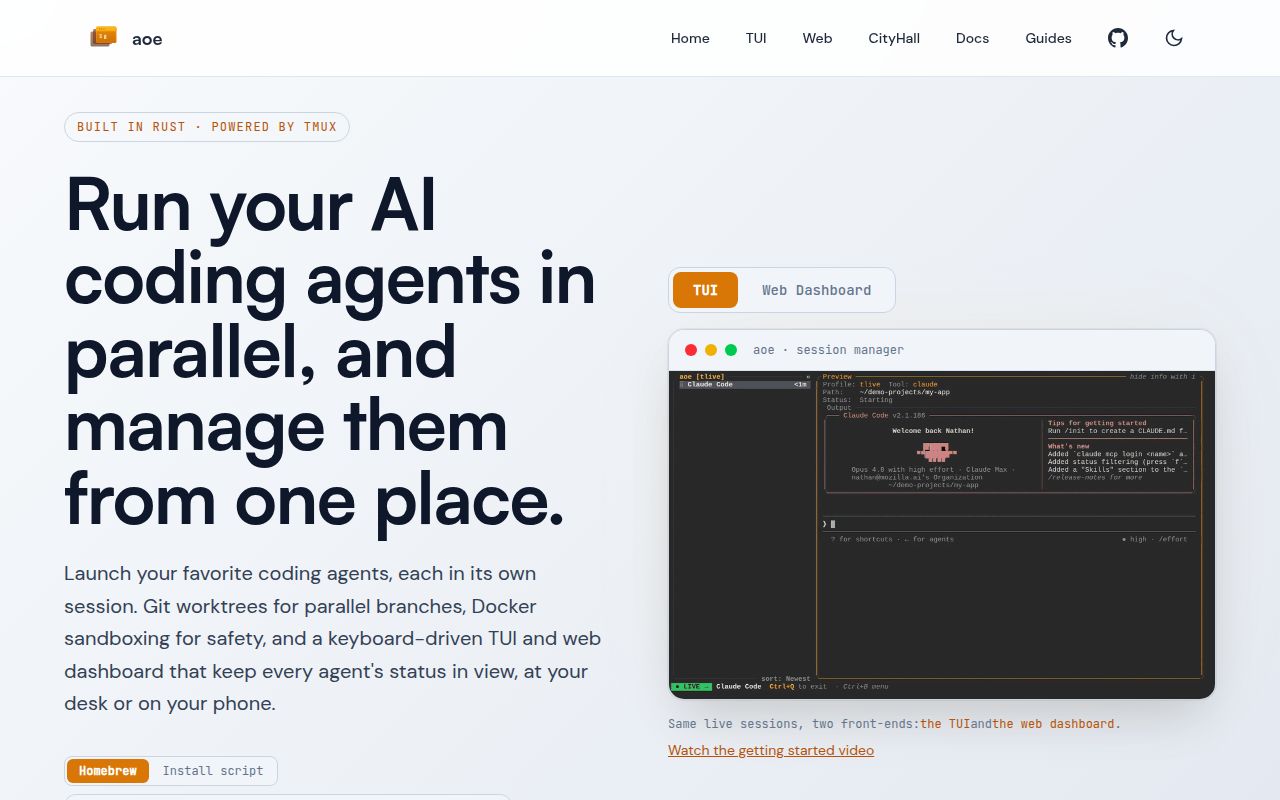
Agent of Empires, or AoE, sits above coding tools that are already installed. The README lists Claude Code, OpenCode, Codex CLI, Gemini CLI, Oh My Pi, Copilot CLI, and several others. Each runs in its own tmux session. AoE adds a status dashboard, session creation, worktrees, optional containers, diff review, notifications, and browser access. Your chosen agent still supplies the model connection, tools, permissions, and bill.
This solves a recognizable coordination problem. Five terminal tabs do not tell you which agent is waiting for approval, which stopped, or which branch contains a finished change. AoE keeps sessions alive after its own interface closes and presents running, waiting, idle, and error states together. Version 1.15.0 also has a structured mobile view through Agent Client Protocol, while raw terminal rendering remains available when an adapter cannot express the full session.
tmux persistence is the feature and the dependency
Every managed agent lives in tmux, so closing AoE, losing SSH, or crashing a terminal does not kill the underlying job. You can reopen the dashboard or attach with tmux directly. That design is understandable and recoverable. It also means AoE inherits tmux's platform limits and naming details. Native Windows is unsupported; the FAQ requires WSL2 because session and process handling assume a POSIX environment.
The basic installation is a downloaded binary, Homebrew formula, Nix command, or Cargo build. Tmux is mandatory. Docker is optional for sandboxing, and the README also names Podman and Apple Containers. At least one agent CLI must be installed and authenticated. AoE auto-detects supported tools, but it cannot make a missing Claude Code subscription or Codex login appear. Budget both the session manager and every agent it launches.
What happened when we ran it
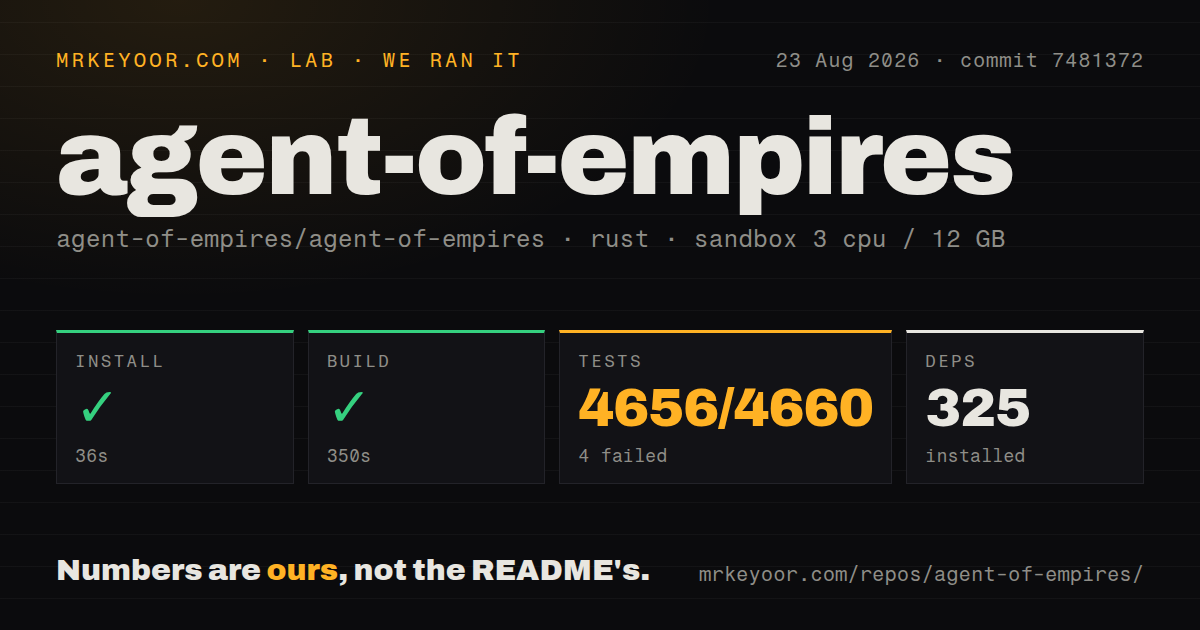
Our Rust install at commit 7481372 completed in 36 seconds and fetched 325 packages. The release build succeeded in 350 seconds inside an unprivileged Debian container with 3 CPUs and 12 GB of RAM. The repository contained 1,644 files and about 583,516 lines of source. This was a substantial compile, yet it reached a usable build without secrets or a running agent service.
Cargo tests ran for 772 seconds and exited 101. The suite reported 4,656 passing tests, 4 failures, and 2 ignored out of 4,660. One failure printed a warning that tmux list-panes could not start because the executable did not exist. Its assertion then received 0 status rows instead of 1. Since tmux is an explicit prerequisite, this is a useful environment finding rather than a surprise.
The other failures were cli_capture_drains_a_queued_correction_before_returning, apply_status_update_propagates_live_status_baseline_from_poller, and poll_statuses_once_never_emits_idle_intent_keep. The supplied tail gives their names but no assertion details. We cannot say whether installing tmux would fix them. A contributor should reproduce the suite in the documented development environment and treat those three as unresolved until the full logs say more.
Worktrees and containers reduce different risks
Git worktrees keep concurrent edits on separate branches. That prevents two agents from writing the same checkout, but it does not limit what either agent can access. Container sandboxing provides the stronger boundary for commands, files, and processes. The README says auth volumes can be shared into sandboxes, which is convenient and sensitive. Review exactly which credential directories are mounted before giving an autonomous session a broad task.
AoE also supports multi-repository workspaces and per-repository base branches. Those features help when a change spans an API and client, yet they increase the number of working trees an agent can mutate. Version 1.15.0 added bounded worktree mutation and container control commands according to its release notes. Keep human diff review in the loop, especially for deletes, rebases, and generated migrations.
Remote access needs a deliberate network boundary
The browser dashboard can create sessions, send input, show terminal output, and review diffs. Pressing R can expose it for phone access through Tailscale Funnel or Cloudflare Tunnel, with QR and passphrase authentication. That is more useful than mobile SSH for quick approvals. It also turns a local control surface into a network service that can steer coding agents, so tunnel identity, passphrase handling, and device access deserve the same care as repository credentials.
The web UI still has ordinary rough edges. Issue 3322 says terminal view on 1.14.0 opens at the top of scrollback instead of current output. Version 1.15.0 added several mobile and web fixes, including sending comments to dormant sessions and preserving state during steered prompts. Current activity is high: the repository was pushed on 2026-08-25 and had 147 open issues and pull requests.
Session identity bugs matter more than cosmetic defects
A session manager must attach the correct conversation to the correct pane. Issue 3516 describes a most-recent-by-working-directory fallback that can cross-assign conversations when several sessions share a directory. Claude received a targeted fix, while the report names OpenCode, Vibe, host Codex, Gemini, Pi, Hermes, Copilot, and Kimi paths that require their own decisions. Until resolved, avoid mass recovery of same-directory sessions without checking identities.
International session names have a separate regression. Issue 3536 reports that version 1.15.0 substitutes the display width of CJK characters when rebuilding an attach target. Tmux keeps the real session alive, but AoE cannot capture or attach it. ASCII-only titles are the documented workaround in that report. This is narrow, reproducible, and significant for a worldwide team.
AoE is worth installing once multiple persistent agents and branches demand a control room. Its 4,656 passing tests and successful build show serious engineering behind the dashboard. The remaining decision is operational: tmux, credentials, worktrees, containers, and remote access all stay under your ownership. If named tmux sessions already feel sufficient, Agent Deck or plain tmux will impose less machinery.