More than 230 roles are offered as instruction files
Agency Agents packages specialist personas as Markdown and converts them for a long list of coding assistants. The README lists more than 230 roles across engineering, design, testing, security, marketing, product work, project management, and other business functions. Each file is meant to define an identity, mission, workflow, deliverables, success measures, and communication style. The repository supplies prompts and conversion scripts; the host assistant still supplies the model, tools, context, and permissions.
That distinction determines whether the project helps. A named code reviewer can remind a model to inspect security and maintainability, but the file does not grant repository access or prove the review was correct. A frontend persona may provide a useful checklist while still producing weak code. Agency Agents is best treated as editable process material whose output is evaluated like any other AI-assisted work.
What happened when we ran it
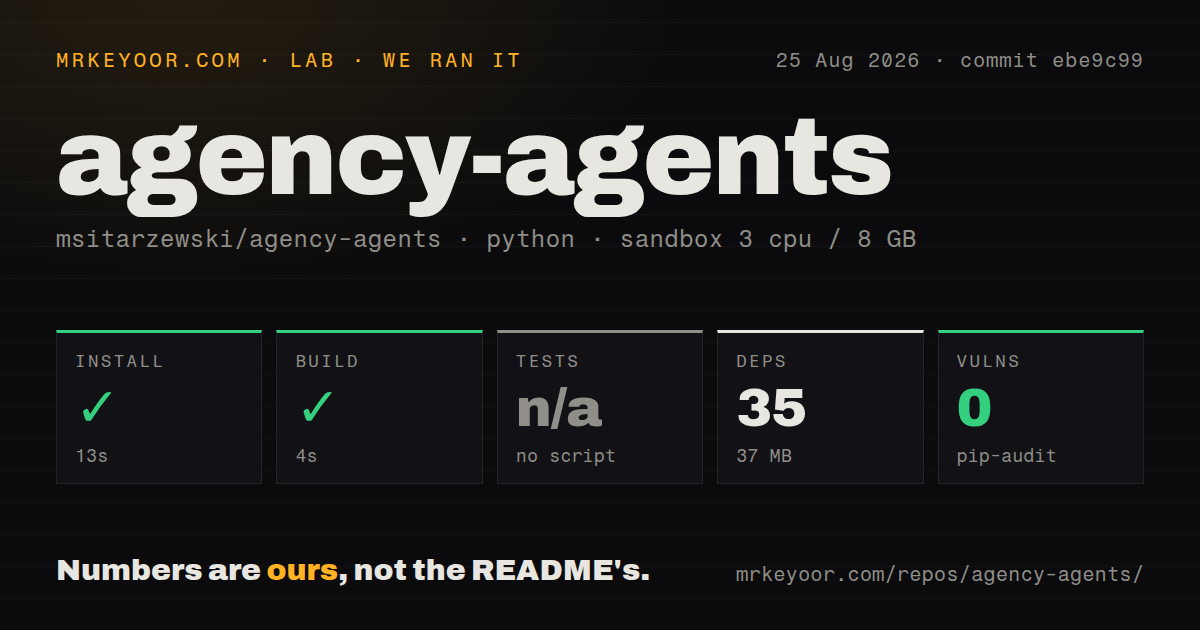
Our run cloned commit ebe9c99 into an unprivileged Python 3.12 Bookworm container with 3 CPUs, 8 GB of RAM, and no secrets. The checkout contained 343 files, about 3,654 lines of source, and occupied 4.4 MB. Installation completed in 13 seconds with 35 packages and used 37 MB on disk. The available build step succeeded in 4 seconds.
There was no test script or target, so our sandbox skipped tests. This is different from a passing test suite: we have no measured behavioral check showing that conversion preserves every field or that installed agents behave consistently across clients. pip-audit found 0 known vulnerabilities in the installed Python environment, which is useful dependency evidence but says nothing about prompt quality.
The repository has 4 CI workflow files, no Dockerfile, and no tests directory. Its 17 seconds of install plus build time makes a local inspection cheap. Before writing to any agent directory, run the documented listing or dry-run paths, inspect generated files, and keep the selected output in version control. A prompt update can change behavior even when every script exits successfully.
Claude Code is native, while Codex needs conversion
Claude Code consumes the repository's Markdown agents directly under its agent directory. Codex uses generated TOML custom agents. Other targets include GitHub Copilot, Gemini CLI, OpenCode, Cursor, Aider, Windsurf, Qwen Code, Kimi Code, OpenClaw, Osaurus, and Hermes, each with its own output location or format. The scripts centralize that translation so users do not have to recreate 14 client layouts by hand.
The installer supports interactive selection by tool, division, or individual agent, plus noninteractive and parallel modes. Those filters are more useful than the install-everything path. A codebase rarely benefits from hundreds of overlapping roles competing for names and context. Start with one reviewer and one domain specialist, read their files, then add another only when it fills a clear gap.
OpenCode drops agents beyond roughly 119
The README records a concrete compatibility problem: OpenCode currently registers only about 119 agents and silently drops the rest because of an upstream bug. Agency Agents recommends selecting divisions to stay below that limit and says the installer warns when a selection is too large. This is exactly why the broad client list should not be read as identical support across every host.
Other clients have different instruction formats and discovery behavior. A conversion can preserve text while losing assumptions about activation, tool access, or file scope. Test a small task after installation and confirm which agent actually ran. For team use, pin the repository commit and review generated diffs instead of letting personal configurations update independently.
Prompt specificity helps until the role overreaches
Many files go beyond a one-line request to act as an expert. They specify workflows, output artifacts, checks, examples, and completion conditions. That structure can improve repeatability because the model receives a concrete job and a definition of done. The roster also makes useful roles discoverable, such as an accessibility auditor, incident responder, database reliability engineer, or evidence collector.
Some README language claims production readiness and proven outcomes, but a prompt file cannot establish either on its own. The repository's missing test target leaves those claims for users to assess through evaluations in their own host model and codebase. Watch for instructions that assume authority the assistant does not have, default to unnecessary output, or prescribe outdated technology. Remove those lines rather than preserving the persona for its own sake.
The app is a separate product and release path
The README promotes a native Agency Agents application for macOS, Linux, and Windows that browses the roster, installs agents, and updates them. That application lives in the separate msitarzewski/agency-agents-app repository. The collection reviewed here has no GitHub release returned by the latest-release endpoint, so there is no tagged package version to cite for this repository itself.
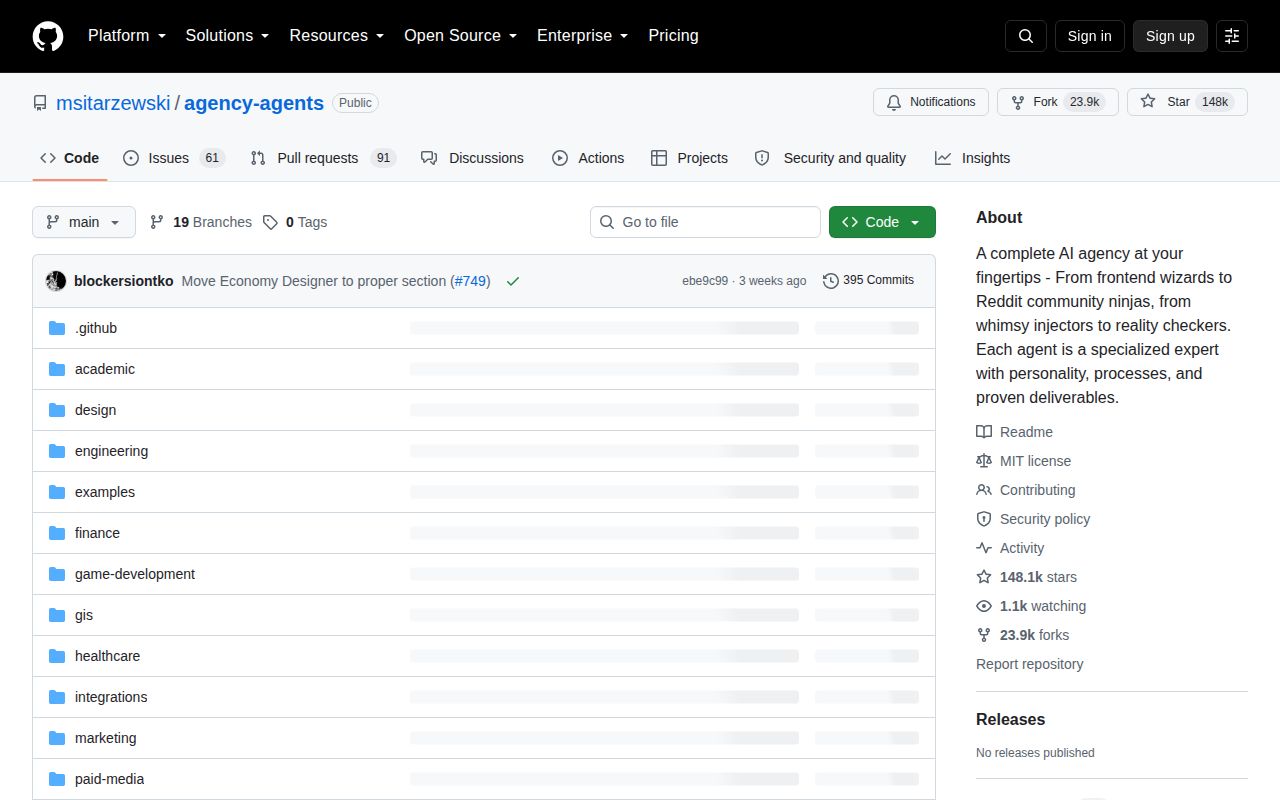
GitHub showed 148,053 stars, 152 open issues and pull requests combined, and a last push on August 6, 2026. Those are strong attention and activity signals. They do not substitute for prompt evaluations, especially when supported clients can change their configuration formats. Track the collection and the desktop app as separate dependencies with separate review decisions.
Agency Agents is a useful catalog for teams that already understand their assistant and want better starting instructions. Our 4-second build and 0 known dependency vulnerabilities make inspection inexpensive, but the absent test target limits what the automation proves. Pick a small set, edit it to match real authority and standards, pin the files, and evaluate outputs on representative work.