About 16 event types replace per-framework UI adapters
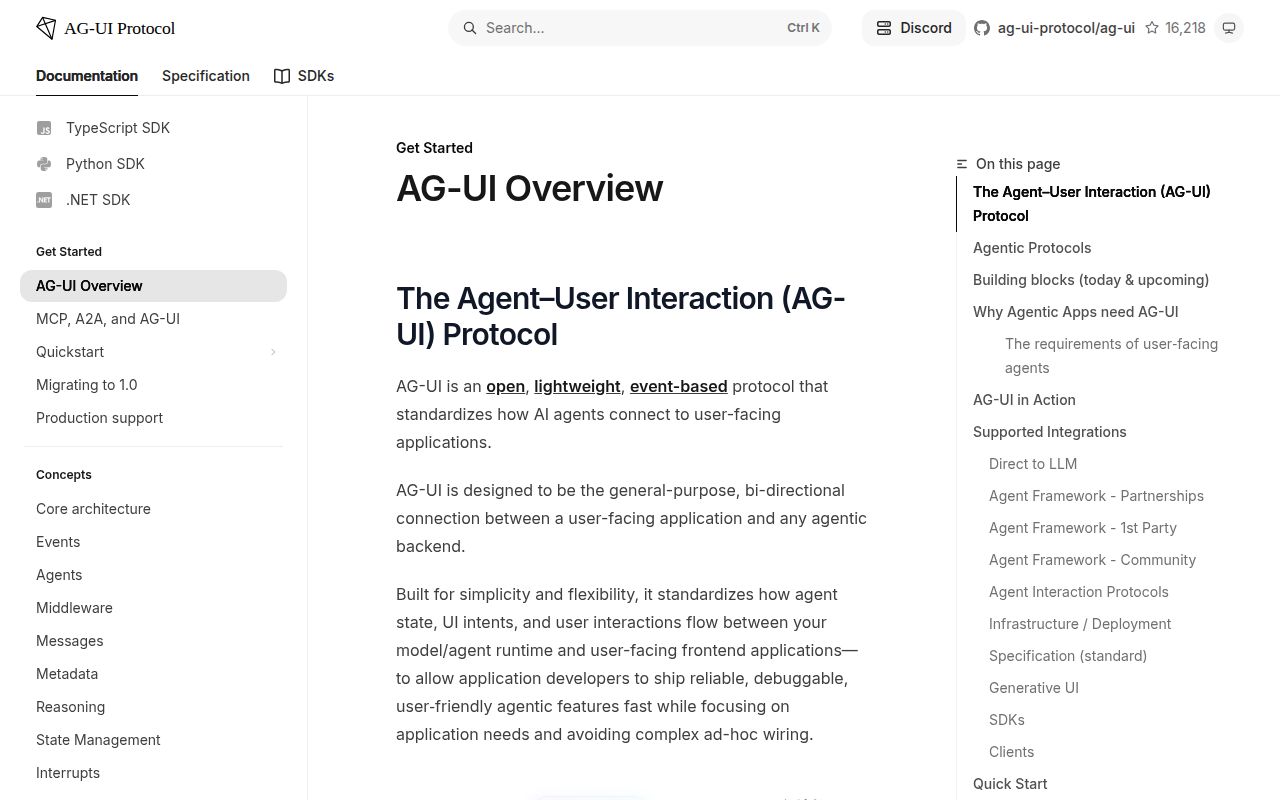
AG-UI defines the traffic between an agent backend and a user-facing application. The README describes about 16 standard event types for streamed chat, shared state, frontend tools, structured messages, and human approval. A backend can use SSE, WebSockets, webhooks, or another transport as long as its messages match the protocol. There is also a reference HTTP implementation and a default connector.
AG-UI does not supply the agent or the model. It gives LangGraph, CrewAI, Google ADK, Mastra, Pydantic AI, and other supported backends a common way to talk to an interface. The value appears when one frontend must survive a backend change, or when several agent runtimes need the same rendering and tool behavior.
The repository is much larger than the core package
The TypeScript core package was version 1.0.1 when we checked it, with Zod as a peer dependency. Around it sits an Nx and pnpm workspace with SDKs, middleware, the Dojo app, a specification, and community bindings for Go, Java, Kotlin, Rust, Ruby, C++, Dart, and .NET. A user of one published package does not operate every part. A contributor sees all of it.
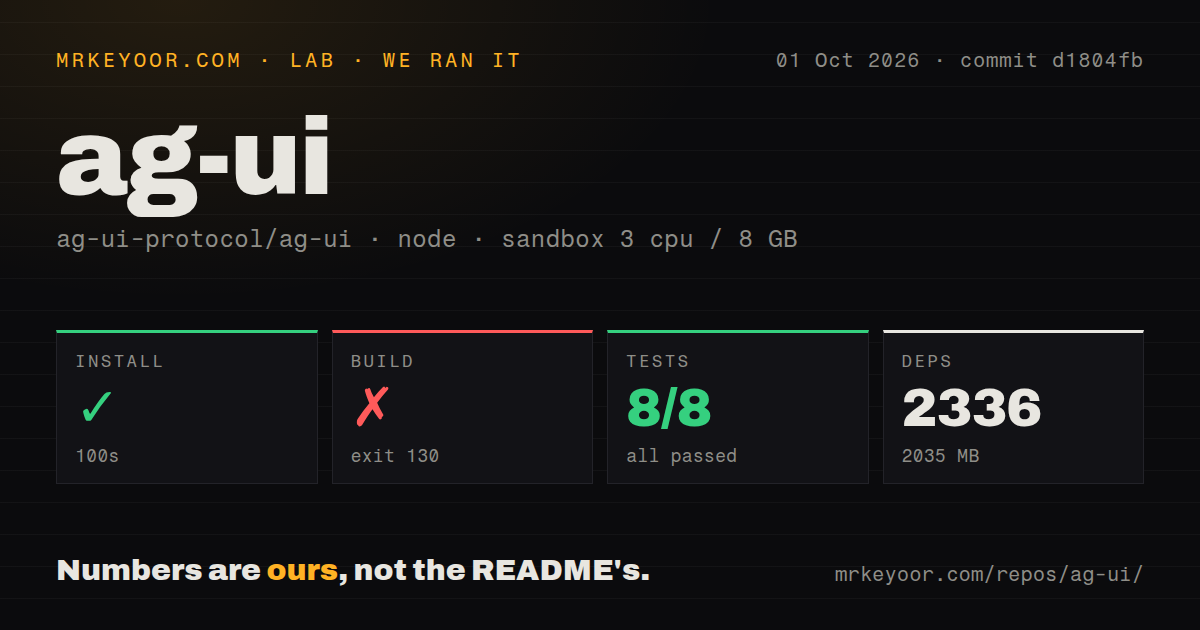
The checkout had 4,394 files, roughly 851,223 lines of source, and occupied 67.4 MB before dependencies. Installation expanded it to 2,035 MB. Node 22 is pinned in .node-version, while package.json pins pnpm 10.33.4 and lists Node 18 as the repository install floor. The guide explains that the root range is not a consumer policy for every package.
What happened when we ran it
Our sandbox installed commit d1804fb in 100 seconds. pnpm added 2,336 packages inside a fresh unprivileged Debian container with 3 CPUs, 8 GB of RAM, Node 22, and no secrets. Installation succeeded. The root build exited 130 after 12 seconds, and its tail listed create-ag-ui-app, @ag-ui/core, and @ag-ui/a2ui-toolkit as failed tasks.
The test command also exited 130 after 13 seconds. Its visible Node summary reported 8 passed and 0 failed. Those checks covered package archives, SPDX metadata, license files, notices, package identity, Apache packages, and proprietary packages. pnpm still marked the command failed. The excerpt does not identify which workspace task caused exit 130, so claiming a failed assertion would go beyond the log.
We did not start an agent, connect a frontend, or send a live model request. The result establishes that the top-level commands did not provide a clean verification path at d1804fb in our container. Build the exact SDK and adapter you plan to ship, then run its conformance and interaction tests.
Integration bugs can strand an agent turn
Open issue 2856 describes Google ADK middleware dropping the second of two same-name client tool calls under Gemini SSE streaming. The report says the missing call leaves an unanswered function call, causing later turns to be rejected. It includes a deterministic reproduction and names ag-ui-adk 0.7.0. This is evidence about one adapter path, not every AG-UI integration.
Issue 2924 covers a different edge in the Claude Agent SDK Python adapter. A display-only frontend tool can pass an empty result onward as a blank prompt. The report traces the source path and says no live provider rejection was reproduced. Both reports explain why a protocol badge cannot replace scenario tests for parallel tools, approval, cancellation, and empty results.
Community SDKs come with community ownership
The contributing guide says community integrations and SDKs are maintained by the people who contributed them. A Go or Ruby binding should be judged on its own code owners, releases, conformance coverage, and issue response. The main repository gives these projects a shared home, not identical staffing.
Adding an integration is substantial work. The guide requires a language implementation, TypeScript client, Dojo registration, port wiring, run scripts, end-to-end tests for every advertised feature, and CI configuration. External pull requests do not run those tests by default. Maintainers open an internal PR to trigger CI, so contributors need coordination before a large change.
MCP and A2A solve different connections
The README places AG-UI beside two protocols. MCP connects an agent to tools. A2A connects agents to other agents. AG-UI connects an agent to a person through an application. A product can use all three because each joins a different pair of systems. MCP is the better pick only when tools and resources are the missing connection.
Vercel's AI SDK is simpler for a TypeScript-only product, while CopilotKit supplies application components built around AG-UI. The protocol earns its complexity when backend portability matters. Our 2,336-package install and two exit-130 commands argue against adopting the entire repository by default. Start with one SDK, one adapter, and the interaction cases users cannot afford to lose.
October 2 activity shows fast development, not settled adapters
GitHub showed 16,218 stars, 455 open issues and pull requests, and a last push on October 2, 2026. The October 1 release published @ag-ui/adk-js 0.0.1, while the TypeScript core was 1.0.1. The repository also contains a 1.1 draft. Different parts are moving at different speeds.
That pace helps when your chosen framework has active maintainers. It also calls for pinned versions and adapter-specific release checks. AG-UI is a credible common language for agent interfaces, but approval should come only after the selected client, backend adapter, and failure cases pass together.