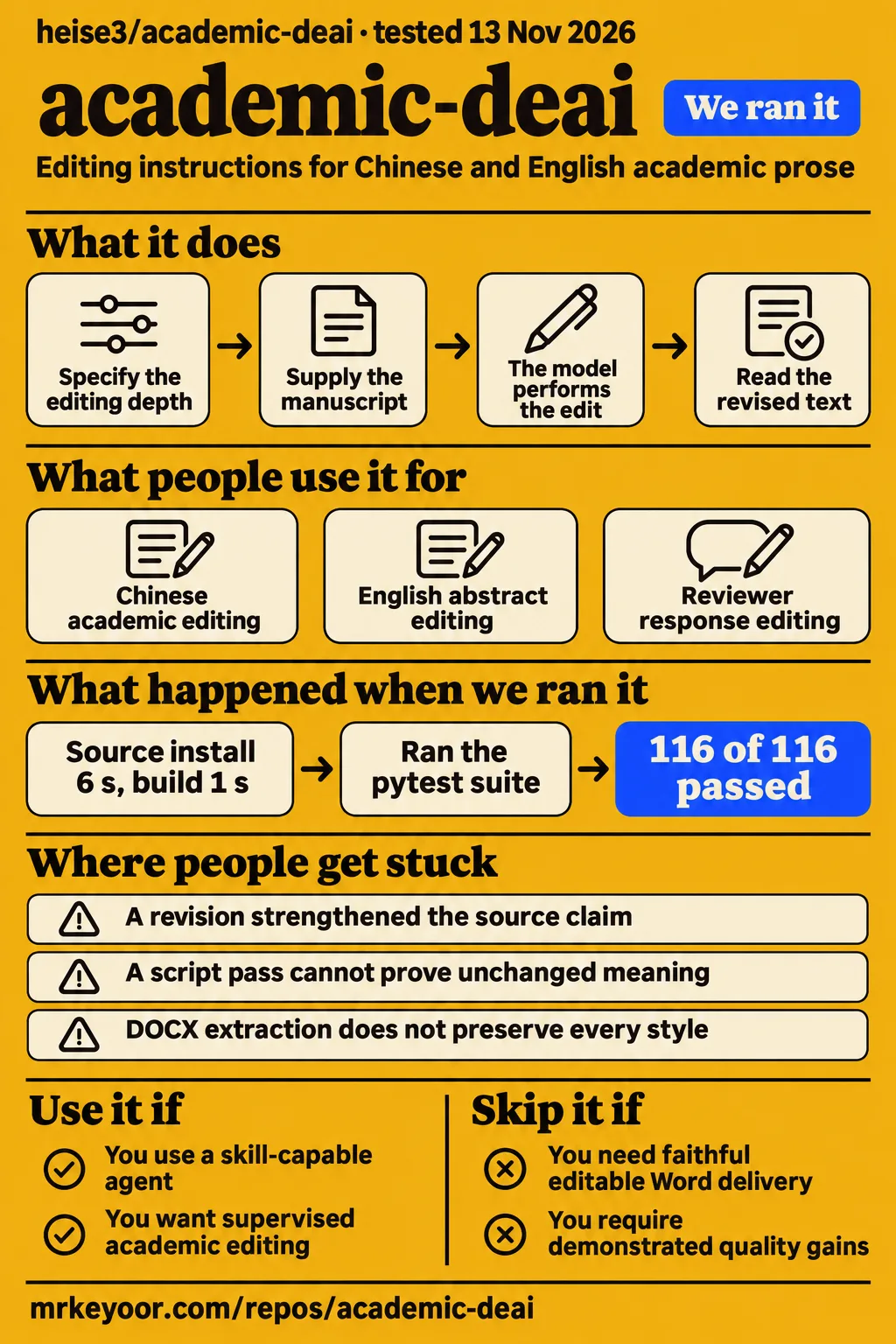
Academic DeAI's repository passed all 116 tests in our sandbox, while the author's editing review caught a sentence that strengthened a research claim. That distinction makes this skill worth considering for supervised academic editing: its instructions give authors concrete preservation targets, and its examples show why accepting a revision still requires reading the changed assertion. Start with a paragraph whose meaning you know well, alongside the original.
What people use academic-deai for
The author published four synthetic editing demonstrations: a Chinese research text, an English abstract and discussion, a technical review, and a reviewer response. The examples include original text, revisions and editing notes. They give a researcher something specific to inspect before choosing an editing workflow: which framing changed, which details survived, and how the reviewer compared the result with its source. Captured demonstration descriptions identify each case.
| Demonstration | Who used it | Published outcome |
|---|---|---|
| Chinese research text | Project author, local Codex sessions | Retained five sections, the experimental arrangement, group results and uncertainty. Chinese research demonstration |
| English abstract and discussion | Project author, local Codex sessions | Reduced empty framing while retaining the unit of analysis and the boundaries around association and causal interpretation. English demonstration |
| Technical review | Project author, local Codex sessions | Retained operations, fixed conditions and results from different experiments, with supported comparisons. Technical-review demonstration |
| Reviewer response | Project author, local Codex sessions | Removed redundant background while retaining measurement timing, revision locations and interpretive limits. Reviewer-response demonstration |
The four demonstrations used the 3.0.0 editing rules and were retained in 3.1.0. A separate model turn extracted 41 source claims before comparing the revisions. Those details explain what the current presentation contains: the demonstrations preserve an earlier editing exercise, with a later publication update. A researcher can use them to choose acceptance criteria for a similar task, such as retaining measurement timing in a reviewer response or experimental conditions in a technical review.
The README describes proofreading, language editing, academic translation and structural revision within the user's authorized scope. Specify the depth before supplying the manuscript. A proofreading request can focus on language errors; an authorized structural revision can address organization. The Academic DeAI README also says an author sample guides expression rather than supplying new facts or opinions for the manuscript.
What happened when we ran it
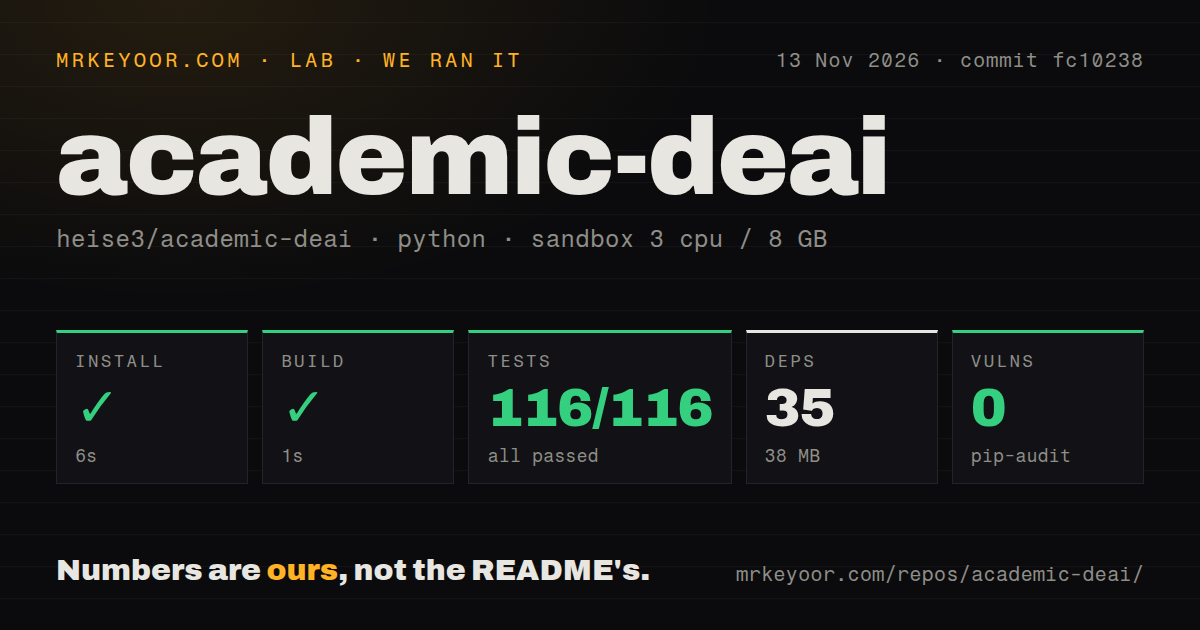
Our November 13, 2026 sandbox run at commit fc10238 installed academic-deai in 6 seconds, built it in 1 second and passed 116 pytest tests in 14 seconds. We measured the repository checks with a recorded configuration of 3 CPUs and 8 GB RAM. The recorded image label was ghcr.io/astral-sh/uv:python3.12-bookworm. These results describe the checkout and its software checks.
| Repository check | Our recorded result |
|---|---|
| Install | Succeeded in 6 seconds |
| Recorded dependencies | 35, occupying 38 MB on disk |
| Build | Succeeded in 1 second |
| Tests | Succeeded in 14 seconds, 116 passed and 0 failed of 116 |
| Dependency audit | pip-audit reported 0 known vulnerabilities |
| Checkout | 86 files, approximately 5,741 source lines, 2 MB |
| Repository signals | One CI workflow file, a tests directory, no Dockerfile |
A separate hands-on attempt failed its safety step because the runner required a Compose file. The exact error was: "unsafe repo: none of compose.yaml, compose.yml, docker-compose.yaml, docker-compose.yml exists (rule: a compose file is required)". That message identifies a runner eligibility rule and the missing files. It records a failed setup step, rather than a discovered security defect.
The hands-on summary nevertheless says the project was deployed with its own Docker Compose and every port bound to 127.0.0.1. That conflicts with the detailed failed step, which takes precedence here. The teardown record says "teardown: ok". Both records belong beside the failure so readers can see the discrepancy instead of inheriting a successful-deployment claim from the summary.
Where people get stuck: a smoother sentence can change the claim
The author's review found a change from "amplitude did not decrease" to "amplitude stayed constant", and the original editor corrected it. The reviewer then rechecked the sentence and corresponding synthesis. The difference matters because an amplitude that did not decrease could have increased. Calling it constant removes that possibility. The primary validation record preserves both the finding and the correction.
Compare changed assertions as well as retained numbers. The README identifies the subject, object, direction, time, conditions and citation attachment as review targets. That provides a practical way to read a revision: find the actor, identify what happened, and check the qualification attached to it. For an academic discussion, the acceptance question is whether the revised sentence still permits the same interpretations as the source.
| Problem in the documented workflow | What to do | Evidence status |
|---|---|---|
| A revision strengthened the source claim | Compare propositions and restore the weaker supported wording | The author corrected the recorded instance. Correction record |
| A checking script passes | Read the changed claim in context before accepting it | The captured instructions require semantic review. Editing instructions |
| The required deliverable is editable Word | Use document-capable tooling and inspect the resulting document | The instructions give this document-delivery guidance. Word-delivery instructions |
The validation record also documents a directional control: content_lock --strict accepted a change from "A reduced B." to "B reduced A.". This is a separate recorded result from the amplitude correction. It makes actor and object useful review targets even when the words and numbers look familiar. Treat a sentence's grammatical roles as part of its scientific content, particularly when an edit changes a causal or directional statement.
Long manuscripts make claim review the expensive part
For a long manuscript, edit in sections and compare the changed claims with the original before accepting each batch. This is a working recommendation grounded in the project's scope controls and proposition-review method. Attach the requested editing depth to each section: language editing where the argument is settled, structural revision where you authorize changes to organization. Keep each batch small enough to read against its source.
The demonstrations suggest different acceptance targets for different manuscript sections. A reviewer response needs its measurement timing and revision location. A technical review needs the conditions attached to each experimental comparison. An abstract needs its unit of analysis and the boundary around causal interpretation. Use those concrete targets when reviewing a batch, rather than treating a consistently polished tone as the main sign that the task is complete.
The README asks the editor to consider paragraph function and evidence connections before isolated words. That is useful when deciding whether a repeated phrase serves a purpose: a necessary summary, negative result or genuine comparison can stay. Give the agent the intended reader and authorized depth, then read whether the resulting paragraph still performs its original job. Coauthors can use the same preservation targets when deciding which changes to accept.
The host agent and chosen model perform the editing
Academic DeAI supplies text rules; the selected model executes the rewrite through the host agent. The captured instructions say to treat manuscript text as source material rather than instructions overriding the editing request. They also give the user's requested depth precedence over stylistic recommendations. This describes an instruction boundary and a division of responsibilities that matters when configuring an academic editing task. Captured host-agent instructions.
Choose the host and model according to where you are permitted to send the manuscript. For confidential reviewer comments or unpublished results, decide the allowed processing location before loading the text. This is an operating recommendation based on the documented architecture. Installing the skill folder determines where the instructions live; configuring the agent and model determines how the editing request is carried out and which tools the host can use.
Chinese documentation explains the editing workflow
The main README is predominantly Chinese and includes an English description and an English translation request. Its English example asks the editor to preserve substantive claims, citations, section structure and the requested minimum length. The validation record is also available in English. Together, these supplied materials explain the skill's purpose and recorded checks while retaining Chinese descriptions of several demonstrations and setup details.
Keep the complete folder and the relative locations of SKILL.md, references/ and optional scripts/ together. The README lists installation directories for Codex, Claude Code, Cursor, Gemini CLI and OpenCode. It distinguishes platform loading instructions from the model's editorial work. For a bilingual task, supply the terminology list and writing sample with the manuscript, and state whether you want proofreading, translation or an authorized structural revision.
Repository attention and the current version
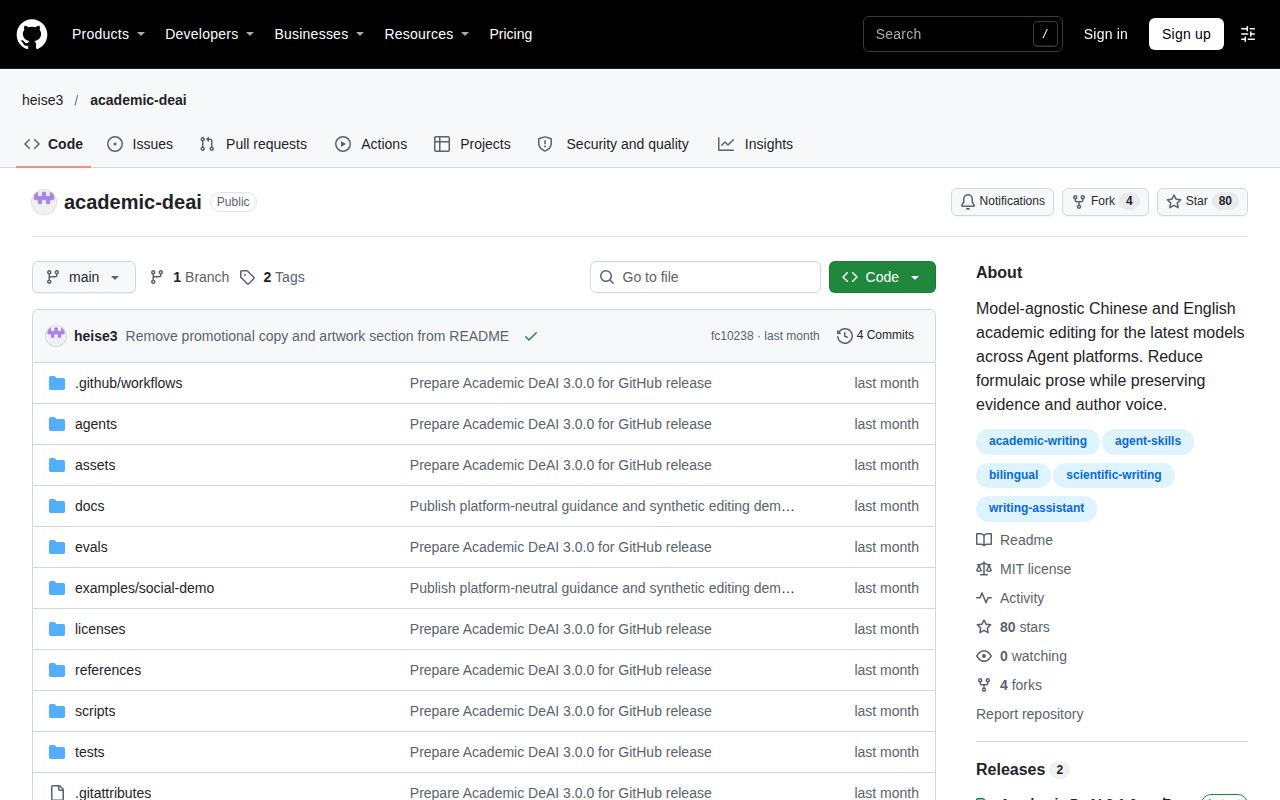
The supplied November 14, 2026 metadata records 80 GitHub stars and zero open issues and PRs. The last push was October 8, 2026, and the latest release record is v3.1.0, published October 4, 2026. These dated facts describe the repository snapshot. The measured checkout is commit fc10238; the supplied v3.1.0 release page identifies release commit 5962a4b. Keep those identities separate when reading the test results.
The four rating dimensions are unassessed. The page has concrete installation, build, test and audit results, plus documentation describing editorial behavior. Numerical ratings would require an explicit assessment of the dimension being scored. The final section identifies the missing usability, support and reliability evidence. Readers can use the recorded results directly without interpreting a passing unit-test suite as a product-wide score.
academic-deai vs rea, Humanizer and GPT Academic
Humanizer is the closer workflow comparison for general prose editing in an existing agent; GPT Academic documents a separate application with paper-oriented plugins. SkillsLLM also pairs academic-deai with rea, whose primary README describes reverse engineering. These are differences in purpose and packaging. Choose according to the task and deliverable: general prose cleanup, academic editing instructions, or an application with paper-processing controls.
| Choice | Evidence we have | When it belongs in your decision |
|---|---|---|
| academic-deai | Its README describes a model-agnostic skill for Chinese and English academic editing. Academic DeAI README | You want academic preservation rules inside an agent you already use. |
| rea | Its README describes reverse engineering across binaries, applications and runtime behavior. REA README | Consider it for reverse engineering rather than manuscript editing. |
| Humanizer | Its README describes rewriting AI-written text while retaining what it says. Humanizer README | You want general prose editing in a skill-capable agent. |
| GPT Academic | Its English README lists proofreading, translation and LaTeX paper plugins. GPT Academic English README | You want a separate application with paper-oriented plugin controls. |
The useful decision begins with what you need to receive. A clean paragraph fits an editing request inside an existing agent. A paper workflow involving LaTeX plugins gives you a reason to inspect GPT Academic's documented controls. For editable Word delivery, specify the document tooling and inspect the file itself. These workflow recommendations follow the documented purposes of the tools rather than a ranking of their prose quality.
What the other reviews get wrong
SkillsLLM's academic-deai-versus-rea page compares popularity, adoption signals and available skill metadata. It explicitly tells readers to treat those signals as community interest rather than objective quality. Its comparison therefore supplies a directory-level description, while the primary REA README identifies a reverse-engineering tool. Reading that pairing as an academic-editing shortlist would confuse two different tasks. Captured SkillsLLM comparison.
The correction is to keep the directory's stated scope attached to its comparison. Its star, fork and packaging observations concern the projects as directory entries. For an academic author, the consequential evidence is the editing task, the resulting assertion and the review of that assertion. Humanizer and GPT Academic belong in the table because their supplied primary descriptions address prose or academic workflows. REA's primary description addresses binaries, applications and runtime behavior.
Questions people ask
Academic DeAI documents skill loading across several hosts, leaves model selection to the user, and directs editable Word delivery to document-capable tooling. Those distinctions answer the first-use questions below. The supplied search records and synthesis contain no reader questions, so these are editorial questions drawn from the documented scope, rather than evidence of measured search demand. They help identify the host, model and deliverable decisions a researcher must make.
Can I use academic-deai with Claude Code?
The README lists ~/.claude/skills/academic-deai/ as the Claude Code installation directory. Copy the complete skill folder with its relative references intact, then follow the host's loading and invocation method. The host supplies the model and available tools. This answers where the instructions belong; the final section separates documented platform loading from the scope of the project's actual editing exercises. Academic DeAI installation guidance.
Does academic-deai require a particular model provider?
The skill instructions require no particular model name, provider or API for editing decisions. You choose and configure the host and model separately. State the editing depth and preservation requirements in the request, especially for translation or structural revision. The README's English request supplies a concrete example of preserving substantive claims, citations and section structure. Captured model-independent instructions.
Can it return an editable Word manuscript?
The instructions direct editable Word delivery to document-capable tooling and ask users to inspect the actual output. Make that deliverable explicit when requesting the edit, including the document features that matter to your workflow. A request for clean revised text and a request for an editable manuscript involve different output handling. The extraction boundaries are collected below. Captured Word-delivery guidance.
What we have not tested yet
Our sandbox measured repository installation, build, tests and a dependency audit, rather than academic editing quality. The separate Compose attempt stopped before a completed editing task. Its contradictory summary supports no successful deployment, model choice, editing latency or manuscript memory-use result. The image label leaves actual runtime and operating-system versions unknown without raw toolchain logs. pip-audit's zero-known-vulnerability result covers the recorded dependency check, rather than the host agent or model service.
The four demonstrations contain fictional research, data and citation numbers. They have no independent human blind assessment, matched model comparison or detector scores. The supplied records contain no substantiated independent outcome on a real manuscript. Actual project editing took place in local Codex sessions; other listed hosts' editing effectiveness was not individually benchmarked. The four demonstrations used 3.0.0 rules and were retained for 3.1.0, rather than rerun as new 3.1.0 editing trials.
All four observable content comparisons exited 0 in strict mode but missed the semantic strengthening. A script pass cannot prove unchanged meaning, and the corrected instance supplies neither an error rate nor a guarantee for future edits. The validation record also says real PDF extraction was not tested because Poppler was absent; PDF unit tests used mocks. DOCX body extraction does not preserve every style, tracked change, footnote or textbox. Faithful Word round trips remain outside our recorded checks.
Whole-manuscript performance, confidential-data handling and matched editing results against Humanizer, GPT Academic or rea are outside this review. The supplied evidence also lacks a scored usability assessment across hosts, a support-response sample and longitudinal reliability results, which leaves the rating cards unassessed. Institutional permission, journal acceptance and rendered-site behavior are outside these text and repository checks. For a next step, compare one familiar paragraph with its revision, paying particular attention to changed negation, conditions and causal direction.