The useful product is the index
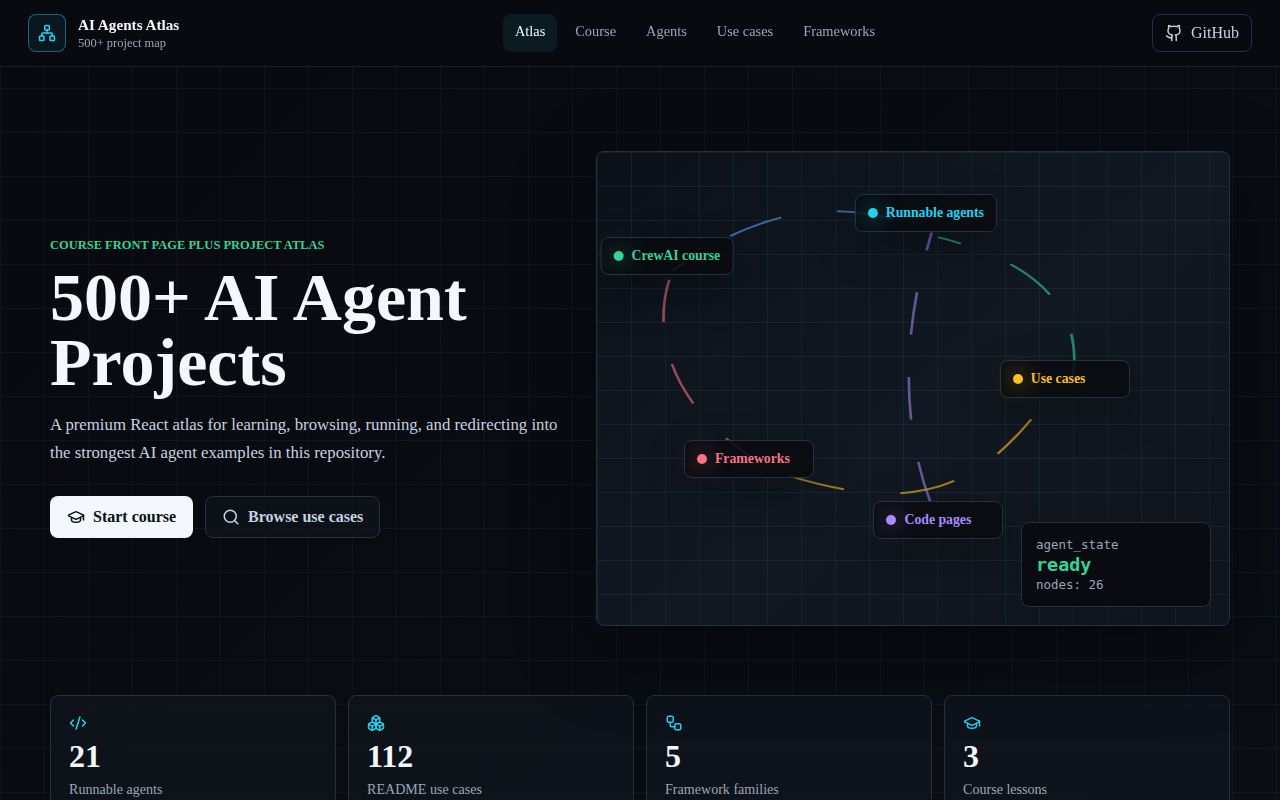
The repository organizes agent projects and use cases by framework and industry. Its README points readers toward LangGraph, CrewAI, AutoGen, Agno, and LlamaIndex examples, then groups applications across healthcare, finance, education, security, retail, logistics, and other fields. Some links go to self-contained folders in this repository; many go to external repositories or framework documentation.
That distinction controls how to use it. A catalog entry is a lead, not an endorsement or reproducible result. The title promises 500 or more projects and use cases, while an individual row may be a tutorial, notebook, repository, or brief description. Readers should judge the linked source on its own maintenance, license, test suite, data handling, model costs, and deployment design.
Framework labels are orientation, not evidence
The comparison table describes LangGraph as suitable for stateful graphs, CrewAI for role-based teams, AutoGen for code and research, Agno for lighter agents, and LlamaIndex for document pipelines. That is a quick vocabulary lesson for newcomers. It can help someone decide which documentation to open first without reading 5 framework sites from scratch.
The table does not publish a benchmark, common task, version matrix, evaluator, or operating-cost comparison. Complexity stars and feature checks are editorial shorthand. Framework capabilities change quickly, and one example may use an older API. Before choosing, build the same narrow workflow in 2 candidates and compare failure recovery, tracing, tool permissions, model portability, test ergonomics, and the amount of custom state code required.
What happened when we ran it
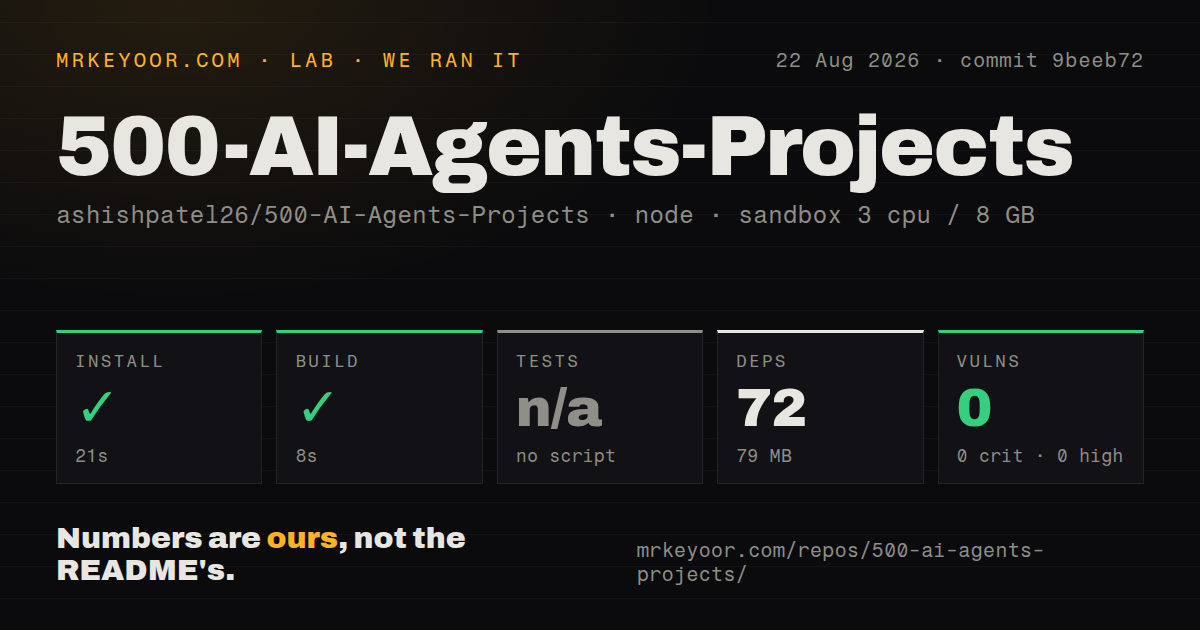
Our sandbox found the Node application under ./web/. It installed 72 packages in 21 seconds, occupied 79 MB, and built successfully in 8 seconds. Npm audit reported 0 known vulnerabilities at critical, high, moderate, and low severities. The full checkout at commit 9beeb72 contained 145 files and roughly 4,759 lines of source.
There was no test script or target, so the harness skipped tests. That is missing evidence, not a clean test result. The repository had 6 CI workflow files, no Dockerfile, and no tests directory. A successful web build shows that the catalog frontend compiled in our Node 22 container. It does not execute, import, or verify every Python agent and external project listed in the README.
The measurement boundary is especially important here. Each runnable agent is described as self-contained with its own requirements.txt and .env.example. Those folders can pull different Python packages, call different models, and request different keys. None inherits the web install's 72-package audit result. Run a separate dependency audit and behavior test for the exact folder or linked repository under consideration.
Self-contained examples trade consistency for speed
A folder-level setup is convenient for learning: enter one agent directory, install its requirements, copy the environment template, add a key, and run the script. You can discard the example without understanding a monorepo. Contributors are asked to include metadata, dependencies, and environment documentation, which gives the collection a basic shape.
The same design allows drift. One folder may pin packages while another accepts wide version ranges. Environment files may request different provider access. Logging, retry policy, prompt-injection defenses, output validation, and cost controls can vary. A beginner can mistake a 5-minute demo for an operational architecture. Treat each example as untrusted sample code until its tool calls, file access, network destinations, and error paths have been read.
High-stakes rows need a higher bar
The industry table includes medical analysis, automated trading, legal review, cybersecurity, identity verification, and wallet tooling. These are useful areas to study, and the one-line summaries cannot communicate clinical limits, financial risk, legal jurisdiction, attack scope, or custody design. Following the link is the beginning of evaluation. It is never the final safety decision.
For a medical or finance example, identify the claimed use, source data, evaluation set, and prohibited decisions. For security software, isolate it and inspect what it scans or executes. For an agent with email, browser, wallet, or cloud access, use a disposable account and least-privilege credentials. A catalog maintainer cannot continuously verify the runtime behavior of hundreds of independent upstream projects.
Activity continues without formal releases
The default branch was last pushed on 2026-07-27, and GitHub showed no latest release. That alone does not make the project stale. Open pull requests were updated through 2026-08-25 for a social-content agent, an outreach entry, identity verification, an MCP hub, dependency changes, and catalog validation. GitHub listed 69 open issues and pull requests combined.
The active contribution queue suggests the collection is still receiving candidates, while the absence of releases fits a repository consumed from its default branch rather than as a versioned package. It also means users should record the commit they consulted. External links can move or disappear after the catalog entry lands, and an example's current default branch may differ substantially from the version implied by its description.
Use it to form a shortlist
This project saves time at the broadest stage of research. Search the tables for a domain or framework, open 3 plausible examples, and use their code to identify common components. Then leave the catalog behind and evaluate the actual sources. Check whether the example runs, what it costs, how it fails, which data leaves the machine, and whether its license fits the intended product.
The web application is light enough to build, but the lack of a test target limits confidence in changes to its catalog UI. The larger caution applies to content: 500 entries cannot share one quality score. Use the repository as a map, cite the destination rather than the map, and never copy a high-stakes agent into production because its row used the words working implementation.