
The catalog covers 50-plus agent exercises, not one application
GenAI Agents is best understood as a shelf of Jupyter notebooks. The README lists more than 50 tutorials spanning basic chat, LangGraph state machines, academic research, business tasks, creative generation, quality checks, RAG, and multi-agent work. Several entries show the same idea through different frameworks, which makes the repository useful when you are still deciding how an agent should be structured. There is no shared product interface to evaluate, and the notebooks are not presented as parts of one deployable service.
The variety is the main reason to visit. A developer can compare a simple conversational agent with a research team, document intake workflow, MCP tutorial, or local Ollama example without searching across dozens of unrelated blogs. The price of that breadth is inconsistency: each notebook can bring its own provider, vector store, web service, data file, or runtime assumptions. Read the selected notebook end to end before installing anything or placing a credential in its environment.
Python 3.9 is the floor, while setup changes by notebook
The repository-wide prerequisites are short: Python 3.9 or newer, plus Docker for some agents. Getting started means cloning the repository, entering the tutorial you want, and following that notebook's instructions. This is honest about the collection's structure, but it is not a reproducible setup guide for all 53 tutorials. There is no single documented command that proves every example can execute under one locked dependency set.
Provider requirements vary with the subject. The catalog names examples built with LangChain, LangGraph, PydanticAI, AutoGen, CrewAI, Ollama, Pinecone, Chroma, LightRAG, and publishing or search services. Some paths can stay local, while others necessarily call outside systems described by their notebooks. That means cost controls, data handling, API-key scope, and model availability must be decided per exercise. A notebook that teaches an idea is not automatically safe enough for customer data.
What happened when we ran it
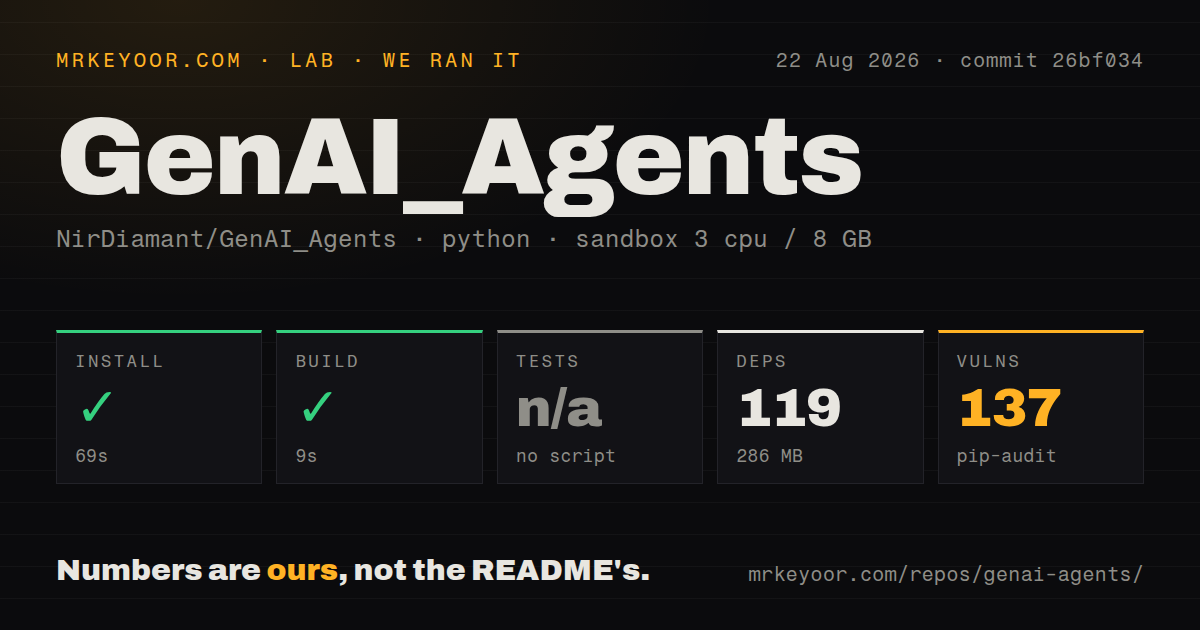
Our sandbox installed GenAI Agents at commit 26bf034 in 69 seconds. The environment added 119 Python packages and occupied 286 MB on disk, then the build step succeeded in 9 seconds. The unprivileged Debian container had 3 CPUs, 8 GB of RAM, Python 3.12, and no secrets. Those results show that the measured repository setup completed without needing a provider key during the install and build stages.
No test script or test target was present, so we skipped tests rather than inventing a passing result. Our scan also found no tests directory, CI workflow, or Dockerfile. Pip-audit reported 137 known vulnerabilities in the installed environment. That count does not prove the notebooks themselves are exploitable, but it is far too large to wave through. Pin the notebook you need, remove unused packages, and review the resulting dependency report before using any borrowed code near real data.
The clone contained 173 files, measured about 103 lines as source under the lab's counter, and used 61.8 MB before the installed environment. Jupyter notebooks can store substantial code and output in JSON that a source-line counter does not represent well, so the file and disk figures describe the checkout more clearly than the line count. We did not run provider-backed notebook cells or judge model output quality in this sandbox.
The custom license rules out casual commercial reuse
The README states that GenAI Agents uses a custom non-commercial license, and GitHub's license field did not identify a standard SPDX license. That matters because the catalog invites readers to adapt implementations, while a company may assume GitHub availability means production reuse is allowed. It does not. Read the license terms and obtain legal approval before placing notebook code in a paid product or an internal commercial system.
The educational framing also changes how reliability should be judged. A tutorial may choose visible, compact code over retries, observability, permission boundaries, or adversarial input handling. The README includes a governance and safety resource, but one linked contract example does not certify all 50-plus notebooks. For any pattern you keep, define allowed tools, validate outputs, restrict credentials, and add tests around the failure modes that matter to your application.
August activity is mostly pull requests, with no tagged release
GitHub showed 23,996 stars, 12 combined issues and pull requests, and a last push on August 19, 2026. The most recently updated open items were pull requests proposing approval workflows, notebook validation, trace-based evaluation, temporal memory, and new provider support. That is active contribution traffic. It also means the combined open count should not be read as 12 unresolved bugs.
The latest-release endpoint returned no release, so users should pin a commit rather than depend on a version tag. The repository's learning value does not require formal releases, but reproducible teaching and team reuse benefit from stable snapshots. commit 26bf034 installed and built in our box; later notebook changes need their own review because a passing top-level build says nothing about every remote call or generated answer inside them.
Use it to choose a pattern, then rebuild the chosen slice
GenAI Agents earns its place as a browsing and teaching resource because one index exposes many concrete agent shapes. Open two or three notebooks that address the same job, compare how they manage state and tools, and keep notes on the assumptions each one hides. That is more useful than copying the most elaborate diagram or choosing a framework from star count.
For production work, extract the smallest relevant idea into your own tested codebase. The 119-package environment, 137 audit findings, absent test target, and non-commercial license make a wholesale adoption hard to defend. A competent team can still learn a lot here, especially when it treats every notebook as an example to question rather than an application to deploy.