RFC 8878 gives zstd a stable format beyond one implementation
Zstandard is both a lossless compression format and its reference C implementation. RFC 8878 documents the format, so a .zst file is not tied to this repository's library forever. The checkout also builds a command-line program that creates and reads zstd files and can work with gzip, xz, and lz4 files. That combination matters: application developers can embed libzstd, while operators get a useful file tool without writing a wrapper.
commit d9c0c7e contained 656 files and roughly 148,950 source lines, yet the checkout occupied only 8.5 MB. The API and format are much larger commitments than that disk figure suggests because compressed data may live for years. The stable specification and independent implementations reduce that risk. If interoperability with an old gzip-only system is fixed, zlib may still be the simpler choice; if both ends can speak zstd, the newer format is easy to justify.
Compression levels trade time for size, while decoding stays predictable
Zstd exposes fine-grained compression levels, including fast negative settings and slower modes aimed at denser output. The README says decompression speed remains roughly similar across settings, which is useful when writers have more compute than readers. It also documents --max for callers willing to spend substantially more time and memory. None of those descriptions chooses a production level for you. A database page, software package, log stream, and backup archive have different write budgets and repetition.
The v1.5.7 command-line program enables multiple threads by default, capped at 4 threads unless the user chooses another value. That can change CPU use after an upgrade, so package owners should pin explicit worker settings where resource limits matter. The same release also fixed a rare 32-bit compression problem tied to long-lived reused contexts. Anyone shipping the library on 32-bit systems has a concrete reason to avoid older builds, even if ordinary short jobs never exposed the defect.
Dictionaries help small records only when both sides share the file
Dictionary training targets collections of related small inputs. Zstd learns a dictionary from representative samples, then uses that file during compression and decompression. The README is direct about the limit: no universal dictionary exists. A dictionary trained on one record family can be a poor fit for another, and gains matter mainly near the beginning of small inputs. This is useful for repeated schemas, short events, or similar metadata, provided the team owns dictionary selection and rollout.
Our 3-CPU sandbox did not benchmark ratios or throughput, and the supplied lab run contains no compression corpus results. It measured repository setup, build, and tests only. Before adopting dictionaries, version each dictionary beside the data format, record its identifier with every compressed object, and test old-object recovery. Losing the matching file turns otherwise valid compressed records into an operational incident. For mixed or unpredictable data, ordinary zstd frames may be a safer contract.
What happened when we ran it
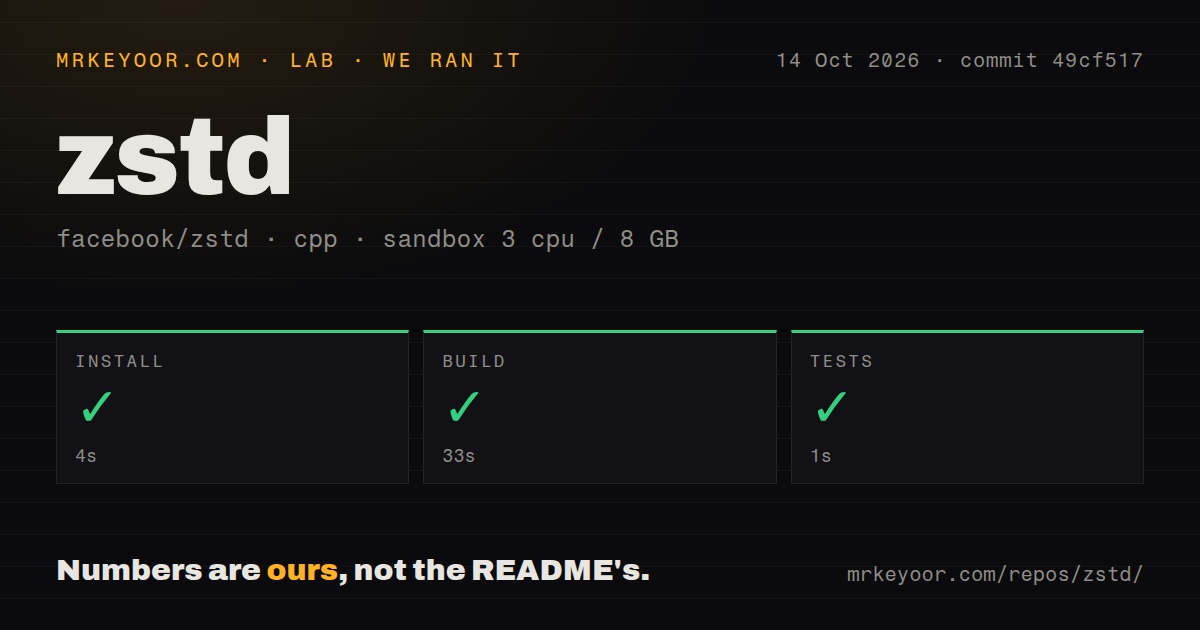
Our sandbox installed the d9c0c7e checkout in 16 seconds, built it in 44 seconds, and completed the tests successfully in 10 seconds. The fresh Debian container had 3 CPUs, 8 GB of RAM, no secrets, and no elevated privileges. Those results cover project mechanics only. We did not measure compression ratio, throughput, peak memory, dictionary quality, or compatibility with a particular application's stored corpus, so this review makes no performance claim from that run.
The repository had 10 CI workflow files and a tests directory. Its README points to make check for an essential local check, while TESTING.md describes wider platform suites and continuous fuzzing. Our test result is still the clearest setup signal: all three measured stages finished without an error. A 70-second install, build, and test cycle is short enough to place in an ordinary source-build job instead of treating validation as a release-only event.
Make is the reference build even though seven other routes exist
The root Makefile is the project's stated reference. CMake, Meson, Bazel, Buck, vcpkg, Conan, and Visual Studio paths are documented, but the README warns that secondary systems can have small differences because perfect synchronization is difficult. That honesty is useful. If a downstream package hits an odd build failure, reproduce it with make before deciding the compressor itself is broken. Teams standardizing on another build system should also test the exact options and library shape they ship.
Source installation needs no credentials or service. A C compiler and standard make cover the main route, and make install adds the CLI, library, and manual pages. One open report from September 1, 2026 says the documentation does not spell out the /usr/local destination clearly enough for newcomers or explain staged installation in the expected place. Packagers already familiar with GNU Make conventions may find the controls, but the first-run explanation could be sharper.
September activity matters more than the older release tag
GitHub recorded 27,739 stars, 368 combined issues and pull requests, and a last push on September 1, 2026. An open installation-doc report arrived that same day, followed by a multithreading question on September 3. The newest tagged release was v1.5.7 from February 19, 2025. The release date alone looks old; current code and issue traffic show that development continued after it. Buyers should distinguish the release branch from the dev default branch when selecting a commit.
Version 1.5.7's own notes disclose a packaging blemish: manual pages in the release archive still identify v1.5.6, with commands given to rebuild or replace them. That is annoying for distributors, though it does not change the compressed format or our successful 10-second test result. Zstd earns a strong recommendation because the standard, reference implementation, build, and tests line up. The remaining work belongs to the adopter: choose a release policy, benchmark representative data, and keep dictionary deployment recoverable.