
YesPlayMusic is a NetEase client with desktop and web paths
Choose YesPlayMusic because you already use NetEase Cloud Music and want another interface for that account. The Chinese project README lists lyrics, music videos, personal FM, and daily recommendations, while explicitly leaving out social features. That makes it a focused listening application for someone who wants the service's music without its social interface. It isn't a server for turning your own audio folder into an independent streaming service.
Our source checkout contained 253 files, roughly 20,689 source lines, and 9.4 MB of files. The README describes Electron packages for macOS, Windows, and Linux alongside a browser deployment. Those are distinct choices. In particular, its alternative-source integration is unavailable in the web version. If that feature is your reason to install YesPlayMusic, a hosted browser copy doesn't meet the requirement, regardless of how similar the screens look.
What happened when we ran it
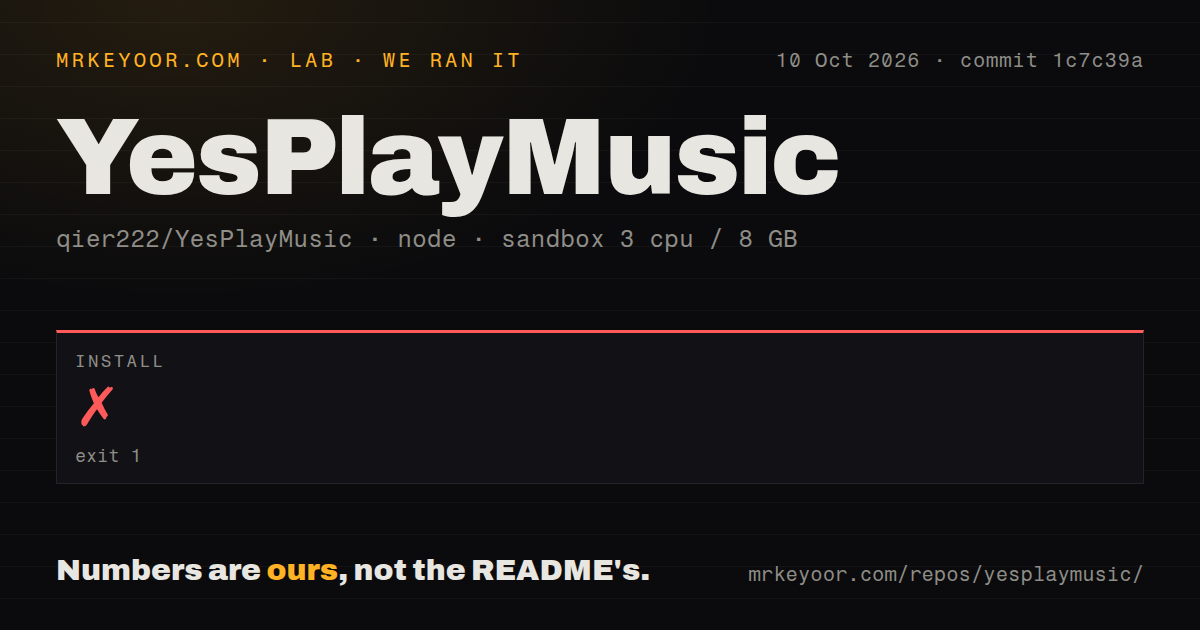
Our sandbox failed to install YesPlayMusic commit 1c7c39a after 5 seconds with exit code 1. The run took place on October 10, 2026, in a fresh Debian container with 3 CPUs, 8 GB of RAM, image lab-node:22, no secrets, and no elevated privileges. Yarn rejected the project's declared Node engine range: it expected 14 || 16 and reported that the running interpreter was 18.20.8.
The image label lab-node:22 and the interpreter version in the log do not agree. The failure should be described using the interpreter Yarn actually reported, Node 18.20.8, without inventing an explanation for the discrepancy. Corepack also noted the missing package-manager field and selected Yarn 1.22.22. The terminating finding was the engine incompatibility. We have no measured build or test result, and this log doesn't establish whether playback or account login works.
The scan found 2 CI workflow files, a Dockerfile, and a Compose file, with no tests directory. Container recipes are useful deployment material, but their presence doesn't turn a failed install into a working container. Anyone maintaining a fork should inspect its declared runtime and reproduce the dependency step before making app changes. Bypassing an engine check would change the experiment, so our result gives no evidence that doing so would be sufficient.
A hosted web copy still needs the NetEase API
The server deployment instructions require a separate NetEase API service and a configured VUE_APP_NETEASE_API_URL. They also warn that putting the API and webpage on different domains can cause bugs, and show a same-origin reverse-proxy route. This is real operational work behind a browser music player: you need the upstream API address and a routing arrangement that keeps the client talking to it correctly.
The 9.4 MB checkout is therefore only part of what you operate. Hosting the frontend doesn't give you ownership of the music service or its account behavior. The README describes QR, phone, and email login, and says overseas users need a NetEase account for direct playback. Our container had no secrets and stopped during dependency validation, so this review cannot certify any of those authenticated paths. Verify the account flow you intend to use before adopting it.
Desktop users can start with the release packages instead of maintaining the web deployment. That avoids making source compilation your first task, though our 5-second failed dependency step says nothing about packaged-app setup. Optional integrations have their own requirements: Last.fm scrobbling involves that service, and the README says its YouTube alternative source needs yt-dlp. Decide whether you need these paths before adding more services and credentials to a personal player.
Chinese documentation and desktop compatibility narrow the audience
The repository's main instructions are in Chinese, and its root supplies no separate English README. English-speaking developers can still work through the named commands and configuration variables, but explanations of deployment choices and restrictions require translation. I'd pass if dependable English support documentation is a selection requirement. This matters particularly when an account stops logging in or an upstream API changes, because understanding the diagnosis is more useful than copying the next command.
The source log identifies the package as 0.4.10. Separately, issue 2477 reports unreadable Chinese text in that desktop version on Fedora with Wayland, with a reported workaround involving static Noto Sans CJK fonts. That is a user report about a particular desktop environment, not a rendering failure from our sandbox. If you use that setup, check the current package yourself rather than assuming English text rendering proves the whole interface is usable.
October maintenance outweighs a static maintenance-mode banner
GitHub recorded the last push on October 10, 2026, with 648 open issues and PRs. Release v0.4.11 appeared the same day and lists playback-history reporting repairs, cache-limit fixes, and Linux MPRIS crash handling. The README says the existing version is entering maintenance mode alongside an alpha successor. Recent release work nevertheless includes features and fixes. Read both sources rather than treating the banner as evidence that development has stopped.
Alger Music Player is a relevant comparison for another client in this service ecosystem. Navidrome suits a different requirement: streaming a music collection you supply. I'd choose between those jobs before judging YesPlayMusic's interface. For a NetEase listener, a current desktop package deserves a compatibility check. For someone wanting independence from NetEase, the separate API requirement already answers the decision, and fixing the Node 18.20.8 rejection would not change that dependency.