Short answer: use it for a YC founder shortlist and individual drafts
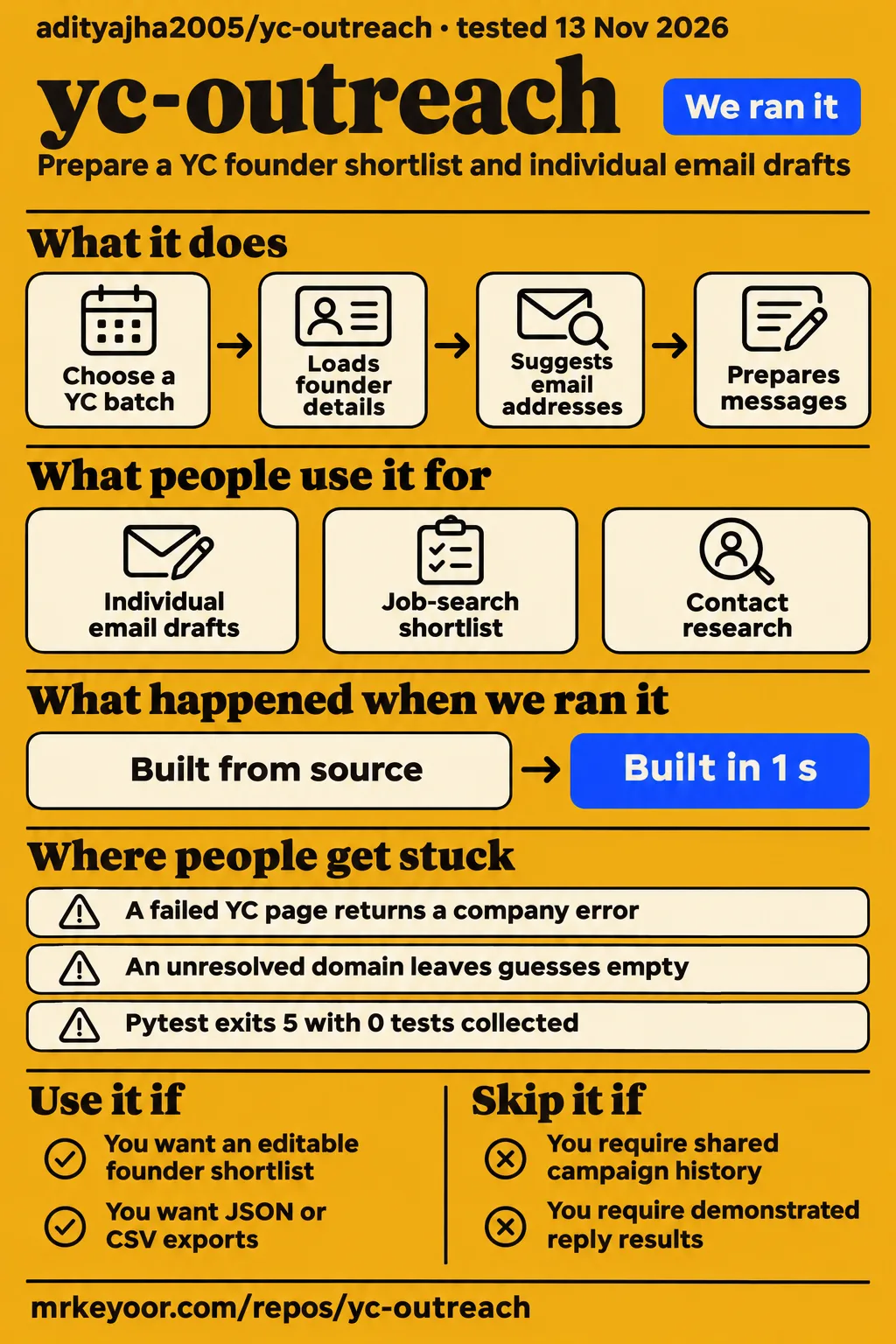
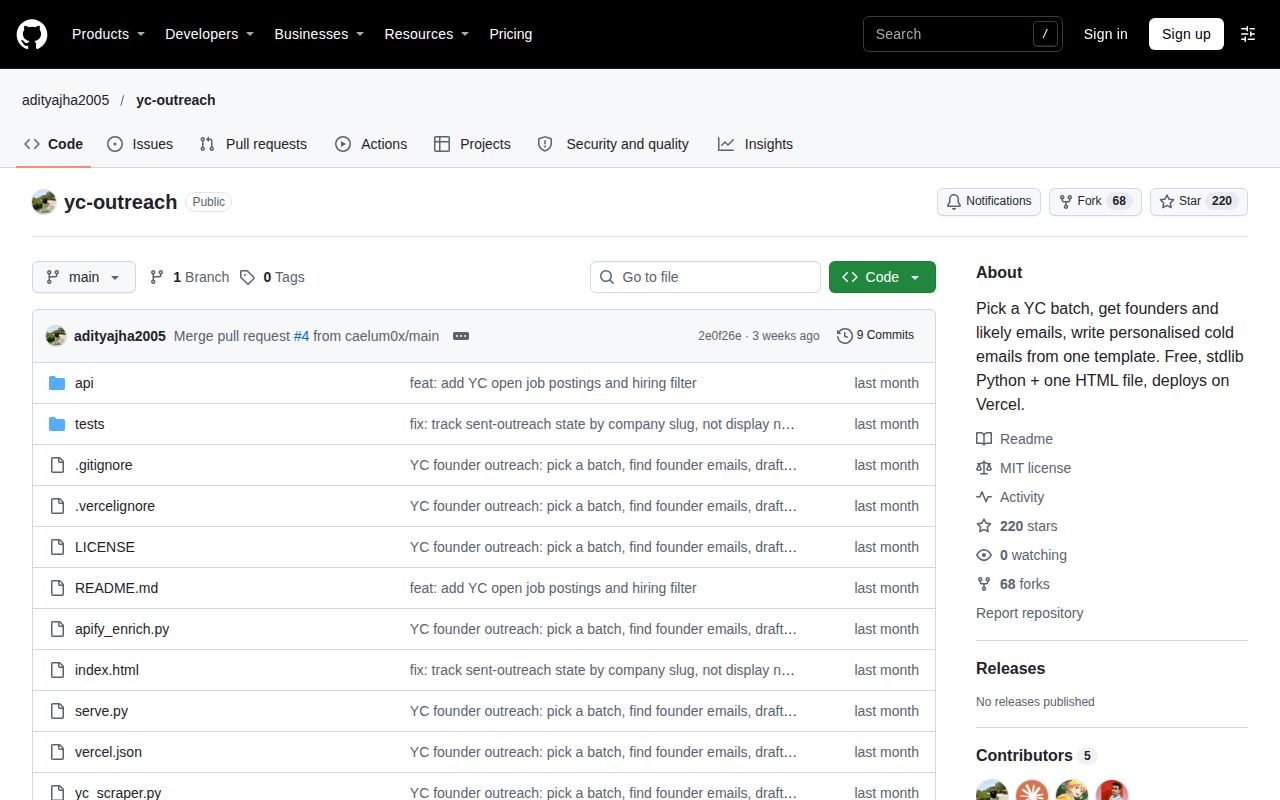
YC Outreach connects YC batch selection, founder details, likely email addresses and a reusable message template. Use it if you want to inspect a shortlist and prepare individual drafts yourself. Skip it if you require shared campaign history or demonstrated delivery and reply results. The exact project is adityajha2005/yc-outreach, whose README describes both a browser composer and command-line exports. That combination suits someone who wants to work directly with contacts and editable source.
The adoption decision starts with the task: choosing a YC batch, checking founder information and reviewing a generated draft. A person still chooses the recipient, edits the request and decides when to use the prepared message. The README's address labels and browser storage are especially relevant to that decision. They explain where a suggested mailbox came from and where the working record lives, which matters when deciding whether this personal workflow fits the way you handle contacts.
What people use yc-outreach for
Yc-outreach documents batch shortlisting, individual email drafts, a hiring filter and JSON or CSV exports. Start with a batch when the YC cohort matters, use open roles when hiring is relevant, or take an export when a file is more useful than the composer. The batch and founder workflow connects those choices to company details, founder names and social links. These are documented applications of the tool rather than customer outcome reports.
For individual email drafts, the browser lets you fill in your name and links, edit the subject and body, and update drafts together. You can copy text or open a draft in your mail application. For a job-search shortlist, the hiring filter hides companies with no listed YC roles. For contact research, the CLI export route produces JSON and CSV files that you can inspect outside the composer.
The author also used the project to check its address guesser. Reveneau's account of the experiment says the author compared guesses with 151 verified founder emails collected through Apify. That activity explains the origin of the address-match figures discussed below. It answers a different question from whether the browser helps someone prepare a useful message: the experiment compared candidate addresses with known addresses, while the composer organizes recipients and drafts.
What you can do with yc-outreach
The README documents a local browser application started with python3 serve.py and opened at http://localhost:8765. Python 3.9+ and the standard library are its stated requirements. The interface loads founder names, titles, LinkedIn and X links, together with company roles listed on YC. Its documented loading pattern is 20 companies per click, implemented as two parallel founder requests. The README's local instructions describe this procedure; the command here is a documented instruction.
The composer labels address suggestions by their source. The documented order is an Apify result, an address published on the company's homepage or contact page, and then name-and-domain guesses. Read the label together with the mailbox: the README explicitly describes an on-site address as potentially generic. A company contact mailbox calls for a different opening from a message addressed personally to a founder. The interface also lets you mark companies as sent and hide them from the working list.
The bulk route uses yc_scraper.py to create JSON and CSV output, followed by optional apify_enrich.py enrichment. The README says the scraper retries requests and checks six contact pages per site. The serverless handler makes one attempt per fetch, checks two pages and stops a website check after 4 seconds. Those documented differences explain why the project keeps separate web and CLI paths. Choose the composer for reviewing drafts beside contacts, or an export when the file itself is the useful result.
What happened when we ran it
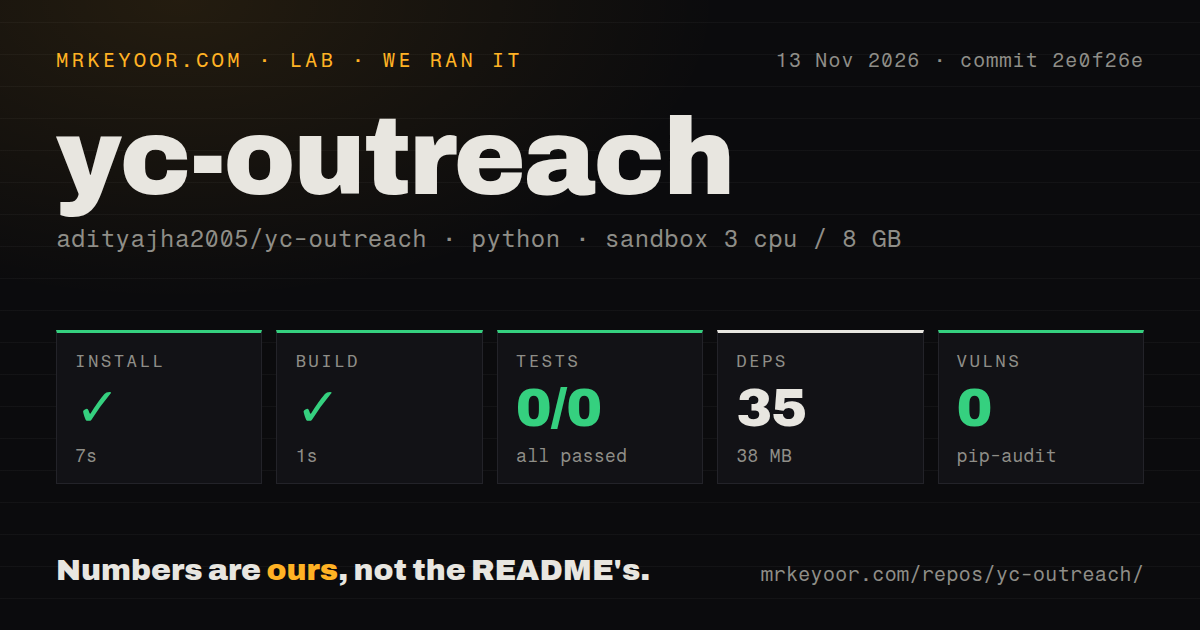
Our November 13, 2026 run at commit 2e0f26e installed in 7 seconds, built in 1 second and failed its test step in 2 seconds with exit 5. Pytest recorded 0 passed and 0 failed out of 0 collected tests. Its final log said no tests ran in 0.01s. The recorded failure was an empty test collection. The log shows no application assertion failure, so the useful follow-up is to inspect test discovery rather than infer a failing application feature.
| Recorded check | Result | What it tells a reader |
|---|---|---|
| Install | Succeeded in 7 seconds | The recorded install step completed |
| Dependency inventory | 35 dependencies, 38 MB on disk | This was the recorded environment footprint |
| Build | Succeeded in 1 second | The recorded build step completed |
| Tests | Failed, exit 5, in 2 seconds; 0 collected | Pytest ran no tests |
| pip-audit | 0 known vulnerabilities | This was the audit result for the run |
| Repository scan | 0 CI workflow files; no Dockerfile; tests directory present | The directory's presence did not produce collected pytest cases |
The checkout contained 11 files, approximately 668 lines of source and 0.1 MB. The configured sandbox had 3 CPUs, 8 GB RAM and image label ghcr.io/astral-sh/uv:python3.12-bookworm. The README describes standard-library-only operation, while the sandbox inventory recorded 35 dependencies. These records describe different things: the application requirements and the environment used for our checks. Follow the README for the local procedure rather than treating the environment's package count as an installation requirement.
The separate hands-on safety step failed because none of compose.yaml, compose.yml, docker-compose.yaml or docker-compose.yml existed. Its error called the repository unsafe under a rule requiring a Compose file. The hands-on run summary says it deployed through Compose with every port bound to 127.0.0.1, which conflicts with that failed prerequisite. The specific failure is the actionable record. The teardown record reports teardown: ok.
Where people get stuck: source errors and empty guesses
The README distinguishes a failed YC company page from an unresolved domain: the first returns a company error entry, while the second leaves address guesses empty. Inspect the returned company entry before editing a template or adding an enrichment token. The documented HTTP API also separates bad input, reported with status 400, from YC being unreachable, reported with status 502. The HTTP API documentation provides those distinctions and the request constraints below.
| Symptom or recorded failure | Evidence | Sensible next action |
|---|---|---|
| A company entry contains an error | README says a failed YC page returns a slug and error | Inspect the company entry and its source page |
| Address guesses are empty | README says guesses are empty when the domain does not resolve | Check the company's current website and domain |
| API returns 400 or 502 | README separates bad input from YC being unreachable | Check batch and slug input, then upstream availability |
| Local test step exits 5 | Our pytest log says no tests ran | Inspect test discovery |
| Hands-on safety step rejects the repository | The runner required a missing Compose file | Use the README's Python route for a separate evaluation |
The API accepts at most 10 slugs per founder request, and the README requires a season-and-year batch name such as Winter 2024. Those constraints are useful checks when a request returns a bad-input response. The README also explains the server's role: browsers cannot fetch YC company pages across origins, so the Python component reads them. For the documented local workflow, start serve.py and use its browser page rather than opening the HTML file alone.
Browser storage makes this a personal workspace
The README stores details, templates, sent marks and loaded batches in browser localStorage, with no database or account. The browser therefore holds the working record for an individual preparing messages. If several people are contacting founders, decide where the shared contact history belongs before assigning work. A sent mark helps one person hide completed entries, while a team needs an agreed record of recipients and follow-up actions. The storage description explains the underlying behavior.
The README describes two Apify token paths. Browser enrichment calls the actor with the visitor's token and says the token never reaches the application's server. CLI enrichment reads APIFY_TOKEN from the environment or a gitignored .env file. The CLI exposes a per-run charge cap through --max-charge, with a documented default of 1 USD, and a default chunk of 50 founders. These settings identify which account supplies enrichment and where its configuration lives; a charge cap is a configuration setting rather than a campaign cost estimate.
yc-outreach vs listmonk, Mautic and YC Cold Outreach
Listmonk manages newsletters and mailing lists, Mautic provides marketing automation, and yc-outreach starts with YC founder discovery and draft preparation. Choose according to the job you need to complete. The separately named YC Cold Outreach listing describes an OpenClaw writing skill. Keeping the full names visible helps distinguish selecting recipients, operating communications software and improving email wording. Each entry below links to the source describing its scope, so the comparison can guide a workflow choice.
| Candidate | Documented job | Choose it when |
|---|---|---|
| yc-outreach | YC batch discovery, likely addresses and template drafts | You want to inspect founder contacts and prepare individual messages |
| listmonk | Self-hosted newsletter and mailing-list management with PostgreSQL | You need to operate a mailing list |
| Mautic | Open-source marketing automation | You need a marketing automation application |
| YC Cold Outreach skill | Drafting, critiquing and iterating cold emails in OpenClaw | You want writing assistance in that environment |
Listmonk's README says it uses PostgreSQL as its data store. It documents both Docker and binary installation routes. Mautic's README recommends Composer or its packaged distribution for production, and considers source outside a tagged release alpha. Those operating requirements make the choice more concrete: a list manager or marketing automation application introduces a different installation and data-management task from opening a founder shortlist. Their own READMEs provide the grounds for those distinctions.
How to interpret the other coverage
Reveneau attributes the address experiment to the author, and Clawbot identifies YC Cold Outreach as an OpenClaw skill. The two pages describe different subjects. Reveneau's account of yc-outreach discusses the guesser and Apify-based address check. The Clawbot skill listing describes drafting, critiquing or iterating emails to potential customers, partners or investors. Read each under its named entity rather than transferring installation instructions or popularity figures between the projects.
The README reports an 80% first-guess match and 93% inclusion somewhere in the guess list against 151 Apify-verified founder emails. Reveneau says the author's figures came from one batch. The percentages therefore describe an address-matching experiment: the first figure concerns the first candidate address, and the second concerns whether the known address appeared anywhere among the guesses. Read them alongside the address-source labels when deciding how to inspect a suggested mailbox before preparing a message.
FAQ
Yc-outreach loads founder names, titles, social links and likely addresses for companies in a selected YC batch. To choose a contact, inspect the person's role and company together, then read the address-source label before preparing a draft. The composer updates messages from a shared template, so recipient review belongs in the workflow even when much of the wording is reused. The questions below address contact selection, writing and alternatives to direct outreach.
How do I find the right email address or person to contact at a YC startup?
Yc-outreach loads founder details and labels address suggestions by source, according to its README. Start with a relevant batch, inspect the founder's name and title, then read the address label before using the draft. The documented hiring filter also lets you focus on companies with listed YC roles when that is relevant to your request. Choose the person through their role and company, then inspect the proposed mailbox using the founder and address documentation.
How do I write a good cold email?
Aaron Epstein's YC lesson recommends seeking a warm introduction through your network and LinkedIn. It names friends, former coworkers and alumni networks as places to look for a connection. For a direct message prepared in yc-outreach, our practical recommendation is to review the recipient, edit the template for that person and make the request clear. The YC cold-email lesson supports the warm-introduction advice; recipient review and template editing are this review's recommendations for using the composer.
What alternatives to direct cold outreach have people used to build a business?
A Hacker News commenter reports better luck with networking or industry events and relevant HN connections. That account offers a concrete alternative to explore when you already participate in a relevant community. Reviewing existing connections is another possible use of your time alongside building a founder shortlist. The Hacker News discussion records an individual's experience, so consider whether that route fits your situation rather than treating it as a general ranking of outreach channels.
Documentation earns more confidence than the test result
Documentation receives 4/5 because the README covers local operation, address labels, storage, API errors, exports and token paths. Setup receives 3/5 because a documented local route accompanies completed install and build steps, while pytest collected no tests. The editorial rubric is: 1 means basic evaluation is obstructed; 2 means only an outline is available; 3 means a documented route with material gaps; 4 means detailed workflow guidance; 5 also requires corroborated execution across those routes.
Community and maturity are unassessed. The project-specific article describes the author's address experiment, while our completed checks concern repository setup. The documentation score rewards explanations that help a reader decide what to inspect, such as the difference between a company-page error and an empty guess list. The setup score retains the failed test result. Neither dimension receives extra credit from the separate OpenClaw skill listing or from the presence of a tests directory.
What we have not tested yet
Our completed checks cover setup at 2e0f26e; the separate hands-on attempt stopped at its missing-Compose prerequisite. Browser directory loading, live contact finding, exports, mobile use, Vercel deployment and shared-team operation remain untested. The records contain no completed browser task or screenshots. We have not independently replicated the author's one-batch address experiment or measured delivery, bounces, replies, meetings or customer acquisition. Address matching supplies no measured campaign outcome, and the comparison table makes no performance or cost ranking.
Raw toolchain and package logs are needed to establish actual runtime and operating-system versions and explain the 35-package inventory. The image label alone supplies neither runtime nor OS confirmation. Test coverage is unknown because pytest collected 0 tests. The missing Compose file is a harness prerequisite failure, not a demonstrated security defect. The audit's 0 known vulnerabilities is a dated tool result, not a security guarantee; network traffic, token handling in execution and shared-machine browser storage have not been inspected.
Apify charges, skip rates and campaign economics also remain untested, as do directory-structure changes, upstream outages and large exports. The Reveneau extract provides no loader failure-and-recovery exercise. Rendered layout, related links and recommendation modules are outside these checks. A useful next evaluation would use a small, consented set of known contacts, retain the export and record enrichment charges separately. That would address practical questions left open by setup timings and the author's address-checking figures.