The MCP tools can read and change a real account
xiaohongshu-mcp drives Xiaohongshu through a browser and exposes the actions as MCP tools. A client can check login state, search, list recommendations, retrieve post details and profiles, publish image or video posts, comment, reply, like, and save. This is much more than a read-only connector. The server holds a live session capable of public activity.
That power needs a human decision before every write. A model can misunderstand a post, choose the wrong account voice, repeat an action, or follow hostile instructions found in retrieved content. Put publishing, comments, replies, likes, and saves behind explicit approval. Read tools should also receive only the minimum account and network access needed for the task.
Chinese documentation leads, with an English edition available
The default README is Chinese and links to README_EN.md through the project's maintained documentation. It includes videos, binary and Docker instructions, MCP client setup, HTTP examples, Windows help, proxy configuration, access control, and troubleshooting. Issue discussion is mostly Chinese, so English-speaking operators may still need translation when a page selector breaks.
GitHub recorded 15,493 stars and 84 combined open issues and pull requests. The last push was August 24, 2026, and v2.5.0 shipped August 13. That release added optional token authentication to both HTTP and MCP interfaces. The activity is strong, but a large issue queue is expected for software tied to a fast-changing consumer website and several operating systems.
What happened when we ran it
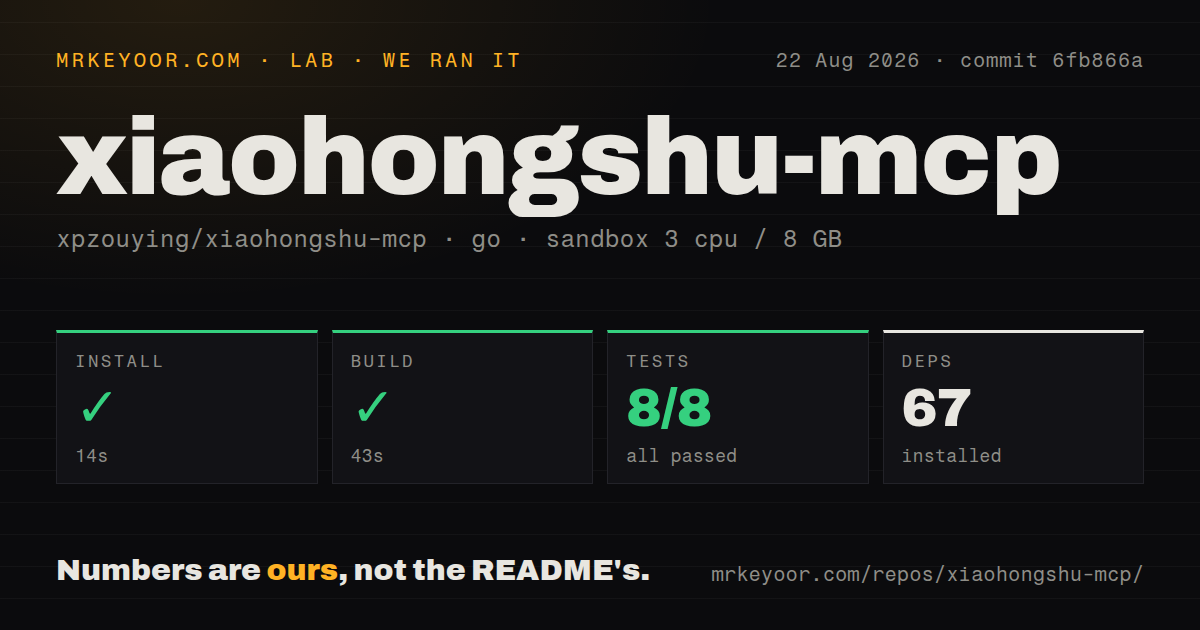
Our sandbox cloned commit 6fb866a into an unprivileged Go 1.24 Debian container with 3 CPUs and 8 GB of RAM. Installation completed in 14 seconds and added 67 packages. The build succeeded in 43 seconds.
Go test finished in 96 seconds with 8 passed and 0 failed out of 8. The complete checkout measured 83.8 MB despite containing only 151 files and about 13,033 lines of source. Our scan found 5 CI workflow files, a Dockerfile, and no separate tests directory; Go test files commonly live beside the packages they exercise.
We did not scan a login QR code, download the runtime browser, connect a real Xiaohongshu account, or invoke any public action. The clean 8-package result therefore verifies source mechanics, not current compatibility with the site's DOM, account controls, or geographic routing. A staging account and a harmless draft are still necessary acceptance tests.
Authentication is optional, while the actions are sensitive
The server listens on a local MCP endpoint and leaves authentication disabled unless AUTH_TOKEN or a nonempty token flag is supplied. The README recommends authentication for production and notes that command-line tokens may appear in the process list. Use the environment variable, bind to a private interface, and restrict inbound traffic even when bearer authentication is on.
The login tool stores cookies so the automated browser can act as the account. Protect that file like a password, exclude it from backups that leave the host, and rotate the session if the machine is lost. The README also warns that logging into the same account from another web browser can kick the MCP session out, although the mobile app may still be used for inspection.
Search failures show the cost of browser automation
Issue 813 reports search_feeds repeatedly ending in a context deadline after roughly 60 seconds, with or without filters, while list_feeds returned normally in the same session. The report connects the behavior to changed page elements and waits that consume the whole request timeout. Whether that exact selector is fixed later, the failure pattern will recur whenever Xiaohongshu changes markup or interaction timing.
An operator should monitor each tool separately. A successful login check does not prove search, publishing, or comments still work. Keep timeouts bounded, preserve screenshots and the final page URL on failure, and stop retry loops before they repeat a public action. Our 96-second test run did not open the website, so it cannot answer any of those browser questions.
RedNote outside China needs more than a different hostname
Issue 812 describes testing against rednote.com from the United Kingdom. The reporter found different login behavior, profile navigation that could not be clicked reliably, language-sensitive tab labels, and hard-coded Xiaohongshu domains in notification code. Several failures waited silently because the expected elements never appeared. This is direct evidence against treating overseas support as a base-URL setting.
Users outside the normal Xiaohongshu web region should test every required tool on their own network before adoption. x-mcp is the project's recommended browser-extension alternative for people who want fewer Docker and server problems. OpenClaw users can compare the separate self-contained skills package. The Go server earns its place when supervised automation and multiple MCP clients justify owning cookies, browser updates, access control, and selector maintenance.