Ten files make this a Claude workflow, not a service
Bazi Skill fits its whole product into 10 files: a Claude Code instruction file, one Python calculator, one regression file, reference tables, a README, and a license. The skill asks for a name, former name, solar and lunar birthdays, birth time, sex, and birthplace. After confirmation, Claude runs the calculator and interprets the printed pillars, luck cycles, annual cycles, and traditional markers. There is no web app, account system, or network server here.
Our checkout was 0.1 MB and contained about 1,602 lines of source. That small size makes the division of work easy to inspect. Python handles date conversion and chart arithmetic, while the language model supplies the narrative reading. The skill explicitly tells Claude to trust script output instead of calculating pillars from memory. That is the right boundary for this design, since prose generation and calendar arithmetic fail in different ways.
What happened when we ran it
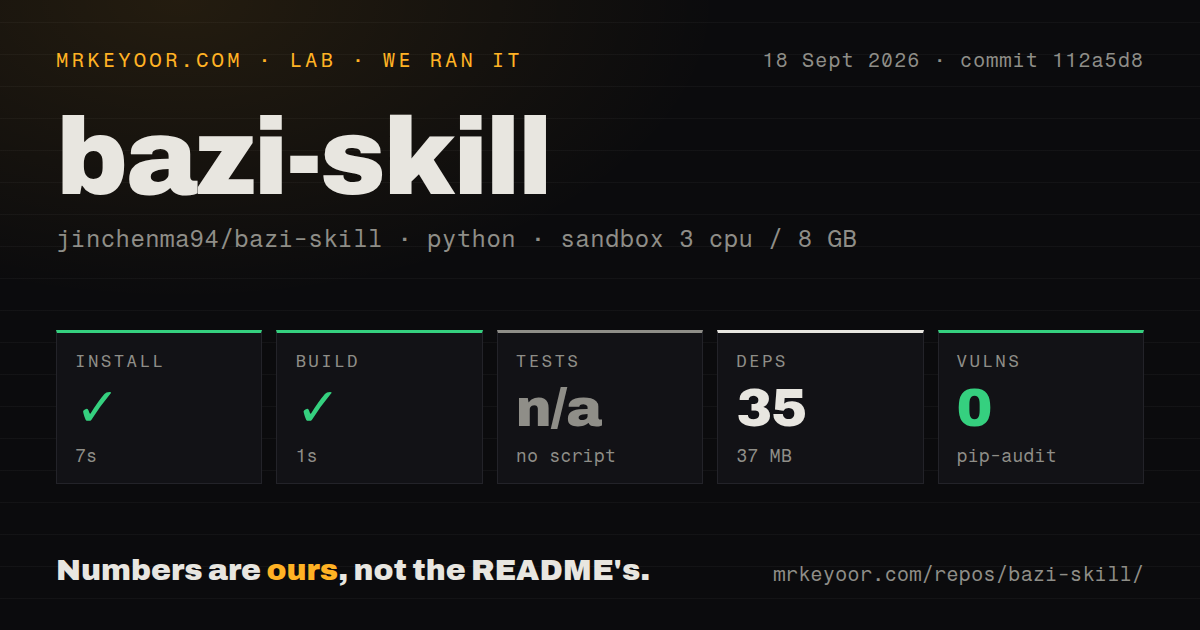
Our sandbox installed 35 packages in 7 seconds and occupied 37 MB. The build then succeeded in 1 second. Those are modest costs, although the README says the runtime calculator itself uses only Python's standard library. We cannot explain the gap from the supplied measurement alone, so the useful conclusion is limited: installation and building completed quickly at commit 112a5d8 in the stated clean container.
Tests were skipped because the repository exposed no test script or target to our harness. That matters even though scripts/test_pai_pan.py is present and the README calls it a regression test. A checked-in test file and a test stage that a new contributor can invoke are different things. Pip-audit found 0 known vulnerabilities, and the scan found no CI workflows, Dockerfile, or tests directory to provide another automated signal.
Python 3.6 covers fixed Beijing-time calculations
The Python 3.6+ calculator documents a 1900 through 2100 range and fixes its clock to Beijing UTC+8. It handles solar or lunar input, leap months, unknown birth hours, early and late midnight-hour rules, solar-term boundaries, luck-cycle direction, and annual rows. When both solar and lunar dates are supplied, the skill says the solar date wins and the lunar value is kept for display. That choice should be visible to anyone checking mismatched input.
The 1-second build did not validate the project's larger claim of accurate charts. Birthplace is accepted, but the code does not look up longitude or perform full true-solar-time correction. It only warns when a supplied clock time is within 15 minutes of an hour boundary. The script also states its astronomy approximations and date range. Users born near a solar term, the 23:00 day boundary, or an hour boundary should compare its output with an independent calendar.
The 10-file workflow asks for unusually personal input
This 10-file skill collects a full name, former names, two forms of birth date, time, sex, and birthplace before it calculates anything. Those details become part of a Claude Code conversation. The repository does not add a database, yet privacy still depends on the Claude Code environment and account policy in use. Someone testing the workflow can use fictional data first and decide whether a real person's complete birth details belong in that session.
The analysis stage then asks Claude to predict 3 to 5 past events and use the person's feedback to adjust its reading. That can feel persuasive because the interpretation changes after the user supplies confirming or disconfirming details. It is also why the README's entertainment disclaimer carries real weight. The repository's 1,602 source lines can make calendar output repeatable, but they cannot turn astrology into a scientific prediction method. Health and money suggestions still need ordinary professional evidence.
3,101 stars have not produced a release track
GitHub listed 3,101 stars and 7 combined issues and pull requests. The last code push was August 17, 2026, while issue activity continued on September 16. There is no latest release tag. Several pull requests opened in May and June remained open, including proposals for an MCP calculator and an expanded health analysis. Those are proposals only, so neither belongs in a description of what the main branch currently does.
Our repository scan found 0 CI workflows, and the open reports deserve more weight than the star count. Issue 23 identifies swapped names for two traditional punishment groupings in a bundled table. Issue 1 reports inaccurate day and hour pillars, although it predates the current script and does not prove the present calculator is wrong. The skill file also contradicts itself on solar-term edges: one section orders Claude to use one script result, while a later table says to discuss two possibilities.
Zero audit findings make a trial cheap, not authoritative
Pip-audit found 0 known vulnerabilities, so a local trial carries little visible dependency risk. Lunar Python is a better base when you need Chinese calendar data as an application library. MingLi-Bench is more useful when you want to test how language models answer traditional fortune questions. Yuan is the closer comparison for users who want a skill spanning Codex, Claude Code, and other Agent Skills runtimes rather than a Claude-specific Bazi flow.
Our 7-second install and 1-second build make Bazi Skill easy to inspect and discard if it does not fit. The absent test target, Chinese-only interface, 1900 to 2100 range, and unresolved instruction conflict keep it in experiment territory. Use it to study how a skill can put deterministic calculations underneath an AI conversation. Keep the disclaimer intact, verify the chart independently, and never let a generated reading decide whether someone takes medicine, changes work, moves money, or ends a relationship.