mrkeyoor.com_
Fri 18 Sept 15:56 UTC
AI Toolsevaluationupdated 18 Sept 2026

GLiNER2 review

GLiNER2 is a Python model family that turns a schema and a piece of text into entities, labels, records, relations, or attributes. It can run local checkpoints on CPU or GPU, which makes it useful when you need structured extraction without sending every document to a general-purpose language model.

Verdict

Our GLiNER2 run consumed 5,690 MB, found 10 known vulnerabilities, and still had not finished the tests after 900 seconds, so adoption needs an evaluation branch and a dependency-remediation plan. Trial it when one local schema must cover several extraction tasks and you can score every field against your own documents. Do not make relation graphs or mixed-script training a production dependency until the open behavior is verified in the exact release you deploy.

We ran it

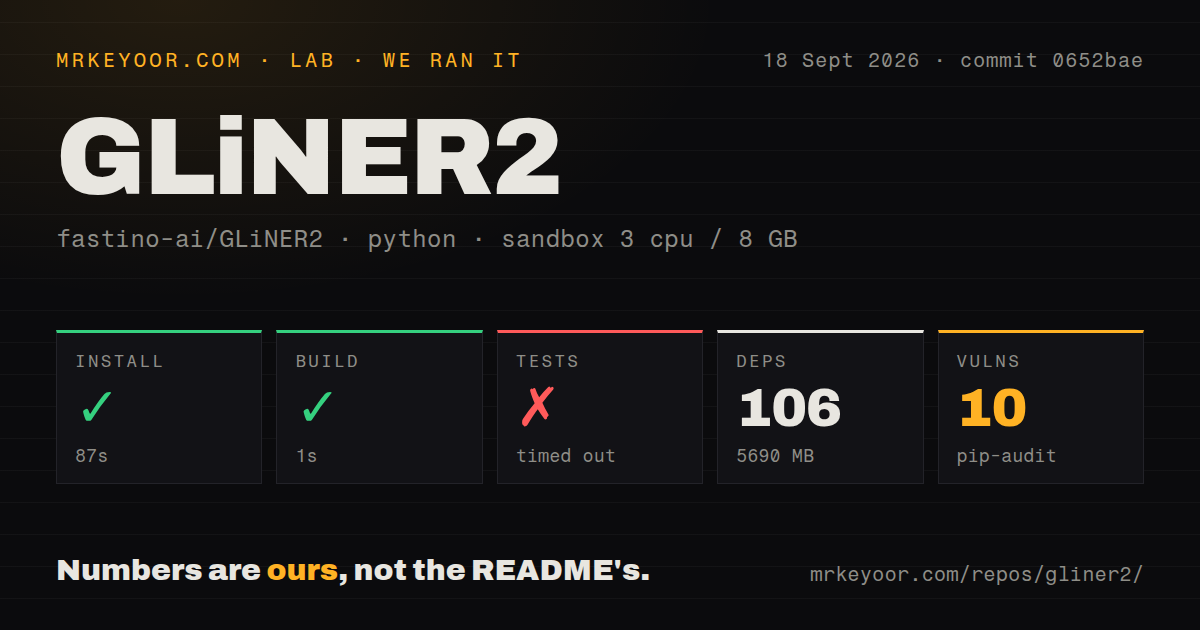
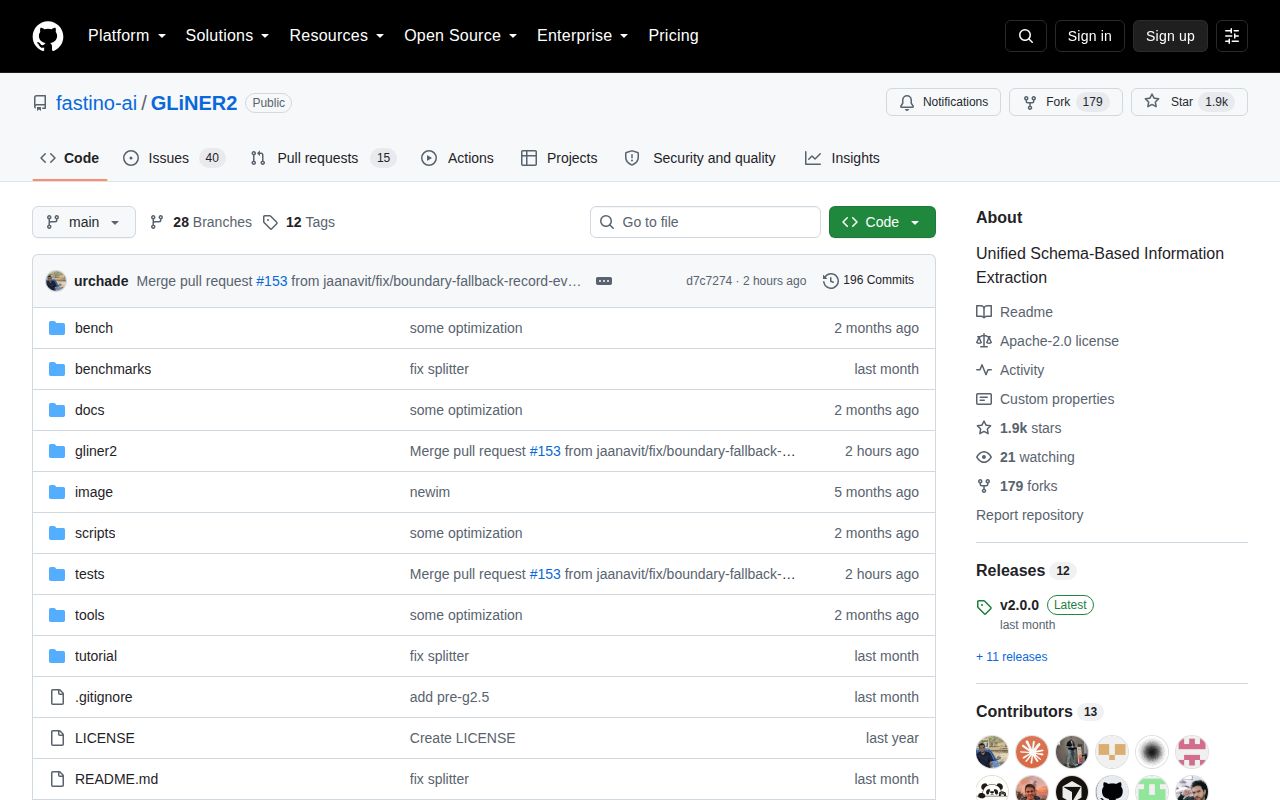
Lab card: what happened when we ran GLiNER2Screenshot of GLiNER2 (github.com/fastino-ai/GLiNER2)
Install✓ · 87s106 packages · 5690 MB
Build✓ · 1s
Tests✗ timed out · 900sran, no count parsed
Known vulns10(pip-audit)
Repo265 files~51,088 lines of source · 6.7 MB · 0 CI workflows · tests dir

Answers from our run

Does GLiNER2 build from source?

Dependencies installed in 87 seconds (106 packages), and the build succeeded in 1 seconds. We cloned commit 0652bae into a clean Debian container with 3 CPUs and no project-specific setup.

Do GLiNER2's tests pass?

We could not finish them: the suite was still running after 15 minutes in our container.

Does GLiNER2 have known vulnerabilities in its dependencies?

pip-audit flagged 10 known advisories in the dependency tree at the time of our run.

Who should not use GLiNER2?

Organizations that require a clean dependency audit before evaluation: our installed environment reported 10 known vulnerabilities.

What are the alternatives to GLiNER2?

GLiNER, spaCy, Transformers. Our GLiNER2 run consumed 5,690 MB, found 10 known vulnerabilities, and still had not finished the tests after 900 seconds, so adoption needs an evaluation branch and a dependency-remediation plan.

Setup2/587-second install used 5,690 MB; full tests exceeded 900 seconds
Docs4/5Many tutorials and loader guidance, with some API behavior disputed
Community4/51,936 stars and same-week issue fixes and pull requests
Maturity2/5Timed-out suite, 10 advisories, and open extraction defects

Who it’s for

Python teams that want one local model interface for entity extraction, classification, records, relations, and span labels.
Document pipelines that can define schemas, keep held-out examples, and evaluate each field before production use.
Privacy-sensitive applications willing to download and operate model weights locally.
Researchers who need training, LoRA, long-document chunking, or English and multilingual checkpoint choices.

Who it’s NOT for

Organizations that require a clean dependency audit before evaluation: our installed environment reported 10 known vulnerabilities.
CI pipelines with a firm 15-minute ceiling: our suite timed out at 900 seconds, after progress passed 51% and failure markers had appeared.
Knowledge-graph work that assumes relation descriptions are honored: open issue 101 confirms that v2.0.0 accepts but silently drops them on the JointIE path.
CJK or mixed-script training without tokenizer tests: open issue 156 shows the default splitter rejecting a Chinese entity that exists in the source text.
Teams seeking proven accuracy on their own domain from the README examples alone; our run did not produce quality or latency measurements.

Setup reality

Our sandbox installed 106 Python packages in 87 seconds and occupied 5,690 MB. The build passed in 1 second. Tests timed out at 900 seconds, with progress beyond 51% and failure markers already visible. Pip-audit found 10 known vulnerabilities.

Python 3.10 or newer is required. The base install omits PyTorch and supports schemas, validation, training-data tools, and a cloud client that reads PIONEER_API_KEY. Local inference needs the [local] extra plus downloaded checkpoint weights; training and benchmarks use larger extras.

AutoExtractor is the safe loader across span and boundary checkpoints. CJK text needs the documented character splitter, which can change quality and must be selected again after reload. The 5.69 GB lab environment is a warning for local images, not the size of the torch-free base install.

One schema can drive five extraction jobs

GLiNER2 puts 5 related jobs behind one Python interface: named entities, text labels, structured records, relations, and attributes attached to spans. You describe the fields or labels you want, then a schema-conditioned encoder searches the text for them. That makes the project appealing for document pipelines that would otherwise maintain separate classifiers, entity models, and record parsers.

The boundary-based GLiNER2.5 checkpoints extend the original fixed-width span approach with start and end pairing. The public models range from a 74M-parameter English option to a 340M-parameter legacy span model, with multilingual and safety-focused choices in between. Long-document methods scan overlapping chunks and remap local offsets into the original text. None of that establishes accuracy on your invoices, contracts, or clinical notes.

The base package is small in scope; local inference is not

The torch-free base package declares 4 direct runtime dependencies and supplies schemas, regex validators, data utilities, and the cloud client. Local checkpoint inference moves to the [local] extra, which adds PyTorch, Transformers, PEFT, NumPy, and safetensors. The client reads PIONEER_API_KEY; the local route needs checkpoint files from the model hub but no per-document hosted call after the assets are present.

Separate extras cover training, tests, development, and benchmarks. That packaging is thoughtful because schema validation should not pull an ML runtime into every service. A local worker still needs storage for the Python stack and chosen weights, plus CPU or GPU memory. The README labels the models CPU-first, while its optional CUDA paths add fp16, compilation, and FlashDeBERTa. We did not measure inference speed.

What happened when we ran it

Our sandbox cloned commit 0652bae, installed 106 packages in 87 seconds, and used 5,690 MB on disk. The repository itself contained 265 files, about 51,088 lines of source, and occupied 6.7 MB. Building succeeded in 1 second. Pip-audit reported 10 known vulnerabilities in the installed environment; the supplied result does not identify their severity here.

The test process hit our 900-second cap and did not complete. The log had crossed 51% and displayed failure markers before timeout, followed by a Python thread stack ending inside the tqdm monitor wait. That tail does not tell us which test kept the process alive or whether the monitor caused the delay. It establishes only that the full suite neither passed nor finished in our stated environment.

Our scan found a tests directory but 0 GitHub Actions workflow files and no Dockerfile. The README describes release gates across Python 3.10 through 3.12, offline checks, checkpoint quality, CUDA hardware, and fresh artifact installs. Those claims may be implemented outside the measured checkout or in later changes; the commit we inspected did not expose workflow files for a buyer to audit.

Two architectures make the loader choice consequential

The public API has a trap the README explains plainly. AutoExtractor reads checkpoint metadata and dispatches to the span or boundary architecture. The older GLiNER2.from_pretrained() alias is span-only and will not load GLiNER2.5 boundary weights. Starting new code with AutoExtractor avoids coupling the application to one family before you have compared its outputs.

Word splitting deserves the same care. Public checkpoints use whitespace boundaries by default. A character splitter is provided for Chinese and other text without whitespace-delimited words, but the README warns that changing boundaries can affect quality and that this runtime choice is not stored with a checkpoint. A service must pass the setting again on reload, then test offsets against the original document.

Relation descriptions and CJK training have open defects

Issue 101 was still open on September 17, 2026. Its follow-up confirms on v2.0.0 that the JointIE schema accepts relation descriptions yet fails to pass them into the model contract. Thresholds on the same relation object work. Silent acceptance is especially risky because an application cannot tell whether the model rejected its definition or the library ignored it.

Issue 156 gives a smaller, reproducible CJK failure. With the default splitter, one Chinese sentence becomes a single token, so an entity inside it cannot align as a token subsequence and training raises a misleading missing-entity error. The documented word_splitter="char" workaround aligns that example, though the report says mixed CJK and URL text still lacks a good built-in option.

September fixes show speed, while the verification debt remains

GitHub reported 1,936 stars, 55 combined issues and pull requests, and a last push on September 18, 2026. Several classification and training bugs opened on September 16 or 17 were fixed by September 18. Release v2.0.0 landed August 24 with long-document chunking, span attributes, constrained classification, JointIE, and the boundary architecture.

That pace is encouraging for a young model library, and it also means the behavior is moving quickly. GLiNER2 is worth a measured trial if a single 194M-parameter checkpoint could replace several narrow extraction services. Keep the trial behind held-out documents, compare spans and records field by field, pin the checkpoint and splitter, and block promotion until the dependency audit and full suite are clean enough for your policy.

Alternatives

ProjectWhat it isPick it when
GLiNERThe original open-label entity recognizer on which GLiNER2 builds.pick this instead when open-label named entities are the job and you do not need GLiNER2's record, relation, or classification layers.
spaCyA production NLP toolkit for trained pipelines, rules, tokenization, and custom components.pick this instead when deterministic rules, mature pipeline tooling, and task-specific training matter more than one schema-conditioned model.
Transformers gh↗A general model library for assembling task-specific NLP inference and training workflows.pick this instead when you want direct control over the model architecture and can build each extraction task yourself.

What people are saying

  1. [github-trending] fastino-ai/GLiNER2

Sources

  1. GLiNER2 repository and README
  2. GLiNER2 v2.0.0 release
  3. Relation extraction issue 101
  4. CJK word-splitter issue 156
  5. GLiNER2 EMNLP system paper

More ai tools reviews

PaddleOCR · bazi-skill · transformers.js · OpenBitFun · rowboat · skills · the whole board →