Version 4.3.0 brings several model families to JavaScript
Transformers.js puts text classification, generation, translation, speech recognition, image classification, object detection, embeddings, and other tasks behind JavaScript APIs. Version 4.3.0 can run in a browser with no application inference server. The familiar pipeline() call chooses a supported model, handles its preprocessing, runs ONNX inference, and turns tensors back into task output. For a web team already living in TypeScript, that is a much shorter path than building a Python service for every feature.
Breadth is the main reason to start here. The same library covers text, audio, vision, and multimodal work, while the README's task table says exactly where support stops. A sentiment widget and an in-browser transcriber can share model loading conventions, cache behavior, and device selection. Apache-2.0 licensing also gives commercial teams a permissive code license, though each model can carry its own terms and must be checked separately.
Version 4.3.0 still makes the browser pay for model files
The default browser path downloads pretrained models from the Hugging Face Hub and precompiled WASM binaries from jsDelivr. That removes your inference server, but it does not remove transfer time, cache behavior, or memory limits. A first visit may fetch far more than the JavaScript package itself. Transformers.js exposes progress callbacks and quantized files, so the product can show a real loading state and choose smaller weights instead of leaving a blank interface during a large download.
Offline use takes deliberate configuration. env.allowRemoteModels = false prevents Hub access, while env.localModelPath redirects model lookup and env.backends.onnx.wasm.wasmPaths moves the runtime binaries. Those settings let an extension, desktop shell, or controlled web deployment serve its own artifacts. You still need every tokenizer, processor, configuration, ONNX graph, and WASM asset at the expected path. Test the packaged application with network access disabled, because one overlooked remote file defeats the offline claim.
What happened when we ran it
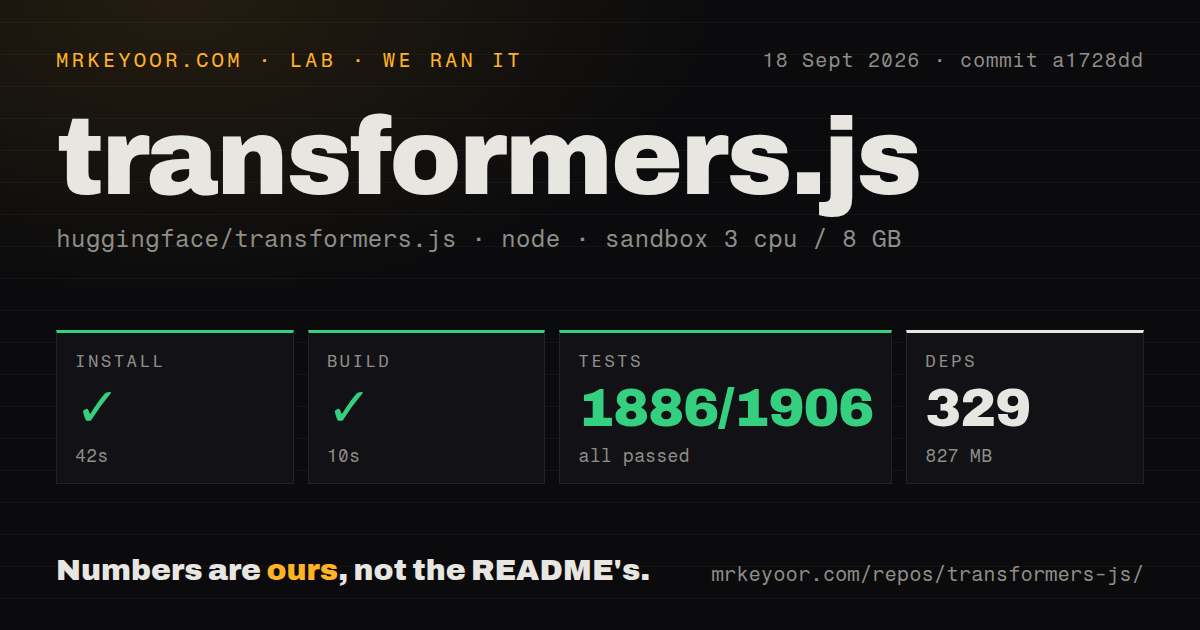
Our pnpm install completed in 42 seconds, added 329 packages, and occupied 827 MB on disk. The monorepo build passed in another 10 seconds. commit a1728dd contained 745 files, roughly 70,148 lines of source, and 3.6 MB before dependencies. We found 5 CI workflow files and workspace configuration, with no Dockerfile and no root tests directory. The successful build is a useful sign for contributors, while the installed size makes this a substantial development checkout.
The test command ran for 586 seconds and exited with code 1. Jest reported 27 suites in total: 25 passed and 2 failed to run. At the test level, 1,886 passed, 20 were skipped, and 0 failed out of 1,906. The supplied log tail does not name the reason those suites failed to start, so we will not assign one. The accurate result is a large passing set inside an overall failed test command.
WebGPU reaches about 85% of users, not every browser
Hugging Face's guide estimated global WebGPU support at about 85% in March 2026. Chromium browsers provide the strongest path, while Firefox may need a flag and Safari support depends on the version. Transformers.js uses CPU-backed WASM by default and switches to the GPU when you request device: 'webgpu'. A production feature needs capability detection and a UI that can explain when it is using the slower fallback or cannot load the selected model.
WebGPU availability also says little about a particular workload. Model shape, data type, browser, GPU driver, and ONNX Runtime behavior all influence whether a task fits and runs correctly. Open issue 1739 describes GPU memory rising by roughly 650 MB for each 30-second Whisper chunk under version 4.2.0, across several operating systems. Version 4.3.0 contains related memory fixes for specific models, but the Whisper report remains open. Long audio deserves a current reproduction before release.
Four common quantization families trade size for model behavior
The documentation names full precision, half precision, 8-bit, and 4-bit options, with exact choices varying by model. WASM commonly defaults to q8, while WebGPU commonly uses fp32 unless you choose another supported type. ModelRegistry.get_available_dtypes() checks which files exist for a model. Multi-session models only report a data type when every required session file is present, which prevents a selector from offering a combination that cannot fully load.
Smaller is not an automatic winner. The guide calls out encoder-decoder models such as Whisper and Florence-2 as sensitive enough to need per-module data types. One component may stay at fp16 while another uses q4. That flexibility is useful, but it moves validation into your application: compare output quality, startup time, peak memory, and browser compatibility for the exact combination. Our sandbox measured repository commands, not model speed or inference quality, so it supplies no benchmark for that choice.
September 2026 activity supports adoption, with 189 open issues
GitHub recorded 16,301 stars and a last push on September 16, 2026. Release 4.3.0 arrived the same day with structured output, 3 new model architectures, Safari 26 WebGPU support, an ONNX Runtime update, and fixes across model loading and generation. The repository showed 257 combined issues and pull requests; a separate GitHub search returned 189 open issues. Those counts describe a busy project with a wide hardware surface, not 257 confirmed bugs.
The open queue is part of the buying decision because browser ML has many combinations that maintainers cannot pre-test for you. Use Transformers.js when keeping data on the device and avoiding a dedicated inference service justify model downloads and hardware variance. The 10-second build and 1,886 passing tests make the codebase credible, while the 2 suites that failed to run rule out blind confidence in this commit. Pin version 4.3.0, test real target devices, and keep the CPU path usable.