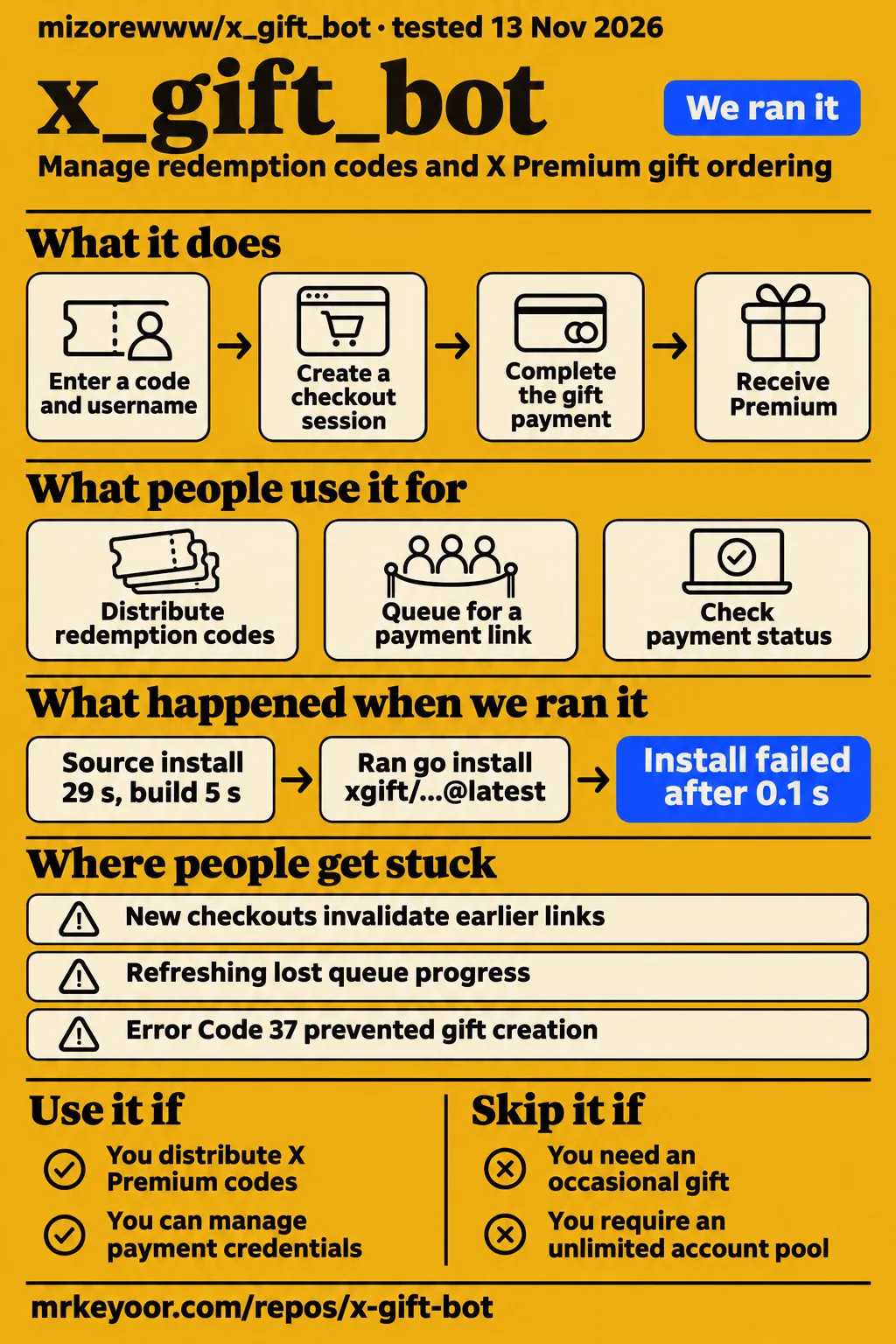
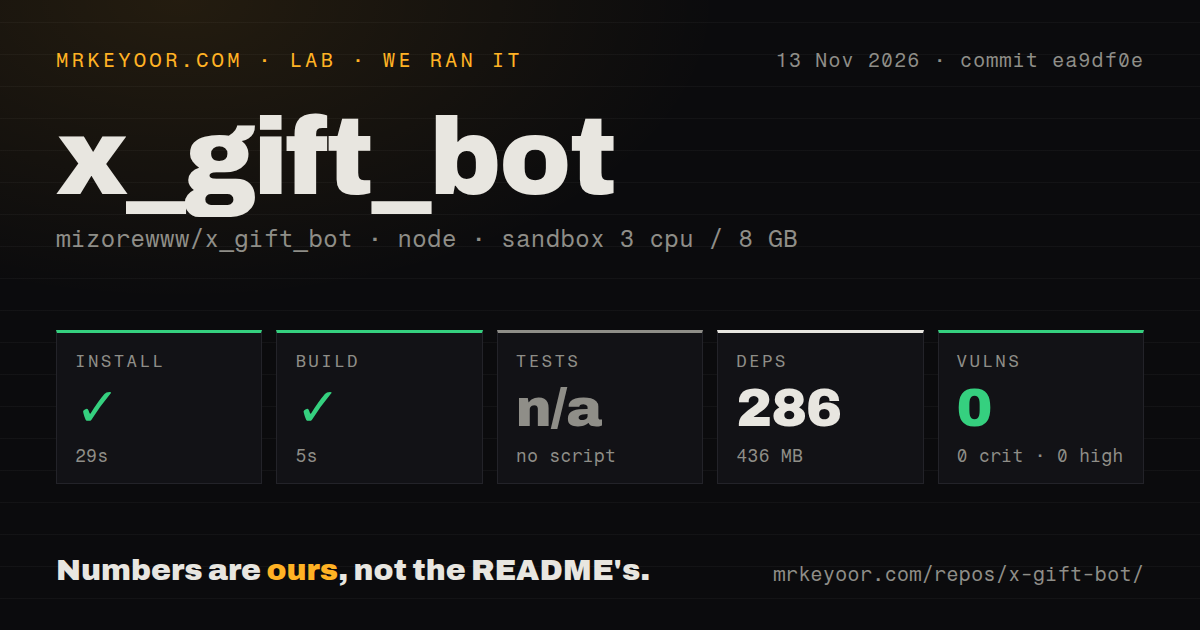
Our npm install took 29 seconds and the build took 5 seconds at commit ea9df0e. XGift, the project named x_gift_bot, is aimed at operators who distribute X Premium redemption codes and manage the resulting orders. Its practical appeal is the redemption desk: recipients enter a code and username, while the operator handles credentials and payment. For an occasional gift, X's own checkout is the more direct choice. For a hosted redemption service, the decision turns on who will investigate an order when its payment state becomes unclear.
What you can do with x_gift_bot
XGift's README describes issuing redemption codes that recipients enter with their X usernames, followed by automated Premium gift ordering and payment. The project README also describes an administration interface for generating and disabling codes, organizing batches, viewing statistics and inspecting order status. This gives a distributor a single place to manage redemptions. The operator supplies the sending account and payment configuration; the recipient supplies the issued code and the account that should receive the gift.
Manual checkout is a separate workflow. In issue #6, the maintainer explains that a manual Stripe payment link buys Premium for the entered X account without generating another redemption code. Someone expecting a code after paying is therefore looking for the wrong output. The useful questions are whether payment was recorded and whether the intended account received Premium. Explaining that distinction before checkout would give recipients a clearer expectation of what the page should show afterward.
The README also describes administrator recovery payments. An administrator previews affected orders, reviews amounts and card suffixes, and explicitly confirms payment. Upstream says that confirmation can initiate real payments independently of the public payments-enabled switch. Previewing orders and inspecting their states are separate operations. Anyone staffing the redemption desk needs to understand those controls because a support action can change from reading an order to authorizing money movement.
What people use x_gift_bot for
The reporter of issue #7 waited for a payment link, returned to the page later and found that the payment window had expired. This is the supplied user account of the queue experience, rather than a hypothetical campaign. The maintainer responded by reporting optional notifications, page-title changes and automatic expansion of the payment area. Those changes address a specific problem: the user needed to notice that a queued request had become an actionable checkout.
| Who used it | What happened | Reported response |
|---|---|---|
| The reporter of issue #7 | Queued for a payment link, returned later and missed the ready link | The maintainer reported optional browser notifications, title changes and automatic expansion of the payment area |
For an operator distributing codes, this report makes the waiting experience part of the service decision. Recipients need to recognize when they are queued, when a link is ready and which action follows. The reported interface changes give each transition a visible signal. They also explain why a redemption desk requires more than a form that accepts a username: someone must communicate the order's progress and respond when a recipient returns after the checkout opportunity has passed.
What happened when we ran it
In our sandbox run on November 13, 2026, npm install succeeded in 29 seconds and the build succeeded in 5 seconds at commit ea9df0e. The configured environment used 3 CPUs, 8 GB RAM and image label lab-node:22. We measured the dependency installation and build steps, and the supplied harness recorded the repository and dependency footprint. These results give a concrete starting point for evaluating the Node portion of the checkout.
| Recorded check | Our result | Verdict | Why |
|---|---|---|---|
| npm install | Succeeded in 29 seconds | Completed | The harness recorded a successful dependency installation |
| Build | Succeeded in 5 seconds | Completed | The harness recorded a successful build |
| Dependencies | 286 recorded, 436 MB on disk | Footprint recorded | These figures describe the installed dependency tree |
| Tests | Skipped: no tests script or target | Skipped | The harness had no test target to run |
| npm audit | 0 known vulnerabilities, including 0 critical, high, moderate or low | No listed advisories | This is the recorded dependency-audit result |
| Repository scan | 142 files, about 21,804 source lines, 3.3 MB checked out | Checkout recorded | These figures describe the scanned repository |
| Automation scan | 0 CI workflow files, no Dockerfile, no tests directory | Artifacts absent from scan | The scan found none of those artifacts |
The README's local preview instructions specify Node.js 22+ and the sequence npm ci, npm run build, then npm run preview. Upstream describes the preview as in-memory example data with no connection to real services. It serves the redemption page at port 4173 and the administration page at /admin. That is a documented interface-preview route; the table above records the separate npm checks actually supplied by our harness.
Where people get stuck: links and queues need different fixes
Issue #2 attributes immediately inactive Stripe links to successive checkouts created through the same sending X account. The reported error was checkout_not_active_session, with Stripe's message, "This Checkout Session is no longer active." The maintainer says a new checkout invalidated the preceding link even when the recipients differed. The issue #2 response reports serialized order creation, persisted occupancy and a Stripe status check before returning an existing link.
| Symptom and source | Explanation in the record | Reported fix or next action |
|---|---|---|
| Issue #2: link immediately inactive | A later checkout replaced the earlier session on the shared sending account | Serialize creation, persist occupancy and regenerate invalidated links |
| Issue #4: queue progress lost on collapse or refresh | The interface lost continuity with the queued request | Keep the component mounted, restore the original ticket and reconnect after network failures |
| Issue #12: Error Code 37 | The response identifies the sending account as ineligible to gift | Inspect the configured sender's status; the response suggests an eligible account or waiting for restrictions to lift |
| Issue #11: payment link temporarily unavailable | The record contains the reported error and a closed issue with 0 comments | No diagnostic response is supplied |
The queue repair described in issue #4 preserves the original ticket through collapse, refresh and temporary network failures. The maintainer also reports checking ticket consistency after simulated Failed to fetch errors and checking restart recovery online. Those are attributed project reports. Their operational point is straightforward: restoring the existing request should precede creating another one, particularly when new checkout creation was itself the cause of an earlier link failure.
Payment status has four meanings worth keeping separate
Issue #3 separates a generated checkout link from a checked payment result. Its response says the repaired handling uses the Stripe result tied to the order and no longer treats session invalidation as payment success. That distinction gives operators a useful vocabulary for support. A recipient saying "the page finished" may be describing a link, a closed session, a charge or the account's Premium benefits; each calls for different evidence.
| State | Evidence to inspect | Question it answers |
|---|---|---|
| Link generated | The application has created a checkout session | Is there a checkout to open? |
| Session inactive | Stripe reports that the checkout is no longer active | Can this session still be used? |
| Payment recorded | The payment result tied to the order has been checked | Has this order's payment been recorded? |
| Premium received | The recipient checks the account's Premium page | Does the intended account show the expected benefits? |
The issue #3 response asks a reporter with an actual debit and missing Premium to reopen the issue with the occurrence time and redacted payment evidence, without paying again. That is a useful support sequence to adopt: inspect the existing transaction and gather evidence before considering another payment. It also gives the operator a concrete way to ask for help without requesting a full card number, verification code or complete statement in public.
Issue #6 reports a read-only lookup by X username that displays plan, generation time and payment state. The maintainer says the lookup neither queues nor creates an order and returns neither a payment link nor card information. Separating inspection from order creation matters here because the user is trying to understand an existing transaction. A status question should take the operator back to that transaction rather than starting another checkout.
Serialized checkout makes the queue part of the purchase
Issue #2 reports making order creation serial so the next checkout does not immediately invalidate the current link. That repair connects checkout reliability to queue behavior. The service has to preserve the active order while telling later visitors that they are waiting. For a distributor, the practical preparation is to explain that sequence before handing out a batch of codes, including how recipients recognize a ready link and return to their existing request.
X's supplied official help says gifts are annual Premium or Premium+ purchases, purchases are final and a sender can buy up to three Premium gifts per day. The README describes a default catalog with 3- and 6-month packages. These are different descriptions of the available products. An operator should read the product shown in checkout and the official gifting terms together before authorizing a purchase, rather than treating a catalog entry as the complete purchasing rule.
The response to issue #10 rejects an account pool for unlimited gifting because of abuse risk. It treats crypto payments separately, saying they are under consideration, require separate Stripe configuration and have no ETA. These product decisions matter when choosing the repository: a request for more sending accounts or another payment method is different from a documented feature an operator can configure today.
Security starts with the operator's payment credentials
The README requires X login cookies, card details and billing information, and describes AES-256-GCM storage for sensitive records. Its documented vault contains cookies, cards, proxy settings and orders. The separate site database holds usernames and states in plaintext, with redemption codes represented by digests and suffixes. These details make file access and backup handling part of operating the redemption desk, alongside the visible checkout and administration pages.
The deployment instructions specify a loopback listener, an HTTPS reverse proxy and an administrator password generated during setup. They recommend placing configuration and password files in a protected directory with permissions of 0600. The README also says that losing the vault password makes the encrypted data unrecoverable and instructs operators to back it up with the databases. A recovery plan therefore needs both the data and the password file required to read it.
Administrator recovery has its own payment controls. Upstream says preview, status inspection, deployment and restart do not initiate payment, while an explicit recovery confirmation does. It describes a 10-minute preview validity period and a new preview when card configuration or order contents change. That makes the preview a review step with a defined lifetime. Support staff should read the order and amount at that step before proceeding to the confirmation that authorizes payment.
English readers will encounter Chinese setup instructions
The supplied README and setup-wizard explanations are Chinese, including the payment-recovery and backup instructions. The commands and configuration keys remain recognizable to an English-speaking developer, but the prose explains what the actions mean. Translate those instructions before entering credentials, especially the distinction between inspecting an order, replacing a checkout and confirming a recovery payment. Those decisions affect the transaction rather than just the appearance of the interface.
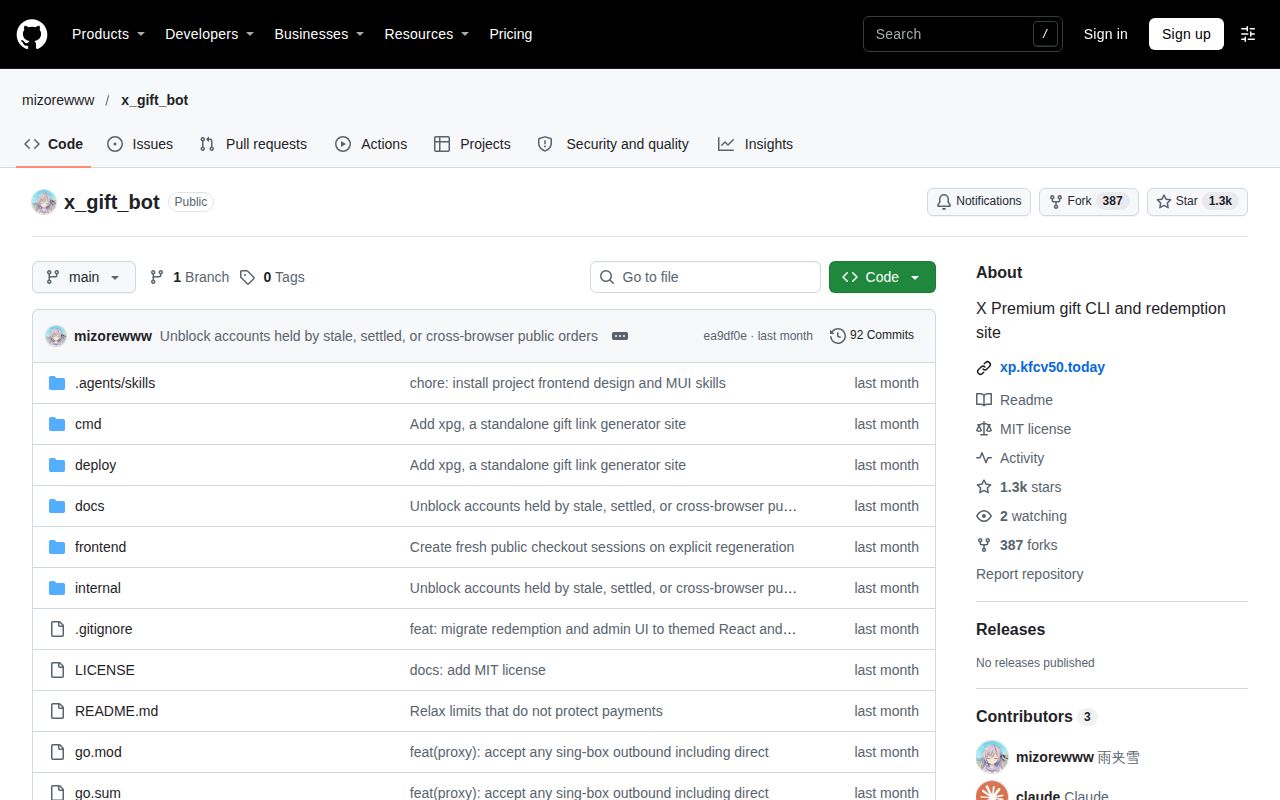
The supplied issue threads are also mostly Chinese, while issue #10 contains an English request and response. Repository metadata records a last push of October 9, 2026, observed on November 13, 2026. The useful maintenance detail in this pack is the content of the repair explanations: they name failure modes, describe state handling and distinguish accepted fixes from rejected product requests. Match any behavior you depend on to the code you intend to deploy.
x_gift_bot vs official X gifting and BTCPay Server
Official X gifting provides a profile-based Premium checkout, while BTCPay Server describes a merchant Bitcoin payment processor. Those documented jobs make the alternatives useful for different requirements. Choose the workflow that matches what you need to operate: issuing redemption codes, buying a gift directly or accepting Bitcoin for a business. The extra administration in XGift is relevant when distributing and tracking redemptions is itself part of the job.
| Choice | Documented job | Pick it when |
|---|---|---|
| x_gift_bot | Redemption codes, an administration dashboard and automated X gift ordering | You need recipients to redeem issued codes and can own credentials and order recovery |
| Official X gifting | Purchase Premium or Premium+ from a recipient's profile | You need an occasional gift without operating a redemption desk |
| BTCPay Server | A self-hosted Bitcoin payment processor | You need to accept Bitcoin for your own business |
BTCPay Server describes itself as a self-hosted Bitcoin payment processor. Its README says merchants can accept Bitcoin directly. That addresses the payment-acceptance requirement raised by interest in crypto, while XGift's described job is ordering and paying for X gifts. For an occasional gift buyer, the direct comparison is X's documented checkout: visit the recipient's profile, choose Premium or Premium+ and complete the gift payment.
What discovery pages leave out
Trendshift's supplied page reports 1,283 added stars and 398 added forks over its stated 43-day period. Its activity description tracks stars, forks and merged pull requests alongside trending rank. Those figures explain attention to the repository. The operational explanation comes from different records: issue #6 distinguishes manual checkout from code redemption, issue #2 explains link invalidation and issue #4 describes preserving a queue ticket.
The useful addition to a discovery summary is therefore the order-state map. A reader deciding whether to host XGift needs to know what a generated link means, where the payment result appears and how to inspect an existing order. The supplied issue discussions answer those questions more directly than repository popularity figures. Reading them alongside the README changes the evaluation from recognizing a trending project to deciding who will handle its payment and recovery workflow.
FAQ
Issue #6 reports a payment-status lookup, issue #2 explains inactive links and issue #3 gives a response procedure for disputed payments. These records answer practical recipient questions about what the interface should produce and what evidence to gather afterward. The answers below attribute reported behavior to the project. Browser requirements, notification conditions and the assessment boundary are collected in the final section so those qualifications have one place on the page.
Can I check the payment status of an order created with x_gift_bot?
Issue #6 reports a read-only lookup by X username showing plan, generation time and payment state. The maintainer says the query neither queues nor creates an order and returns neither a payment link nor card information. Use that inspection route to understand an existing request before deciding what to do next. It separates the question "what happened to this order?" from the action of creating another checkout.
Does a manual Stripe payment link generate a redemption code?
The maintainer says a manual Stripe link purchases Premium for the specified X account without generating another redemption code. That flow has a different expected output from redeeming an issued code. After using manual checkout, the useful evidence is the order's payment state and the recipient account's benefits. Searching for a new code would confuse the two workflows described in issue #6.
Why does my generated Stripe payment link immediately expire?
Issue #2 attributes immediately inactive links to a later checkout invalidating the earlier session on the shared sending account. The maintainer reports serializing order creation, persisting occupancy and checking Stripe before returning an existing link. The response says already invalidated links need regeneration. It asks users who encounter the problem again to reopen the issue with the occurrence time and displayed error.
What should I do if I paid but received no confirmation or Premium benefits?
Issue #3 asks users with an actual debit and missing Premium to reopen the issue with timing and redacted payment evidence, without paying again. Keep card numbers, verification codes and complete statements out of a public thread. The operator's next task is to inspect the original order and payment evidence, then compare that result with the benefits shown on the intended recipient account.
Can x_gift_bot notify me when my payment link is ready?
Issue #7 reports an optional readiness notification, a changed page title and automatic expansion of the payment area. The notification option asks the user for permission, and the maintainer describes a Service Worker notification in supported browsers. These changes respond to the reporter who returned after the payment opportunity had expired. They give an operator specific interface behavior to explain when a recipient asks how to recognize readiness.
Why does x_gift_bot return Error Code 37 when creating a gift?
The response to issue #12 identifies the sending X account as ineligible to gift. The reporter could look up the recipient but received the error when initiating the gift. The response directs attention to the configured sender and distinguishes the hosted service's account from an account used in a self-hosted deployment. That distinction helps the operator inspect the credentials responsible for initiating the transaction.
Does x_gift_bot support Stripe crypto payments or an X account pool?
Issue #10 says crypto payments are under consideration with no ETA and require separate Stripe configuration. The same response rejects an account pool for unlimited gifting because of abuse risk. These are separate decisions about payment methods and sending accounts. An operator choosing the project should base the configuration plan on its documented workflow rather than treating either requested capability as an available setting.
Should payment-link generation require GitHub login and usage limits?
The maintainer rejected the GitHub-login and quota proposal in issue #5 as unsuitable for the project's current use case. The reply treats those admission controls separately from queue recovery and says the refresh problem was fixed independently. If your intended service requires the proposed login, account-age, binding or frequency controls, include that requirement in the choice of software before preparing a public redemption service.
What we have not tested yet
Our npm checks cover installation and build at ea9df0e; they do not establish Go-binary operation, live payment, Premium delivery, sustained throughput or the correctness of reported repairs. The configured lab-node:22 image label supplies neither actual runtime versions nor an operating-system version. Raw toolchain logs would be needed for those details. The preview described upstream uses example data, and no independently measured delivery success rate accompanies this pack.
A separate quickstart-cli run records commit ea9df0eca7e1 on November 13, 2026, in an unprivileged golang:1.24-bookworm container with 2 CPUs, 4 GB RAM, no published ports and no secrets. Its clone step took 1 second. The install step failed in 0.1 seconds with exit 1 after attempting go install xgift/...@latest: go: xgift/...@latest: malformed module path "xgift": missing dot in first path element.
The probe's install-failed finding records that same error, and its teardown record says teardown: ok. The attempted install command differs from the README's clone-and-build instructions, which specify Go 1.27+ and building two binaries. The probe therefore supplies a failed step, not a demonstrated failure of that documented route. The npm harness remains the source for the installation, build, dependency, audit and test figures reported above.
Checkout recovery, notifications, mobile behavior and browser-local lookup were not reproduced in our run. Issue #6 restricts lookup to the browser that generated the links; changing devices or clearing site data prevents lookup. Issue #7 requires the page to remain open, with mobile system notifications dependent on browser and OS permissions. Issue #4 says leaving the site exits the queue after a short recovery allowance, while explicit abandonment cancels immediately.
The payment-window duration is unresolved: issues #2 and #3 describe 15 minutes, while issue #7 says 180 seconds. The extracts do not reconcile those values. Issue #12 supplies suggested responses to sender ineligibility without a successful recovery record. Issue #11 has no diagnosis, and issue #3 explicitly leaves its reporter's particular debit unconfirmed. The supplied records also do not establish that the repository's configured catalog bypasses X's official gifting constraints.
Encryption implementation, credential handling, administrator authorization and financial correctness have not been audited here. Zero npm advisories is the dependency-audit result; the missing test target supplies no regression-suite result. Another X gifting project, rendered layout, assets, related links, recommendation modules and template content were not evaluated. All four score cards remain unassessed because the evidence supports specific observations rather than numerical judgments about complete setup, documentation accuracy, support quality or production maturity.
Before supplying real card details, the missing transaction evidence to seek is one reconciled order: its checkout, recorded payment result and Premium benefits on the intended account. The recovery procedure should be understood before considering a second payment. That is the next useful evaluation step for an operator choosing this redemption desk, alongside matching the deployed code to the repair behavior described in the supplied issues.