Six modules cover WeChat backend work, with no web app
WxJava divides WeChat work into 6 modules: official accounts, mini programs, payments, corporate WeChat, the open platform, and Channels or WeChat Store. Each wraps the corresponding server API behind Java services and data objects. The repository also carries Spring Boot starters, a Maven BOM, demos, and Javadocs. It has no dashboard or mobile client. The README calls it an SDK and explicitly says there is no web implementation.
Our commit f95fd76 copy had 5,072 files and about 422,554 lines of source, yet it was only 16.1 MB before dependencies. This is a multi-module library, not a service to deploy. Import the artifact for the WeChat surface you need; your backend owns HTTP endpoints, persistence, secrets, and packaging. Pulling the repository is mainly for contributors or teams auditing the implementation.
The Maven module is the decision that matters
The README maps 6 business scenarios to artifact IDs, including weixin-java-mp, weixin-java-miniapp, weixin-java-pay, and weixin-java-cp. Teams using several can manage versions through wx-java-bom, available from 4.8.3.B. A single-service application can declare one module. A payment integration therefore does not require every class for corporate messaging or mini-program commerce.
Version guidance needs a careful read. The direct dependency example names 4.8.0, the BOM section starts at 4.8.3.B, and the latest formal GitHub release is v4.8.0. The README says timestamped builds and test versions can appear between formal releases. It sets JDK 8 as the current minimum, directs JDK 7 users to 3.8.0 or earlier, and sends JDK 6 users to another repository. Pin the artifact line your team tested.
What happened when we ran it
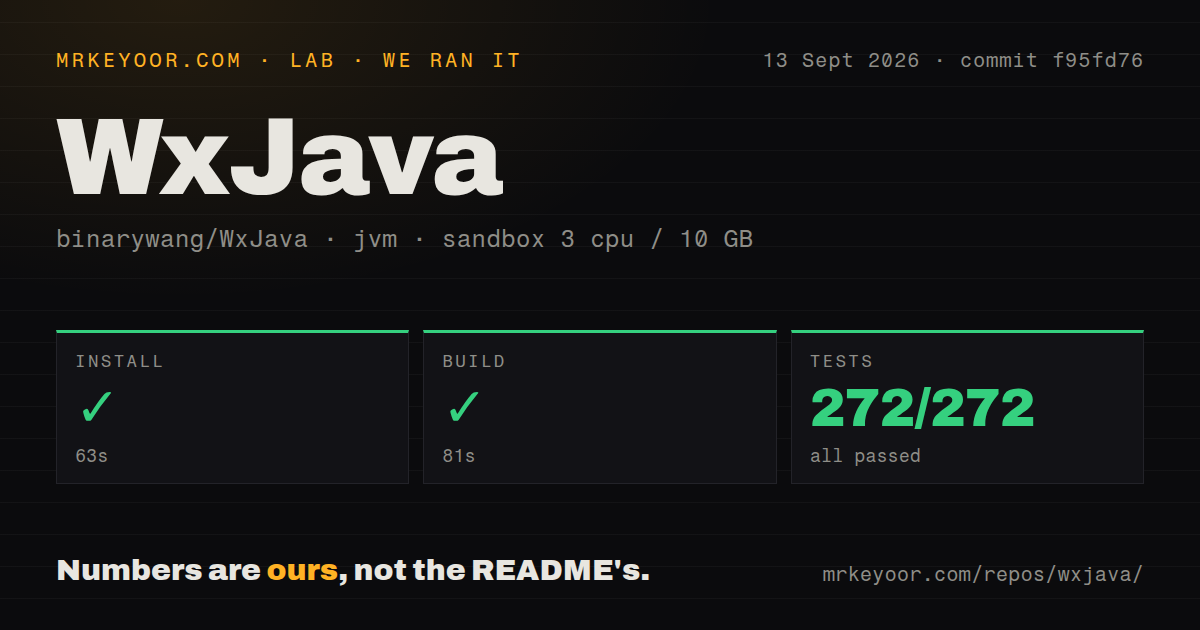
Our sandbox installed the commit in 63 seconds, built it in 81 seconds, and completed the test step in 13 seconds. Maven Surefire reported 272 passed and 0 failed out of 272. Those figures come from an unprivileged container with 3 CPUs, 10 GB of RAM, JDK 21, and no secrets. The result covers repository mechanics at commit f95fd76, not authenticated calls to every WeChat product.
The structural scan found 1 CI workflow file, no Dockerfile, and no top-level tests directory. Maven still discovered and passed 272 tests, so the root-folder result is a layout detail. A library embedded in another application does not need its own container recipe, but teams wanting a reproducible build image must supply one.
Chinese documentation covers breadth, but versions need checking
The 18,699-byte README and linked wiki are Chinese, and the root has no English README. Chinese-reading developers get a module chooser, Maven snippets, 2 minimal examples, separate demos, Javadocs, and troubleshooting pages. The repository includes 5 installable skills covering selection, integration, troubleshooting, contributions, and upgrades. English-only teams will be translating setup instructions and failure reports for code tied to payments and account access.
The wiki says its AI-generated project map may differ from current code, and the README warns that parts of the wiki may lag. The mixed 4.8.0 and 4.8.3.B examples show why that warning matters. Verify the chosen artifact in Maven Central and read its module code or tests before copying an older wiki snippet. Contributors also get a separate guide and video walkthroughs.
Production starts with App ID, secret, and token storage
The smallest official-account example sets an App ID and secret before requesting an access token. The mini-program example does the same before exchanging a login code for a session. Our 63-second install required neither value because it did not call WeChat. A deployed service must protect the correct account credentials and match each config object to the right account and module.
Clustered setups add state choices that a code sample cannot settle. The wiki points multi-account users to separate examples and recommends shared access-token storage, such as Redis, for clustered corporate WeChat deployments. WxJava supplies the SDK layer; the host application still owns credential storage, cache availability, callback routes, and deployment. No Dockerfile turns those choices into a ready-made service.
A September fix shows active issue handling
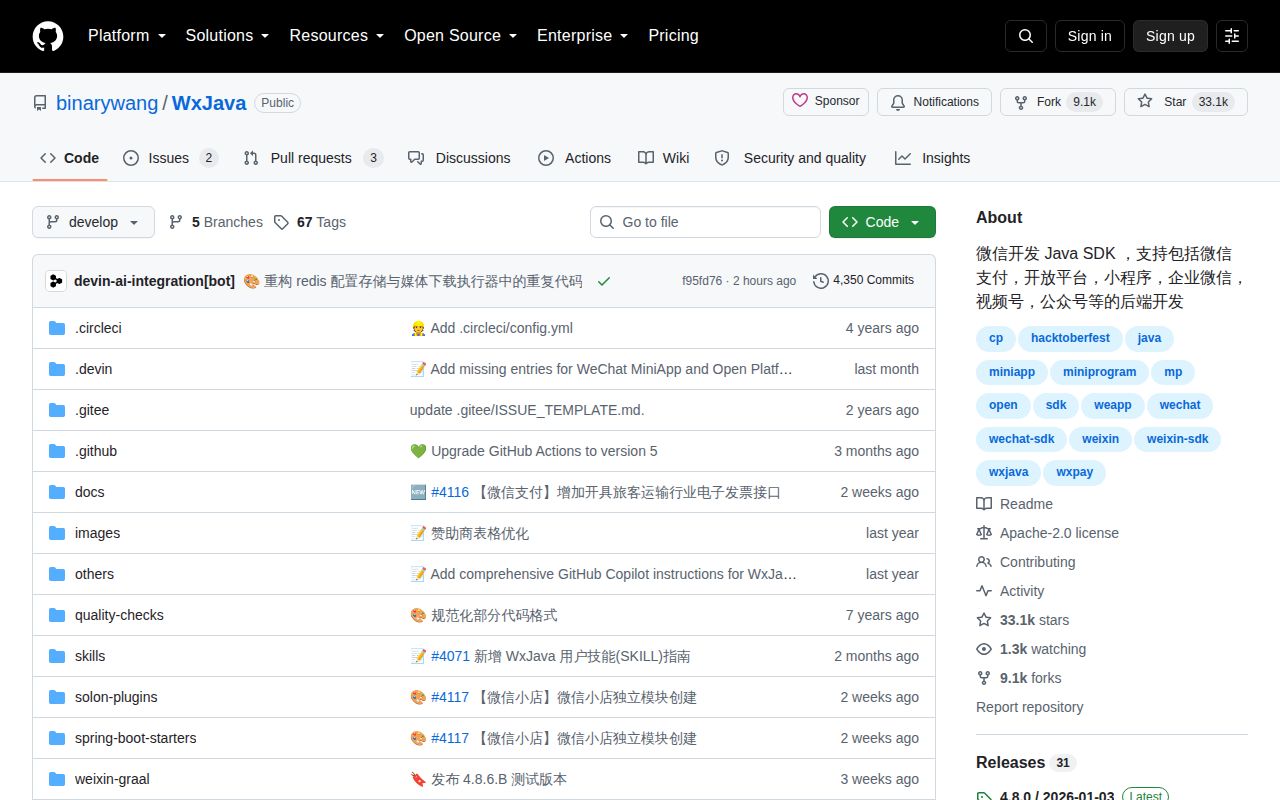
The repository was pushed on September 13, 2026 and had 33,087 stars. GitHub listed 5 combined issues and pull requests: 3 were pull requests, while the 2 issues were pinned community threads. The latest formal release, v4.8.0, arrived on January 3 and covered payment, mini-program, corporate WeChat, open-platform, Channel, and infrastructure changes. The release gap does not indicate inactivity because the develop branch and issue tracker kept moving.
Issue 4123 reported the wrong endpoint and signature construction for the mini-program checkSessionKey call on September 10. Pull request 4124 corrected both and merged on September 13. The response concerns a precise API defect and ended in code. Our separate 272-test run passed at f95fd76, but an integrator should add contract tests around business-critical WeChat calls because provider APIs can change independently of a green local suite.
For Java backend breadth, WxJava is the sensible first trial
WxJava belongs in an existing Java service that needs several WeChat products, especially when Spring Boot and Chinese documentation are normal for the team. For API v3 payments alone, wechatpay-apiv3/wechatpay-java has the narrower official scope. IJPay makes more sense when WeChat Pay sits beside Alipay and other providers. Python applications should compare wechatpy before adding a Java boundary solely for this SDK.
The measured result supports a trial: 272 of 272 tests passed in 13 seconds after a successful 63-second install and 81-second build. WxJava does not provide English documentation, a mobile SDK, web UI, or credential operations. If those limits fit, select only the required modules, pin their versions, and test the live WeChat flows that generate revenue or control account access.