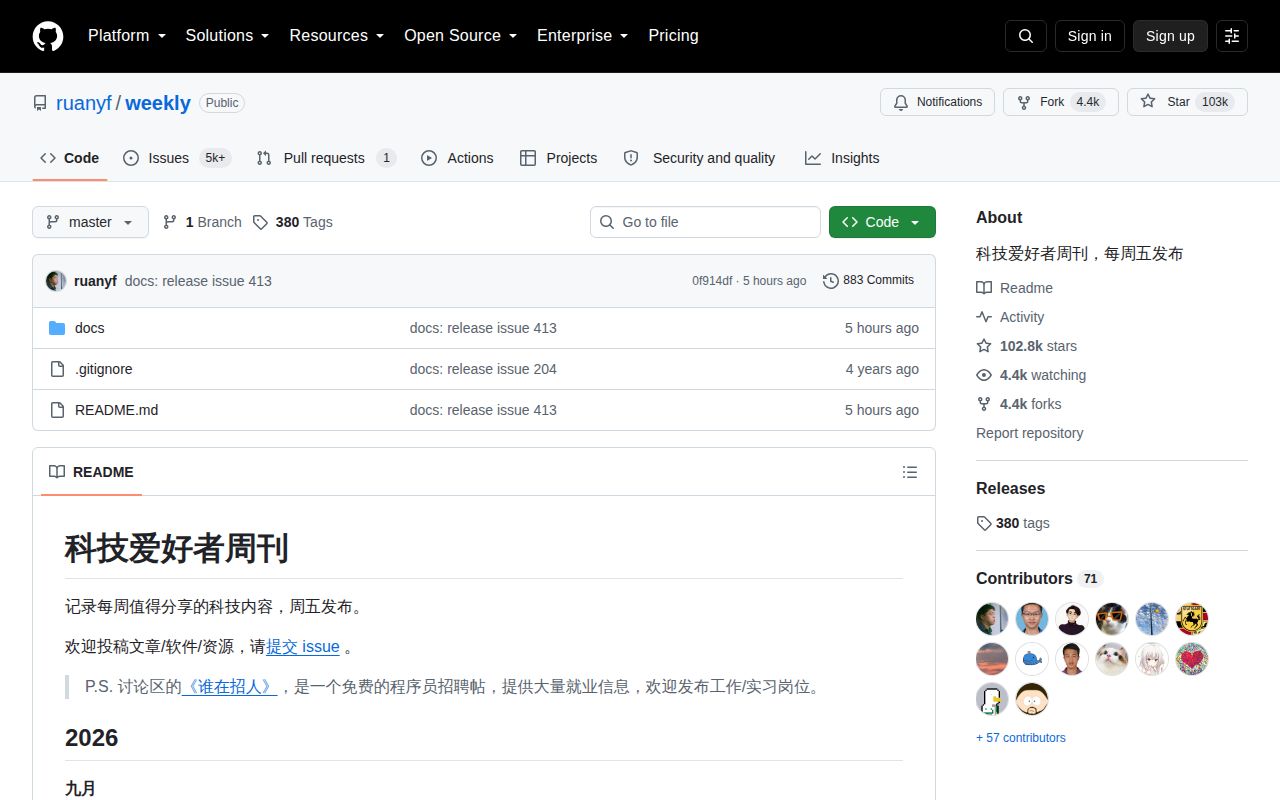
The repository is a 413-edition Chinese publication archive
ruanyf/weekly stores a Chinese technology newsletter as one Markdown file per edition. The README says publication happens on Fridays and links every issue by year and month. Edition 1 appeared in April 2018, while edition 413 was committed on September 18, 2026. That span makes the repository useful in two ways: you can read the current digest, or search eight years of editorial choices without depending on a newsletter inbox.
Each edition has more personality than a link dump. Issue 413 opens with an essay, then moves through technology news, articles, tools, resources, images, excerpts, quotations, and past-year links. Entries usually add a short Chinese explanation and an image, even when the destination is an English article. The editor's framing is the product. GitHub provides storage, history, corrections, and a public submission inbox around it.
What happened when we ran it
We did not run commit 0f914df in our sandbox because the repository has no supported programming ecosystem and no Dockerfile. There was no package installation, build command, test command, dependency count, or vulnerability scan to report. That result fits the checkout: it is published reading material, so readers should judge navigation, editorial accuracy, link survival, and reuse terms instead of expecting software test output.
The back catalog is easier to browse by edition than by topic
The tree contains 413 numbered files from docs/issue-1.md through docs/issue-413.md, plus one README index. Chronology is excellent. You can jump to a month, open an edition, and follow links in context. Topic retrieval is less deliberate because there is no taxonomy or per-entry metadata file. GitHub search works for names and terms, but it does not turn eight years of prose into a clean subject database.
That trade is acceptable for reading and awkward for analysis. A researcher can clone the Markdown and parse headings or links, yet the repository publishes no schema promising that sections or labels will stay consistent. The first edition used categories such as tutorials and curiosities, while issue 413 uses resources, images, and quotations. Anyone building an index should treat those headings as editorial structure that may change, not as an API contract.
Chinese summaries make English links accessible, not English documentation
The only README is Chinese, and the recursive tree contains no English documentation file. Issue 413 marks several article links as English and explains them in Chinese, which helps readers decide whether the source is worth the language effort. It does not provide translated editions. English-only readers would have to machine-translate the editor's commentary, including jokes and judgments where literal translation can miss the point.
Editorial voice also means editorial fallibility. The September 18 edition names Spotify in a paragraph whose source and context concern Shopify. Pull request #11783 proposes the one-word correction and was still open when checked. Git history makes that error visible and fixable, which is better than a silent change. It also shows why a weekly digest should be used for discovery. Verify consequential claims against the linked source before repeating them.
GitHub Issues hold 9,118 open submissions
GitHub reported 9,122 combined open issues and pull requests, while an issue-only search returned 9,118. Recent entries are mostly people recommending their own sites, open-source tools, and articles. That queue is not evidence of 9,118 defects. It is the publication's intake system, and the README explicitly asks contributors to submit material there. A project author gets a visible submission record, but no promise of selection or response time.
Activity is current on both sides of the workflow. The repository was pushed on September 18, 2026, issue 413 landed that day, and new submissions arrived within hours. GitHub listed 102,837 stars and 4,386 watchers when fetched. There is no GitHub Release history because editions are ordinary commits, so the latest release endpoint returns nothing. Health is better read from Friday publication and issue triage than from tags.
Missing license and feed files limit reuse
The repository root has only .gitignore, README.md, and the docs directory. GitHub reports no license, and the recursive tree has no license file. Public access does not by itself grant clear republishing rights. Reading, linking, and contributing are straightforward. Mirroring the full archive, translating it for redistribution, or packaging it into a commercial dataset calls for permission instead of assumptions.
The same tree has no RSS, Atom, or named feed file. A reader can watch the repository, visit the README on Fridays, or follow the linked publication channels, but the repo does not document a stable machine-readable subscription endpoint. That is a meaningful omission for teams hoping to ingest each edition automatically. Building against Markdown paths is possible, though it leaves you responsible for detecting editorial structure changes.
Use the archive as a source list that still needs verification
A Chinese-reading developer can get real value from 413 editions without installing anything. The strongest use is discovery: scan the editor's explanation, open the links that matter, and keep the original source for claims you plan to reuse. The archive is active, searchable, and unusually long-lived. Its 9,118 open submissions also make clear that inclusion is curated rather than automatic.
Choose Trendy Weekly for a more personal Chinese mix, Awesome for topic-based evergreen lists, or Hacker News for fast English discussion. ruanyf/weekly is the better pick when one Chinese editor's weekly judgment is exactly what you want. Keep the boundary clear: it is a reading habit and historical archive, without the license or feed guarantees required of a dependable data service.