A source build leaves speech generation unverified
VoxCPM installed and built in our sandbox, but the run did not load model weights or generate speech. Developers considering VoxCPM2 for voice design still need a listening trial on the device and deployment image they intend to use.
The VoxCPM README documents voice design by placing a description in parentheses before the text to synthesize. It also documents reference-audio cloning, style instructions, continuation with a reference transcript, streaming output, and 30 supported languages. These are project-documented capabilities. Our run measured none of their output quality or performance.
The README warns that Voice Design and Controllable Voice Cloning results can vary between runs. A trial should therefore assess whether the requested voice and style are consistent enough for the application, as well as whether the output says the supplied text correctly.
What happened when we ran it
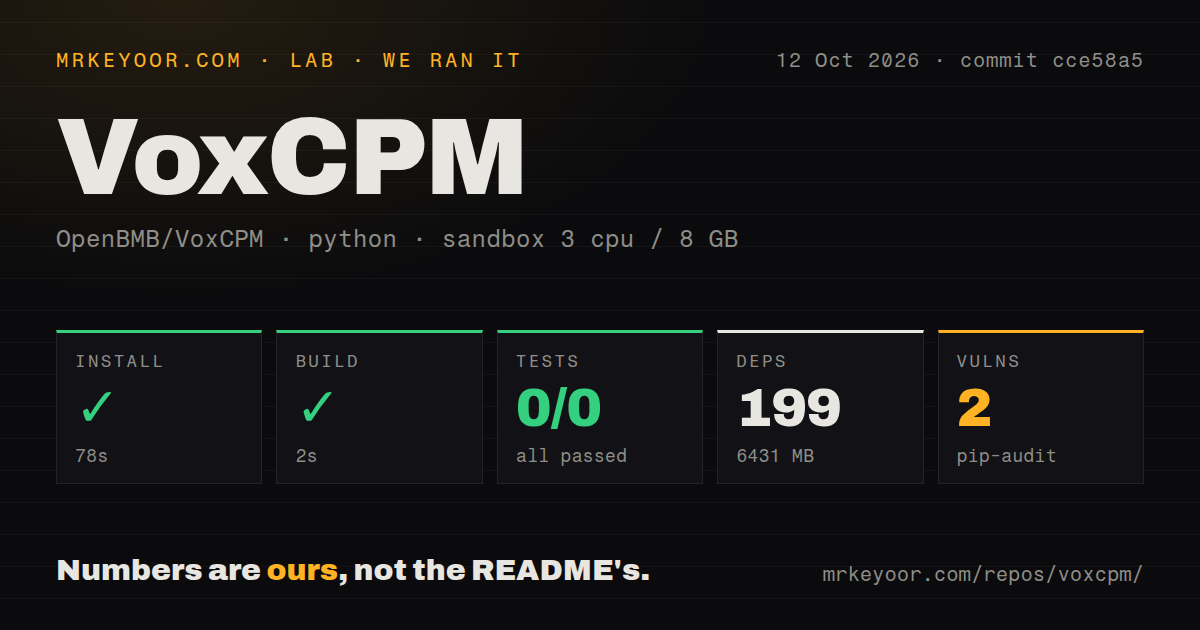
Our sandbox installed VoxCPM commit cce58a5 in 78 seconds on 2026-10-12, recording 199 dependencies and 6,431 MB on disk. The source build passed in 2 seconds. The checkout occupied 6 MB across 82 files and roughly 12,930 source lines. That checkout size is much smaller than the installed environment observed in this run.
Pytest failed with exit code 3 after 11 seconds, reporting 0 passed and 0 failed out of 0 tests. During collection, it imported scripts/test_pick_runtime_dtype.py. The log shows that script calling sys.exit(0 if passed == total else 1), followed by SystemExit: 0 and an internal error. No pytest tests ran. The separate script summary in the log is not evidence that the pytest suite passed.
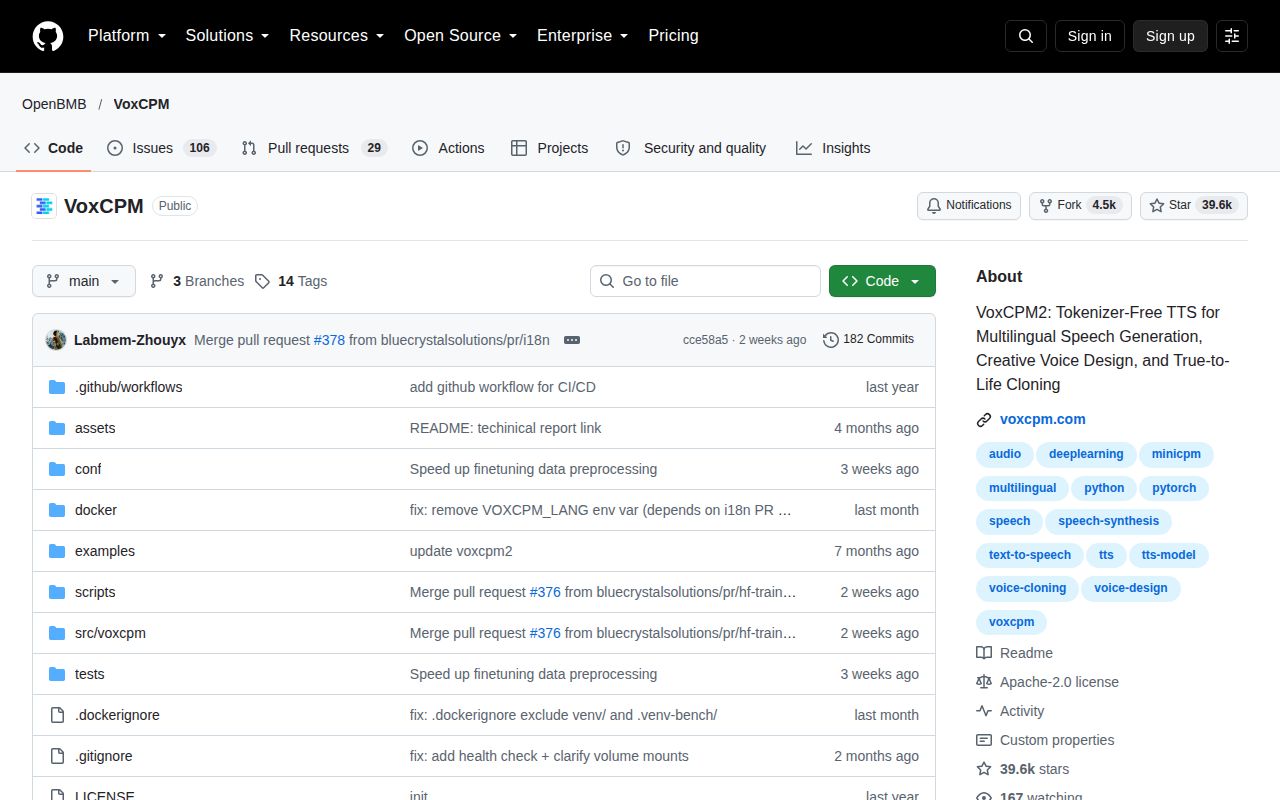
Pip-audit reported 2 known vulnerabilities. The supplied results do not identify affected packages, severity, or fixes, so exploitability cannot be assessed here. The repository scan found one CI workflow file and a tests directory, with no Dockerfile.
The recorded sandbox configuration was 3 CPUs, 8 GB RAM, and image label ghcr.io/astral-sh/uv:python3.12-bookworm. The image label does not establish actual runtime or operating-system versions. These findings describe repository setup, not a working model-serving deployment.
Model loading and serving need separate checks
The README shows loading openbmb/VoxCPM2 through from_pretrained and downloading weights from ModelScope for local loading. These are unexecuted documentation examples in this review. Neither example shows a hosted speech API credential. Model-file access, storage, and the intended device configuration still need checking.
For concurrent serving, the README points to Nano-vLLM-VoxCPM and vLLM-Omni. For deployment without Python, it describes a separate C++ implementation and GGUF weights. We did not exercise those projects. Our 6,431 MB installation measurement is not a storage budget for a complete speech service.
The main installation requirements specify Python at least 3.10 and below 3.13, PyTorch at least 2.5.0, and CUDA at least 12.0. The Web demo documents CPU, MPS, and CUDA device choices. Those documented choices do not establish that a particular deployment configuration works.
Issue 419 reports a compiler failure during generation
Issue 419 was opened on October 16, 2026. The reporter describes optimized generation failing on a machine with Triton but no C compiler. The reported environment uses voxcpm 2.0.3. According to the report, optimization setup returns without warning and the first generation call fails; model loading can encounter this during its warm-up generation.
The reporter lists installing a compiler or passing optimize=False as workarounds. We have not reproduced either. This is a user-submitted execution report, separate from our pytest collection failure. The supplied test log does not connect that collection failure to a missing compiler. Include model loading and the first generation call in acceptance checks for a minimal deployment image.
Release notes describe changes, not our test results
The release shown in the packet is 2.0.3, published on May 11, 2026. Its notes document runtime device handling, streaming changes, training-manifest validation, and safer legacy LoRA loading. Those changes do not establish that our later checkout passes its tests or that deployment will be stable on a particular device.
Supplied repository metadata records a push on October 8, 2026. Together with the October issue report, this establishes dated activity. It does not establish maintainer response quality or resolution times. Numerical product ratings remain unassessed because the packet does not support them.
Choose alternatives by the constraint you need to resolve
Pocket TTS is designed for CPU speech generation. Evaluate it when CPU execution is your main constraint. This review provides no comparison of its voices or speed against VoxCPM2.
F5-TTS documents inference and training workflows. Its code is MIT-licensed, while its pretrained models use CC-BY-NC. Check that distinction against the intended use before selecting those weights.
For a VoxCPM2 trial, save a voice description and representative text, including names and numbers your application needs to pronounce. Generate speech in the intended environment and listen against the text before adding a serving engine. Retain the configuration and output so the team can judge pronunciation and voice consistency.