mrkeyoor.com_
Tue 29 Sept 15:36 UTC
AI Toolsevaluationupdated 29 Sept 2026

voltagent review

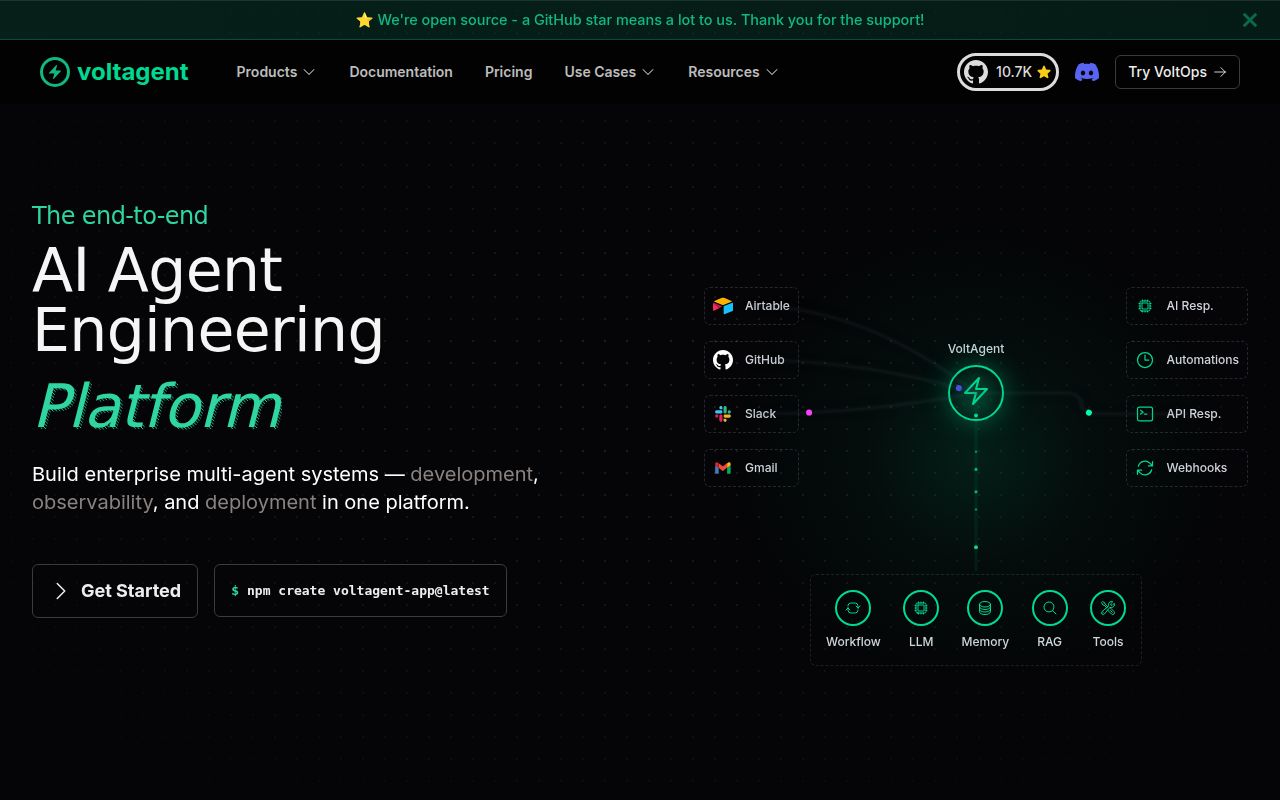
VoltAgent is a TypeScript framework for building agents with tools, memory, workflows, supervisors, guardrails, retrieval, voice, evaluations, and MCP connections. Its companion VoltOps product adds tracing, automation, deployment, and a console, either in the cloud or self-hosted.

Verdict

Our VoltAgent checkout installed 3,934 packages and occupied 4,268 MB, then failed both the root build and test commands. Adopt it when its TypeScript workflow, memory, MCP, and operations pieces replace several tools you would otherwise maintain. For a small agent service, the monorepo footprint and current memory and streaming issue reports make a narrower SDK easier to trust.

We ran it

Lab card: what happened when we ran voltagentScreenshot of voltagent (voltagent.dev)
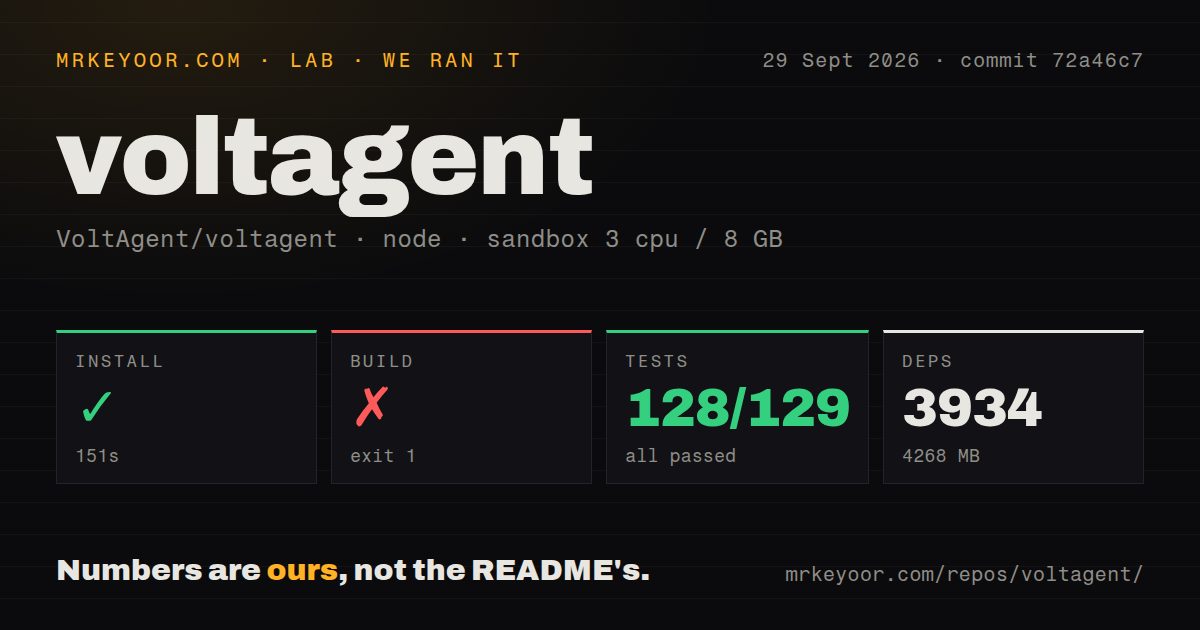
Install✓ · 151s3934 packages · 4268 MB
Build✗ · 198s
Tests✗ · 103s128 passed · 0 failed · 1 skipped of 129 (vitest)
Repo2807 files~295,286 lines of source · 20.2 MB · 3 CI workflows

Answers from our run

Does voltagent build from source?

Dependencies installed in 151 seconds (3934 packages), and the build failed. We cloned commit 72a46c7 into a clean Debian container with 3 CPUs and no project-specific setup.

Do voltagent's tests pass?

Yes: 128 of 129 passed when we ran the project's own test command (vitest). Some failures need services or credentials a bare container does not have.

Who should not use voltagent?

Developers seeking a small framework checkout: our monorepo install pulled 3,934 packages and occupied 4,268 MB.

What are the alternatives to voltagent?

Mastra, LangGraph.js, OpenAI Agents SDK for JavaScript. Our VoltAgent checkout installed 3,934 packages and occupied 4,268 MB, then failed both the root build and test commands.

Setup2/5151-second install, 4,268 MB footprint, and failed root commands
Docs4/5Clear quick start and feature guides across a very wide surface
Community5/510,700 stars, release 2.11.0, and active September issue work
Maturity3/5Frequent releases, but our build and complete test command failed

Who it’s for

TypeScript teams that want agents, workflows, memory, and HTTP serving in one framework.
Developers building supervisor and sub-agent systems with typed tools.
Teams that want MCP connections and OpenTelemetry-style operations around agent code.
Organizations willing to test storage, authorization, streaming, and deployment paths against their own requirements.

Who it’s NOT for

Developers seeking a small framework checkout: our monorepo install pulled 3,934 packages and occupied 4,268 MB.
Release teams that require green root commands: our build stopped on the Netlify Functions example, and the test command ended with one failed @voltagent/core file.
Multi-tenant apps expecting memory ownership enforcement from the server: open issue 1371 reports cross-user conversation access, and the current handlers still accept conversation IDs or user IDs without an ownership check.
Supervisor apps that require output guardrails on a terminating SSE stream: open issue 1415 reports that this combination can leave the client hanging.
Teams relying on an untouched generated Dockerfile with npm: open issue 1427 says the template also requires Yarn and pnpm lockfiles that npm projects do not have.

Setup reality

Our Node 22 sandbox installed commit 72a46c7 in 151 seconds, pulling 3,934 packages and using 4,268 MB. The build failed after 198 seconds, with voltagent-example-netlify-functions:build named as the failed task. Tests exited 1 after 103 seconds.

The starter requires Node 20 or newer and a model-provider credential for the chosen model. The README example uses OpenAI, local LibSQL memory, a Hono server, and optional VoltOps. Other memory, voice, retrieval, MCP, and managed services bring their own configuration and credentials.

The harness-counted Vitest slice had 128 passed, 0 failed, and 1 skipped of 129. The final @voltagent/core tail separately showed 1 failed file, 109 passed files, 1,399 passed tests, 2 skipped, and 1 todo. The supplied tail does not show the failed queue assertion.

VoltAgent joins a TypeScript framework to an operations product

VoltAgent has two connected products. The MIT-licensed framework supplies agents, typed tools, supervisors, workflows, memory adapters, guardrails, retrieval, voice, evaluations, and MCP clients. VoltOps adds traces, logs, prompts, automation, managed deployment, and a web console. A team can use the code framework alone, self-host the operations layer, or connect to the hosted console.

The quick start targets Node 20 or newer and creates an agent, a local LibSQL memory adapter, a Hono server, and an expense-approval workflow. The example listens on port 3141 and uses an OpenAI model, so a model credential is needed before the first useful response. Other providers can be swapped through configuration, while voice, hosted retrieval, remote MCP tools, and external memory stores add their own accounts.

The monorepo installs 3,934 packages before one agent runs

Our checkout had 2,807 files, about 295,286 lines of source, and occupied 20.2 MB before dependencies. The pnpm workspace includes packages/*, every directory under examples, and nested example workspaces. Installing from the root expanded that checkout to 4,268 MB. This is the cost of developing the entire project, not the expected size of every generated user application.

That distinction matters when choosing VoltAgent. An application can depend on a few published packages without cloning dozens of examples. A contributor, a vendor patching the framework, or a team treating the monorepo as its release gate inherits the whole workspace. Three CI workflow files were present, while our scan found no root Dockerfile or root tests directory. The workspace packages keep tests beside their source.

What happened when we ran it

Our unprivileged Node 22 sandbox installed commit 72a46c7 in 151 seconds. Pnpm pulled 3,934 packages and consumed 4,268 MB on disk. The root build then ran for 198 seconds and exited with code 1. Its tail identifies voltagent-example-netlify-functions:build as the failed task but does not contain the underlying compiler or deployment error.

The test command also exited with code 1 after 103 seconds. The harness-counted Vitest slice reported 128 passed, 0 failed, and 1 skipped out of 129. Farther down the command-wide tail, @voltagent/core reported 1 failed file and 109 passed files, with 1,399 passed tests, 2 skipped, and 1 todo out of 1,403.

The failing core file was src/utils/queue/queue.spec.ts, where its line reported 9 tests with 1 failed. The tail includes expected-looking agent and memory error logs but omits the failed assertion, so those logs cannot be named as the cause. The defensible result is that many tests passed while the complete workspace command remained red.

Memory ownership and failed writes need application tests

Open issue 1425 describes buffered conversation messages disappearing from the retry set after a storage write fails. Issue 1429 reports invalid SQLite syntax when D1 or LibSQL callers provide an offset without a limit. Both were opened on September 28, 2026 and remained open the next day. A serious adopter should simulate storage outages and pagination combinations against the exact adapter it plans to ship.

Issue 1371 is more sensitive. It reports that memory REST handlers read, update, or delete a conversation by supplied identifiers without checking the authenticated user's ownership. At measured commit 72a46c7, the relevant handlers still retrieve by conversation ID and accept user IDs without an ownership comparison to request identity. Multi-tenant services should enforce authorization outside those handlers until the behavior is explicitly fixed and tested.

Supervisor guardrails have an open streaming failure

VoltAgent's supervisor model, suspendable workflows, resumable streams, and output guardrails cover jobs that smaller SDKs leave to application code. The integrations are where combinations matter. Open issue 1415 says a supervisor with output guardrails reaches its finish step but never closes the SSE stream, leaving the client waiting. The report covers core versions 2.9.2 and 2.10.0.

The MCP support is broad enough to connect agents to servers and to expose a documentation server for coding assistants. That earns the mcp tag, but MCP does not shrink the trust boundary. Each remote tool still needs scoped credentials, cancellation, error handling, and an approval policy for destructive actions. The framework supplies hooks; the application decides what an agent may do.

Release 2.11.0 shipped with 99 open items

GitHub showed 10,700 stars, 41 open issues, and 58 open pull requests on September 29, 2026. Core version 2.11.0 was released on September 28, the same day as the measured commit and repository push. That release added control over command normalization for custom workspace sandboxes, evidence that the project is still changing at the runtime boundary.

Current maintenance is active, and the issue queue contains recent, reproducible reports rather than only old feature wishes. The root build and test failures keep this from being an easy default recommendation. VoltAgent makes sense when one TypeScript team will use several of its layers and can own integration tests around them. If all you need is tool calling and a handoff, 4,268 MB of contributor dependencies is a warning to choose less.

Alternatives

ProjectWhat it isPick it when
Mastra gh↗A TypeScript framework for agents, workflows, retrieval, memory, and evaluations.pick this instead when you want another TypeScript platform and prefer Mastra's runtime and deployment model.
LangGraph.jsA TypeScript graph runtime for stateful and durable agent workflows.pick this instead when explicit graph execution and durable control flow matter more than one broad platform.
OpenAI Agents SDK for JavaScriptA smaller JavaScript and TypeScript SDK for agents, handoffs, tools, and voice.pick this instead when a compact agent SDK is enough and OpenAI's model ecosystem fits the job.

What people are saying

  1. [github-trending] VoltAgent/voltagent
  2. [velocity-scout] VoltAgent/awesome-openclaw-skills
  3. [github-trending] VoltAgent/awesome-design-md

Sources

  1. VoltAgent README
  2. VoltAgent core 2.11.0 release
  3. Open memory persistence issue
  4. Open memory ownership issue
  5. Open supervisor guardrail issue
  6. Open generated Dockerfile issue
  7. VoltAgent memory handlers
  8. VoltAgent repository facts

More ai tools reviews

InferenceX · Bonsai-demo · qwen-audio-agent · wechat-intelligence-hub · dlss5-visual-enhancer · ABot-Recon · the whole board →