mrkeyoor.com_
Tue 29 Sept 06:38 UTC
AI Toolsevaluationupdated 29 Sept 2026

ABot-Recon review

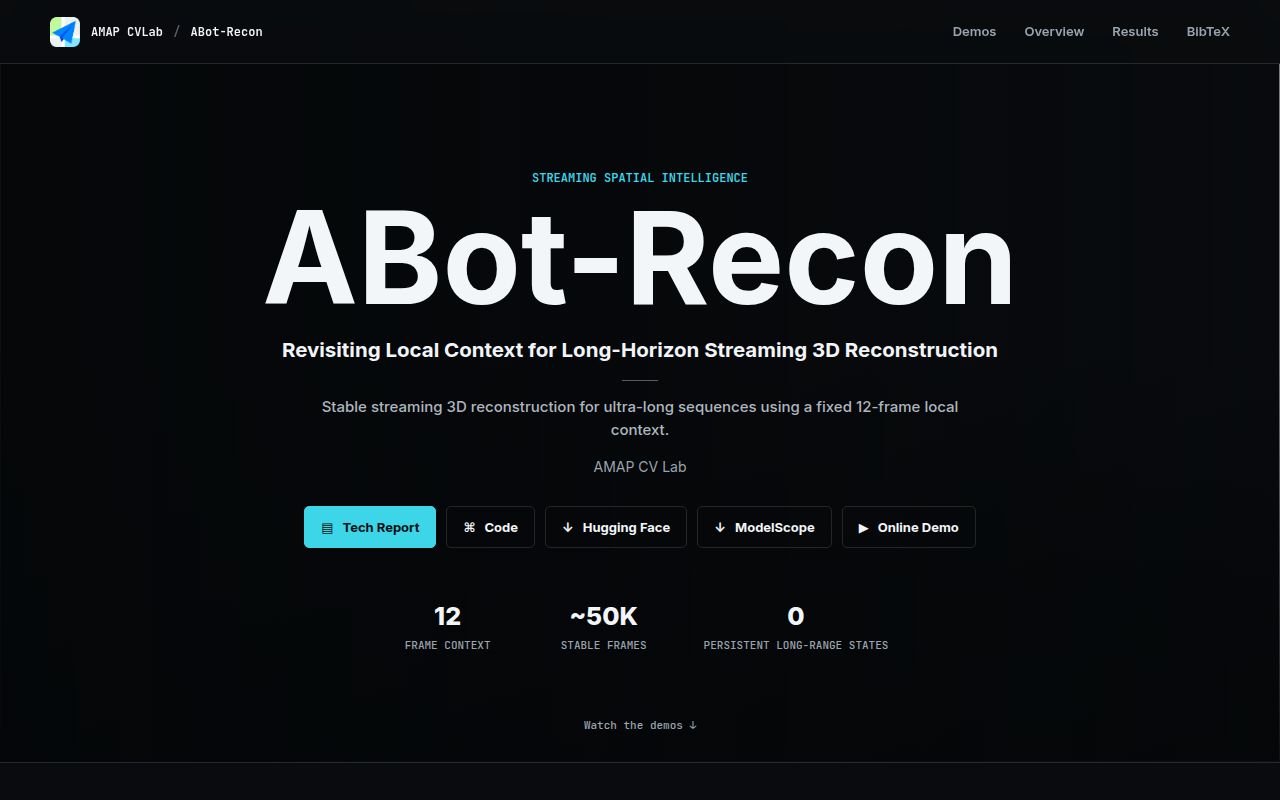
ABot-Recon turns a long, ordered video into camera poses and a 3D point reconstruction while keeping only a 12-frame local context. It is aimed at researchers who need streaming geometry without model memory that grows with every frame.

Verdict

Our ABot-Recon run built in 9 seconds, but its 42-test command ended with 2 failures, 1 collection/setup error, and 22 known vulnerabilities, so this is research code to evaluate rather than a dependency to ship unchanged. Try it for long-video experiments when a fixed 12-frame context and direct geometry outputs solve a real memory problem. Skip it for commercial use of the supplied weights or for live loop closure.

We ran it

Lab card: what happened when we ran ABot-ReconScreenshot of ABot-Recon (amap-cvlab.github.io/ABot-Recon-html)
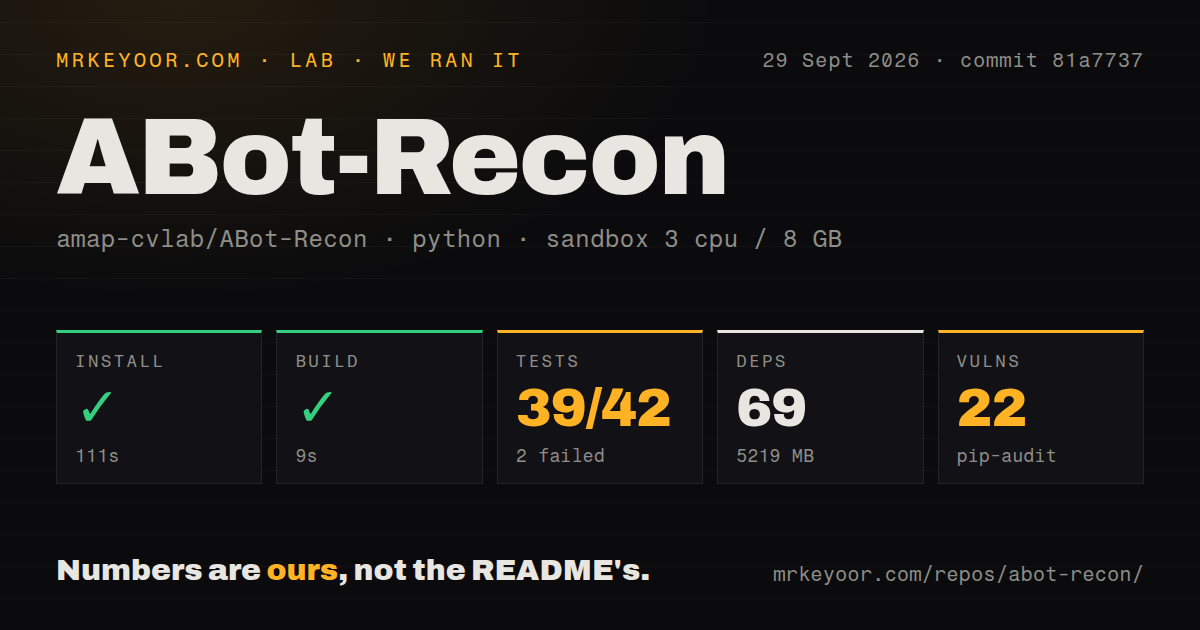
Install✓ · 111s69 packages · 5219 MB
Build✓ · 9s
Tests✗ · 20s39 passed · 2 failed · 7 skipped · 1 errors of 42 (pytest)
Known vulns22(pip-audit)
Repo94 files~12,352 lines of source · 22 MB · 0 CI workflows · tests dir

Answers from our run

Does ABot-Recon build from source?

Dependencies installed in 111 seconds (69 packages), and the build succeeded in 9 seconds. We cloned commit 81a7737 into a clean Debian container with 3 CPUs and no project-specific setup.

Do ABot-Recon's tests pass?

Not all of them: 39 of 42 passed and 2 failed when we ran the project's own test command (pytest), with 1 collection error. Some failures need services or credentials a bare container does not have.

Does ABot-Recon have known vulnerabilities in its dependencies?

pip-audit flagged 22 known advisories in the dependency tree at the time of our run.

Who should not use ABot-Recon?

Commercial products that need the published checkpoint: the code is Apache-2.0, but the model weights are CC BY-NC 4.0 and require separate permission for commercial use.

What are the alternatives to ABot-Recon?

VGGT, CUT3R, COLMAP. Our ABot-Recon run built in 9 seconds, but its 42-test command ended with 2 failures, 1 collection/setup error, and 22 known vulnerabilities, so this is research code to evaluate rather than a dependency to ship unchanged.

Setup2/55,219 MB installed, and the base test command failed
Docs4/5Clear inference, output, acceleration, and branch guides
Community3/5September 25 push, 1,094 stars, and 4 open issues
Maturity2/5No tagged release, failed suite, and offline loop closure

Who it’s for

3D vision researchers testing local-context reconstruction on long video sequences.
Robotics and mapping teams that already have NVIDIA CUDA hardware and can validate trajectories against their own scenes.
Developers who need camera poses, local point maps, confidence maps, or an exported PLY from ordered frames.
Academic teams that can use the released weights under their noncommercial license.

Who it’s NOT for

Commercial products that need the published checkpoint: the code is Apache-2.0, but the model weights are CC BY-NC 4.0 and require separate permission for commercial use.
Teams with a clean-test or low-risk dependency gate: our run ended with 2 failed tests, 1 collection/setup error, and 22 known vulnerabilities.
CPU-only or non-NVIDIA deployments that need a documented supported route: the README targets CUDA 12.1 and says the release environment was validated on an NVIDIA A100.
Live SLAM systems that need online loop closure: the maintainer says the current loop-closure implementation is offline post-processing.
Buyers expecting a small Python utility: our 22 MB checkout grew to 5,219 MB after installation.

Setup reality

Our fresh Debian sandbox installed commit 81a7737 in 111 seconds, adding 69 packages and occupying 5,219 MB. The build passed in 9 seconds. Pytest failed in 20 seconds: 39 passed, 2 failed, 7 were skipped, and 1 collection/setup error was reported in the 42-test run. Pip-audit found 22 known vulnerabilities.

Basic inference downloads the checkpoint from Hugging Face unless you place it locally. Loop closure needs the loop extra plus two retrieval assets. No API key is listed, but offline use requires downloading and caching those files first.

The documented target is Linux, Python 3.10 or newer, PyTorch 2.5.1, and CUDA 12.1. FlashInfer and compiled cuRoPE are recommended accelerators. Input filenames must sort in frame order, and the default maximum stream length is 22,000 frames.

A 12-frame window makes long video manageable

ABot-Recon reconstructs an ordered video one frame at a time. For each new image, it caches features from the previous 11 frames, predicts geometry in the current camera coordinates, and estimates the pose relative to the adjacent frame. Those relative poses are composed into the full trajectory. The useful idea is bounded work: the model's learned state does not grow just because the video has been running longer.

That choice gives the project a sharp purpose. The default maximum is 22,000 frames, yet the learned context remains 12 frames. The model writes camera poses, relative poses, local point maps, colors, confidence maps, and metadata. It can also transform local geometry into world coordinates and export an RGB point cloud as PLY. You get inspectable artifacts rather than only a rendered demo.

The 5,219 MB install is heavier than the 22 MB checkout

Our clone contained 94 files, about 12,352 lines of source, and occupied 22 MB. Installing commit 81a7737 pulled 69 packages and expanded the environment to 5,219 MB. That footprint fits a CUDA research workstation more naturally than a small edge container. ABot-Recon has no Dockerfile or CI workflow in the repository, so your team owns the repeatable image and automated checks.

The documented environment is specific: Linux, Python 3.10 or later, PyTorch 2.5.1, and CUDA 12.1. The authors validated the release on an NVIDIA A100. FlashInfer is optional, with PyTorch SDPA as the fallback, and compiling cuRoPE is recommended for faster rotary position encoding. The README does not give a supported CPU or AMD path.

What happened when we ran it

Our sandbox installed the project in 111 seconds and built it in 9 seconds. Our test method used a fresh Debian container with 3 CPUs, 8 GB of RAM, Python 3.12, no secrets, and no elevated privileges. The checkout had a tests directory, while the repository had no CI workflow files and no Dockerfile.

Pytest failed in 20 seconds. The reported result was 39 passed, 2 failed, 7 skipped, and 1 collection/setup error in the 42-test run. Both API failures ended with an ImportError from abot_recon.loop_closure because pypose was absent. Collection also stopped on tests/test_loop_closure.py. The log does not establish anything beyond that missing module, so we would not label the cause a packaging defect without another controlled run.

The skipped cases were explicit about their requirements. Real-checkpoint integration needs a checkpoint and image directory, while the cuRoPE checks need the extension or CUDA. Pip-audit reported 22 known vulnerabilities. Installation and build therefore worked, but the supplied base test command did not finish green in the same 5,219 MB environment.

Loop closure is optional, offline, and enabled by default

The base model does not require loop closure, according to the README. It still enables loop closure by default in the command-line options, while a minimal command passes --no-loop-closure. Installing the optional path adds FAISS, OpenCV, PyPose, SciPy, and two retrieval checkpoints. That distinction matters because our failures all pointed at the absent pypose module.

Loop closure also changes what "streaming" means here. In issue 8, a maintainer confirmed that the current released loop-closure path is offline post-processing. The front end can produce streaming results, then the extra stage revisits frame pairs and corrects accumulated drift. A robotics system that needs online correction must build that engineering itself.

Apache code does not make the checkpoint commercial

The source code uses Apache-2.0, but the released weights use CC BY-NC 4.0. The model license limits them to noncommercial research and education, requires attribution, and says commercial use needs separate written authorization from the relevant rights holders. That split can stop a product evaluation even when the API and outputs fit. Check dataset and upstream Pi3 terms separately as well.

Fine-tuning exists on a separate train branch with 18 supported data sources. Its guide says the examples are for fine-tuning, not reproduction of the full paper recipe. Evaluation lives on another eval branch. This keeps the main inference checkout focused, though teams that pin one commit for training, evaluation, and deployment will need a more deliberate source-management plan.

A September 25 push shows activity, but there is no tagged release

GitHub showed 1,094 stars and 4 open issues on September 29, 2026, with no open pull requests in the API response we checked. The last push was September 25, the same date the fine-tuning code was announced. There was no GitHub release or tag to pin, so commit hashes are the practical version boundary.

ABot-Recon is worth a controlled trial if long videos make growing model state unacceptable. Start with loop closure disabled, zero-pad every frame name, cache the checkpoint, and compare its poses against data you trust. The 12-frame design is the reason to choose it. The failed base suite, 22 audit findings, noncommercial weights, and offline loop correction are the reasons to keep it out of an unreviewed production path.

Alternatives

ProjectWhat it isPick it when
VGGTA feed-forward model that predicts cameras, depth, point maps, and tracks from one or more views.pick this instead when whole-set reconstruction and a commercial-use checkpoint option matter more than bounded streaming state.
CUT3RA continuous 3D perception model built around a persistent state.pick this instead when you want the persistent-memory approach that ABot-Recon was designed to challenge.
COLMAPA mature Structure-from-Motion and Multi-View Stereo pipeline with GUI, CLI, and Python bindings.pick this instead when a classical reconstruction workflow, broad platform packaging, and established tooling matter more than learned streaming inference.

What people are saying

  1. [velocity-scout] amap-cvlab/ABot-Recon

Sources

  1. ABot-Recon repository and README
  2. ABot-Recon model weight license
  3. ABot-Recon package metadata
  4. Maintainer explanation of offline loop closure
  5. ABot-Recon fine-tuning branch
  6. ABot-Recon paper

More ai tools reviews

wechat-intelligence-hub · dlss5-visual-enhancer · unreel · camera-to-blender · DLSS-NR-on-AMD · commerce-agents · the whole board →