mrkeyoor.com_
Tue 29 Sept 15:38 UTC
AI Toolsevaluationupdated 29 Sept 2026

InferenceX review

InferenceX is an open research platform for repeatedly benchmarking large-language-model serving software on current accelerators. It supplies configurations, launchers, evaluation tooling, result processing, and a public dashboard so performance comparisons can change as vLLM, SGLang, TensorRT-LLM, CUDA, ROCm, and hardware change.

Verdict

Our InferenceX run built in 10 seconds and passed 1,605 tests, but 8 failures and 128 collection/setup errors kept the suite red. Use it when you have serious accelerator infrastructure and need auditable, changing comparisons across serving stacks. For benchmarking one API or one server on hardware you already own, a narrower harness will demand far less operational work.

We ran it

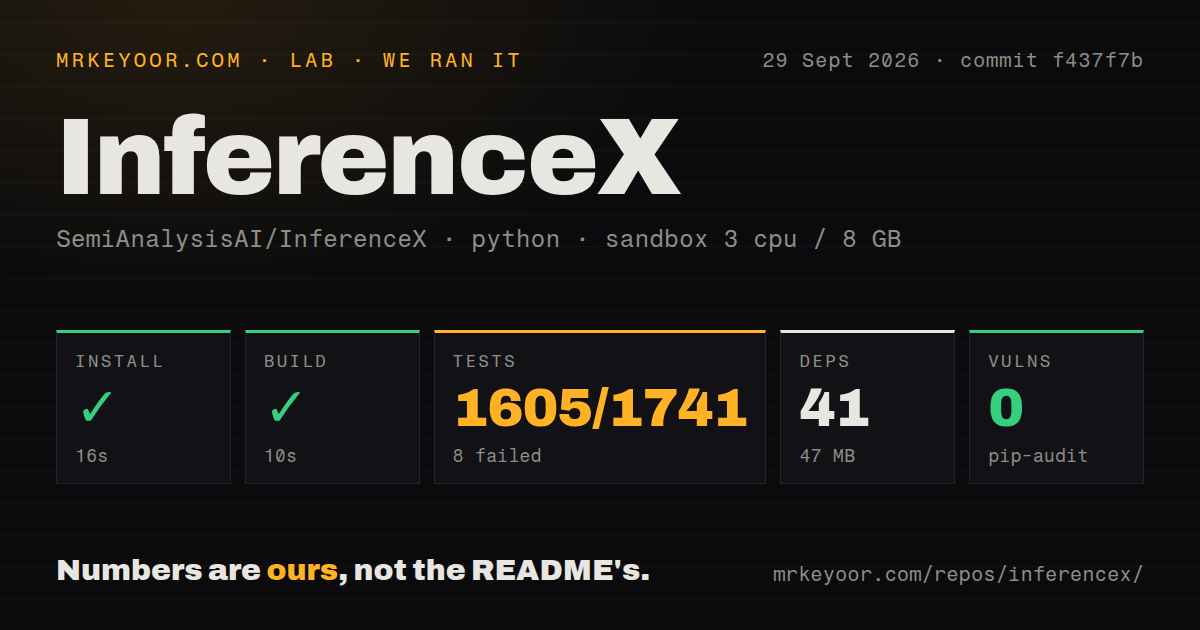
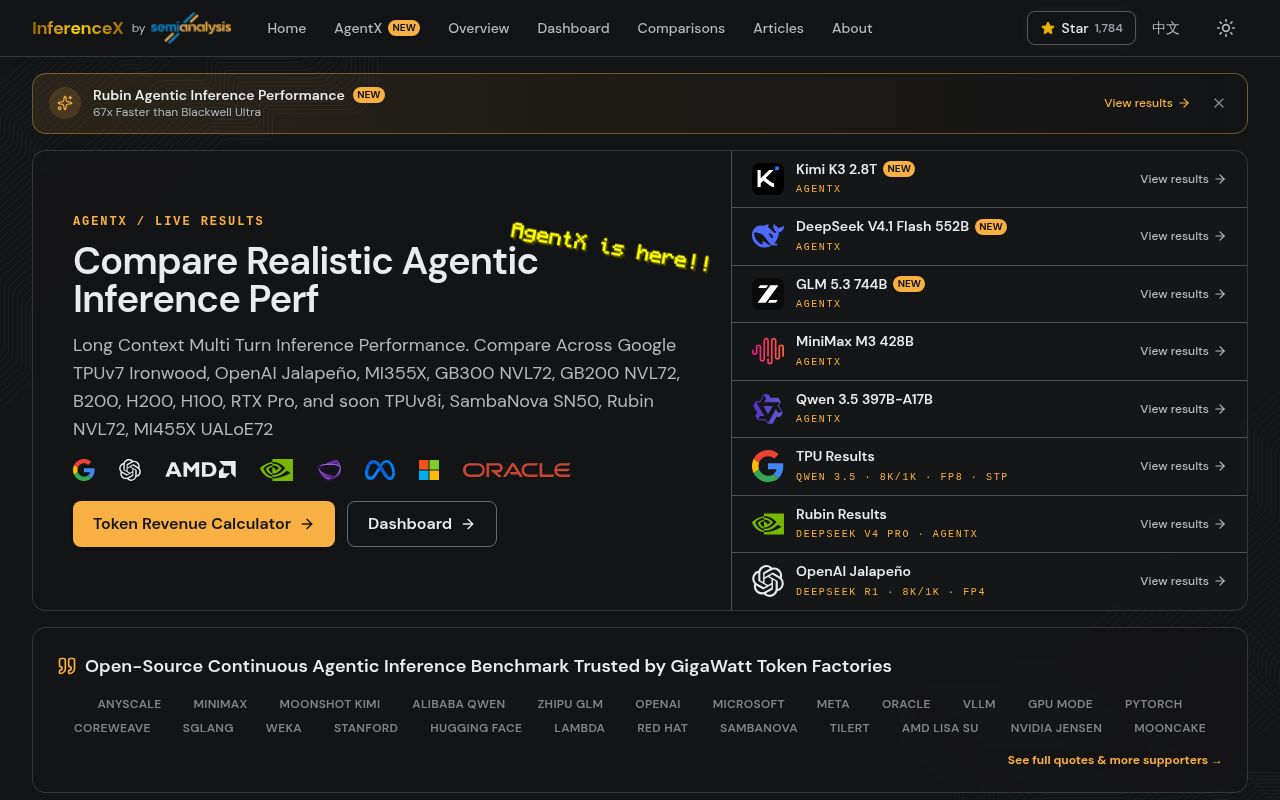
Lab card: what happened when we ran InferenceXScreenshot of InferenceX (inferencex.com)
Install✓ · 16s41 packages · 47 MB
Build✓ · 10s
Tests✗ · 179s1605 passed · 8 failed · 1 skipped · 128 errors of 1741 (pytest)
Known vulns0(pip-audit)
Repo4011 files~814,444 lines of source · 64.9 MB · 23 CI workflows

Answers from our run

Does InferenceX build from source?

Dependencies installed in 16 seconds (41 packages), and the build succeeded in 10 seconds. We cloned commit f437f7b into a clean Debian container with 3 CPUs and no project-specific setup.

Do InferenceX's tests pass?

Not all of them: 1605 of 1741 passed and 8 failed when we ran the project's own test command (pytest), with 128 collection errors. Some failures need services or credentials a bare container does not have.

Does InferenceX have known vulnerabilities in its dependencies?

pip-audit found none in the dependency tree at the time of our run.

Who should not use InferenceX?

Application developers seeking a quick laptop benchmark: the supported matrix centers on data-center accelerators, clusters, containers, Slurm, and self-hosted runners.

What are the alternatives to InferenceX?

MLPerf Inference, vLLM, SGLang. Our InferenceX run built in 10 seconds and passed 1,605 tests, but 8 failures and 128 collection/setup errors kept the suite red.

Setup2/5Local tooling is small; useful sweeps need costly cluster infrastructure
Docs5/5Bilingual task router covers configs, CI, evidence, and recovery
Community4/51,785 stars, same-day commits, and 291 open issues and PRs
Maturity3/5Operational rules are deep, but our repository-wide suite failed

Who it’s for

Inference teams operating H100, H200, Blackwell, AMD Instinct, TPU, or multi-node systems.
Framework and hardware engineers who can submit a full sweep with evaluation evidence.
Researchers comparing serving recipes while preserving model, image, topology, power, and provenance data.
Teams with an existing OpenAI-compatible server that want to replay the standalone AgentX workload.

Who it’s NOT for

Application developers seeking a quick laptop benchmark: the supported matrix centers on data-center accelerators, clusters, containers, Slurm, and self-hosted runners.
Teams needing a clean fresh-container release gate today: our run ended with 8 failed tests and 128 collection/setup errors.
Users who expect the base Python install to reproduce dashboard numbers: real sweeps also require model access, accelerator capacity, pinned serving images, telemetry, and result ingestion.
Buyers who need versioned releases: GitHub returned no latest release, and the tooling package identifies itself as version 0.1.0.
Operators who cannot absorb a fast-moving failure queue: open issue 3425 says one B300 multi-node TensorRT-LLM path is broken, while issue 3322 tracks missing GB200 curve points.

Setup reality

Our sandbox installed commit f437f7b in 16 seconds, adding 41 packages and 47 MB. The build passed in 10 seconds. Tests failed after 179 seconds: pytest reported 1,605 passed, 8 failed, 1 skipped, and 128 collection/setup errors. Pip-audit found 0 known vulnerabilities.

The local tooling needs Python 3.12 and uv. Practical sweeps add model access, large accelerators, pinned server images, GitHub Actions or Slurm runners, artifact storage, power telemetry, and the result pipeline. The standalone AgentX guide still assumes an existing OpenAI-compatible server.

Five named failures ended with ModuleNotFoundError: No module named 'tabulate'. Three launch-layout cases ended in assertions. The tail names utils/srt-slurm/tests/test_vllm_router_frontend.py among the errors but does not show the underlying traceback, so the other 128 errors cannot be assigned one cause from this log.

InferenceX compares serving stacks on 12 supported accelerator classes

InferenceX exists because a fixed inference result ages quickly. A new server image, kernel, quantization path, scheduler, or driver can move throughput and latency without any hardware change. The repository stores recipes and automation for vLLM, SGLang, TensorRT-LLM, CUDA, ROCm, NVIDIA systems, AMD Instinct systems, and TPU hardware, then sends validated results to a public dashboard.

The README listed 12 supported hardware entries on September 29, 2026, from H100 and MI300X through GB300 NVL72 and TPUv7x. This is a data-center research platform. Its 64.9 MB checkout contains launchers, workflow generation, evaluation, power collection, network and kernel experiments, result processing, and bilingual operating guides. An ordinary application benchmark uses only a thin slice of that machinery.

A standalone AgentX profile still runs for one hour

The easiest route avoids InferenceX's CI and Slurm orchestration. Its standalone AgentX guide pins a separate harness, points it at an existing OpenAI-compatible server, and runs a trace workload. The sample command uses concurrency 8, 393 dataset entries, a 3,600-second measurement, and separate preparation, warmup, and drain time. You still provide the model server and tokenizer access.

Full participation is much heavier. The contribution flow asks for a green full sweep with evaluations, CODEOWNER evidence, an append-only performance changelog entry, and explicit reuse of expensive artifacts at merge. Recipes record server images, model and hardware topology, concurrency, sequence lengths, power measurements, and provenance. Those rules make public comparisons easier to audit, while also making this a poor fit for casual timing tests.

What happened when we ran it

Our sandbox installed the Python project under inferencex-e2e in 16 seconds. It added 41 packages and used 47 MB on disk, then built in 10 seconds. Pip-audit reported 0 known vulnerabilities. The fresh Debian container had 3 CPUs, 8 GB of RAM, Python 3.12, no secrets, and no elevated privileges.

The test step failed with exit code 1 after 179 seconds. Pytest's own summary reported 1,605 passed, 8 failed, 1 skipped, and 128 collection/setup errors out of 1,741. The pytest summary clock was 143.20 seconds. A large passing majority is useful evidence of covered local behavior, but it does not make the complete command green.

commit f437f7b contained 4,011 files, about 814,444 lines counted as source, and 23 CI workflow files. The scan found no Dockerfile and no repository-root tests directory, although the Python project keeps suites under paths such as infx/tests and utils. The source moved again later on September 29, so our measurement is a commit-specific snapshot.

Five failures stopped at the missing tabulate module

Five of the 8 named failures ended with ModuleNotFoundError: No module named 'tabulate'. They came from reusable-sweep artifact validation cases, including metric selection, filename ordering, and decoder-failure handling. The project manifest places tabulate in its optional results dependencies. The log proves the import was absent in our environment, but we did not rerun with another dependency selection.

Three launch-layout tests failed assertions for historical, nested, and stale-submodule layouts. Their assertion text is truncated in the supplied tail. The tail also names utils/srt-slurm/tests/test_vllm_router_frontend.py among the collection errors without showing its traceback. Assigning all 128 errors to tabulate, Slurm, missing GPUs, or system packages would go beyond the evidence.

Python tests cannot prove a GPU sweep

InferenceX's testing guide draws a useful boundary. Local checks can validate YAML, schemas, matrix generation, result transforms, and focused Python behavior. A smoke run can prove one allocation, server start, workload, and artifact path. Only a full sweep plus evaluation covers the selected concurrency space on the target hardware, and reviewers still have to inspect the jobs and artifacts.

That distinction is why the red sandbox result matters without settling the product verdict. Our 1,605 passing tests say a lot about local control logic. They say nothing about H200 allocation, a Blackwell kernel, ROCm communication, power-sample coverage, or whether a model server produced a fair curve. Anyone publishing numbers needs the exact image, model, topology, workload, and validation path attached.

Same-day commits coexist with 291 open issues and pull requests

GitHub showed 1,785 stars, 105 open issues, and 186 open pull requests on September 29, 2026. The repository was pushed that day, after our measured commit, with fixes for a GB300 recipe and an MI300X Slurm partition. Issue 3425 reports a broken B300 multi-node path, and issue 3322 documents a GB200 curve that lost 18 of 31 points.

That queue is evidence of active hardware work and a large maintenance burden. GitHub returned no latest release, so consumers follow commits, pinned images, and workflow evidence rather than a stable tagged package. InferenceX is worth that pace when cross-vendor performance research is your job. If you only need to load-test one OpenAI-compatible endpoint, its governance and cluster surface area will cost more than the comparison is worth.

Alternatives

ProjectWhat it isPick it when
MLPerf InferenceReference implementations and rules for standardized MLPerf inference submissions.pick this instead when an industry submission standard matters more than continuously changing serving curves.
vLLM gh↗A production inference server with its own benchmark and profiling tools.pick this instead when you need to operate and tune one serving engine rather than compare several frameworks.
SGLang gh↗A serving framework with benchmarking tools for its own runtime and model paths.pick this instead when SGLang is already your chosen server and cross-framework governance adds little value.

What people are saying

  1. [github-trending] SemiAnalysisAI/InferenceX

Sources

  1. InferenceX README
  2. InferenceX end-to-end README
  3. InferenceX testing guide
  4. Standalone AgentX guide
  5. Broken B300 benchmark issue
  6. GB200 missing curve-points issue
  7. InferenceX repository facts

More ai tools reviews

voltagent · Bonsai-demo · qwen-audio-agent · wechat-intelligence-hub · dlss5-visual-enhancer · ABot-Recon · the whole board →