One Gradio app joins transcription, translation, and dubbing
Voice-Pro puts a long media-processing chain behind browser tabs. It can download YouTube media, separate vocals with Demucs, transcribe through Whisper implementations, translate text, generate subtitles, and synthesize replacement speech. F5-TTS, E2-TTS, and CosyVoice cover cloning paths, while Edge-TTS and Kokoro offer other speech choices. The result is attractive for creators who would otherwise pass files between several command-line tools and align outputs by hand.
The breadth also makes failures harder to isolate. A dubbed video may depend on yt-dlp, ffmpeg, a separator, an ASR model, a translation endpoint, a TTS engine, and Gradio state. Open pull request 103 describes Demucs failures surfacing later as missing ffmpeg inputs, which produced a misleading error. Version 4 adds persistent error toasts, but an operator still needs to know which stage produced a bad subtitle, missing stem, or mistimed replacement track.
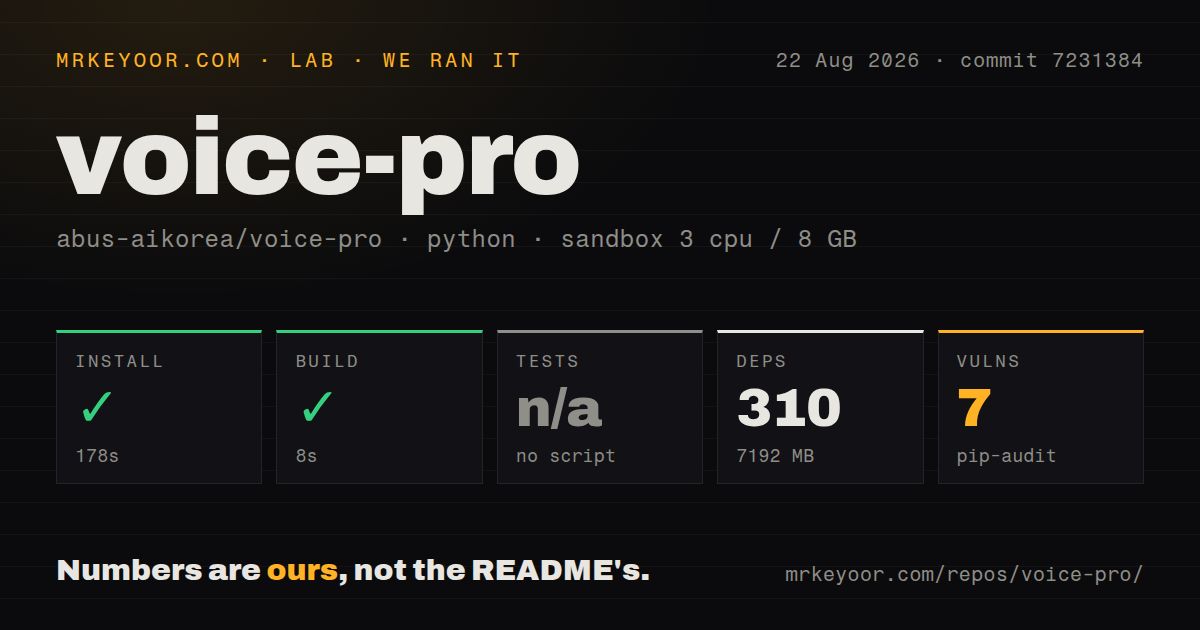
The 7,192 MB install is larger than many complete creator apps
Our fresh Debian sandbox installed 310 Python packages in 178 seconds and occupied 7,192 MB. The build then passed in 8 seconds. That measured environment is unusually large for a web UI and reflects the number of speech, media, and machine-learning components pulled together. The repository itself was only 44.8 MB, with 507 files and around 45,677 source lines.
First use still obtains selected AI models, so the base dependency result is not the final storage requirement. The v4 release moved setup to uv with a committed lockfile and uses Python 3.12, Torch 2.8.0 with CUDA 12.8, and Gradio 6.20. On Windows, start.bat can download a portable ffmpeg and does not require the CUDA Toolkit or Visual Studio Build Tools. Those improvements reduce manual prerequisites without making the installation small.
What happened when we ran it
Our run confirmed that the Python install completed in 178 seconds and the build completed in 8 seconds. The harness found no test script or target, so it skipped tests. We did not launch the Gradio interface, transcribe media, clone a voice, translate subtitles, or render a dubbed video. No such outcome should be inferred from the passing build.
Pip-audit found 7 known vulnerabilities in the 310-package environment. The supplied measurement does not list advisory identifiers or severity, so we cannot say which dependency or feature path is affected. The correct next step is to reproduce the audit with the locked v4 environment, map each advisory to a loaded component, and upgrade or isolate it. Shipping the app with an unexplained 7-advisory result would be a poor trade for setup convenience.
Windows with NVIDIA is the only platform the README endorses confidently
The requirements section lists Windows 10 or 11, Linux, and Apple Silicon Mac. A nearby notice says Voice-Pro works well on Windows with NVIDIA and that Mac and Linux operation has not been verified. Earlier history also claimed all three platforms. These statements conflict, so a buyer should use the narrower current warning: Windows is the supported trial path, while start.sh on other systems is an experiment.
GPU guidance asks for a recent NVIDIA driver, at least 4 GB of VRAM, and preferably 8 GB or more. CPU mode can be selected, but issue 85 records repeated dependency failures on Windows 11 with an AMD GPU using older releases. It does show why testing the exact GPU mode, ASR model, TTS engine, and video length matters.
Free services avoid keys but add network dependence
By default, translation uses Deep-Translator with Google's free web endpoint, and speech synthesis can use Edge-TTS. Azure Translator and Azure Speech are optional and require keys in .env. The README warns that corporate security appliances may rate-limit or block the free translation endpoint. Voice-Pro retries and preserves original text for failed lines, while Azure is the documented route around that network behavior.
A local UI therefore does not guarantee a fully local workflow. YouTube download, free translation, Edge-TTS, Azure, and model repositories all introduce external services at different points. Decide which media may leave the workstation, choose local model paths where needed, and test a blocked-network scenario. Keep .env out of version control as the README instructs, especially when workspaces contain client media.
Voice cloning needs consent controls the app does not supply
The README advertises zero-shot cloning and includes a large reference catalog named after public figures. A technical ability to generate similar speech does not establish permission to use a recording, imitate a person, or distribute the result. Voice-Pro's interface cannot make that decision for a creator. A workplace deployment needs an intake record for the source recording, consent, allowed uses, retention, and review before publication.
The same caution applies to downloaded video and translated subtitles. Keep source attribution, verify the right to download and modify media, and have a speaker review the final language when accuracy carries consequences. ASR and translation can return fluent text that is still wrong. Since our run never processed audio and the project supplies no automated test target, quality checks belong in the production workflow rather than in a hopeful reading of the feature list.
Version 4 arrived before an explicit development pause
GitHub showed 12,647 stars, 59 combined open issues and pull requests, and a last push on July 13, 2026. Release v4.0.0 was published the same day. The README also says Voice-Pro development and updates are unavailable for the time being because of work on WeConnect. Issue comments continued into August, but user discussion is not the same as maintainer releases or merged fixes.
Licensing needs one more check before redistribution. GitHub detects GPL-3.0 and the repository's LICENSE contains GPL version 3, while the README's metadata comment says LGPL. Treat the actual license file as the operative repository signal and ask counsel if bundled models, sample voices, or third-party media carry separate terms. The combination of paused updates, 7 advisories, no tests, and a 7,192 MB install makes Voice-Pro a capable workstation experiment rather than a dependable platform.