A broad ViT workbench, not a finished vision platform
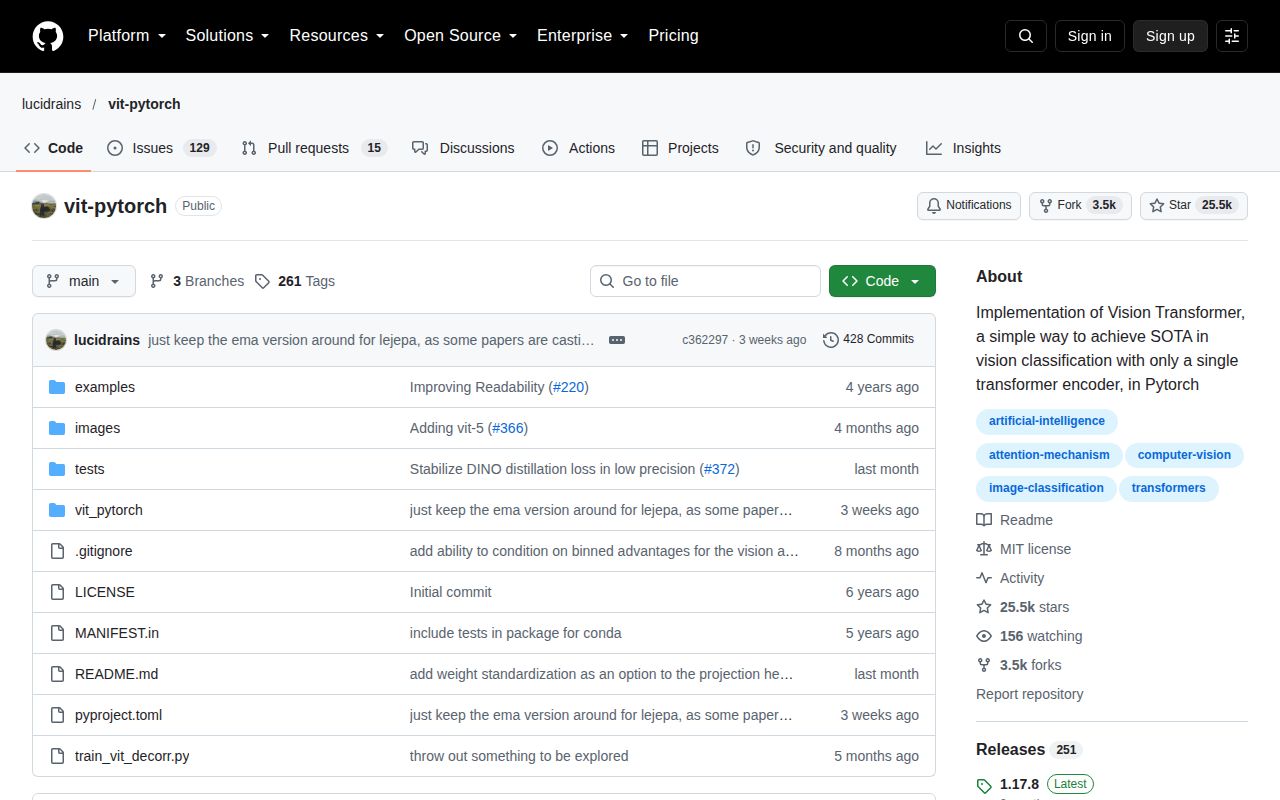
vit-pytorch packages many Vision Transformer implementations as familiar PyTorch modules. The repository began in 2020 and now carries 25,499 stars, making it a highly visible place to inspect these architectures in Python. Its purpose is narrow: turn ideas from papers into importable code for quicker experiments. It is not a hosted service, training platform, or catalog of production-ready checkpoints.
The README covers far more than the original ViT. Its contents span Simple ViT, NaViT, Deep ViT, CaiT, CCT, CrossViT, PiT, LeViT, CvT, MaxViT, MobileViT, XCiT, masked-image approaches, 3D ViT, ViViT, and Dino. Version 1.17.8 feels less like one polished model and more like a shelf of readable research implementations with one installation path.
What happened when we ran it
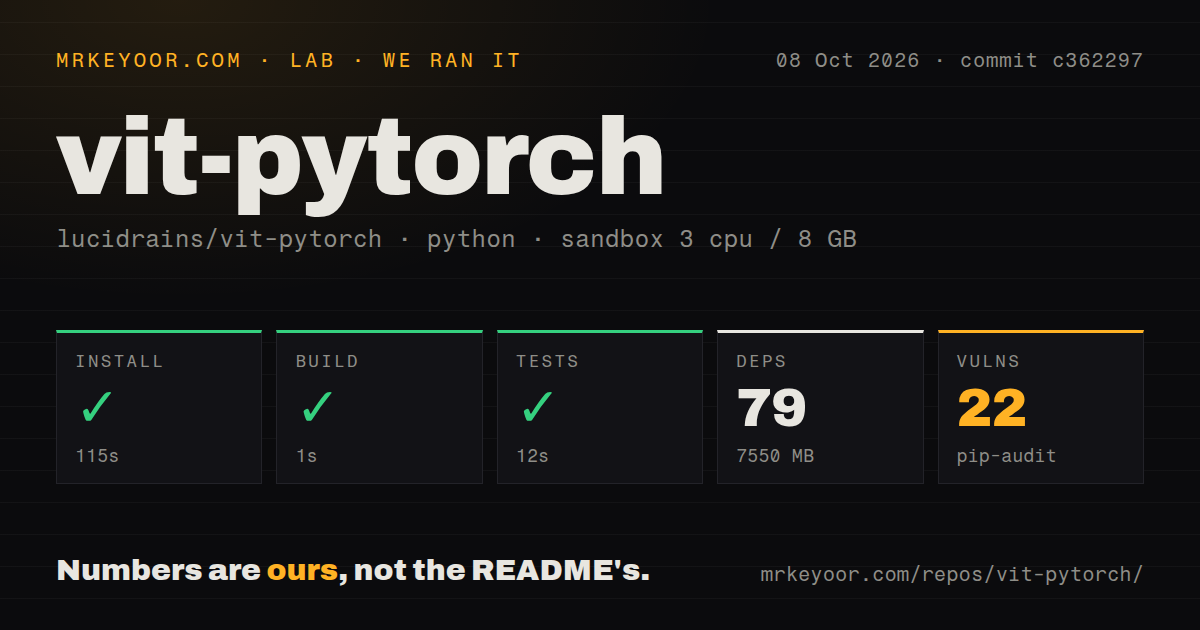
Our run used commit 7cb4b22 in an unprivileged Debian container with Python 3.12, 3 CPUs, 8 GB of RAM, and no secrets. Installation succeeded in 127 seconds, the build in 8 seconds, and tests in 19 seconds. Those clean outcomes support the README's claim that starting can be as simple as installing the package and importing a model.
The cost was footprint and dependency exposure. Our environment installed 79 packages and occupied 7,228 MB, despite a 12.8 MB checkout containing 126 files and roughly 20,185 source lines. pip-audit reported 21 known vulnerabilities in the resolved environment. That does not prove 21 flaws in vit-pytorch, but production users should identify affected transitive packages, check reachable code paths, and pin or replace versions.
We also measured 0 CI workflow files, found no Dockerfile, and found a tests directory. The passing 19-second test step is useful evidence for the pinned commit, but there is less visible proof that each change is checked across supported Python and PyTorch combinations. A container recipe would make the 7,228 MB environment easier to reproduce and trim.
The strongest feature is concrete architectural breadth
The basic API is approachable. The README constructs ViT with a 256-pixel image size, 32-pixel patches, 1,000 output classes, a 1,024-dimensional representation, 6 transformer blocks, and 16 attention heads, then accepts a PyTorch tensor and returns class predictions. Parameters such as channels, pooling, dropout, and embedding dropout are explained beside the example. That clarity helps with reading, teaching, and controlled changes.
The implementations expose meaningful differences instead of hiding every design behind one factory. SimpleViT documents 2D sinusoidal position embeddings, global average pooling, and removal of the class token. NaViT accepts differently sized images, can group them under a maximum sequence length of 64, and offers a nested-tensor flavor for PyTorch 2.5. The distillation section pairs DistillableViT with a ResNet50 teacher.
This breadth helps teams compare ideas at source level. The README connects implementations to papers, shows module imports, and explains constraints such as image_size being divisible by patch_size. With more than 30 named architecture or technique sections in the contents, one dependency can replace many one-off paper reproductions during early exploration.
The rough edges appear when experiments become systems
The package does not solve the surrounding machine-learning job. Its example creates random input and produces a (1, 1000) tensor, but a real stack still needs data loading, training loops, evaluation, checkpoint management, monitoring, and export or serving decisions. The README directs users wanting pretrained models to the project now maintained as huggingface/pytorch-image-models, clearly marking where this library's responsibility ends.
Some constraints need careful handling. Standard ViT requires the image size to be divisible by the patch size, and the stated patch count must exceed 16. Rectangular-image guidance says to use the maximum dimension, while NaViT introduces grouping, masking, sequence budgets, and optional nested tensors. These controls do not automatically prevent poor memory use or a mismatched data pipeline.
The maintenance signals are mixed but healthy overall. A last push on 2026-09-02 shows active development, although the latest tagged release was 1.17.8 on 2026-02-11. The repository also has 141 open issues. Inspect that queue for problems relevant to your chosen variant, but the recent push means the older release date alone is not evidence of abandonment.
It fits in research code before the production boundary
In a real stack, vit-pytorch fits between paper selection and a hardened training or serving system. Use it to instantiate a candidate, modify attention or token handling, and run controlled experiments. Surround it with your dataset code, reproducibility controls, evaluation suite, artifact tracking, and deployment path. The MIT license and 12.8 MB checkout aid source inspection, but neither substitutes for model validation.
Choose timm when pretrained weights and train or export scripts matter more than minimal implementations. Choose google-research/vision_transformer when official JAX lineage is the priority. Choose torchvision when integration with standard PyTorch datasets, transforms, and packaging matters most. All 3 alternatives define a clearer operational path, while vit-pytorch stays attractive because its source is easy to pull apart.
The 8-second build earns a trial, not automatic production approval
vit-pytorch is easy to recommend as a research workbench: our install, build, and tests completed, the examples are concrete, and the architecture coverage is unusually broad. Serious use needs a clear gate: review the 21 audit findings, pin the 79-package environment, add CI around required variants, and validate the model on your data. Treat it as organized experimental source, not a turnkey vision product.