
mrkeyoor.com_
Wed 09 Sept 13:30 UTC
AI Toolsevaluationupdated 09 Sept 2026

pytorch-image-models review

PyTorch Image Models, usually imported as `timm`, is a Python library that puts many image encoders, pretrained weights, data transforms, optimizers, and training scripts behind a shared PyTorch interface. It solves the tedious parts of comparing vision backbones and reusing their intermediate features without copying each paper's repository.

trackingstars / 7d
Verdict

Our timm install consumed 5,432 MB and its test run exited 137 after 319 seconds at roughly 1% progress, even though the 7-second package build succeeded. Use it when a shared PyTorch API across many image backbones will save more engineering time than the large environment and model-by-model validation cost. Commercial teams should approve each weight's training-data terms separately from the Apache-2.0 code license.

We ran it

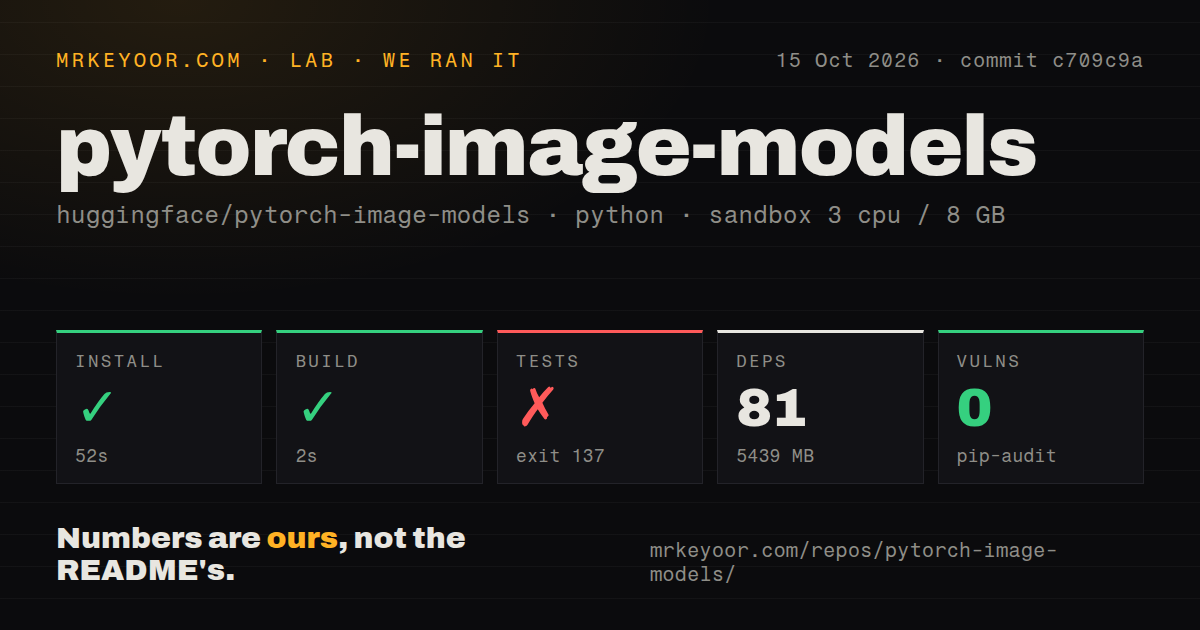
Lab card: what happened when we ran pytorch-image-modelsScreenshot of pytorch-image-models (huggingface.co/docs/timm)
Install✓ · 66s80 packages · 5432 MB
Build✓ · 7s
Tests✗ · 319sran, no count parsed
Known vulns0(pip-audit)
Repo481 files~139,251 lines of source · 13.4 MB · 5 CI workflows · tests dir

Answers from our run

Does pytorch-image-models build from source?

Dependencies installed in 66 seconds (80 packages), and the build succeeded in 7 seconds. We cloned commit a694045 into a clean Debian container with 3 CPUs and no project-specific setup.

Do pytorch-image-models's tests pass?

The test command failed in our container, and its output did not report a pass or fail count.

Does pytorch-image-models have known vulnerabilities in its dependencies?

pip-audit found none in the dependency tree at the time of our run.

Who should not use pytorch-image-models?

Small CPU-only environments: our install added 80 packages and occupied 5,432 MB before downloading any pretrained weights.

What are the alternatives to pytorch-image-models?

Torchvision, Transformers, MMPreTrain. Our timm install consumed 5,432 MB and its test run exited 137 after 319 seconds at roughly 1% progress, even though the 7-second package build succeeded.

Setup3/566-second install, 5,432 MB environment, and tests did not finish
Docs4/5Strong API and training guides; weight licensing needs close reading
Community5/537,133 stars with a recent release and same-week issue activity
Maturity4/5Version 1.0.29 is active, but the full measured suite stopped early

Who it’s for

PyTorch developers comparing image classifiers or feature backbones through one model factory.
Computer-vision teams that need pretrained encoders for classification, detection, segmentation, retrieval, or multimodal systems.
Researchers who want reference training, validation, inference, augmentation, optimizer, and scheduler code in one repository.
Engineers prepared to pin model names, weight tags, preprocessing configuration, and the PyTorch version used for validation.

Who it’s NOT for

Small CPU-only environments: our install added 80 packages and occupied 5,432 MB before downloading any pretrained weights.
Teams that need a complete detector or segmentation product: the README positions timm models as encoders and points to separate downstream frameworks for those tasks.
Commercial users who assume Apache-2.0 covers every pretrained weight: the README warns that ImageNet and some third-party training data can impose separate terms.
Pipelines that require the entire test suite to finish in a constrained container: our run exited 137 after 319 seconds while progress was around 1%.
Users feeding a flat unlabeled image folder to the reference inference script: open issue 2323 says it expects labeled subfolders and documents a dummy-folder workaround.

Setup reality

Our sandbox installed 80 Python packages in 66 seconds and used 5,432 MB on disk. The package build succeeded in 7 seconds. Tests ran for 319 seconds, showed progress around 1%, then failed with exit code 137. The log tail contains progress dots and one skipped marker, with no Python traceback or test summary, so it does not establish the cause.

The package declares Python 3.8 or newer and depends on PyTorch, torchvision, PyYAML, Hugging Face Hub, and safetensors. Pretrained use downloads model configuration and weights unless you supply a local model directory. Training also needs a dataset layout, compute choice, and experiment configuration.

The dependency environment alone consumed 5,432 MB; model weights and datasets come later. Our scan found 5 CI workflows, no Dockerfile, and a tests directory. Pip-audit reported 0 known vulnerabilities in the installed packages, but the incomplete suite leaves compatibility and model-specific behavior for adopters to verify.

timm standardizes image backbones behind one PyTorch factory

A call to timm.create_model can select an architecture, load a named pretrained checkpoint, change the input-channel count, or replace the classifier. Models expose shared methods for classifier access and feature extraction, which lets application code compare different families without importing a new project for each paper. The catalog spans convolutional networks, vision transformers, mobile models, and image encoders used inside larger multimodal systems.

The surrounding package matters as much as the model definitions. timm includes data loading and augmentation, optimizers, schedulers, reference training, validation, inference, and export code. Release v1.0.29 added LowFormer, CPUBone, PP-LCNetV2, and LingBot-Vision definitions or weights, plus fixes around augmentation, classifier resets, NaFlex position handling, and optimizer behavior. That scope makes it useful for controlled comparisons, though each extra subsystem expands the compatibility surface.

Intermediate features make timm useful beyond classification

Passing features_only=True turns supported models into multi-scale feature extractors and exposes channel and reduction metadata through feature_info. Detection, segmentation, retrieval, and multimodal code can then reuse an encoder without treating its internal module names as a stable API. The README says most networks default to output stride 32 and allows selected models to change that through dilation. Support still varies by architecture, so the candidate list should be tested before a downstream design assumes identical feature maps.

The model factory also handles pretrained configuration, input transforms, classifier adaptation, and a change from 3 input channels to 1 when supported. Local directories can supply configuration and weights without a Hub lookup. These conveniences remove repetitive glue, but they do not decide whether a checkpoint suits a medical image, satellite scene, retail photo, or document page. Accuracy tables from ImageNet answer a narrower question than most production datasets ask.

What happened when we ran it

Our run at commit a694045 installed 80 packages in 66 seconds. The environment occupied 5,432 MB on disk before any separate checkpoint or dataset was added. Building the Python package succeeded in 7 seconds. Pip-audit found 0 known vulnerabilities in the installed dependency set, which is a useful snapshot of that resolved environment rather than a permanent security guarantee.

Tests ran for 319 seconds and ended with exit code 137. The log tail shows rows of progress dots, one s marker, and movement from 0% to 1%. It contains no traceback, failed-test name, or final pytest count. We therefore know that the suite did not finish in our 3-CPU, 8 GB container, but the supplied evidence does not show whether a particular test, resource limit, or external action ended it.

The checkout contained 481 files, about 139,251 source lines, and 13.4 MB of repository data. Our scan found 5 CI workflow files, no Dockerfile, and a tests directory. Those numbers explain part of the test cost: this is a large matrix of models and layers rather than one network. They do not justify a claim about inference speed or training throughput, neither of which our sandbox measured.

Apache-2.0 code does not settle every weight license

The source code is Apache-2.0, while the README gives pretrained weights a separate warning. ImageNet was released for noncommercial research, and the maintainer says users should assume its dataset terms apply to weights trained on it. Some referenced Facebook weights have an explicit CC-BY-NC 4.0 license, while other checkpoints may depend on proprietary training data the maintainer cannot inspect. Commercial approval has to happen checkpoint by checkpoint.

This distinction changes how a model registry should be built. Store the exact timm model name, weight tag, source URL, license note, preprocessing settings, and approval record together. Version v1.0.29 is not enough to identify the artifact because a single package release can address many unrelated checkpoints. Teams that cannot establish acceptable terms should train from cleared data or select weights with documentation their counsel can approve.

Two open issues expose edges in reference workflows

Issue 2323 reports that inference.py rejects images placed directly in one unlabeled directory because its reader expects class subfolders. The reporter's workaround puts the inputs under a dummy label. That is a small mismatch for an application calling model APIs directly, but it matters to users choosing the reference script precisely to avoid writing an inference loop. A smoke test should use the intended production directory shape.

Issue 2766, opened on 2026-09-09, reports that PatchEmbed returns a view tensor that triggers a PyTorch FSDP2 warning. The warning says an in-place operation on that view can skip a pre-backward hook and lead to failed or wrong gradients. The report uses timm 1.0.29 and a newer PyTorch build. Distributed training teams should reproduce their exact sharding and compiler setup instead of assuming a basic forward pass covers it.

Release 1.0.29 and 37,133 stars show current maintenance

GitHub recorded 37,133 stars, 61 combined issues and pull requests, and a push on 2026-09-08. Release v1.0.29 followed on 2026-08-28. The README logs changes throughout 2026, including checkpoint-loading safety work, newer model families, training changes, and compatibility fixes. The open queue mixes recent bugs with feature requests that date back several years, so age alone does not describe current project health.

For teams already on PyTorch, timm is often the practical first catalog to test because one interface covers both familiar and recent image encoders. Torchvision is smaller and closer to PyTorch itself. Transformers fits projects whose vision model shares a pipeline with language or audio, while MMPreTrain favors config-led OpenMMLab experiments. Our 5,432 MB environment and unfinished tests argue for a pinned project image and a focused validation subset built around the few models you will ship.

Alternatives

ProjectWhat it isPick it when
TorchvisionPyTorch's official package for vision models, datasets, transforms, and operators.pick this instead when official PyTorch integration and a smaller model catalog matter more than breadth.
Transformers gh↗A multi-framework model library covering vision, language, audio, and multimodal architectures.pick this instead when the image encoder belongs inside a larger multimodal pipeline with standardized processors.
MMPreTrainAn OpenMMLab toolbox for image classification, pretraining recipes, and downstream backbone use.pick this instead when config-driven experiments and the OpenMMLab ecosystem fit the research workflow.

What people are saying

  1. [velocity-scout] huggingface/pytorch-image-models

Sources

  1. PyTorch Image Models README
  2. PyTorch Image Models v1.0.29 release
  3. timm package metadata and dependencies
  4. Flat-folder inference issue 2323
  5. FSDP2 PatchEmbed issue 2766

More ai tools reviews

ChatGPT · GamePhanes · Open-Sora · koharu · logocreator · personaplex · the whole board →