Start here: research evaluation is the sensible use
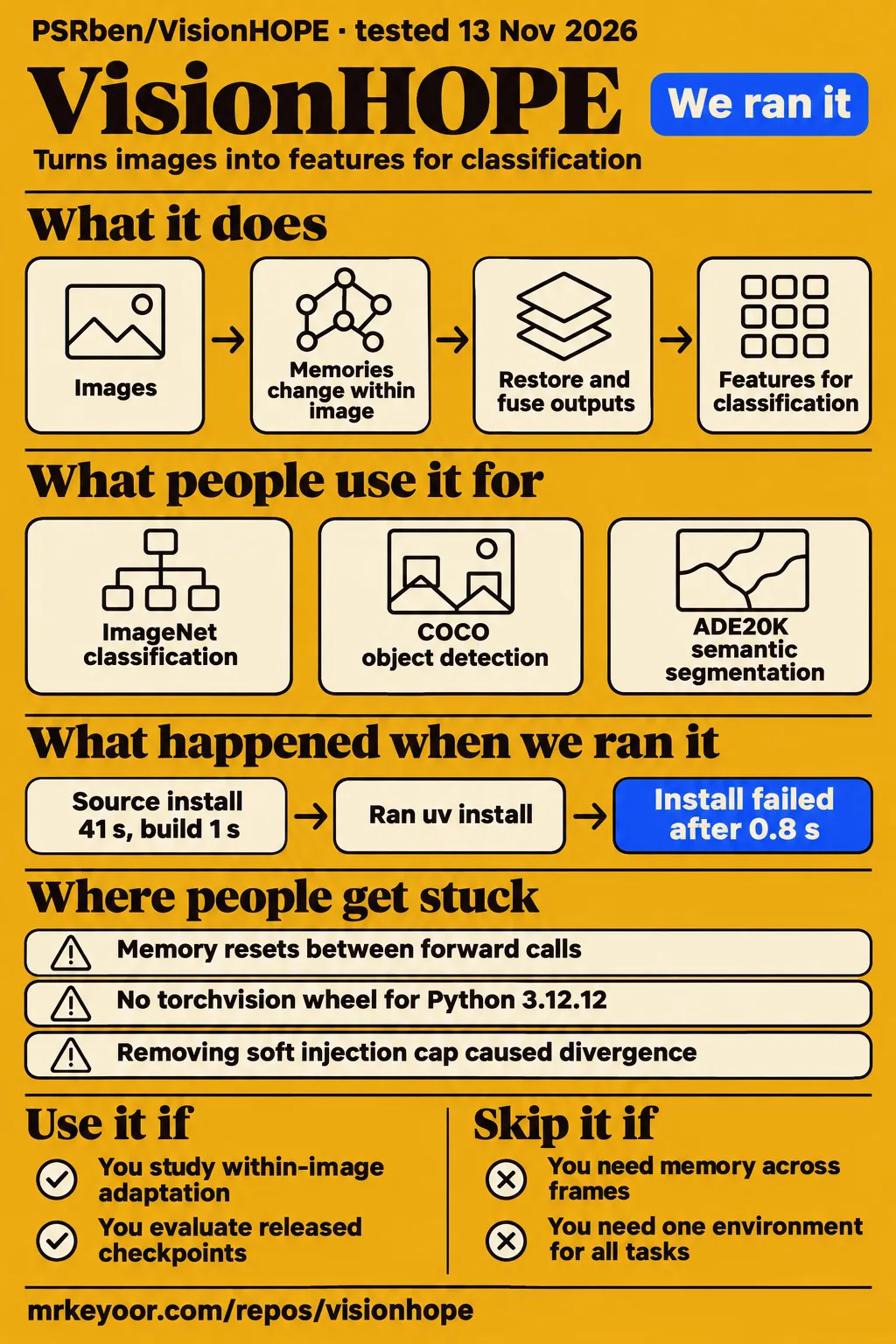
VisionHOPE turns images into features for classification, object detection and segmentation, with memories that change as it processes an image. Run it if you want to study that mechanism or reproduce the authors' visual-recognition experiments. Skip it if your requirement is a model that accumulates experience across separate images through its public SRNL interface. The difference is consequential: a memory that changes during a scan is useful research, but it doesn't give a camera application continuing memory across frames.
Our sandbox installation succeeded in 41 seconds and occupied 5,419 MB. That earns VisionHOPE a closer look from researchers prepared to manage its task environments, rather than a recommendation as a ready-to-serve image API. Start by choosing the task and checkpoint you intend to evaluate. Otherwise it is easy to spend your first session assembling an environment for the wrong experiment.
What people use VisionHOPE for
The documented uses are the authors' classification, detection and segmentation experiments, with released checkpoints covering those task families. The following results describe their research, as reported in the paper and summarized by alphaXiv. AP measures detection or mask quality; mIoU measures overlap between predicted and reference segmentation regions. Those metrics answer different questions, so a larger number in one row doesn't make that task easier or that model cheaper to run.
| Who used it | Task and outcome | What the result helps you decide |
|---|---|---|
| VisionHOPE authors, summarized by alphaXiv | P-VisionHOPE-S reportedly scored 82.3% ImageNet-1K Top-1 accuracy; removing adaptive key/value memories and adaptive update dynamics together reduced it to 81.7%. | A useful ablation for researchers asking whether within-image adaptation contributes to classification. |
| VisionHOPE authors, summarized by alphaXiv | Hierarchical VisionHOPE-T reportedly scored 47.9 box AP and 43.1 mask AP with Mask R-CNN under the COCO 1× protocol. | A released backbone path for object detection and instance segmentation. |
| VisionHOPE authors, with alphaXiv's reported result and the maintainer's protocol clarification | VisionHOPE-T reportedly scored 49.4% mIoU on ADE20K with UPerNet, using single-scale validation. | A semantic-segmentation reference whose evaluation scale is explicitly identified. |
The classification ablation is the most informative result for someone studying the architecture. It changes the adaptive components while keeping the backbone and training protocol fixed, according to alphaXiv's account. For an application developer, the downstream checkpoints are more immediately useful: they let you begin with a model intended for the task rather than treating ImageNet classification weights as a finished detector. The choice between those starting points determines which scripts, dependencies and dataset layout you need.
What happened when we ran it
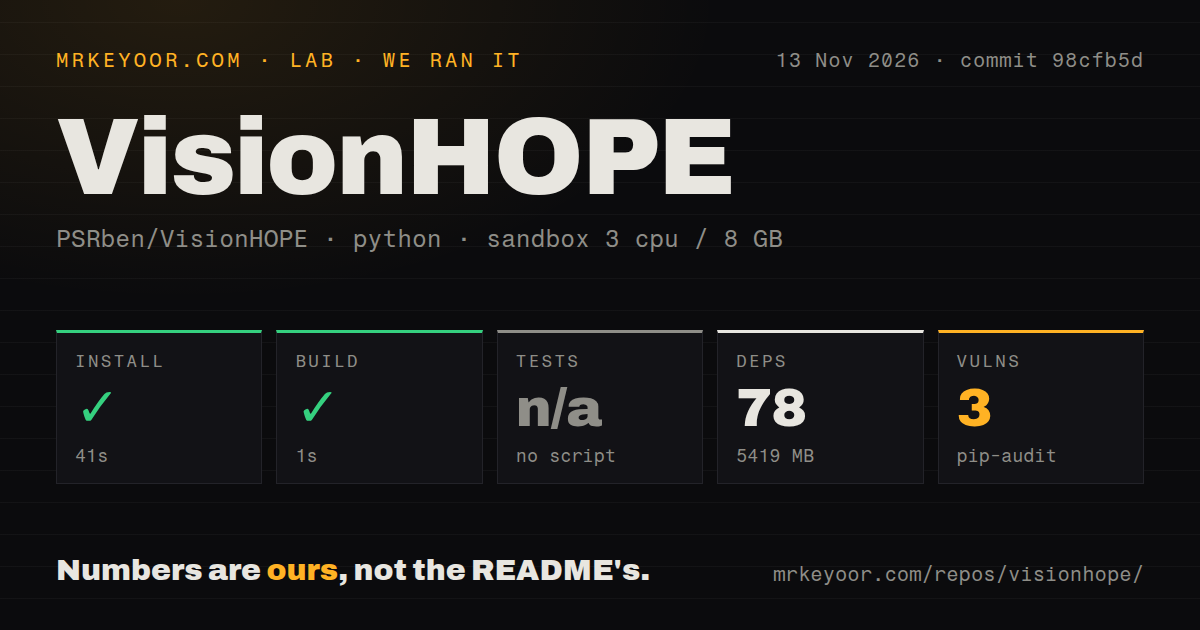
Our November 13, 2026 sandbox run at commit 98cfb5d installed VisionHOPE in 41 seconds, with 78 dependencies recorded and 5,419 MB on disk. The recorded configuration specified 3 CPUs, 8 GB RAM and image ghcr.io/astral-sh/uv:python3.12-bookworm. That image name is a configuration label; actual runtime and operating-system versions require the raw toolchain logs.
| Check | Our recorded outcome | Practical consequence |
|---|---|---|
| Install | Succeeded in 41 seconds; 78 dependencies recorded; 5,419 MB on disk | Budget for the installed environment, not just the source checkout. |
| Build | Succeeded in 1 second | The recorded build step completed. |
| Tests | No tests script or target; skipped | There is no passing test-suite result in this run. |
| Dependency audit | pip-audit reported 3 known vulnerabilities | Review the affected packages before adopting this environment. |
| Repository scan | 121 files, about 7,754 source lines, 1.1 MB checked out | The source is much smaller than the installed environment. |
| Automation signals | 0 CI workflow files, no Dockerfile, no tests directory | The scan found none of these supporting artifacts. |
The separate quickstart attempt in the research pack stopped at dependency resolution. Its install log names Python 3.12.12 and reports no matching wheel for torchvision==0.16.0; the finding lists available ABI tags cp38, cp39, cp310 and cp311. That is a specific package-and-runtime mismatch in that attempt. It doesn't contradict a successful install recorded by another procedure, and it isn't evidence that the model's predictions are broken.
That quickstart record identifies commit 98cfb5d60044, an unprivileged container configured with 2 CPUs and 4 GB RAM, no published ports and no secrets. Its teardown record says cleanup completed. Keeping that attempt separate from the 3-CPU harness matters: these records describe different procedures, and the supplied evidence gives no basis for merging them into a single successful GPU session.
Where people get stuck: choose the task environment first
The maintainer recommends Python 3.10 for all tasks, while classification additionally supports Python 3.11. That answer in issue #4 is more useful than assuming one modern Python environment will cover every example. The README calls for Linux, an NVIDIA GPU, the CUDA toolkit including nvcc, and a C++ compiler. Its documented PyTorch/CUDA combination and task dependencies should guide a reproduction, especially when moving into the OpenMMLab-based downstream tasks.
| Reader's problem | Maintainer's answer | Status and decision |
|---|---|---|
| One Python 3.11 environment for everything | Issue #4 recommends separate Python 3.10 environments for COCO and ADE20K. | Workaround documented; choose environments by task. |
| Training examples suggest evaluation needs several GPUs | Issue #6 confirms single-GPU evaluation with CUDA_VISIBLE_DEVICES=0 and the matching script and checkpoint. |
Closed with guidance; memory needs depend on the configuration. |
| Unsure which pretrained file belongs to detection or segmentation | Issue #5 says to use a task-specific checkpoint for direct evaluation. | Closed with examples; classification weights can initialize downstream training. |
| Dataset lives on another disk | Issue #7 supports --data-root and dataset environment variables. |
Closed with guidance; preserve the internal directory layout. |
| Unsure whether to convert the whole model to half precision | Issue #14 recommends FP32 parameters with torch.autocast. |
Answered; scripts offer fp16 and bf16, while ImageNet evaluation defaults to FP32. |
Issue #6 captures an easy misreading. A reader saw the multi-GPU training examples and asked whether evaluating a released checkpoint also required that setup. The maintainer answered yes to one-GPU evaluation and supplied the device setting. That removes a machine-count barrier for someone reproducing the results. It still leaves a concrete purchasing question: which GPU has enough memory for your model, task and input dimensions? The reply explicitly makes those the determining factors.
The checkpoint question is just as practical. For the Small model, issue #5 names visionhope_small_coco_1x.pth for COCO and visionhope_small_ade20k.pth for ADE20K. Someone starting from the classification file should expect to train a downstream model, rather than hand that file to an unrelated evaluation script. Keeping the filename beside the chosen task is a simple way to avoid comparing results from different model configurations.
Its memory changes within an image and resets between calls
Each SRNL forward call starts a new sequence, according to the maintainer's answer in issue #8. The ending memory state of one call is not carried into the next. This is the boundary to understand before building anything around the phrase self-modifying: the public interface describes adaptation during a sequence, rather than accumulating a user's image history across calls. Memory behavior in issue #8.
The paper describes five coupled memories: content, key, value, learning rate and retention. As visual context accumulates, the memories change both what is stored and the quantities controlling future updates. Four directional scans apply the mechanism across rows and columns, then restore and fuse the spatial outputs. The useful research question is whether that extra adaptation produces better features for your task, compared with an inner learner whose update machinery stays fixed. Architecture and mechanism.
There is also a concrete integration answer in issue #10: both VisionHOPEOperator and VisionHOPEBlock accept rectangular feature maps and preserve the input shape. The maintainer names the tensor layout as [batch, channels, height, width] and points to a 14 × 20 example. That makes the standalone operator worth examining if your existing architecture already produces rectangular maps. It doesn't require you to replace the whole feature-extraction stack just to inspect the operator interface. Rectangular-map clarification.
Linear token scaling leaves pipeline costs to measure
VisionHOPE's recurrent computation scales linearly with token count, while global self-attention has quadratic token complexity. That is an architectural comparison, not a stopwatch result. For a deployment decision, the relevant work includes getting an image into the right shape, transferring data, running the backbone and producing predictions. Those steps need to be measured together on your intended input sizes. The paper's complexity discussion.
You can measure FLOPs, throughput and GPU memory without setting up a dataset, using run_inference.sh complexity and run_inference.sh efficiency. The maintainer's answer in issue #13 says these use synthetic inputs. Its throughput and memory benchmarks cover the forward pass and exclude loading, preprocessing and prediction postprocessing. Save those results as a model-only baseline, then measure the surrounding application separately. A fast synthetic forward pass can identify a promising configuration without answering how quickly your service handles an uploaded photograph. Benchmark boundary.
The stability claim deserves equally careful reading. AlphaXiv reports that removing the soft injection cap caused numerical divergence in the authors' ablation. The proposed scheme combines that cap with a spectral clamp, with a proof concerning memory dynamics under the paper's conditions. Someone changing the update mechanism should preserve that context when comparing variants. A bound on those dynamics is a different result from showing that every training configuration converges. Stabilization and ablations.
Security starts with the environment's three audit findings
Our pip-audit result reports 3 known vulnerabilities, which makes dependency review part of adopting this checkout. The supplied summary gives a count, so it supports a clear action: obtain the advisory details and affected versions before deciding whether the environment is acceptable for your work. It supplies no severity breakdown or package names to justify calling these findings harmless, remotely exploitable, or fixed by a particular upgrade.
Use an isolated research environment and keep production credentials out of it while evaluating the model. That is our operating recommendation, grounded in the unresolved audit details rather than a claim about an observed exploit. The quickstart attempt followed that separation with an unprivileged container, no secrets and no published ports. Its installation error also shows why environment selection deserves attention before you put application data or service access into the experiment.
VisionHOPE vs Vision-TTT, H-ViT³-T and global-attention ViTs
Vision-TTT is the closest conceptual comparison in the supplied research because it also adapts an inner learner along visual tokens. VisionHOPE's stated distinction is that its key/value maps and update dynamics also evolve within the image. Pick the comparison that matches your question: isolating a learning mechanism requires a different experiment from choosing the best downstream detector. The following table uses the paper results as summarized by alphaXiv, rather than a new comparison on our hardware.
| Alternative | What the supplied comparison says | When to consider it instead |
|---|---|---|
| Vision-TTT | VisionHOPE additionally adapts its key/value representation maps and update dynamics within an image. | You want a reference for studying recurrent inner-learner adaptation without making VisionHOPE's additional mechanism the starting assumption. |
| H-ViT³-T | The reported COCO comparison is 47.3 box AP and 42.8 mask AP, versus VisionHOPE-T's 47.9 and 43.1; ADE20K is 48.0% mIoU versus 49.4%. | You need the named downstream baseline under the reported Mask R-CNN and UPerNet protocols. |
| Global-attention Vision Transformers | Global self-attention has quadratic token complexity; VisionHOPE's recurrent computation is linear in token count. | You want global self-attention as the architectural reference and will measure the complete workload on your hardware. |
Architecture comparison and reported downstream results, paper's attention-complexity discussion.
The H-ViT³-T results give a reason to include VisionHOPE in a reproduction. They don't settle whether changing a working application is worthwhile. Keep the dataset split, task framework and evaluation settings aligned before interpreting the reported differences. In particular, a box-AP comparison says nothing about whether either implementation meets your response-time budget. Choosing a backbone for a paper comparison and choosing one for a service are separate decisions.
What the other reviews get wrong
The official checkpoint card explicitly covers classification, COCO detection and segmentation, and ADE20K segmentation, so summaries that reduce VisionHOPE to classification leave out released artifacts. Four corrections in the supplied coverage are useful because they change what you might try, whom you credit, or how much hardware you expect to need. None requires treating another review's conclusion as a benchmark.
| Coverage | Correction supported by the records |
|---|---|
| ZICQ attributes the introduction to Hugging Face. | The paper names a research team affiliated with Mininglamp and academic institutions. Hugging Face hosts the paper listing and weights. |
| OpenTrain says it found no direct paper-linked Hugging Face artifacts. | The official model card identifies pretrained weights for the paper across the three task families. Use that card to find them. |
| Interfaze marks native object detection as absent. | The released COCO checkpoints support downstream detection with Mask R-CNN. This is a backbone integrated with a detection framework, rather than evidence of a standalone detection API. |
| ToKnow.ai infers affordable 1280-pixel inputs from linear scaling. | Complexity alone supplies no elapsed time or affordability result. The maintainer in issue #6 makes memory needs depend on model size, task and input dimensions. |
Questions people ask
Released VisionHOPE checkpoints support single-GPU evaluation with the matching task script and checkpoint, according to the maintainer. They are especially useful alongside the README because they explain what a reader should infer from the example commands. The answers below refer to the released interfaces and documented evaluation path, with the relevant source beside each one.
Does VisionHOPE update weights while processing an image, and what does that cost in latency and resources?
VisionHOPE updates its coupled memory states and update machinery within an image, according to the paper. The label self-modifying refers to that mechanism. Use the synthetic efficiency tools to measure a selected configuration, then time the surrounding pipeline separately; linear complexity supplies no universal latency or memory figure. Mechanism, measurement tools.
Does SRNL retain memory between forward calls?
No. The maintainer says each forward call starts a new sequence in the current public interface. The ending state is not passed into the next call. If your application needs continuity across frames or successive uploads, this interface behavior should guide the design before you select VisionHOPE for its memory terminology. Issue #8.
Can I evaluate released VisionHOPE checkpoints on one GPU?
Yes. Set CUDA_VISIBLE_DEVICES=0 and use the matching task script and checkpoint, according to the maintainer. The required GPU memory depends on model size, task and input dimensions, so the answer is permission to use the single-GPU path rather than a promise that any particular card will fit every checkpoint. Issue #6.
Can classification, COCO, and ADE20K all run under Python 3.11?
Python 3.10 is the recommended common version, and classification additionally supports Python 3.11. The maintainer recommends a separate Python 3.10 environment for each of COCO and ADE20K, with the corresponding dependencies. Follow that task split rather than treating classification's extra version support as a statement about every downstream framework. Issue #4.
Should I use torch.autocast or model.half() for mixed precision?
Keep model parameters in FP32 and use torch.autocast, the maintainer recommends. The evaluation scripts offer --precision fp16 and --precision bf16; ImageNet evaluation uses FP32 by default. Record the precision alongside any comparison result so that a default evaluation and an explicitly mixed-precision run aren't silently treated as identical configurations. Issue #14.
Does VisionHOPE support rectangular feature maps and preserve their shape?
Yes. The maintainer says VisionHOPEOperator and VisionHOPEBlock accept [batch, channels, height, width] tensors and preserve the input shape. Issue #10 points to a 14 × 20 example. That reply addresses the operator and block interfaces specifically, which is the relevant boundary when inserting one into an existing architecture. Issue #10.
Are the reported ADE20K results single-scale or multi-scale?
The table uses single-scale validation with UPerNet, according to the maintainer. Select the ADE20K test script for your model size and load the matching ADE20K checkpoint. This clarification matters when comparing mIoU against another result: changing the evaluation scale changes the protocol rather than merely changing how the same number is displayed. Issue #12.
Which checkpoints should I use for direct COCO and ADE20K evaluation?
Use the task-specific checkpoint and matching test script. The maintainer distinguishes direct evaluation from using ImageNet weights to initialize a backbone for downstream training. For the Small model, the examples are visionhope_small_coco_1x.pth and visionhope_small_ade20k.pth. Decide whether you are evaluating a released task model or training one before downloading the file. Issue #5.
Can VisionHOPE use datasets stored outside the repository?
Yes. Pass --data-root or use IMAGENET_ROOT, COCO_ROOT or ADE20K_ROOT, while preserving the documented internal structure. For ADE20K, the maintainer specifies the extracted ADEChallengeData2016 directory as the root. External storage therefore doesn't require moving the data into the repository, but the scripts still expect the right layout beneath the chosen directory. Issue #7.
What we have not tested yet
Our successful install and build are setup observations, not a reproduction of ImageNet, COCO or ADE20K accuracy. We did not run a GPU evaluation, training workload, precision comparison, rectangular-map regression, or application latency test. The skipped tests provide no regression coverage. The separate failed quickstart supplies an environment error and cleanup result, with no completed visual task or known-answer questions. No screenshot records accompany this pack.
The supplied evidence contains no independent benchmark reproduction or documented production deployment. Issue #11 records the authors checking catalog entries and saying they look correct; that is author review of recorded results, not a second lab running the experiment. We have not assessed support capacity, service security, or the three advisories' severity and exploitability. The sandbox image label also leaves actual harness runtime versions unresolved. Catalog discussion.
Documentation receives 3/5 under this editorial rule: a usable task path with material setup caveats. The README describes environments, checkpoints and evaluation, while issue replies settle questions about persistence and precision. A 1 would mean a documented blocker without a usable path; a 5 would require complete, independently exercised task guidance. Setup ease, community and maturity remain unassessed because these records don't support comparable numerical judgments. For your first experiment, select one task-specific checkpoint and reproduce its matching evaluation protocol before changing the backbone.