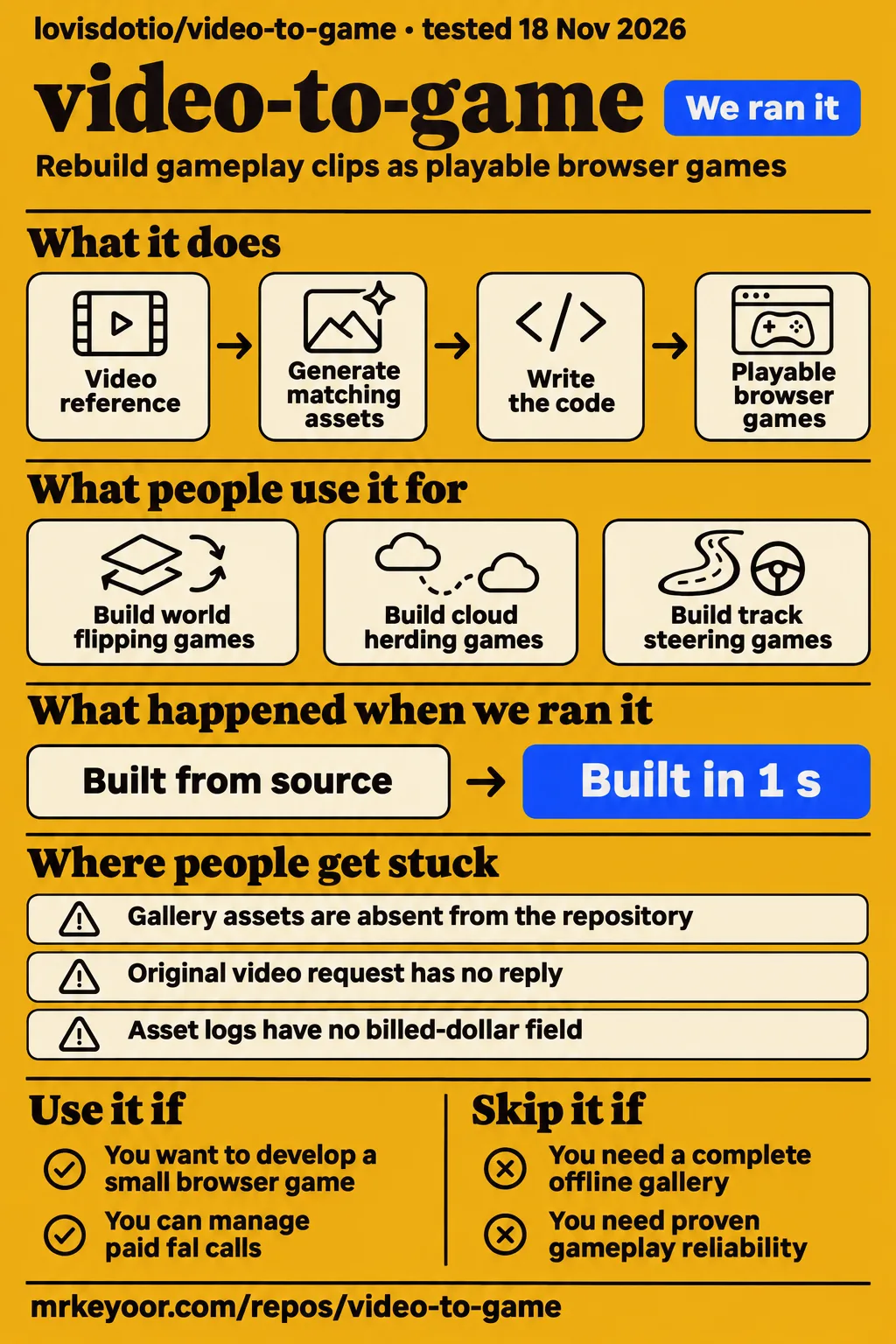
Video-to-game is an open-source coding-agent skill that rebuilds gameplay clips as Three.js browser games. Use it if you want to develop a small original game from a visual reference and can manage a coding agent, generated assets and paid fal calls. Skip it if you expect a complete offline gallery after cloning, or a production game whose reliability has already been demonstrated.
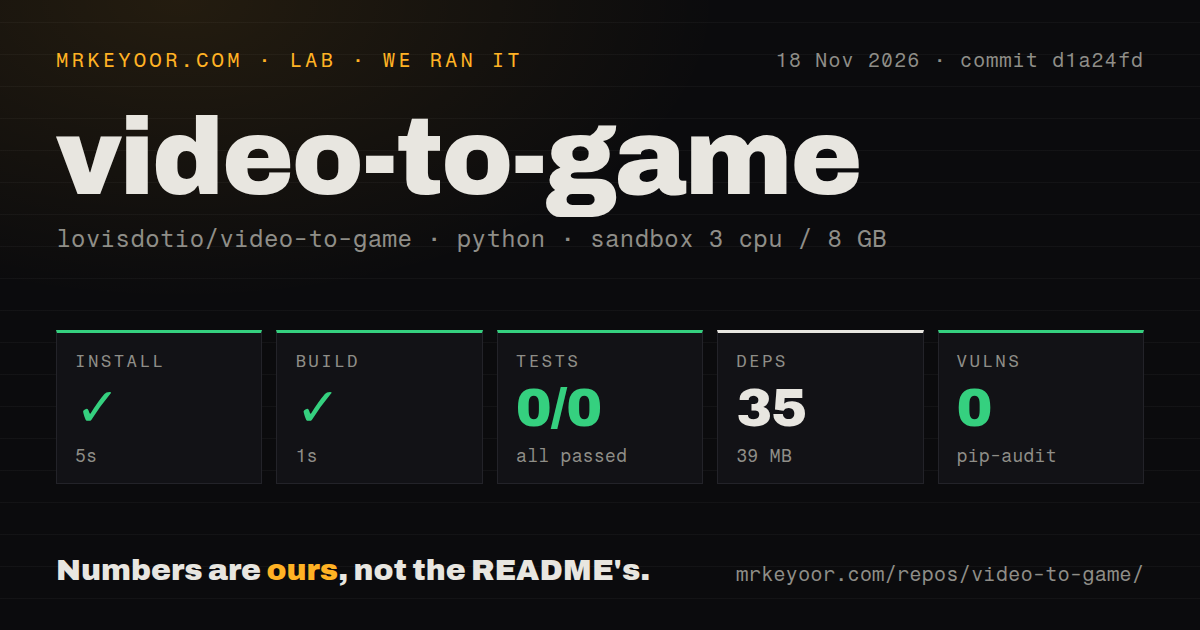
Our sandbox installation completed in 5 seconds and the build in 1 second, but pytest exited 5 after finding no tests. The author’s gallery is the reason to investigate this project. Reproducing that gallery is a separate decision from installing its Python dependencies.
What people use video-to-game for
Lovis Odin reports rebuilding 31 original gameplay clips as browser games, with $202 in fal spending across the gallery. Those are author-made demonstrations and author-reported costs. The project README describes a workflow that studies video frames, generates matching assets and writes the interactive implementation.
| Who used it | What they made | What the evidence supports |
|---|---|---|
| Project author Lovis Odin | A gallery of 31 Three.js browser games rebuilt from original AI gameplay clips | The author reports the gallery and its fal spending; these are demonstrations rather than independent gameplay ratings. README |
| Lovis Odin, with gallery mechanics summarized by AI IDE List | Snow Globe’s world flipping, Cloud Shepherd’s cloud herding, and Train Painter’s track steering | The documentation describes distinct interactions, including rotating gravity, gathering clouds to produce rain, and curving newly laid rails. Gallery analysis |
These examples make the intended scale clear. A single action changes something visible in the scene. For a developer choosing a prototype brief, that is more useful than asking for an entire genre: identify the action, its consequence and the camera that lets a player read both. The skill’s own instructions require the mechanic in the video to survive the reconstruction.
Cloud Shepherd is an instructive example on paper. Moving a shepherd is only the input. Pushing clouds together and producing rain is the interaction being sold. A reconstructed scene that merely contains clouds would miss the point, even if its colors matched. That is our reading of the documented mechanic, rather than a claim that we played it.
What happened when we ran it
Our sandbox install succeeded in 5 seconds, the build succeeded in 1 second, and the test command failed with exit 5 in 1 second because pytest reported no tests ran.
We ran the source checks at commit d1a24fd on 2026-11-18, with 3 CPUs and 8 GB RAM configured. Its image label was ghcr.io/astral-sh/uv:python3.12-bookworm. That label records the selected image; actual runtime and operating-system versions require the raw toolchain logs.
| Sandbox observation | Recorded result | What it means for a reader |
|---|---|---|
| Installation | Succeeded in 5 seconds; 35 dependencies recorded; 39 MB on disk | The recorded dependency step completed. |
| Build | Succeeded in 1 second | The recorded build step completed. |
| Tests | Failed, exit 5, in 1 second; 0 passed, 0 failed of 0 | Pytest supplied no executed test cases. |
| Test log | no tests ran in 0.04s |
The log shows an empty run, rather than a failing gameplay assertion. |
| Dependency audit | pip-audit: 0 known vulnerabilities | The audit reported no known vulnerabilities in this run. |
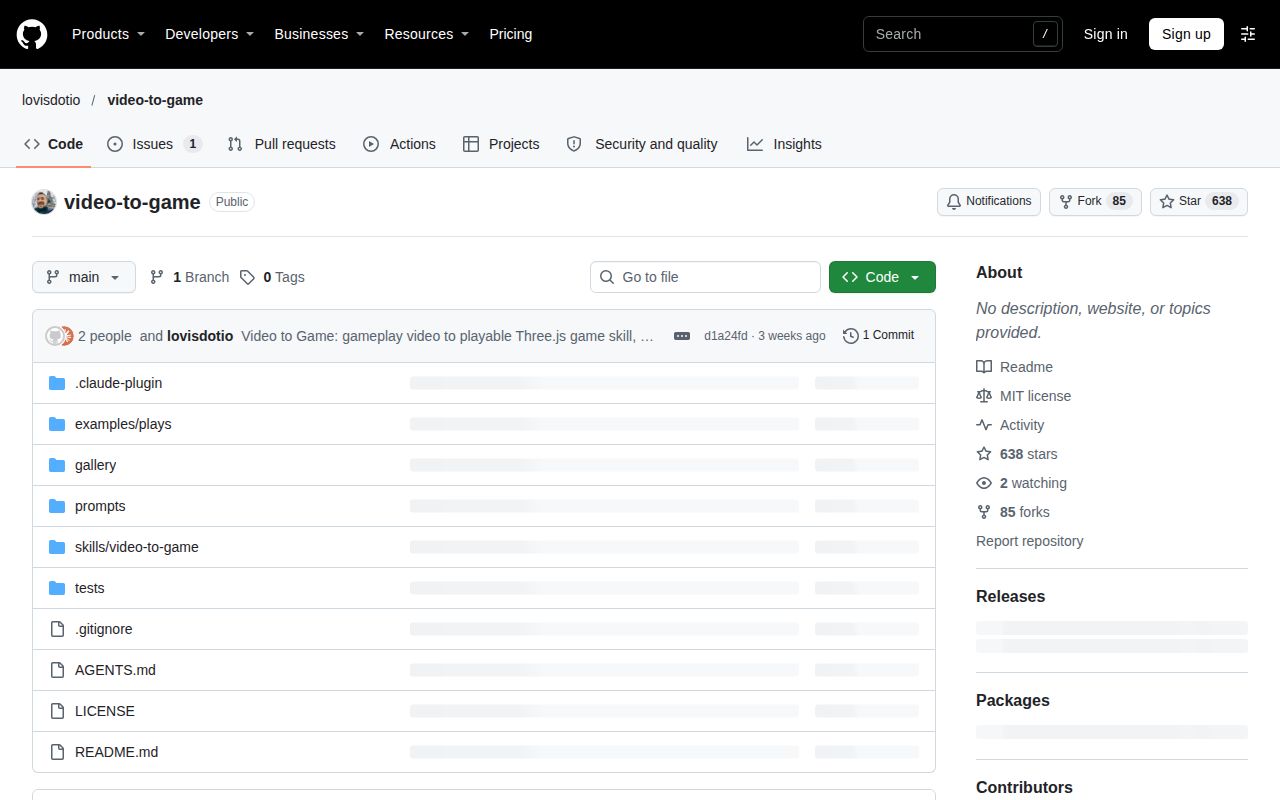
| Repository scan | 143 files, approximately 8,315 source lines, 28.2 MB checked out | This describes the measured checkout. |
| Automation signals | 0 CI workflow files, no Dockerfile, a tests directory present | A directory named tests did not translate into collected pytest cases. |
The failed test command matters because a successful dependency step is easy to overread. The log gives a concrete result: pytest collected no cases. It supplies no package exception or environment diagnosis, so blaming a Python version or declaring the game generator broken would go beyond the evidence. Our harness recorded repository setup, build and test steps, separate from the author’s generated-game recordings.
A separate hands-on attempt also stopped at its safety check. Its step record says none of compose.yaml, compose.yml, docker-compose.yaml or docker-compose.yml existed, and that this runner required a Compose file. The runner called that an “unsafe repo” failure. It is a deployment-policy result, not a finding of malicious code.
The run summary uses a generic “deployed with its own docker compose” description, which conflicts with that explicit failed step. We give the step log precedence and report the attempt as blocked, rather than claim a working deployment. The teardown record says “teardown: ok.”
Where people get stuck: reference videos and missing assets
A user in issue #1 asked for original video assets to try the same inputs with open models; the supplied issue is open with no comments. The request is about reproducing inputs, not a report of failed game generation. No reply or delivered video is documented in that record.
| Obstacle in the supplied evidence | Practical response | Recorded status |
|---|---|---|
| Issue #1 requests source videos for an open-model comparison | Obtain an original reference clip before attempting a same-input comparison | Open, no comments in the supplied issue record |
| AI IDE List reports that gallery assets are not necessarily in the repository | Collect the required assets and host them with the game | Workaround; no restoration is documented |
| AI IDE List says the asset log has no billed-dollar field | Keep billing or usage records beside generation logs | Workaround; no script-level billing change is documented |
| Our Compose-based runner rejected the repository | Evaluate through the documented coding-agent workflow instead of treating it as a Compose application | The recorded hands-on attempt stopped at the safety check |
The asset problem affects what you can hand to someone else. An HTML entry point can refer to models, textures and audio outside that file. AI IDE List specifically reports that individual gallery documentation, including Train Painter’s, says assets are absent from the repository. Treat downloading code and collecting a deployable game as separate tasks. That distinction also belongs in any delivery agreement with someone generating a prototype for you. Asset analysis
The documented setup needs an agent and paid asset generation
The README lists Python 3.9+, ffmpeg, Node 18+, playwright-core, fal-client and a FAL_KEY for the scripts. These are documented requirements, not runtime versions inferred from our sandbox image. The project offers a Claude Code plugin route and a skills command for other agents. Setup instructions
For Claude Code, the README gives claude plugin marketplace add lovisdotio/video-to-game followed by claude plugin install video-to-game@video-to-game. Its other-agent route is npx skills add lovisdotio/video-to-game. Copying the skill directory is another documented option. The command puts instructions in an agent’s reach; the workflow still needs its video input, asset service and browser recorder.
The project documentation is in English. Prepare the reference video and its original prompt when available, then ask the agent to explain the camera and central mechanic before it spends money on assets. This is an editorial recommendation based on the skill’s analysis-first sequence. It gives you something concrete to reject early, such as a camera angle that hides the platforms the player must land on.
The reported $202 covers fal, not your whole development budget
The author reports $202 in fal spending for 31 games; coding-agent usage is billed separately. The VideoToGame explainer explicitly separates those costs, and AI IDE List explains why generation spending alone is an incomplete development budget.
A useful budget follows a prototype through acceptance. Keep rejected asset attempts and coding repairs attached to the game they were meant to produce. Add the time someone spends checking controls and collecting deployable assets. Otherwise a cheap scene can appear successful in your spreadsheet even if nobody accepts the result. This is a suggested accounting method, not a measured cost result from our lab.
AI IDE List identifies another accounting wrinkle: the published request total and the asset-category totals are not a reconciled billing breakdown. It also reports that the asset script logs endpoints, arguments, elapsed time, prompts and output files without a billed-dollar field. Keep those logs for provenance and use actual billing records for expenditure. An asset log helps explain where a file came from; it cannot supply a price it never recorded. Cost analysis
A recorded playthrough checks a chosen path
The skill directs the agent to play through keyboard inputs while reading window.__game, then select the liveliest stretch of the recording. That is a concrete quality-control step in the workflow, with a specific purpose: exercise controls and show the reference video’s key moment.
The separation between reading state and acting through controls is sensible. A scenario can time a jump from state information while still using the same key a player would press. The instruction also asks for side-by-side visual comparisons at fixed moments. Those two checks answer different questions: whether the scene resembles its reference, and whether the selected inputs produce a playable sequence.
For a release decision, ask for the whole take as well as the selected excerpt. AI IDE List explains that the best-window helper ranks visual activity. A lively stretch is useful for showing a mechanic, while the full run gives a reviewer the surrounding loading and movement context. Keep your acceptance criteria tied to behavior you care about, rather than the attractiveness of a short recording. Playtest analysis
Credentials belong in generation, outside public game files
The scripts use a fal API key to generate assets, and the documented delivery includes HTML, assets and a README. Keep that credential out of the public delivery. AI IDE List gives the same advice in its setup analysis.
The skill also says to create original worlds and excludes copying characters, logos, names or level designs from existing games and films. That is a workflow instruction, not a legal clearance service. Choose a reference you have the right to use and review the delivered files before making them public. Our dependency audit’s zero-known-vulnerability result answers a narrower question than the safety of granting an agent access to local files and paid services.
Video-to-game vs VideoToGame, world models and a text-only agent
The unaffiliated VideoToGame hosted service offers a different operating choice: its vendor says it runs builds without local installation or API-key management. Those promises describe that service, not Lovis Odin’s repository. Its explainer explicitly says the products are unaffiliated.
| Alternative | Why consider it | What changes in the decision |
|---|---|---|
| VideoToGame hosted service | Its vendor offers the video-first workflow with builds run on its side | Choose it if avoiding local toolchain and key management matters more than running the skill yourself. Vendor explanation |
| A real-time world model | The supplied comparison guide recommends that category for exploring photorealistic scenes | The guide distinguishes generated frames from delivery of editable game code. Vendor comparison |
| A coding agent given a text specification | You can describe the desired camera and mechanic yourself | The video-first guides argue that a clip supplies visual direction the written brief would otherwise need to settle. Workflow guide |
Claude Code is already one of the agents the repository supports. If you can specify the appearance and behavior precisely in writing, a text brief is a reasonable comparison to make before adopting the extra video and asset workflow. That is a choice of development method, with no measured winner here.
For the query “Is Genie 4 a video-to-game tool?”, the supplied VideoToGame guide says no: it places the named product in the live world-model category, rather than the code-delivery category. Treat that as the vendor guide’s classification. Its assertions about another vendor’s release date and availability are outside the evidence needed to choose this repository.
How is the hosted VideoToGame service different from Genie and other world models? Its vendor describes delivery of HTML and JavaScript, while its comparison guide describes world models as generating frames during play. Do you need a GPU to play a video-to-game result? The guide says no dedicated generation GPU is needed to play the finished browser page; that claim supplies no device-performance guarantee. Comparison guide
What the README gets wrong
The README’s blanket “no template” wording conflicts with the skill’s explicit instruction to build from templates/game.html. The template is a Three.js skeleton with a post-processing stack and state contract. Reusing it is reasonable; describing the workflow accurately helps developers understand what they are extending. README, skill specification
The “single index.html” description also needs its delivery context. The skill asks for index.html plus assets/, documentation and comparison materials. AI IDE List reports missing gallery assets in the clone. Read the phrase as an entry-point description, rather than a promise that one downloaded file includes every model, texture and sound. That changes the practical work of archiving or hosting a generated game.
Questions people ask
The supplied request for original gameplay videos remains open with no comments, so it contains no documented delivery of the requested clips. Issue #1
Can the author share the original gameplay videos so I can reproduce the examples?
A user asked for a couple of original video assets in issue #1. The supplied thread records the request, with no reply resolving it. It is a request to the author, rather than evidence that the input clips are available. Issue #1
Can I use the same reference video to compare results from open models?
Using the same reference video is exactly the comparison proposed by the user in issue #1. The thread contains no completed comparison or shared result. It supports the experimental idea, not a ranking of open models against the author’s agent. Issue #1
Is Video2Game free to run?
The repository is MIT licensed, while the documented workflow uses paid fal calls and a separately billed coding agent. Free source code does not settle the cost of generating a new game. The hosted service has separate commercial terms. README, cost explanation
What does Video2Game actually cost?
The author reports $202 in fal spending across 31 games, before coding-agent costs. Use that as a report about the author’s gallery, rather than a quote for your own prototype. AI IDE List recommends accounting for rejected attempts and human repair as well. Cost analysis, explainer
Can any video become a game?
The documented method favors a continuous gameplay clip with one camera, a visible character and one readable action. The VideoToGame guide says film footage, talking heads and fast-cut trailers do not specify a game clearly enough to rebuild. Choose a clip that actually communicates the interaction. Clip-selection guide
Is the output a real game or an AI video I can steer?
The intended output is a Three.js game implemented as browser code, with controls, a goal, feedback, an ending and restart behavior. The skill asks for a recorded keyboard playthrough as delivery evidence. Those are implementation requirements, rather than a guarantee for every generated result. Skill specification
How long does turning a clip into a game take?
The supplied guide says completion depends on rounds of playing and fixing. It gives no measured repository generation time. Our dependency-install and build durations measure different steps and cannot answer how long creating an accepted game takes. Workflow guide
Can I play the example games?
Yes: the README links the author’s 31-game gallery at fal-video-to-game.vercel.app. Those hosted links are the documented route to playing the examples; cloning source code has the asset caveat discussed above. README
Is Video2Game made by MiniMax?
No: the supplied explainer identifies Lovis Odin as the independent project’s author. MiniMax’s video model is part of the described clip-generation workflow, not the project’s ownership. Project identity
What we have not tested yet
Our evidence covers repository setup steps and a blocked Compose-based attempt, not an independently completed video-to-playable-game run. We have not tested generated gameplay reliability, reproduction success rates, mobile or desktop performance, gamepad behavior or delivery with all assets retained offline. The recorded sandbox configuration is not a minimum hardware requirement.
The supplied coverage offers no completed same-video comparison against open models and no measured total cost per accepted prototype, including unsuccessful attempts, coding-agent usage and human repairs. Automated failure recovery, repeated restarts, missing-asset behavior and multiple level seeds still need broader checks. Performance targets in the skill are instructions, not measured frame rates.
The pack’s X search, YouTube transcripts and Bilibili search do not identify a relevant independent trial of this project. We therefore draw no user-outcome claims from those records and no adoption estimate from unrelated results. Anonymous GitHub facts and latest-release requests were rate-limited on 2026-11-18, so current stars, last-push status and release freshness are omitted. The supplied single issue is too narrow to judge support responsiveness or production maturity.
For a useful next evaluation, retain one original input clip, the agent configuration, all generated files and the complete playthrough. Record expenditure through the point where a person accepts or rejects the game. That would answer the question the gallery leaves you with: can this workflow produce a game you can keep, run and repair on your own terms?