One repository, several different speech products
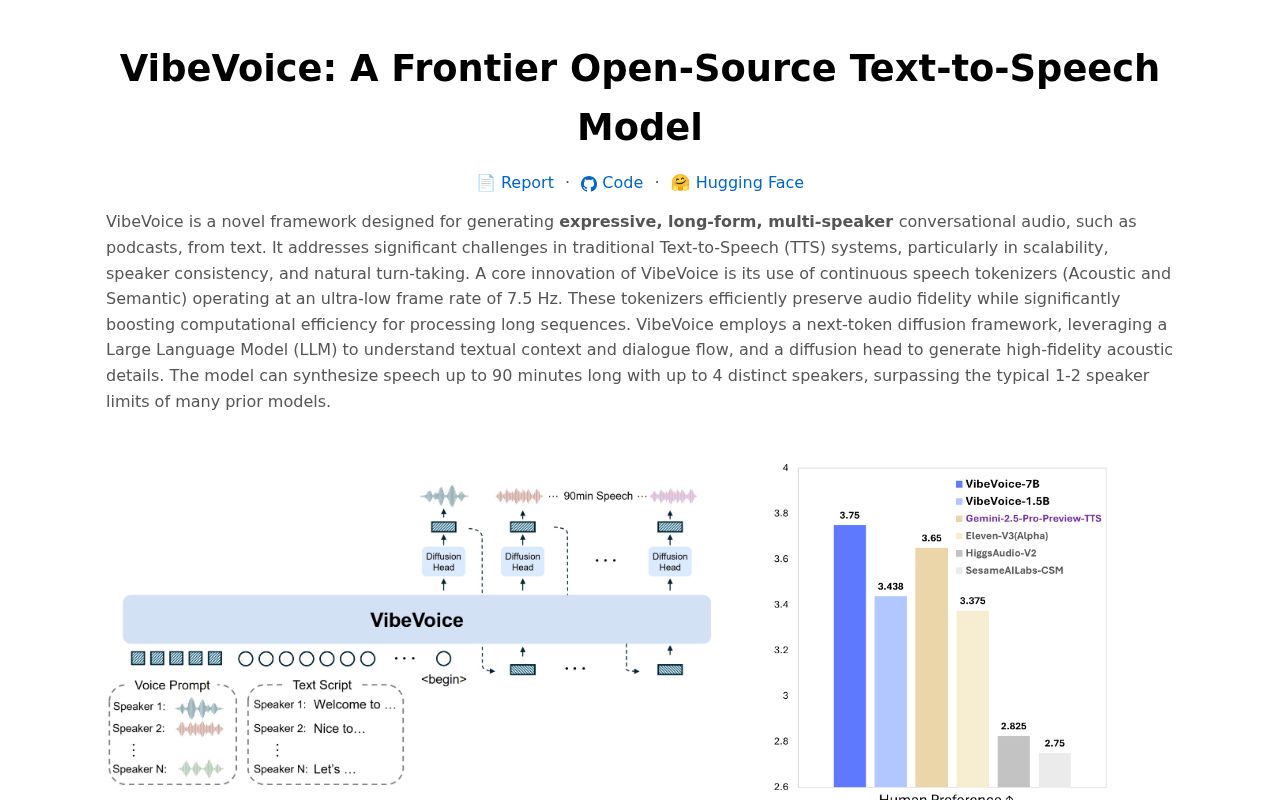
VibeVoice is easier to understand when separated into its current paths. The 7B ASR model accepts long recordings and returns transcription text, speaker identity, and timestamps together. It supports custom hotwords for names or technical terms and is documented for more than 50 languages. The realtime 0.5B TTS model does the opposite job: it turns streaming English text into a single speaker's audio. A BitNet ASR implementation lives in a separate C++ repository for CPU inference.
Those paths share research ideas, but they are not interchangeable packages. ASR users choose between the repository demos, a Transformers integration, vLLM, and the separate CPU engine. Realtime TTS has its own optional dependency and demo. The older 1.5B multi-speaker TTS entry remains visible in the model table, yet its quick try is marked disabled. Microsoft says it removed TTS code in September 2025 after finding uses inconsistent with the project's intent, then released the more constrained realtime model later.
That history matters to anyone selecting the project for a product. Available models, code, and permitted interaction patterns can differ even when they carry the VibeVoice name. Pin the exact model card and repository commit you evaluated rather than treating the family as one stable API.
ASR has a useful long-recording proposition
Most transcription pipelines divide an hour into chunks, run recognition, then align speakers and timestamps afterward. VibeVoice-ASR is designed to accept up to 60 minutes within its context limit and emit the who, when, and what in one structured result. This can reduce stitching problems at chunk boundaries and lets hotwords influence recognition of names or domain terms.
The repository includes file inference, a Gradio demo, LoRA fine-tuning instructions, and a vLLM route. A separate Hugging Face Transformers model lowers integration friction for teams already using that library. These are good entry points for evaluation, especially for meeting transcription or multilingual recordings with code switching.
Do not turn the one-pass limit into a guarantee for every recording. Issue 332 reports a 34-minute file exceeding the model's maximum sequence length. Other reports describe repeated transcription content and diarization changing sharply after a small waveform gain adjustment. One issue concerns an MLX community port rather than Microsoft's reference path, so it should not be used as proof of an upstream decoder defect. The upstream reports are enough to justify tests with your microphones, preprocessing, overlap patterns, and longest files.
Realtime TTS is deliberately constrained
The streaming model is meant to start generating while text is still arriving, which fits assistants that should speak before a complete answer exists. It uses one speaker and embedded voice prompts. The documentation says custom voices require contacting the team, a meaningful restriction for products built around personal or branded speech.
English is the supported target. Experimental voice files cover nine other languages, but the documentation says those behaviors have not been extensively tested and may produce unpredictable output. Code, formulas, and uncommon symbols need normalization before synthesis. Very short inputs can also become unstable. This is a research component for controlled text, not a general narration service that accepts arbitrary application output.
Synthetic voice also carries an abuse burden. Microsoft's risk section calls out impersonation, fraud, and disinformation, and asks users to disclose generated audio. A real deployment needs consent rules, visible disclosure, rate limits, and monitoring suited to its audience. The code license does not remove those operational responsibilities.
What happened when we ran it
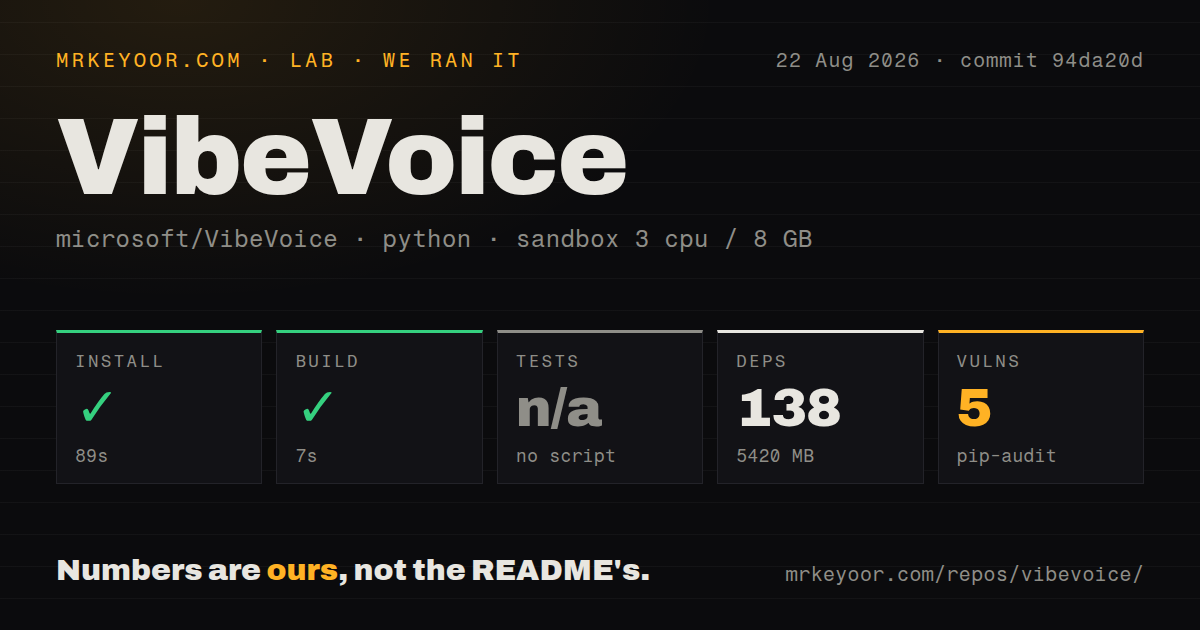
We cloned commit 94da20d into a clean, unprivileged Python 3.12 Bookworm container with three CPUs, 8 GB of RAM, and no secrets. The checkout was 149.4 MB, with 101 files and about 17,233 lines of source. Installation succeeded in 89 seconds, adding 138 packages. The resulting environment occupied 5,420 MB before any model weights were counted. The package build succeeded in 7 seconds.
There was no test script or target, so our harness skipped tests. The repository also had no tests directory, no CI workflow files, and no Dockerfile in that checkout. Pip-audit reported five known vulnerabilities in the installed Python environment. These findings do not judge recognition or synthesis quality because we did not have secrets, model assets, or a GPU run in the supplied measurement. They do show that a successful package build is a small part of production readiness.
The official ASR instructions recommend an NVIDIA PyTorch container and show it running with privileged mode, host networking, host IPC, unlimited memory locks, and all GPUs. FFmpeg is installed separately for the demo, and FlashAttention may also need manual installation. Those flags are convenient for research, but a service operator should reduce privileges, pin the image, scan dependencies, and expose only the required device and network access.
Active research, weak release discipline
The repository was last pushed on July 24, 2026. Issues continued to arrive in August, including a report that the linked ASR playground was unavailable. GitHub listed 183 open issues and pull requests. The releases API returned no latest release, so users cannot rely on a conventional tagged-release channel for choosing a tested source snapshot.
Documentation is better than that release story. The ASR guide explains architecture, installation, inference, fine-tuning, language coverage, and evaluation tables. Realtime TTS has a separate guide with installation, limitations, examples, and model behavior. Still, the absence of an upstream automated test target in our checkout makes compatibility work land on adopters.
VibeVoice belongs in an evaluation notebook or a carefully isolated speech service trial. Long-context ASR with speaker and timestamp output is the strongest reason to try it. Teams needing a supported production service, small deployment, customizable realtime voices, or a tested release artifact should choose a narrower alternative.