Short answer: use Verus when a written guarantee is worth maintaining
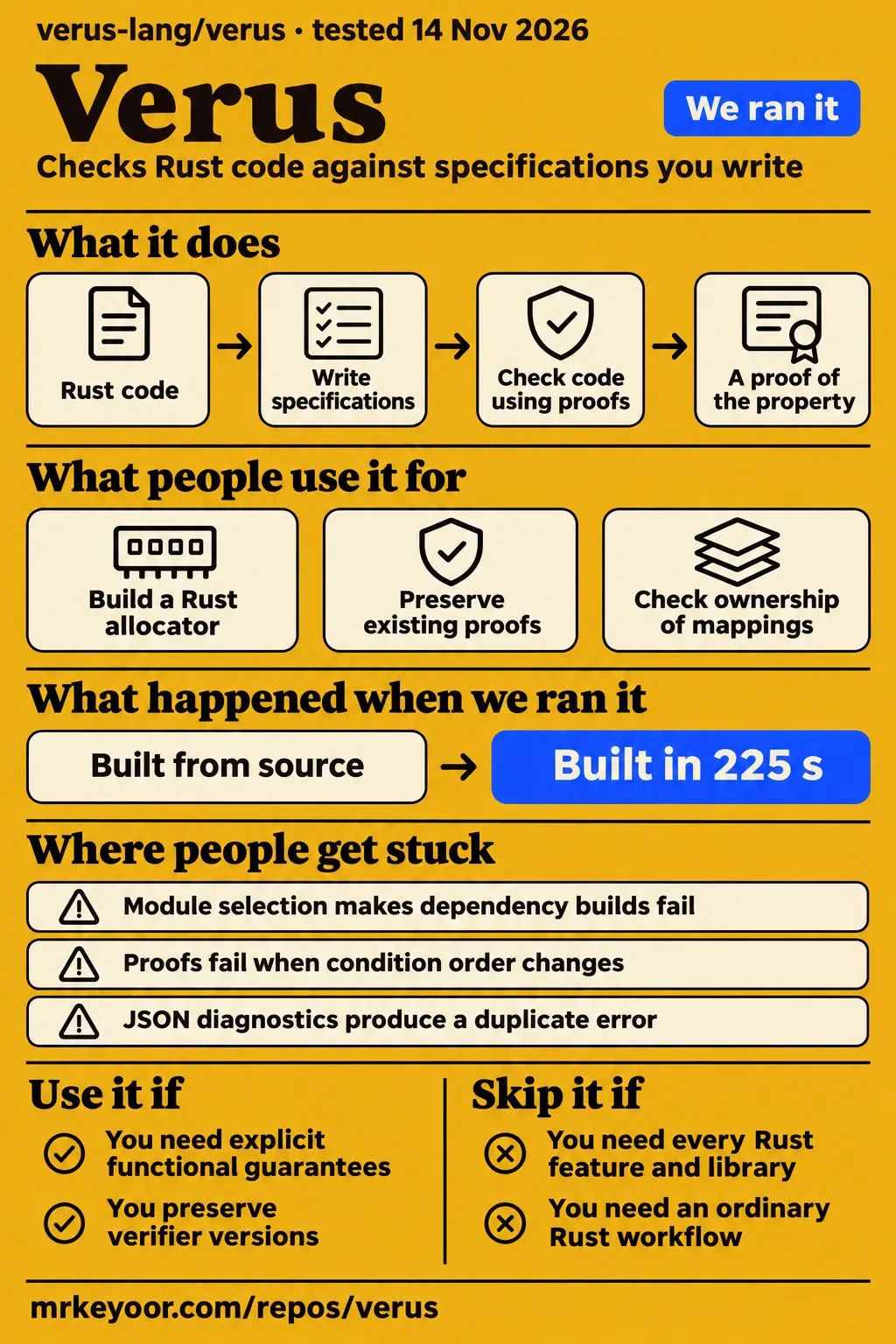
Use Verus for Rust components whose explicit functional guarantees justify writing and maintaining proofs. The official overview describes static checking against developer-written specifications, without added runtime checks. A specification states what a function must do; a proof supplies the reasoning needed to establish that property for every execution covered by the specification. The adoption question is whether that property warrants the additional work in your component.
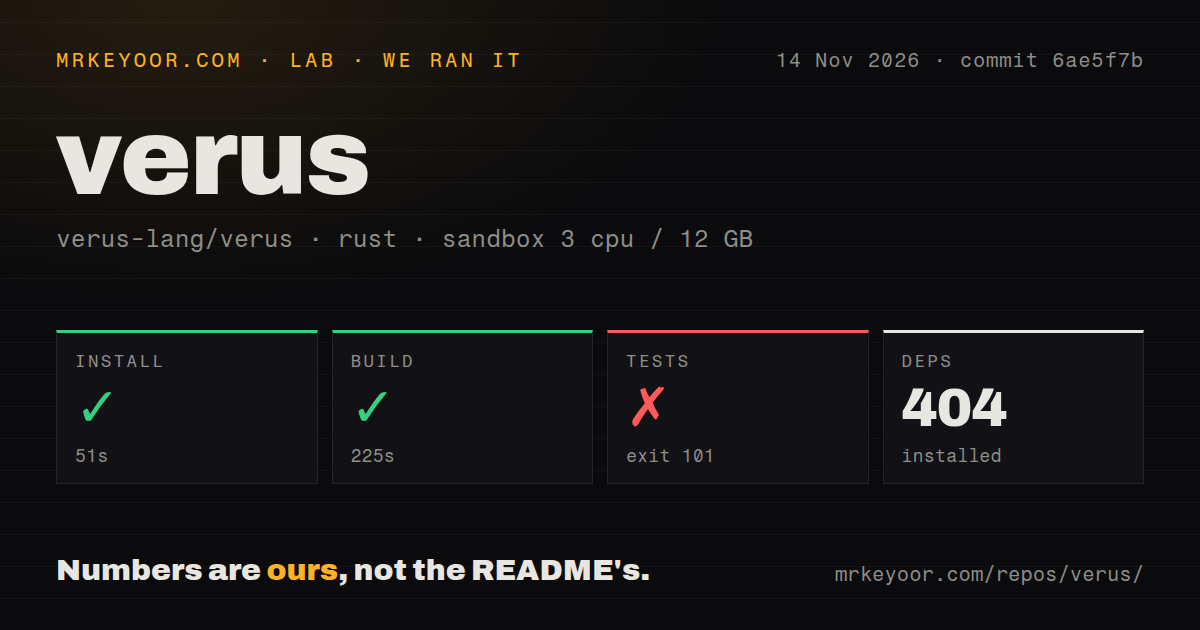
Our sandbox build succeeded in 225 seconds. The subsequent test step failed after 215 seconds while compiling library tests, as recorded in our November 14 source checks. Teams seeking ordinary Rust with little additional onboarding should skip Verus. Existing Kani users have a more specific decision: identify a property their current workflow fails to cover before adding another tool. In the r/rust adoption discussion, Amadex describes extra onboarding and in-code proof material as reasons to keep their existing workflow.
What people use verus for
Reported Verus applications include a running allocator, an Anvil upgrade and a migration to generic associated types. The accounts come from people presenting or working on those projects, rather than from our sandbox. They show different uses of the tool: implementing a component, preserving existing proofs through an upgrade and adopting a Rust language feature. The AI development and memory-budget examples below add two further workflows, with the latter belonging to a fork.
| Who used it | What they did | Reported outcome |
|---|---|---|
| Verus contributor Travis | Developed a Rust memory allocator | In his allocator presentation, he reports a running allocator callable from verified and unverified Rust. |
| Catoverflow, contributing to Anvil | Upgraded Anvil to a newer Verus version | Encapsulating most unwrap_or calls unblocked the migration. |
| GitHub user y1ca1 and their team | Migrated a codebase from trait lifetime parameters to generic associated types | y1ca1 reports that the migration worked after a series of fixes. |
| Microsoft Research and GitHub Next | Used PDD Kit and Chopin with a login flow | GitHub Next describes a workflow reaching a verified pull request. |
| X user rndhouse | Added peak source-level memory bounds in a fork called Verus Meter | rndhouse reports a changed loop violating its declared memory budget. |
Travis reports that the allocator runs and can be called from verified or unverified Rust. In the presentation, he also describes overriding the system memory allocator as a way to demonstrate that the implementation has no inadvertent dependency on another allocator. That is a concrete implementation milestone. It helps distinguish a program that runs from the separate work of completing its correctness proofs, whose status and missing allocation features are collected in the final section.
These examples suggest starting with a particular component and property. Anvil's upgrade concerns proofs already embedded in a project, while y1ca1's account concerns changing how a codebase expresses associated types. The PDD Kit announcement describes another sequence: discuss intent, propose a formal specification, obtain the developer's approval and prove that the code meets that specification. In each case, the specification and its maintenance are part of the engineering work.
What happened when we ran it
Our November 23 attempt failed its safety step because the repository had no Compose file. The failed safety step explicitly requires one of four Compose filenames. The run summary nevertheless labels the attempt a deployment through its own Docker Compose stack with every port bound to 127.0.0.1. Those records conflict; the failed step is the concrete outcome. The teardown record says teardown succeeded.
Our source checks ran separately on November 14, 2026, at commit 6ae5f7b. Installation succeeded in 51 seconds with 404 dependencies recorded, and the build succeeded in 225 seconds. Tests failed with exit 101 after 215 seconds. These are our measured source-check results. The harness recorded 495 seconds in total, using 3 CPUs, 12 GB RAM and the image label lab-rust:1, with the project located in ./source/.
| November 14 source check | Recorded result |
|---|---|
| Installation | Succeeded in 51 seconds; 404 dependencies recorded |
| Build | Succeeded in 225 seconds |
| Tests | Failed, exit 101, after 215 seconds |
| Sandbox configuration | 3 CPUs, 12 GB RAM, image label lab-rust:1 |
| Checkout | 1,566 files, approximately 705,169 source lines, 31.7 MB; project in ./source/ |
| Repository scan | Eight CI workflow files; no Dockerfile or tests directory detected by the scan |
The failing test log names punycode, rustc_demangle and rustc_pattern_analysis as crates required in rlib format but unavailable in that form. It ends with failure to compile rustc_mir_build library tests due to 170 previous errors, followed by a warning that other jobs were still finishing. The diagnostic also suggests adding extern crate rustc_driver; at the top level. That suggestion is part of the compiler output, rather than a repair performed during the run.
The repository scan and README describe different things. Our scan reported no tests directory, while the README links unit tests under source/rust_verify_test/tests. Verus therefore has a documented test location despite that scan result. The Compose requirement likewise comes from the deployment harness; the installation instructions describe a command-line binary release. Neither the missing Compose file nor the scan's directory signal explains the library-test compilation errors.
Where people get stuck: proofs and tools can fail separately
Issue #1428 reports identical preconditions and postconditions failing to prove, with the order of two conditions changing the result. A trigger is a pattern that helps the solver decide when to use a quantified statement, such as a rule about every element in a sequence. In the nested-index discussion, the reporter says reversing the conditions works. The reviewed issue is marked open and includes a request for a warning about this behavior.
The issue discussions distinguish proof failures, argument forwarding and compiler crashes. In issue #158, a maintainer explains that Z3 returning unknown is expected for verification failures involving incomplete reasoning. In issue #1938, arguments intended to select a module also reach dependencies. These lead to different investigations: the first concerns the solver's reasoning, while the second concerns which crates receive a command-line option.
| Symptom and report | What the discussion says to do | Resolution shown |
|---|---|---|
| Module selection reaches dependencies, #1938 | Clear the target cache, run full checking, then select a module | Reporter describes a single-crate workaround |
| Nested indexing triggers depend on condition order, #1428 | Reverse the conditions in the reported example | Workaround reported; issue open |
| Z3 returns unknown for a failing assertion, #158 | Interpret the result using the maintainer's explanation of incomplete reasoning | Explanation of verification failure and diagnostic models |
| JSON diagnostics produce a duplicate error-format error, #1572 | Pass Cargo --message-format=json | Discussion reports the separate diagnostic-span problem addressed in PR #1667 |
| An async future gains a Send bound and causes an internal compiler error, #2323 | Reporter says removing Send or using --no-lifetime prevents the crash | Two reported workarounds |
The async report names the Send bound and --no-lifetime as changes that prevent its crash. The discussion in #2323 connects the problem to auto traits and opaque types. For a reproducer, retain the original function, bound and invocation together: changing a trait bound changes the program presented to the tool. The scope consequence of disabling lifetime checking belongs with the other evaluation limits in the final section.
Anvil's upgrade shows why proofs need maintenance
Catoverflow reports that encapsulating most unwrap_or calls unblocked Anvil's migration. The Anvil upgrade report names the error as variable shadowing not yet supported, pointing into vstd/std_specs/option.rs at spec_unwrap_or. It describes migration from version 0.2025.11.30.840fa61 and says that version had handled the calls. The error points into Verus's specification library, while the workaround changes the consuming project's code.
The Anvil discussion's toolchain account says an update to 1.95 made an earlier commit difficult to test. That connects proof maintenance to the Rust toolchain as well as the verifier. Keeping a small reproducer, the verifier version and the Rust toolchain together gives an upgrade investigation concrete inputs. The supported sequence here is the reported migration error, wrapper workaround and toolchain difficulty; it does not require a more elaborate reconstruction of the investigation.
In y1ca1's migration report, #1161, a series of fixes eventually allowed their team to move from trait lifetime parameters to generic associated types. Those associated types can themselves take parameters, including lifetimes. The reporter explicitly says the migration worked and thanks the maintainers. The account supplies both an adoption outcome and a maintenance lesson: the successful migration followed repeated fixes rather than a single unchanged upgrade.
The trust boundary includes the verifier and compiler
The official overview excludes proving the verifier itself and the Rust/LLVM compilers from its goals. It also states that Verus supports selected Rust features and libraries. Those documented scope choices define what an adoption decision must account for alongside the written specification. A checked property concerns the code and assumptions represented in the verification task; the overview does not describe a proof of every tool involved in producing the executable.
Historical issue #1366 reports an unsoundness problem involving empty structs and datatype axioms. Soundness concerns whether the reasoning system can establish false claims from its rules. The reporter supplies a reduced example, and the discussion requests another analysis including PR #1411. That makes the issue relevant to the trust assessment without turning an old report into a claim about the current measured checkout; the retest boundary is stated in the final section.
For a component review, record the specification, checked functions and trusted assumptions together. The README says developers write the specifications that Verus checks against executable Rust. A proof that a function meets a postcondition therefore answers the question expressed by that postcondition. Whether it captures the behavior the team needs is a separate specification decision, illustrated by PDD Kit's explicit developer approval step before proving the proposed specification.
English documentation exists, but ordinary Rust knowledge is only the start
The English guide assumes some Rust familiarity and introduces specifications and proofs in Rust syntax. Its Fibonacci walkthrough begins with an iterative implementation that fails its postcondition and overflow checks. The worked solution adds loop invariants and a recursive monotonicity lemma. An invariant is a statement that must stay true through every loop iteration; a lemma is a supporting fact proved so that later reasoning can use it.
The editor documentation names VS Code and Emacs as supported paths. VS Code requires the project's verus-analyzer fork of rust-analyzer. Emacs uses verus-mode.el, which documents syntax highlighting, checking on save and navigation to definitions. The workspace argument-forwarding problem in #1938 also arose while adding editor support, connecting the command-line checking behavior to the feedback a developer sees while working on a file.
The installation guide recommends weekly point releases for command-line users and distinguishes them from the rolling prerelease that follows main. It directs developers and people seeking a specific commit to the source-build instructions. After unpacking a binary release, running ./verus reports any required Rust toolchain installation. This is a more useful setup instruction than treating the guide's example archive or example toolchain as the version used in our source run.
Verus vs Kani, F* and Dafny
Kani is a bit-precise model checker for Rust. Its README describes checks for undefined behavior, panics, arithmetic overflows and custom correctness properties. Verus's overview instead centers written specifications and proofs for functional correctness. The r/rust discussion distinguishes these approaches and supplies a practical adoption objection: another verification tool adds onboarding and proof material to a codebase that already has a checking workflow.
| Alternative | What makes it a real choice | When to consider it |
|---|---|---|
| Kani | Its README describes a bit-precise model checker for Rust; Amadex reports an existing workplace workflow | Keep it when its checking approach covers the requirement; identify a concrete benefit before adding Verus |
| F* | Reddit user 98f00b2 expresses interest in replacing F* with direct Rust development | Use the desire to work directly in Rust as a reason to evaluate Verus |
| Dafny | Its README describes code and specifications in the Dafny language, with compilation to C#, Go, Python, Java and JavaScript | Consider it when the implementation language is a choice rather than a fixed Rust requirement |
| Unit and property-based tests | The Verus demonstration contrasts testing inputs with proving a specified property | Keep tests for behavior and integration questions outside the properties expressed in proofs |
Dafny puts code and specifications in the Dafny programming language. The Dafny README lists proof tools including preconditions, postconditions, loop invariants and termination conditions, along with its compilation targets. That makes the language choice a concrete comparison point: Verus is for Rust code, while Dafny supplies its own language. Amadex's Kani objection raises a different question, namely whether another proof workflow supplies enough benefit to justify its ongoing cost.
The Verus name leads to unrelated products
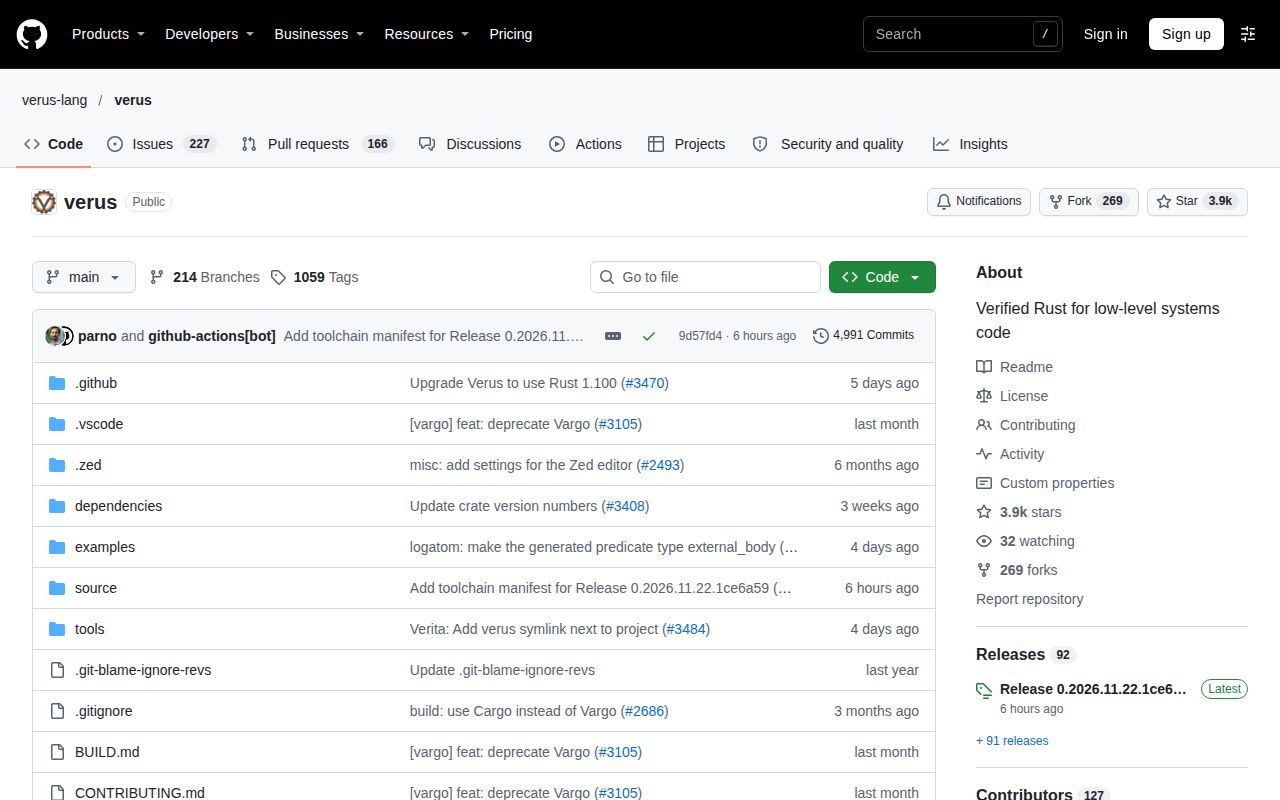
This review covers verus-lang/verus, the Rust correctness tool identified by the official guide. The name also belongs to a trading service, Verus Engineering car parts and Verus Audio cables. Use the repository name or the qualifier "Rust verifier" when looking for installation instructions, issue reports and comparisons; those namesakes answer different questions.
Questions people ask
Verus uses written specifications and deductive proofs, while Kani is a Rust model checker. In the r/rust discussion, Amadex asks whether Verus adds enough to justify another verification tool and describes keeping Kani until there is a needed benefit. The questions below address that adoption decision alongside source organization, solver diagnostics and workspace behavior raised in the guide and issue discussions.
How does Verus differ from Kani, and when does it justify adding another verification tool?
Kani checks Rust through model checking; Verus checks written specifications using deductive proofs. Amadex's account puts the decision in terms of a missing capability: their team intends to keep Kani until Verus adds something they need. For a team with an existing workflow, choosing one important property gives the comparison a concrete subject rather than making the number of available verification tools the reason to adopt another.
How does Verus compare with Lean?
Verus's overview establishes that it targets Rust and checks specifications through static theorem proving. The phrase "verus vs lean" appears in search suggestions, which identifies a comparison question rather than a technical result. The final section records the comparison work still needed; this review's practical alternatives table uses the documented Kani and Dafny approaches and the attributed F* adoption comment.
Can Verus replace F* while letting me write Rust directly?
Verus targets Rust, and 98f00b2 explicitly expresses interest in replacing F* with direct Rust development. The official guide says Verus uses Rust syntax and type checking for specifications, proofs and executable code. That supplies a language-level reason to evaluate it. The comment's evidence is the reader's interest in that workflow, while the completed migration account elsewhere on this page concerns generic associated types within a Verus codebase.
Can Verus specifications and proofs be kept out of the main executable code?
Verus writes specifications and proofs in Rust syntax, according to the official guide. Its static checks add no runtime checks, which describes execution behavior rather than where source annotations reside. In the Reddit discussion, participants ask about putting proofs in another file and express concern about in-code boilerplate. Those comments explain the source-organization concern behind the question without documenting a universal separate-file arrangement.
How can formal verification establish whether AI-generated code meets the developer's intent?
PDD Kit's announcement describes proposing a formal specification for the developer to approve, then proving that the generated code meets it. Developer approval is the step connecting the specification to the intended behavior. The workflow therefore gives the human a particular artifact to judge, rather than deriving intent from a passing result alone. The announcement's fallback and the status of our evaluation are collected in the final section.
What does SMT-based verification mean in Verus?
Verus uses automated solver reasoning to check logical obligations generated from specifications and code. The official overview describes computer-aided theorem proving, while issue #158 shows Z3 reasoning about quantifiers and nonlinear arithmetic. The Fibonacci tutorial supplies a concrete programmer task alongside that automation: write invariants and a supporting inductive lemma so the required facts are available to the proof.
Does Verus use separation logic, and what principles support its memory reasoning?
The Verus overview describes lightweight linear type checking for reasoning about memory and aliasing. That documented approach supplies a concrete answer about the tool's memory reasoning. The allocator presentation establishes a Rust allocator project callable from verified and unverified code. Its status is useful implementation evidence, while the narrower technical question about separation-logic terminology is included among the remaining evidence limits below.
Why does cargo verus pass --verify-module to dependencies, and how can I verify only part of a workspace?
Issue #1938 reports module-selection arguments reaching dependencies, including vstd. The reporter describes clearing target, running full checking first and then selecting the module. They explicitly say this workaround works for single-crate situations. The same report connects the workspace difficulty to partial-checking performance while editing a file, so the reported problem concerns both command behavior and the resulting developer feedback loop.
Should partial verification use a separate command or a dependency-skipping option?
The #1938 discussion considers a separate command and an option resembling --verify-without-deps. These are proposals for how to express partial checking. The concrete workaround reported in the thread instead runs full checking before module selection in a single crate. Keeping those two kinds of statements separate prevents a design suggestion in an issue discussion from becoming an installation instruction for a particular release.
Why can identical preconditions and postconditions fail when triggers contain nested indexing?
The reporter in #1428 describes a nested-index trigger and says reversing the conditions works. A respondent explains that the indexed expression is absent from the solver's context while it tries to prove the bounds condition. The opening report considers the encoding and Z3's handling as possible places to investigate. The useful recorded outcome is the order-dependent workaround for that example.
Can Verus warn when quantifier triggering depends on conjunct order?
The #1428 discussion contains a request for a warning about order-dependent triggering, and the reviewed issue is marked open. The request follows a successful workaround in which the reporter reverses the conditions. It documents why a warning would help that user: the same precondition and postcondition had failed before the ordering change. The final section distinguishes that request from evidence of implemented warning behavior.
Why does Z3 return unknown for a simple failing assertion, and can its model be trusted?
A maintainer in #158 explains that unknown is expected for verification failures. They describe the model as an assignment satisfying the formula under limited quantifier instantiations and limited nonlinear arithmetic results. That makes the model diagnostic information about the solver's attempted reasoning. It is not a successful proof of the function's specification, and the explanation answers why a failing assertion can produce unknown rather than the sat result the reporter expected.
What we have not tested yet
Our source test command ended in compilation errors, and the November 23 Compose attempt stopped at its safety rule. We have not reproduced the binary-release installation route, completed a representative proof task or measured verification latency, proof-to-code volume, onboarding effort or upgrade maintenance time. The 225-second build measures a build, not a proof workload. The image label lab-rust:1 identifies the recorded configuration rather than actual operating-system or runtime versions, and the missing rlib formats have no diagnosed cause in the available log tail.
The November 14 checkout was commit 6ae5f7b, not the later recorded release/0.2026.11.22.1ce6a59. The November 23 summary's Docker Compose deployment claim conflicts with its failed safety step; successful teardown does not demonstrate successful deployment. No clean suite result follows from the failed test command, and the compiler's extern crate rustc_driver; suggestion was not executed as a repair. The historical issue workarounds and migration accounts have not been retested against either of those exact versions.
At the time of Travis's allocator presentation, correctness proofs were in progress, aligned allocations and realloc were unsupported, and allocations had a size limit. The readable excerpts do not establish the detailed freed-memory and permission demonstrations or settle the separation-logic terminology question. PDD Kit is an announcement rather than an independently reproduced workflow; it describes falling back to tests and computer-use agents where proof is unavailable. Verus Meter's memory-budget checking belongs to rndhouse's fork rather than an established upstream capability.
For #1366, the discussion requests retesting with PR #1411 without a final confirmation of the soundness repair. For #2323, the account supplies workarounds rather than confirmation of an implemented fix; --no-lifetime disables lifetime checking and changes the checking performed. The Anvil excerpts establish the migration error and wrapper workaround, but not the detailed investigation sequence or a successful retest of a final fix. Issue #1938's single-crate workaround does not establish a shipped workspace solution, and #1428's warning request does not establish an implemented warning.
There is no matched Verus-versus-Kani, F* or Dafny workload or technical Lean evaluation behind this comparison. The F* comment expresses interest rather than a completed migration, and the source-organization discussion does not document a universal separate-file proof workflow. Search suggestions establish neither search volumes nor popularity. This review includes no audit of the verifier, solver, compiler or generated binaries. For an adoption evaluation, choose one important function, write the property the team needs and preserve the toolchain and proof together so a later upgrade can repeat that same task.