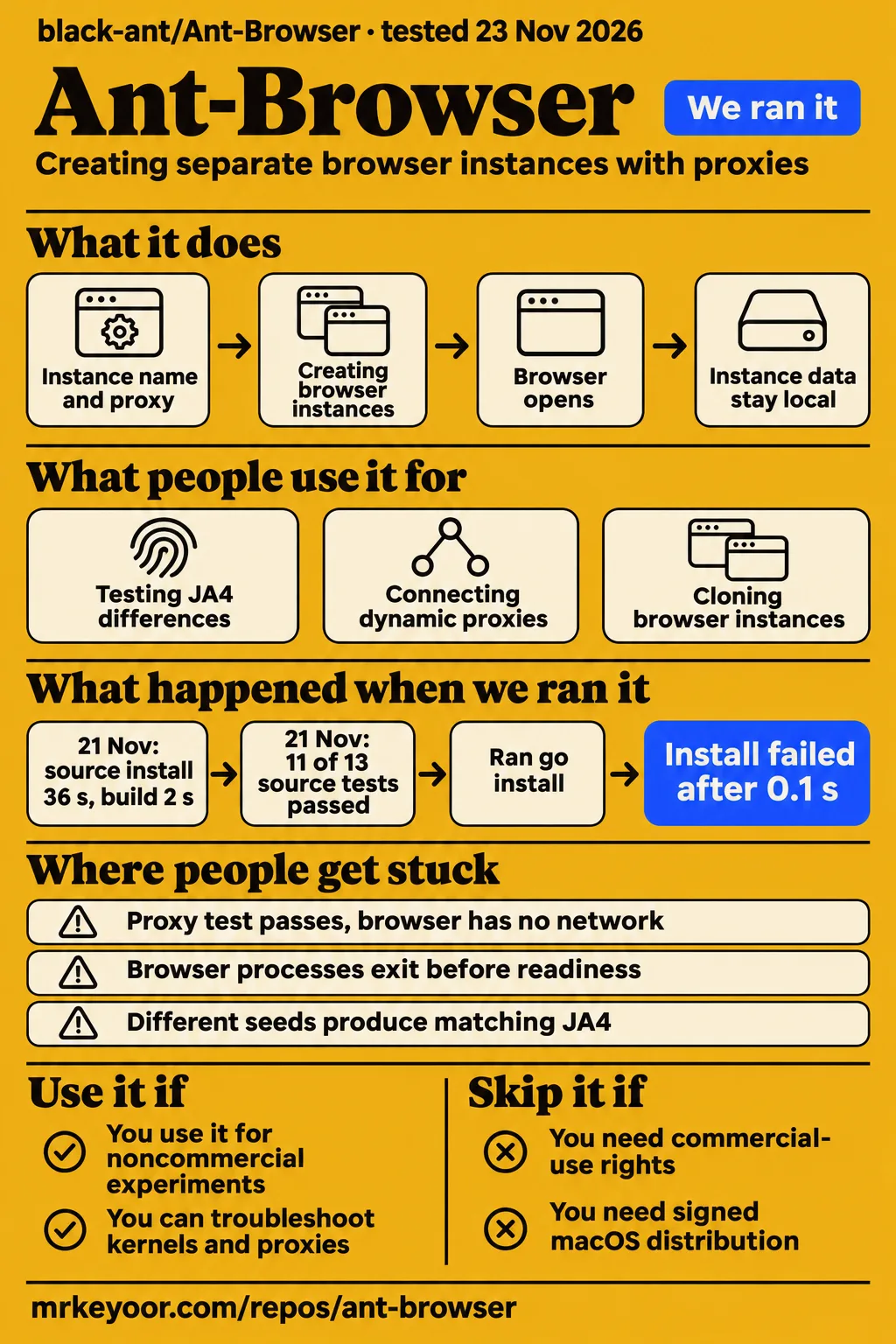
black-ant/Ant-Browser built successfully in our sandbox, but its test command failed: the build took 2 seconds, and tests exited 1 after 91 seconds with 2 failures recorded. It suits noncommercial desktop experimenters who can troubleshoot browser kernels and proxies with Chinese documentation. Users needing commercial-use rights or choosing it specifically for distinct JA4 fingerprints should look elsewhere: the README restricts the source license to noncommercial use, and issue #70 records matching JA4 results across differently configured instances.
What people use Ant-Browser for
GitHub users report testing JA4 differences, connecting dynamic proxies, opening unsigned macOS builds and retesting relaxed proxy health checks. These accounts describe concrete tasks and outcomes, rather than customer deployments inferred from a feature list. The README also describes creating and cloning browser instances, assigning proxies and managing browser kernels. A kernel here is the browser engine and executable selected for an instance; the manager and the browser executable are separate parts of setup.
| Who used it | What they did | What happened |
|---|---|---|
| GitHub user stfei | Built v1.8.0 and compared instances with different proxy IPs, regions and seeds | The instances returned identical JA4 fingerprints. |
| GitHub user zhangkaihua88 | Connected a dynamic proxy | The proxy worked after enabling a local virtual network adapter. |
| GitHub user zpljd258 | Followed the README workaround after macOS refused to open the application | The application opened after removing its quarantine attribute. |
| GitHub user DwyaneLee and developer black-ant | Retested startup after the developer relaxed proxy checks | DwyaneLee confirmed the change worked. |
AgentUpdate recommends Ant-Browser for e-commerce, social-media operations and automated testing. Those are the directory's recommendations. The issue discussions above answer more specific questions: whether a particular proxy configuration connected, whether an unsigned application opened and whether changed instance settings produced different JA4 results. For a noncommercial evaluation, these tasks give you concrete behaviors to compare with the README's feature descriptions.
What happened when we ran it
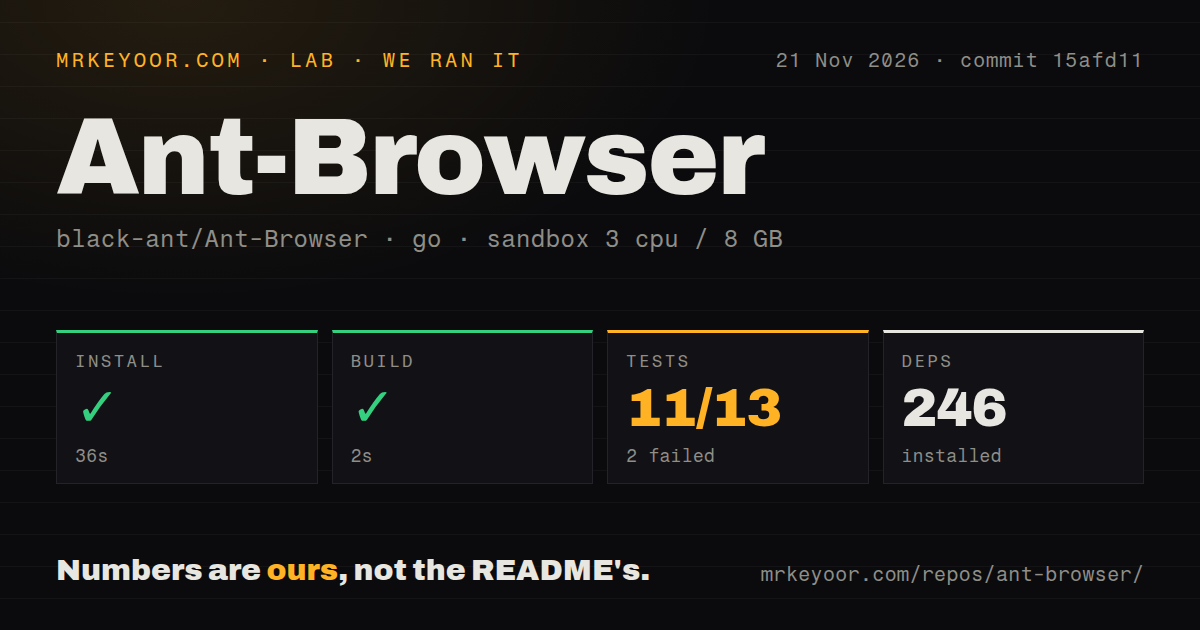
Our November 21 run installed Ant-Browser in 36 seconds and built it in 2 seconds; tests failed after 91 seconds with 11 passes and 2 failures recorded out of 13. Our repository measurements used commit 15afd11, with a sandbox configuration of 3 CPUs, 8 GB RAM and image label golang:1.24-bookworm. Installation, compilation and test-command results are separate outcomes, so the successful build and failed tests both belong in the result.
| Repository check | Our result |
|---|---|
| Install | Succeeded in 36 seconds; 246 dependencies recorded |
| Build | Succeeded in 2 seconds |
| Tests | Failed, exit 1, in 91 seconds; 11 passed and 2 failed of 13 recorded |
| Checkout | 950 files, approximately 166,879 source lines, 372.4 MB |
| Project signals | 4 CI workflow files, a tests directory, no Dockerfile detected |
The visible test-log tail lists successful packages for automation, backup channels, browser, configuration, database, launch codes, proxy, snapshot and window sizing, then ends with FAIL. Its package durations include browser at 4.693 seconds and proxy at 0.846 seconds. Those passing lines sit inside an overall failed command; they do not turn the recorded result into a passing suite or identify which two recorded failures caused the exit.
Our November 23 quickstart-cli attempt used commit 15afd113e2ff in a fresh unprivileged golang:1.24-bookworm container configured with 2 CPUs, 4 GB RAM, no published ports and no secrets. The next step tried go install ant-chrome/...@latest, deriving the package name from the manifest. Installation failed in 0.1 seconds with exit 1 and the error malformed module path "ant-chrome": missing dot in first path element.
The quickstart recipe stopped at installation, and teardown completed successfully. The failed module command was a choice made by that recipe. The README instead directs desktop users to release packages and names source-development entry points including bat\dev.bat and ./scripts/dev.sh. The November 21 source build and November 23 command rejection therefore describe different operations, with different recorded outcomes.
Where people get stuck: proxy checks and browser traffic disagree
Issue #6 reports SOCKS5 proxies passing tests while launched browsers have no network, with commenters also naming HTTP and HTTPS failures. The sequence matters: the check succeeds, the browser opens and traffic fails. The README's first-use procedure includes opening an IP-checking website from the launched instance, which checks a different part of the path from the manager's initial proxy test.
| Symptom | What the discussion says | Useful next step |
|---|---|---|
| Proxy test passes, browser has no network | Issue #6 includes SOCKS5, HTTP and HTTPS reports | Record the check result and launched-browser result separately. |
| Dynamic proxy fails inside a profile | Issue #40 records a virtual-adapter success and a developer's jump-host configuration | Compare the complete connection arrangement with yours. |
| Health checks reject usable proxies | Issue #16 records relaxed checks and DwyaneLee's successful retest | Include your version and health-check behavior in a report. |
| Browser traffic times out after a good check | Issue #32 reports Xray bridge compatibility problems | Include the protocol and selected connection stack. |
In issue #32, hmtdpetn reports VLESS bridge problems and submitting a PR, while shuhao0920 names an obsolete allowInsecure configuration option that prevents Xray startup. hmtdpetn also describes a local repair. The current README distinguishes an Xray plus sing-box combination from an independent Mihomo stack, says operations must use the selected stack consistently and calls for another speed check after switching stacks. Protocol, provider, dynamic or static address and chain arrangement belong beside the exit-IP result in a useful reproduction.
Windows and macOS launches have different failure reports
Windows reports include browser processes exiting before readiness; a macOS user reports opening the unsigned application after removing quarantine attributes. In issue #18, the readiness error names C:\Program Files\AntBrowser\chrome\144\chrome.exe. Schyliang suggests moving the installation outside Program Files and attributes the problem to elevation. Separately, issue #1 includes zpberry's Windows 11 launch-failure report.
Issue #43 records a newer Windows build failing after an older version worked. huanglifeng0415 says disabling antivirus changed nothing; black-ant suspects Windows blocking and suggests a source build or installer. On macOS, issue #39 names Tahoe 26.2 and reports that the README workaround opened the application. The command xattr -dr com.apple.quarantine <app路径> removes the quarantine attribute from the chosen application path. The README describes these macOS packages as unsigned internal-test builds.
Profile seeds did not change JA4 in one user's test
stfei reports identical JA4 results across source-built v1.8.0 instances despite different proxy IPs, regions and seeds. Developer black-ant responds that changing JA4 requires kernel modifications beyond the browser fingerprint changes they currently make. The distinction is central to choosing the tool: separate instance settings and different network fingerprints are different requirements, and this discussion records a failed attempt to obtain the latter through seeds and proxies.
The same issue #70 discussion includes stfei's observation of different results across computers or virtual machines, while different kernel versions inside the fingerprint browser still matched. getf asks about TikTok and whether changing kernels would help. The thread therefore contains two different results: machine changes produced different JA4 values in stfei's comparison, while changes within the fingerprint browser produced matching values.
Local storage and backup credentials have separate files
The README says configuration and instance data stay local, while OpenList tokens and S3 credentials go into backup.local.yaml rather than config.yaml. Its backup instructions list local storage, OpenList and S3 destinations, full or selected-instance backups, and restoration that merges data instead of directly clearing existing data. These are documented behaviors with concrete file and destination choices, useful when planning where browser sessions and exported profiles will live.
The same instructions tell users not to copy backup.local.yaml into a public repository or commit it to Git. They describe masked credential display and a separate local credential file. Anyone preparing a migration should therefore account for the browser data, exported archives and that credential file as separate items. The README also says Windows upgrades or removal of an older version migrate the old installation's credential file into the user's application configuration directory.
Chinese documentation is part of the setup cost
The main README is Chinese and does not link an English README counterpart. Its first-use instructions use 代理池配置 for proxy-pool configuration and 实例列表 for the instance list, then describe choosing an instance name, kernel, proxy, labels and startup arguments. These labels help an English-speaking reader match a translated instruction to the control named by the project, without making assumptions about other files in the repository.
FingerBrowser lists the interface language as Chinese. The Chinese issue discussions also contain the dynamic-proxy success in #40 and the macOS opening result in #39. When translating those discussions, preserve protocol names, version strings, executable paths and configuration keys. Tutorials using a subscription screen or cloud-profile service may concern commercial AntBrowser, whose identity and terms differ from black-ant's repository.
Ant-Browser vs GeekEZ Browser, AdsPower and commercial AntBrowser
Commercial AntBrowser is a separate product; the GeekEZ and AdsPower comparisons here come from GitHub participants. FingerBrowser explicitly distinguishes black-ant's project from commercial AntBrowser, while the commercial site's own description advertises cloud profiles and configurable access rights. Starting with the owner and repository prevents subscription terms or hosted features from being assigned to the wrong application.
| Alternative | Evidence for including it | When to compare it |
|---|---|---|
| GeekEZ Browser | Efarxs reports switching to GeekEZ and finding VLESS stable in issue #32. | VLESS connectivity is your immediate requirement. |
| AdsPower | stfei reports identical JA4 results in its free version in issue #70. | You have a precise TLS fingerprint requirement to evaluate. |
| Commercial AntBrowser | Its website advertises cloud profiles and configurable team permissions. | Hosted profile sharing and team access are requirements. |
In issue #70, getf cites AdsPower's advertised kernel-level TLS changes, and black-ant mentions possibly investigating kernel modifications if time permits. The commercial namesake also appears in Proxy Sale's video walkthrough of team controls. The walkthrough describes a 24-hour trial with up to two profiles, followed by a Pro plan that includes a transaction log and an advanced proxy checker.
What the other reviews get wrong
AgentUpdate's open-source label and FingerBrowser's October 15 no-license snapshot differ from the current repository's PolyForm Noncommercial license. AgentUpdate calls Ant-Browser open source, while FingerBrowser says its snapshot found no license file. The current README identifies PolyForm Noncommercial License 1.0.0 and excludes commercial use. That current statement determines the audience described in this review.
The iTechGuides review describes subscriptions and a one-day trial for commercial AntBrowser. FingerBrowser describes black-ant's separate project as free with no paid tier. Meanwhile, LycheeIP lists a continuing free plan with 10 profiles, whereas the commercial product page lists a one-day trial with two profiles. Neither commercial pricing description belongs to black-ant's source-license terms.
Other comparisons contain conflicting commercial-product claims. AntidetectReview says the tool runs only on Windows and Mac, while the commercial product's download listing includes Linux. LycheeIP's cloud-phone claim conflicts with Multilogin's explicit denial of cloud phones. Multilogin's missing-cloud-profile comparison also conflicts with the commercial site's advertised cloud profiles and configurable permissions. These claims concern the commercial namesake, whose subscriptions, download listing and advertised team features belong to a separate product.
FAQ
black-ant/Ant-Browser is separate from paid AntBrowser, according to FingerBrowser's product identification. Its current README specifies PolyForm Noncommercial License 1.0.0, while the commercial namesake advertises subscriptions and cloud profiles. The repository owner and license are therefore the starting points for distinguishing the two products before following installation instructions, comparing prices or choosing an application for commercial work.
Is black-ant/Ant-Browser the same product as the paid AntBrowser?
No. FingerBrowser explicitly calls black-ant's project unrelated to commercial AntBrowser. black-ant's README directs desktop users to GitHub releases; the commercial product has its own subscription and cloud-profile offering.
Why does my proxy pass its test but leave the browser without internet access?
Issue #6 records that exact sequence. In issue #40, zhangkaihua88 reports a working dynamic-proxy connection after enabling a local virtual network adapter. The README also directs users to check the exit IP from the launched instance.
Is Ant-Browser's Xray bridge causing proxy timeouts or unstable connections?
Issue #32 reports Xray bridge compatibility problems. hmtdpetn names VLESS and a submitted PR; shuhao0920 names an obsolete allowInsecure option preventing Xray startup. The README distinguishes the Xray plus sing-box stack from independent Mihomo.
How do I start an instance when usable proxies fail every health check?
Issue #16 records black-ant relaxing the checks and DwyaneLee confirming success. The README separately says that switching connection stacks requires another speed check.
Why won't Ant-Browser launch on Windows 11?
zpberry reports a Windows 11 launch failure in issue #1. Issue #18 names a browser process exiting before readiness under C:\Program Files\AntBrowser; Schyliang suggests moving that installation elsewhere. The README asks users to check the kernel path and executable.
Why does a newer Windows build fail to launch when an older version worked?
Issue #43 records that regression and says disabling antivirus did not help. black-ant suspects Windows blocking and suggests a source build or installer.
Why do separate instances still have the same JA4 fingerprint?
black-ant says JA4 changes require kernel modifications beyond their current browser fingerprint changes. stfei's source-built v1.8.0 instances returned matching results despite different proxy IPs, regions and seeds.
Does using the same browser on different computers produce the same JA4 fingerprint?
stfei reports different JA4 results across computers or virtual machines. Different kernel versions inside the fingerprint browser still returned matching values in that user's comparison.
Does an identical JA4 fingerprint matter for TikTok, and would changing browser kernels help?
stfei reports matching JA4 values with different kernel versions inside the fingerprint browser. getf asks whether identical JA4 affects TikTok in the same discussion.
Can Ant-Browser implement kernel-level TLS fingerprint changes like those discussed for AdsPower?
black-ant says they may investigate kernel modifications if time permits. getf cites AdsPower's advertised kernel changes, while stfei reports matching JA4 values in AdsPower's free version.
Is Ant-Browser formally open source, or is its code available without a license?
The current README identifies PolyForm Noncommercial License 1.0.0, replacing the older no-license description. Its license statement excludes commercial use; the personal-use provision includes research, experiments, testing, study and hobby activities without anticipated commercial application.
Is there a continuing free option, or only a one-day trial?
FingerBrowser describes black-ant's project as free with no paid tier. The one-day, two-profile trial belongs to commercial AntBrowser. black-ant's current README specifies a noncommercial source license.
What we have not tested yet
Our measured scope is the November 21 repository checks and November 23 rejected module-install attempt, rather than packaged desktop operation. The latter produced no desktop task answers or screenshots. We have not tested packaged Windows, Linux or macOS launches, a protocol-by-provider proxy matrix, static versus dynamic connections, chains, browser exit IPs, JA4 reproduction, TikTok outcomes or automation API compatibility. Context7's snippet inventory and Antybrowser's separate API documentation do not supply a tested black-ant API example.
The failing harness log tail omits the failing package names and diagnostics, and its image label does not establish actual runtime versions. Current behavior on release v1.9.4, dated November 18, 2026, is outside these commit-specific checks. The root-directory contents endpoint has no captured response supporting a repository-wide English-documentation claim. An English-interface check, rendered layout, resolved links, automatic related links, recommendation modules and template content are also outside the observations reported here.
Historical issue outcomes have narrower coverage than a current compatibility test. Issue #6 has no confirmed common fix; #32 has no demonstrated upstream release resolving every configuration; #1 has no diagnosis; and #18 and #43 have no successful retest of the proposed remedies. The macOS result is an unsigned-build workaround. The cross-computer and kernel-version JA4 results concern stfei's configurations, and getf's TikTok question supplies no account outcome. GeekEZ and AdsPower comparisons are individual reports, while commercial cloud profiles and permissions are advertised capabilities. black-ant's possible kernel investigation is future work. Conflicting cloud-phone claims do not independently establish whether that separate product has the capability.
Persistence, migration, backup restoration, credential protection, host-Chrome changes, sustained memory use and large profile collections still need direct reproduction. FingerBrowser summarizes extension/settings loss in #61, lost migrated logins in #67, Windows registry disruption in #78, memory pressure in #44, interface lag in #77, signup detection in #75 and risk warnings with kernels newer than 138 in #53. Its memory summary describes one profile exhausting a 16 GB PC. Those are secondary reports, not our measurements; the current README's masked credential display and backup-file separation are not an independent security audit.