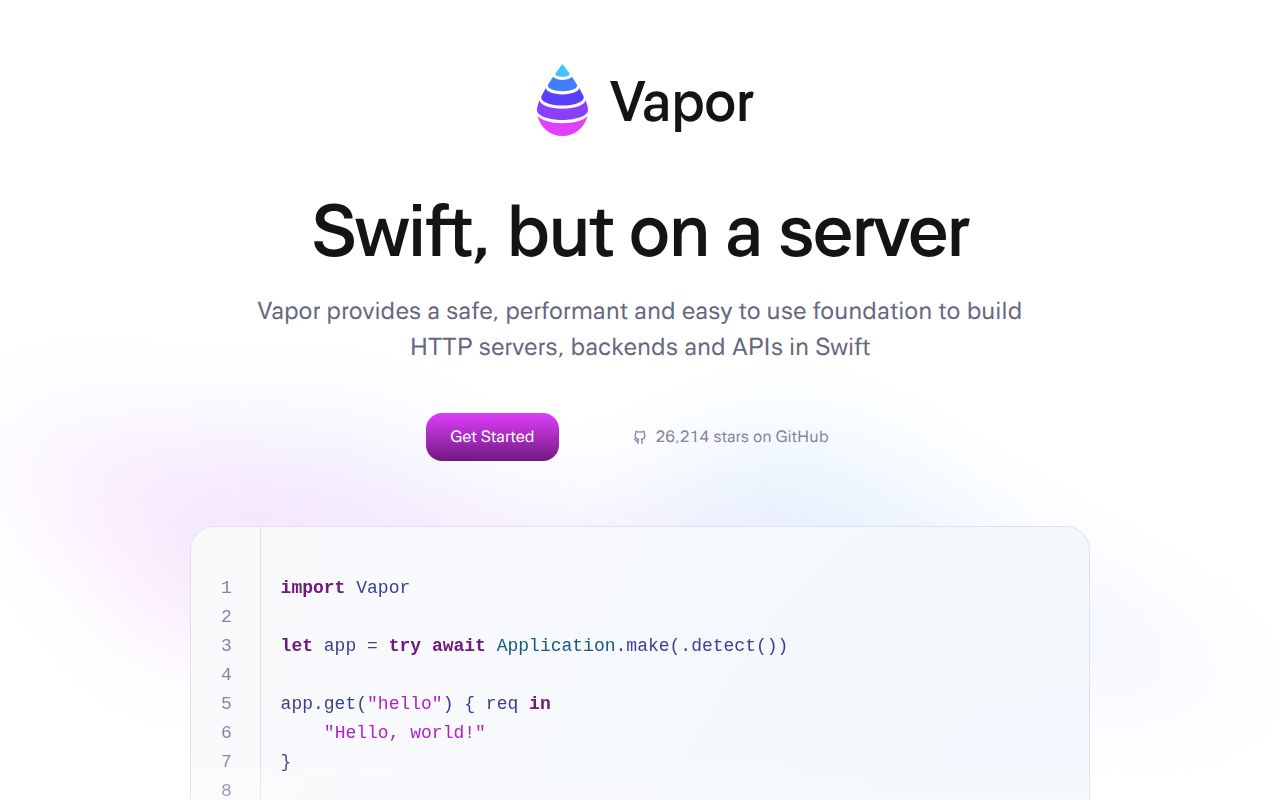
Vapor brings HTTP server work into a Swift 6 codebase
Vapor handles the familiar web-framework jobs in Swift: routes, requests, responses, middleware, content encoding, commands, and test support. Its package manifest connects those APIs to SwiftNIO, Apple crypto, logging, metrics, tracing, HTTP types, certificates, and service lifecycle packages. That makes sense for an organization whose developers already think in Swift types and concurrency. It is a larger commitment for a backend team that would otherwise choose JavaScript, Rust, Go, or Python.
Our lab screened commit 780152c on September 22, 2026, in an unprivileged container with 3 CPUs and 8 GB of RAM. The harness stopped before installation because Swift is outside its supported ecosystems, and the repository did not supply a Dockerfile as a fallback route. We therefore have no measured package count, disk footprint, build result, test result, or vulnerability audit for Vapor. That missing evidence lowers our setup score even though upstream CI exists.
The core framework leaves databases and views to companion packages
The main repository is the HTTP layer rather than an entire application stack. Its manifest produces the Vapor library, VaporTesting helpers, and macro support. The wider documentation points developers to separate sections and packages for Fluent persistence, Leaf templates, and Redis. This separation keeps the core focused, but a real application still needs choices about a database driver, migrations, authentication, deployment, logging export, and secrets. The shortest hello-world path is not the whole production setup.
At commit 780152c, the manifest requested Swift tools 6.4 and enabled several upcoming or experimental language features. The README advertises Swift 6.0 or newer, so a developer following the badge may still find that the current main branch expects a newer compiler. Package Manager must also resolve the networking, crypto, syntax, and server dependencies listed in that manifest. Pin a release tag instead of pointing a production app at main.
What happened when we ran it
There was no execution run for Vapor in our standard sandbox. The lab classified the repository as Swift, an unsupported ecosystem, then found no Dockerfile it could use for a controlled build. It did not start an install, compile the package, execute tests, count resolved dependencies, measure installed size, or run a vulnerability audit. Any sentence claiming that Vapor passed or failed those steps on our box would be invented.
The boundary matters because the available environment had 3 CPUs and 8 GB of RAM, but no Swift toolchain supplied by the harness image. Upstream shows a GitHub Actions test workflow and the source contains test targets, yet those are project signals rather than our result. Before choosing Vapor, run the exact release with your Swift compiler, Linux distribution or macOS version, database packages, and deployment image. Save that output as the evidence this review cannot provide.
Vapor 4.122.2 is stable while Vapor 5 remains beta
Vapor 4.122.2 was published on September 17, 2026, with a file-response header fix. Vapor 5.0.0 Beta 2 was published one day earlier and fixed a Swift Package Manager dependency-resolution problem. The 5.0 release work changes the HTTP server foundation, response and request bodies, testing APIs, routing macros, and concurrency internals. Those are substantial reasons to test the beta, and equally strong reasons to keep a production migration deliberate.
Our screened commit 780152c belongs to the active main line after the Beta 2 release, not to the stable Vapor 4 tag. GitHub's releases/latest endpoint returned 5.0.0-beta.2 because that release is marked as non-prerelease, even though 4.122.2 was published later. Automation that blindly follows the latest endpoint can therefore select the beta-named line. Pin 4.122.2 when stability is the requirement, and isolate Vapor 5 trials.
Windows builds and HTTP/3 are still open requests
Issue 2646 asks for native Windows build support. It was opened in June 2021 and updated on September 12, 2026, but remains open. Issue 3513, opened in August 2026, asks Vapor to connect HTTP/3 support from its newer server layer. A separate routing bug, issue 3349, reports that path components containing slashes can be registered but cannot be reached, returning 404 in the supplied example. These are specific edges to check against your application.
A 3-CPU, 8 GB Debian screening environment tells us nothing about those platform and protocol paths because no Swift command ran. Windows-first teams should prove the toolchain before adopting the framework. Services that require HTTP/3 should choose another server or wait for the issue to close with a release. Applications generating routes dynamically should add a regression for slash-bearing components instead of assuming route registration guarantees reachability.
September releases and issue work show active maintenance
GitHub recorded a push on September 22, 2026, one day before this review. The repository had 26,214 stars and 82 combined open issues and pull requests. Our API page split those into 59 issues and 23 pull requests. The routing report was updated on September 21, and releases for both major lines landed the previous week. That is current activity, while the older open bugs show that age and popularity do not remove application-specific testing.
Vapor is a serious option when Swift itself is part of the architectural decision. commit 780152c could not clear our lab gate, so start with your own proof rather than treating upstream status badges as a substitute. Build stable 4.122.2 in the image you will deploy, connect the real database and logging stack, and keep a separate Vapor 5 branch. The framework choice becomes defensible when that branch survives your routes, load shape, and operating system.