MovieBox-Tui delegates every stream to an external player
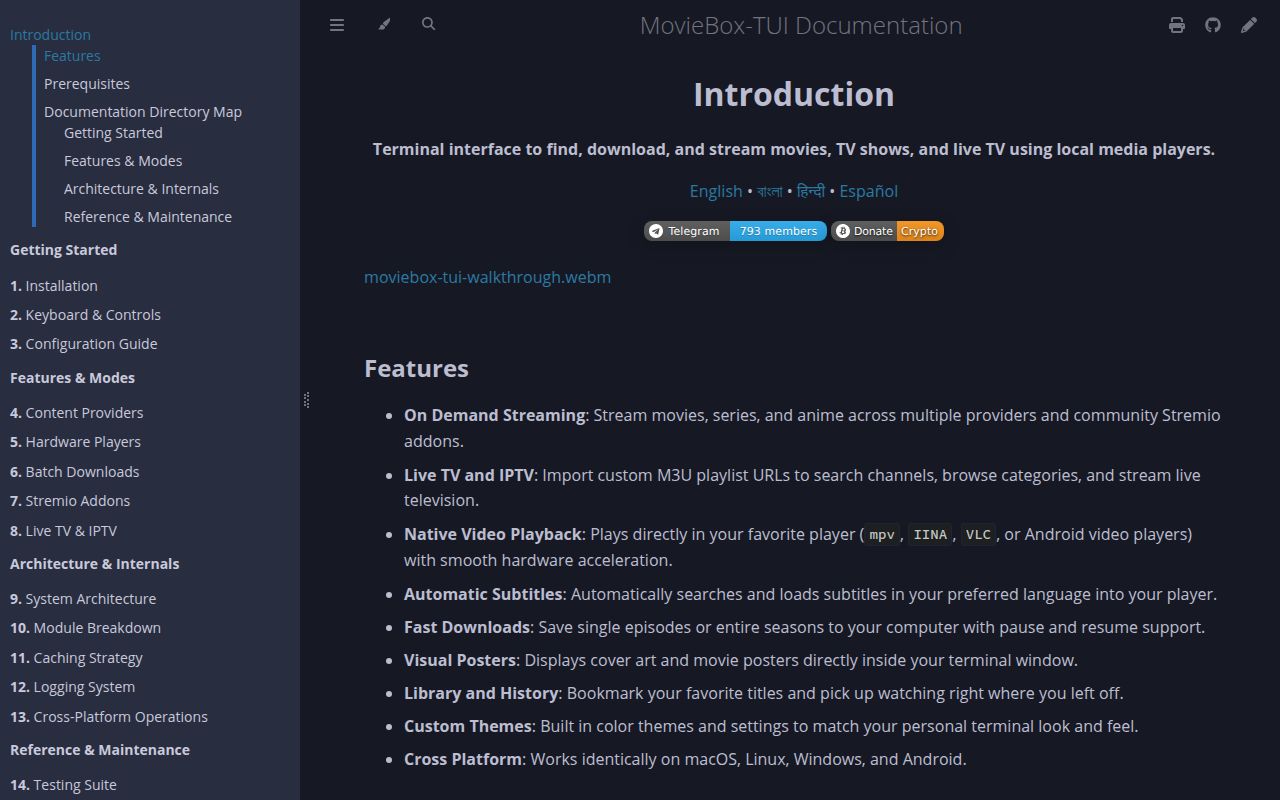
MovieBox-Tui searches outside catalogs, presents results in a Ratatui interface, then launches mpv, VLC, IINA, or an Android player. The application handles posters, subtitles, favorites, downloads, and resume history around that handoff. A basic terminal gets a text fallback, while Ghostty, Kitty, WezTerm, and iTerm2 can render cover art. This split is sensible: the terminal stays good at browsing and the media player keeps responsibility for decoding and hardware acceleration.
The split also defines the first setup cost. At least 1 supported player must be installed and discoverable. MovieBox DASH downloads require yt-dlp and ffmpeg, although other providers use the built-in downloader. Termux needs Android intent tools and an external video app. Player support differs by stream too, because some sources need a referer, user agent, or signed cookie. A detected player is therefore necessary without being sufficient for every provider.
Five provider clients create more choice and more breakage
The provider guide documents 5 client paths: MovieBox, FourKHDHub, 2 Bangladesh-only BDIX mirrors, and community HTTP addons. M3U playlists add a separate live-TV route. These sources do not behave alike. MovieBox resolves signed DASH manifests, FourKHDHub probes rotating mirrors, BDIX depends on reachable local ISP infrastructure, and addons supply their own manifests and streams. Normalizing them behind one interface makes the app pleasant, but it cannot make an expired token or dead mirror play.
The known-issues page is direct about that limit. FourKHDHub mirrors may rotate or expire, after which the app asks the viewer to choose another release. MovieBox request signing also depends on a hardcoded API secret and a spoofed device identity, which the docs call inherent to the scraper. Open issue 159, filed September 21, reports that added Stremio addons produced retry errors on Windows even though the reporter believed the addons worked elsewhere. That report lacks logs, so it establishes a current failure report rather than a general Windows defect.
Version 0.1.23 fixed a real mpv command failure
Issue 153 documented mpv 0.41.0 exiting with code 1 because a comma inside a browser user-agent string broke a generated --ytdl-raw-options value. Release v0.1.23 changed header and cookie argument construction, kept native user-agent and referrer flags, and added shorter notices for player exit codes. The release arrived on September 21, 2026, the same day the issue closed. That is a good response time, while the bug itself shows how a minor provider-header change can stop playback before decoding begins.
Player-specific paths remain substantial. VLC and Android can route signed CloudFront streams through a detached localhost proxy that injects required headers. mpv and IINA receive native command flags, subtitles, and resume positions. Android chooser launches may have less header support than termux-am. These branches give the app broad reach, but each combination of operating system, player, provider, and stream format needs real-world checking that a Rust unit test cannot fully replace.
What happened when we ran it
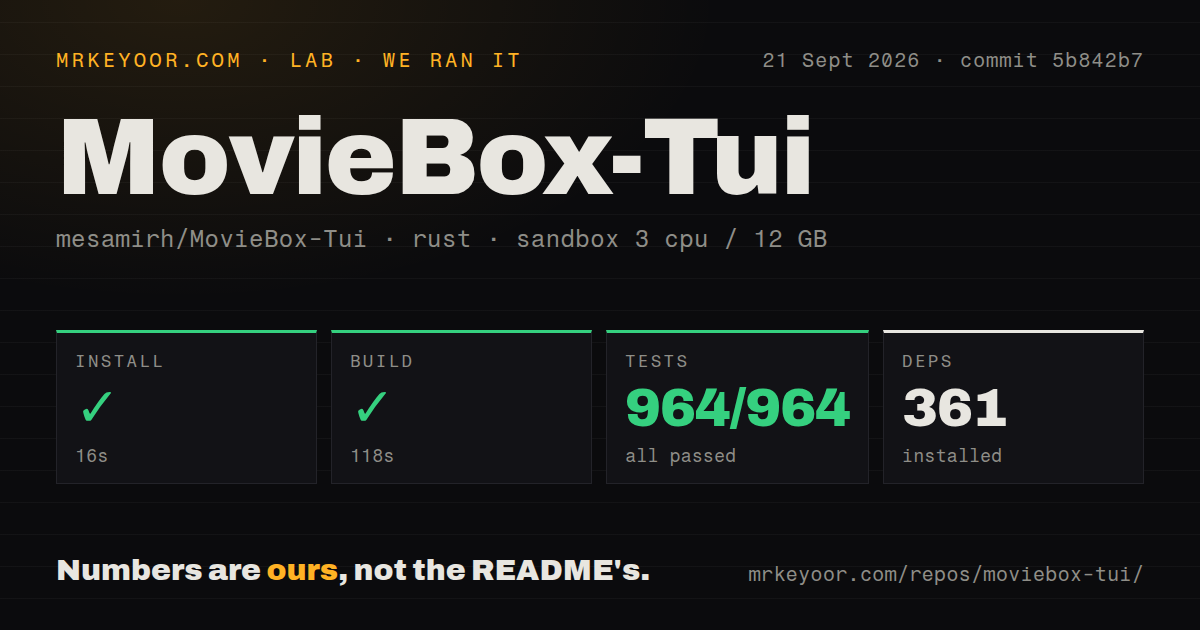
Our sandbox installed 361 packages in 16 seconds. Building commit 5b842b7 took 118 seconds, and cargo test completed in 100 seconds with 964 passed and 0 failed out of 964. The repository occupied 2.4 MB before dependencies, with 148 files and roughly 52,980 source lines. It had 7 CI workflow files and a tests directory, but no Dockerfile. That shape fits a cross-platform interactive binary rather than a server image.
The result is excellent evidence for the code paths the suite exercises. It is not a live playback guarantee. The project's testing guide says network stream verification is opt-in and ignored during the default offline run. Our supplied lab record does not say that opt-in check ran. The same guide still claims 447 automated tests even though our run passed 964, so its count has fallen behind the code. Trust the measured run for the number and use a current provider trial for playback.
Local history does not make network use private
The README says MovieBox-Tui has zero telemetry and keeps history, bookmarks, and configuration on the local filesystem. Config files are written under the operating system's normal config directory, while watch history and favorites use its data directory. That is better than sending viewing history to the app author. Searches and playback still contact MovieBox, FourKHDHub, enabled addons, IPTV hosts, subtitle sources, or update endpoints. Minimal systems may also fall back to public DNS resolvers when no system resolver configuration exists.
Media rights require a separate decision. The project uses MIT or Apache-2.0 for its code, states that it hosts no media, and puts responsibility for local-law compliance on the user. A permissive code license says nothing about whether a third-party stream is authorized in your country. If your organization needs a known catalog and auditable rights, use a licensed service or a self-hosted library with media you control.
Same-day releases show attention, while providers set the ceiling
GitHub recorded 2,163 stars, 8 combined open issues and pull requests, and a last push on September 21, 2026. Version 0.1.23 was published that day, and several playback, audio, resolution, and provider reports were closed around it. That is active maintenance, not evidence that upstream services will stay stable. MovieBox-Tui is a good fit for a tinkerer who values keyboard navigation and is willing to switch sources. Anyone expecting a television appliance should choose the source and rights model first, then the interface.