Univer is an office construction kit, not a finished workspace
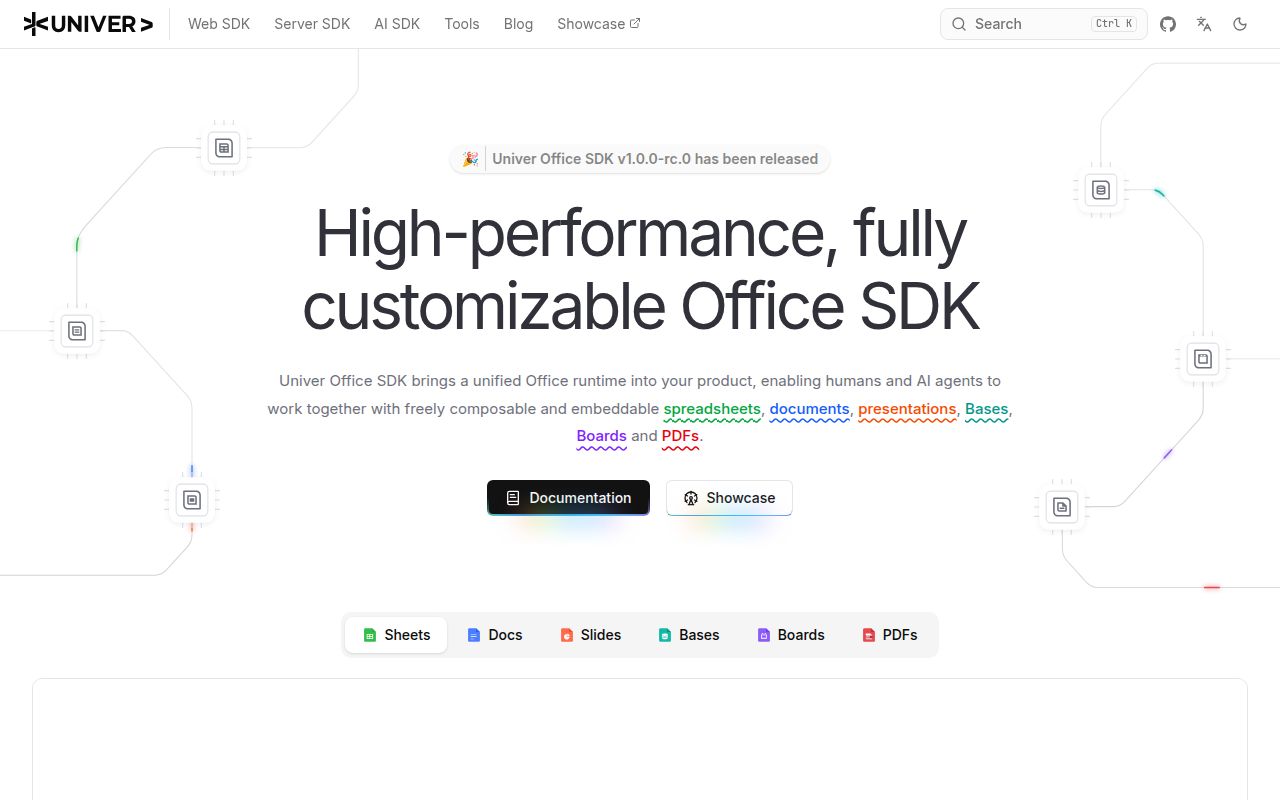
Univer gives a product team the pieces for an embedded office editor: workbook and document models, a formula engine, Canvas rendering, interface components, plugins, and a higher-level Facade API. The same architecture can run in a browser or without a UI in Node.js. That is more ambitious than dropping a grid onto a settings page. It makes sense when the spreadsheet or document is part of your product's workflow and must share its identity, storage, permissions, and surrounding interface.
The distinction matters because the repository does not hand you a complete hosted office suite. At commit d31d624, the checkout held 7,244 files and about 1,257,785 lines of source. Univer Workspace, its agent integrations, and the commercial server stack are separate products or repositories. A buyer who mistakes the SDK for a ready deployment will discover the missing application decisions after adopting a very large dependency tree.
Sheets is mature, while the free and paid boundary shapes the design
The open-source side includes spreadsheet editing, formulas, formatting, filters, validation, comments, notes, tables, hyperlinks, and the shared rendering and plugin foundations. Documents have a model and editor UI. Slides have public model and UI packages, but the README calls that surface under active development and names Sheets as the most mature. This is a spreadsheet-led SDK that has expanded toward a common office runtime.
Several features many teams associate with an office suite are commercial. Real-time collaboration, edit history, import and export, printing, charts, pivot tables, sparklines, server-side calculation, and collaboration services are listed under Univer Pro. The Apache-2.0 core can still be useful on its own, but the product plan should mark each required capability as open source or Pro before integration begins. Otherwise a late licensing decision can rewrite the architecture.
What happened when we ran it
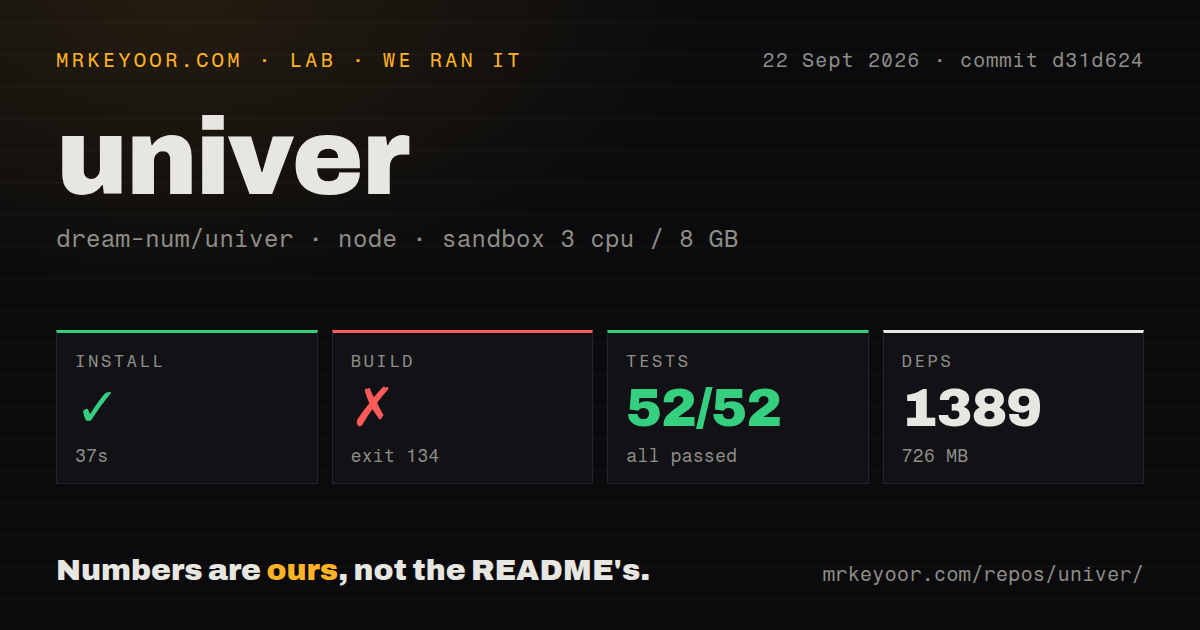
Our sandbox cloned commit d31d624 and installed 1,389 pnpm packages in 37 seconds. The dependency tree occupied 726 MB. The build then failed after 11 seconds with exit 134. Turbo reported 0 successful tasks out of 61 and named @univerjs/sheets-hyper-link-ui as the failed workspace command, while several other package builds ended with lifecycle errors. The log tail does not say why the process exited, so it cannot support a claim about a missing package or memory limit.
The test command ran for 459 seconds and exited 1. Our harness parsed 52 passing Vitest tests and 0 failures in that parsed set, but the workspace log tail separately showed the Docs package with 247 passing tests and 1 failure out of 248. Other package commands then reported lifecycle failures. The defensible result is simple: the full workspace test command did not pass in our fresh Debian container, even though many tests completed successfully.
The source signals are substantial: the 90 MB checkout is a pnpm workspace with 8 CI workflow files and a tests directory. There is no Dockerfile. That leaves contributors to reproduce the documented Node.js 22.18 and pnpm 11 environment themselves. A container image is not mandatory for a JavaScript SDK, but one would have made the gap between the short development recipe and our failed build easier to diagnose.
Presets shorten the first integration, plugins control the final one
Preset mode bundles compatible plugins, styles, locales, and Facade registrations for supported Sheets, Docs, and Node profiles. Plugin mode makes every dependency explicit. The README's plugin example installs 14 named packages before the CSS, locale, rendering, formula, document, sheet, and UI registrations are wired together. Presets are the sensible evaluation path; plugin mode becomes useful after the product team knows which behaviors need replacement or lazy loading.
Compatibility work is ordinary but real. Headless Univer supports Node.js 18.17 or newer, while monorepo development needs Node.js 22.18 or newer. The browser target covers Chrome and Edge 88+, Firefox 90+, Safari 14.1+, and Electron 12+. Older environments may need Intl.Segmenter, and Webpack 4 can need manual handling for package export maps. All coordinated @univerjs/* packages must remain on the same release line.
September activity is current, and open bugs reach visible editing behavior
The repository was pushed on September 22, 2026. GitHub showed 15,030 stars and 137 combined issues and pull requests when fetched. Recently updated issues covered a multi-line formula assistant covering the formula, header and footer images failing to render on the live canvas, cell text selection, formula references after spaces, and a Slides export problem. That is active issue traffic on the same day as the last push, rather than a large queue beside a dormant branch.
Release v0.25.2 arrived on September 17 and contained a fix for prototype pollution in drawing and formula maps. Frequent maintenance is reassuring, but it also means teams should pin the coordinated package line and read release notes before upgrading a plugin-heavy integration. Our failed source build adds one more reason to test upgrades against the exact subset used in production instead of treating the monorepo's main branch as a drop-in dependency.
Pick Univer when the editor itself is product work
Univer earns a serious trial when your application needs a branded, programmable office surface and a plain data grid cannot express the workflow. The browser and headless split, common APIs, and plugin system give a capable team room to shape storage, automation, and UI around its own product. The cost is ownership: package coordination, a large codebase, and early decisions about Pro features.
If the requirement is one editable table, Handsontable or FortuneSheet asks the team to understand less. If the requirement is a complete collaborative office service with Office file handling, ONLYOFFICE Docs starts closer to the finish line. Univer sits between those choices. It offers more control than a document server and more office semantics than a grid, provided you are willing to build the missing product around it.