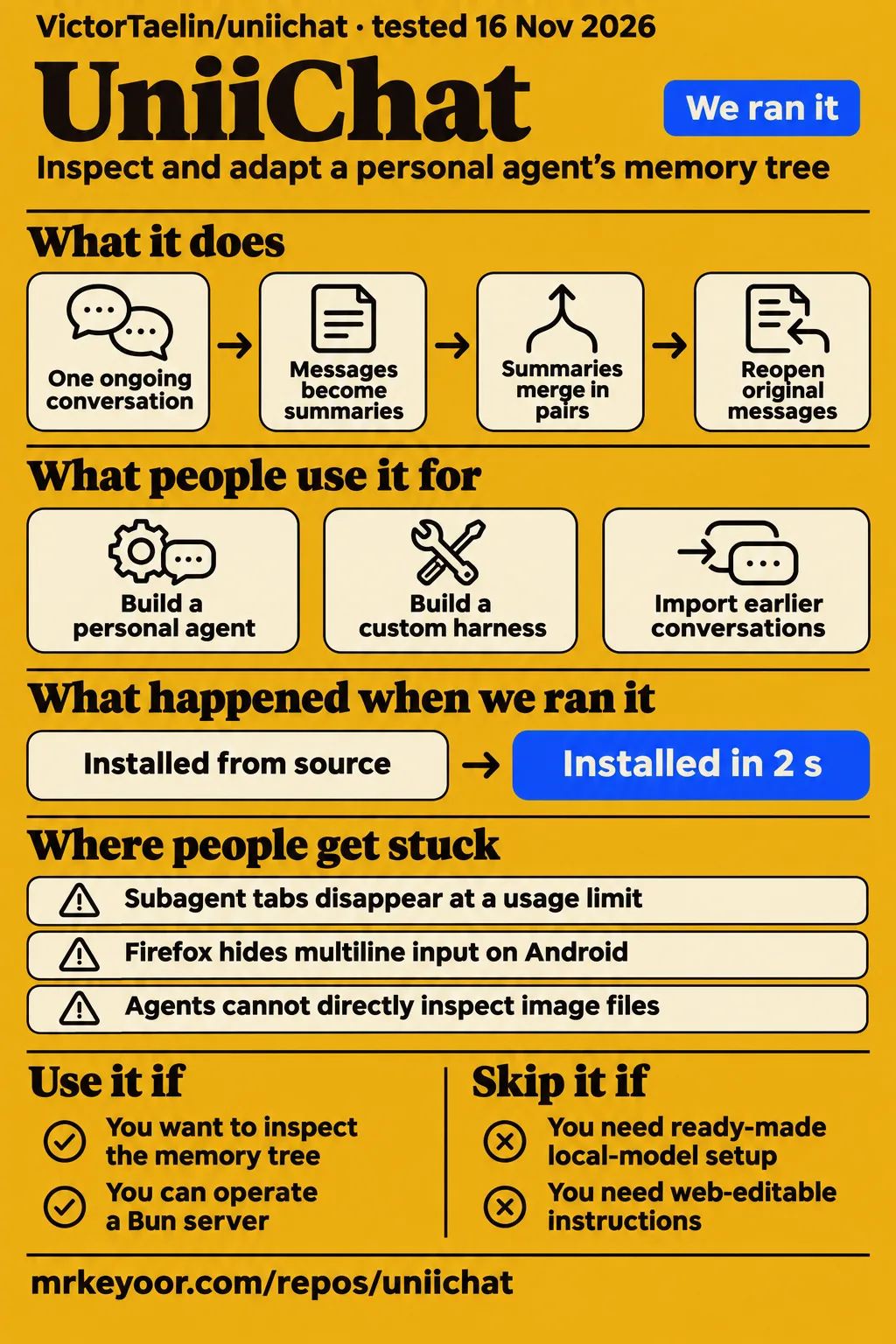
Short answer: use it to inspect and adapt persistent memory
Our sandbox installed UniiChat in 2 seconds, then its test command exited 127 because the shell could not find Bun. Use it if you want to inspect or adapt a personal agent's memory system and can operate its Bun server. Skip it if your workflow requires ready-made local-model setup, direct image-file inspection or identical subscription features across distributions.
UniiChat keeps one conversation, summarizes its history into a tree and lets the agent reopen original messages. Its source is useful to developers who want to understand that arrangement or build on it. The practical choice is whether you want to own the server, model configuration and backups that accompany the design. The README says AI agents wrote and reviewed nearly all the repository and tells readers to expect bugs. UniiChat README
What people use uniichat for
Digg reports a month of creator use, while X users describe personal agents and custom harnesses built from the UniiChat design. The table identifies which implementation each account concerns. That distinction makes the reports useful: someone borrowing a memory design has a different starting point from someone installing this repository and expecting its existing interface and vendors.
| Who | What they used | Reported outcome | What that tells you |
|---|---|---|---|
| Victor Taelin, as reported by Digg | UniiChat as his only agent | A month of personal use | The creator used the project for an everyday-agent workflow. Digg report |
| X user joan_mp | A personal agent built from the OptChat/UniiChat specification and pi-ai libraries | Praised the memory visualization and their experience using it | The design supplied a starting point for a personal implementation. joan_mp's report |
| X user SHxKM | A custom harness called ethos | Reported agent spawning, scheduling, self-updates, notifications and voice interaction | These capabilities belong to ethos. SHxKM's report |
| X user valeriomc_ | A custom agent harness with UniiChat memory | Reported working memory tools and OpenAI subscription-based access | The report concerns that custom integration. valeriomc_'s report |
The supplied Opt video adds a history-import workflow. Its presenter describes building a modified implementation and bringing earlier conversations into it. This is a useful reason to study the design: an existing archive can become part of a continuing conversation instead of staying in separate exports. The blog's research-lab scenario is a proposed use, while the accounts in the table describe people reporting their own use. Opt video, blog overview
What happened when we ran it
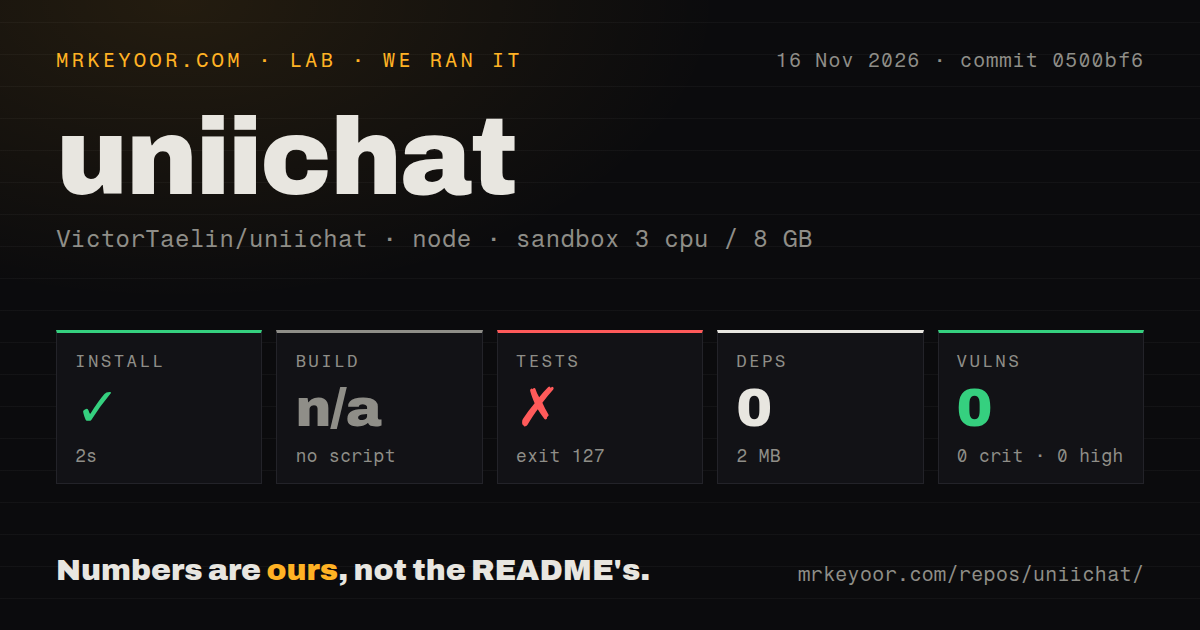
We measured a 2-second npm installation and a test-command failure after 1 second in our November 16, 2026 sandbox at commit 0500bf6. The recorded configuration allocated 3 CPUs and 8 GB RAM and used image label lab-node:22. The checkout contained 65 files, about 16,659 source lines and 0.9 MB of repository content.
| Recorded check | Result | Meaning for a setup decision |
|---|---|---|
| Install | Succeeded in 2 seconds | The npm installation step completed. |
| Dependency record | 0 dependencies, 2 MB on disk | This is the recorded installation footprint. |
| Build | Skipped, no build script or target | The harness skipped its build step. |
| Tests | Failed, exit 127, in 1 second | The command invoked Bun, which the shell could not find. |
| npm audit | 0 known vulnerabilities across all recorded severities | The audit recorded 0 critical, 0 high, 0 moderate and 0 low findings. |
| Repository scan | 65 files, about 16,659 source lines, 0.9 MB checked out | These figures describe the checkout. |
| Repository signals | 1 CI workflow file, no Dockerfile, no tests directory | These are the harness's file-scan results. |
The log shows bun test --isolate followed by sh: 1: bun: not found. The runner therefore stopped before reporting test assertions. The README separately documents Bun commands for tests, rebuilding the web application and compiling the terminal executable. Reading those instructions alongside the harness result explains the immediate setup requirement: the documented toolchain includes Bun, while this command could not find it. README commands
The separate deployment attempt failed its safety step because none of compose.yaml, compose.yml, docker-compose.yaml or docker-compose.yml existed. The setup summary nevertheless describes deployment with the repository's own Docker Compose and every port bound to 127.0.0.1 on November 16, 2026. The teardown record says teardown: ok. These are the three recorded outcomes of that attempt.
Where people get stuck: distribution, input and agent tabs
Issue #18 reports different Claude subscription capabilities in source and binary 1.0.138, and issue #13 reports an installer-version mismatch in that binary. The following table collects reporter-described symptoms and outcomes. Installation path, browser and the distinction between main and a proposed change matter because they determine which report applies to a particular setup.
| Report | What the reporter encountered | Recorded workaround or resolution |
|---|---|---|
| Issue #13 | Binary 1.0.138 served an installer stamped 1.0.137 | The official hosted installer supplied 1.0.138; source builds were unaffected. The issue is open. |
| Issue #18 | The released binary had a Claude subscription vendor missing from source | Requested an SDK-based implementation; closed as not planned. |
| Issue #14 | Multiline input in Firefox for Android hid the line being typed | Chrome worked on the same phone. The issue is open. |
| Issue #15 | Subagent tabs disappeared when a usage limit was reached | Proposed change #29 retained tabs in a contributor's fake-vendor 429 test; the discussion says it had yet to land in main. |
| Issue #31 | Extra subagent tabs seemed unreachable | Reporter closed it after confirming Shift+wheel on a mouse and touch dragging on phones. |
| Issue #16 | Web numbered lists restarted and nested content rendered incorrectly | The issue is open and requests preserved numbering, continuation and nesting. |
Issue #15 describes an interruption during background work: tabs vanished at the usage limit and returned after the agents were messaged. The contributor says proposed change #29 waits for the vendor reset time or retries every 30 minutes. In their fake-vendor 429 test, tabs stayed on #29 and vanished on main. The discussion explicitly leaves the issue open until the fix lands. Rate-limit discussion
The input reports suggest simpler responses. Issue #14 names Chrome as the browser that worked on the same phone, and issue #31 ends with a confirmed scrolling gesture. Those are concrete actions a reader can try before changing code. For a bug report, include the distribution, version and browser so that a packaging problem, an input problem and a proposed runtime fix stay distinguishable.
The memory tree preserves messages and exposes them through zoom
The README describes a binary summary tree and a chat view of up to 128 KB per model call. Every message becomes a one-line summary, adjacent summaries merge in pairs and the agent can expand a line back toward its original messages. Recent conversation occupies more detailed lines; older conversation occupies fewer, broader lines. Memory design
A separate compactor model writes summaries as messages arrive. For a developer inspecting the implementation, the README points to Memory.ts for the tree and view, Server.ts for chat and workers, and AskAI.ts for model calls and caching. These are useful entry points because the proposed benefit depends on several connected operations: retaining messages, summarizing them and selecting details for a later answer.
HotRepo describes recall as depending on the summaries and the agent's decision to zoom. It also identifies background compactor work and cost separately from the main conversation. That explanation turns the memory design into a practical evaluation task: put a known detail in an old conversation, ask about it later and inspect which original message the agent retrieves. HotRepo's memory explanation
Security and privacy: understand what a history import contains
The hosted privacy policy says chat and account data remain until account deletion, with backup copies overwritten within 30 days. Its chat category includes messages, images, device commands and output, files, screenshots when computer use is enabled, agent logs and summaries. A history import therefore belongs alongside device access when deciding what material to give the service. Hosted privacy policy
The policy says model calls send Anthropic or OpenAI recent messages, summaries, images and tool output needed to answer. It says provider API terms bar training on that material and allow retention for abuse detection for up to 30 days, with longer retention under the stated legal or investigation conditions. Financial and consent records have a five-year period; access logs can remain for up to ten years.
The README describes self-hosting with your own API keys and documents the terminal's daily version check. That check sends version, operating system, CPU type and whether the computer has ever self-hosted; UNII_NO_TELEMETRY=1 turns it off. Because the agent can run shell commands and edit files on connected devices, start with a disposable working directory containing material suitable for the selected model provider. Self-hosting and telemetry documentation
UniiChat vs neurastream, Opt and hosted UniiChat
Choose source UniiChat to inspect or modify memory, hosted UniiChat to avoid server operation, neurastream to evaluate reported sequencing enforcement, and Opt to study a derivative. These choices address different jobs. The comparison below identifies the source of each distinction so a personal-memory implementation and an autonomous-work planner do not become interchangeable recommendations.
| Choice | Evidence-backed difference | Choose it when |
|---|---|---|
| Source UniiChat | The README documents running your own server with your own API keys | You want to inspect or change the memory implementation and operate its storage. README |
| neurastream | Creator UmidKD describes plan files and deterministic scripts at every step | You want to evaluate its reported enforcement of task sequencing. Creator's report |
| Opt | The video presenter describes a personally modified implementation and subscription access | You want to study that derivative workflow. Opt video |
| Hosted UniiChat | The README links the hosted service; HotRepo presents it as the alternative to operating a server | You prefer the hosted account and published retention terms to server maintenance. Hosting comparison |
UmidKD says the UniiChat recipe did not meet their specific needs and describes putting rules in plan files and enforcing steps through scripts. That is a useful selection criterion for work where a missed instruction invalidates the result. UniiChat's memory tree addresses continuity of conversation; the reported neurastream design addresses execution order. Choose the requirement first, then examine the implementation that claims to meet it.
What the other reviews get wrong
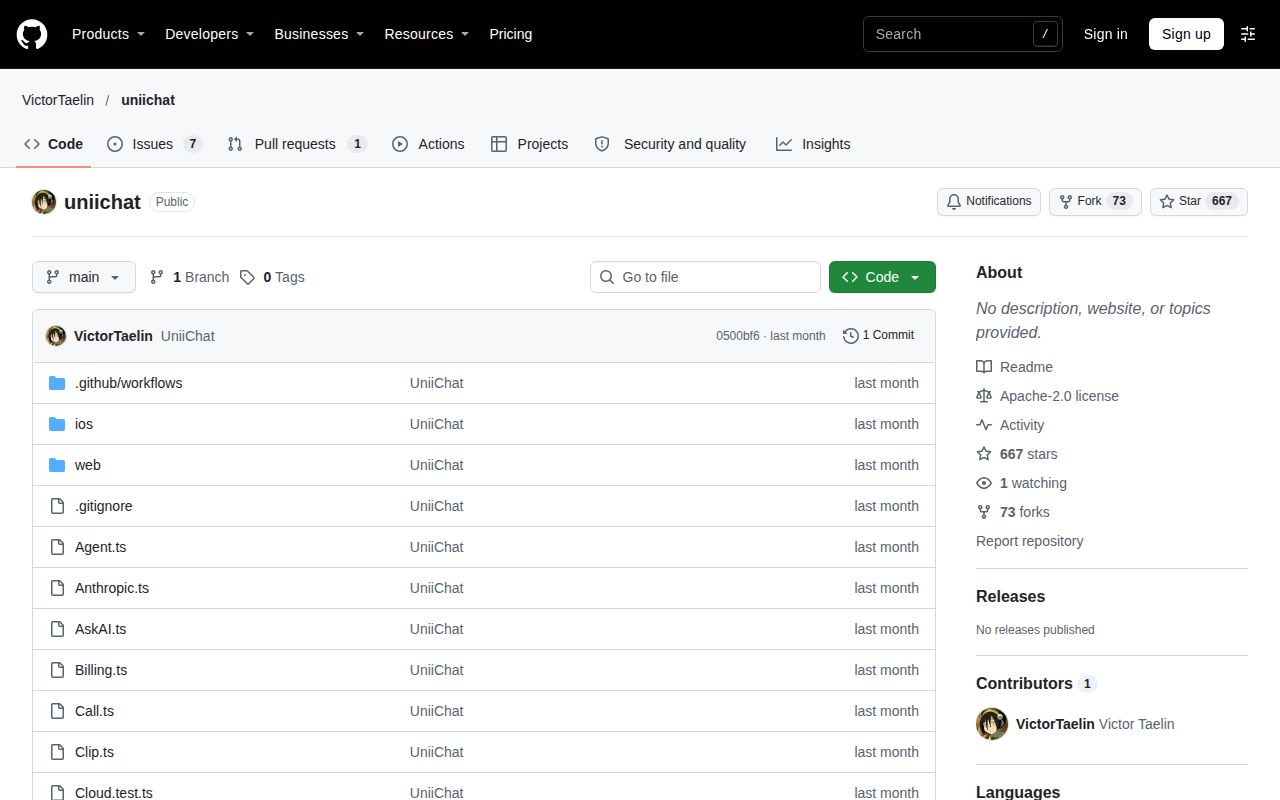
GitHubTree displays 0 stars alongside placeholder repository text, while HotRepo records 587 stars on October 25, 2026. Those records make the zero display a poor basis for an adoption claim. HotRepo identifies its figure as a dated snapshot on the NEW-REPOSITORY board. Neither a star counter nor the personal-harness reports counts daily upstream users. GitHubTree display, HotRepo snapshot
The README's phrase that context never rots also needs a concrete reading. Its described mechanism retains originals and permits expansion of summaries; HotRepo explains that recall depends on summaries and zoom selection. Keep those two facts together when evaluating a claim about memory. Search results also include unrelated UniChat products, so use the exact VictorTaelin/uniichat identity when following feature descriptions or troubleshooting advice.
Questions people ask
UniiChat is the open-source AI agent in VictorTaelin/uniichat, built around one ongoing conversation and a retrievable summary tree. The questions below come from the supplied search intents, issues and X reports. Their answers distinguish the repository, released binaries and custom harnesses, and name a reported workaround or issue outcome where the evidence supplies one. Project README
What is UniiChat, and where is its GitHub repository?
UniiChat stores a continuing conversation in a tree of summaries that can expand back to original messages. Its repository is VictorTaelin/uniichat on GitHub. The README links the hosted service and describes the source as a way to run your own server with your own API keys. It also documents importing past Claude and ChatGPT chats. README
Can UniiChat use a local LLM instead of an Anthropic or OpenAI API key?
The README documents Anthropic API setup and an OpenAI configuration path. Issue #2 asks whether those keys are a hard requirement and whether a local LLM can be used instead. Its supplied record is open with zero comments. For the documented OpenAI path, the README changes vendors, pick and compactor together. Local-model question, configuration instructions
Can I use a Claude subscription with a source build of UniiChat?
Issue #18 reports that released binary 1.0.138 had a claude-sub vendor that source lacked. The requester proposed adding that vendor through the Claude Agent SDK. The readable issue page records closure as not planned on October 26, 2026. This makes distribution a necessary detail when discussing subscription access or choosing an installation path. Subscription-vendor report
Can I edit per-user instructions or a SOUL.md from the web interface?
Issue #17 describes a compiled base prompt and a server-wide rules file appended for every user. Editing that file requires shell access to the server. The requester asks for per-user web-editable instructions and an owner-only base-prompt override. The supplied record is closed with zero comments; the existing README documents rules as a file appended to every system prompt. Instructions request
Why does the UniiChat installer served by binary 1.0.138 install 1.0.137?
Issue #13 reports an installer embedded in binary 1.0.138 with the older 1.0.137 stamp. It says the official hosted installer supplied 1.0.138 and that the source wrapper simply ran the official installer. The actionable distinction is where the installer came from: the affected binary's server or the official hosted endpoint. Installer report
How can I keep multiline message input visible in Firefox for Android?
Chrome worked on the same phone according to issue #14. The Firefox report says the typed line became hidden behind the keyboard and browser controls once a message spanned several lines, with the address bar at either the top or bottom. Switching to the browser named in that report is the supplied workaround. Android input report
Why do subagent tabs disappear when a usage limit is reached?
Issue #15 connects disappearing tabs to subagent calls ending as failed at the usage limit. The contributor reports that proposed change #29 waits through the limit and retained tabs during a fake-vendor 429 test. The discussion keeps the issue open until that fix lands in main, preserving the distinction between the tested proposal and main. Subagent-limit report
How do I reach subagent tabs that extend beyond the tab bar?
Shift+wheel scrolls the tabs sideways with a mouse, and touch dragging works on phones, according to the reporter who closed issue #31. The earlier request proposed navigation buttons for hidden tabs. The closing comment instead identifies gestures already sufficient for that reporter, giving readers a direct interaction to try in the tab bar. Tab-scrolling resolution
Why do numbered lists restart at 1 in the web interface?
Issue #16 reports that separated numbered items become separate lists and that a list starting at 4 displays as 1, 2. It also describes indented sublists being folded into item text and indented paragraphs ending lists. The requested behavior is preserved numbering, continued items across blank or indented lines and at least one nesting level. Markdown-rendering report
Can UniiChat agents view screenshots, charts and photos stored on disk?
Issue #44 says the read tool returns text only and names an image-wrapping MCP server as the workaround. It separately says user-sent images, images recovered through zoom and images returned by MCP tools reach the model. Returning image blocks directly from read is the report's suggested fix, which matters for agents checking their own screenshots. Image-file report
Do newer UniiChat versions fix the problem reported on X?
The supplied philogy post asks whether newer versions fix a problem but names no symptom in its excerpt. It therefore supplies a troubleshooting question without a diagnosis. For an upgrade decision, use a concrete symptom such as the installer-version mismatch or disappearing subagent tabs and follow the corresponding issue's recorded outcome. philogy's question
Can someone combine pi, UniiChat memory, remote browser pairing and retries after the five-hour limit?
X user dorian100x requests that combination, including durable objects and optional mobile access. The post asks someone to build it or point to it. The personal-harness accounts elsewhere on this page describe their own combinations of tools and memory; the request itself supplies no implementation to install or documented sequence for assembling those components. dorian100x's request
What we have not tested yet
Our run ended before a supported Bun test run or a working interactive deployment. The Compose summary conflicts with its failed safety step, so it supplies no reliable deployment success. The hands-on pack contains no question-and-answer task or screenshot records. Actual runtime and operating-system versions require raw toolchain logs; lab-node:22 is the recorded image label.
Recall accuracy, import correctness, long-running conversations, browser behavior, provider billing, local models, subscription access and the reported workarounds remain outside our hands-on results. We have not reproduced the derivatives or compared alternatives side by side. Issue states describe the supplied records, and cross-repository commits or closed labels alone do not demonstrate that a requested feature shipped upstream. The installer report's suggested cause and philogy's underlying symptom also remain unresolved by this evidence.
We have not audited shell permissions, device access, authentication, provider traffic, backups, deletion or implementation of the hosted privacy policy. The npm audit's zero known vulnerabilities covers its recorded scope. Before importing a large archive, start with old conversations containing facts you can check, request the originals and assess whether retrieval and operating controls meet your needs. The numerical product dimensions remain unassessed because this evidence supports setup observations and attributed reports, not completed operational evaluation.