It is a database core with SQLite as its first language
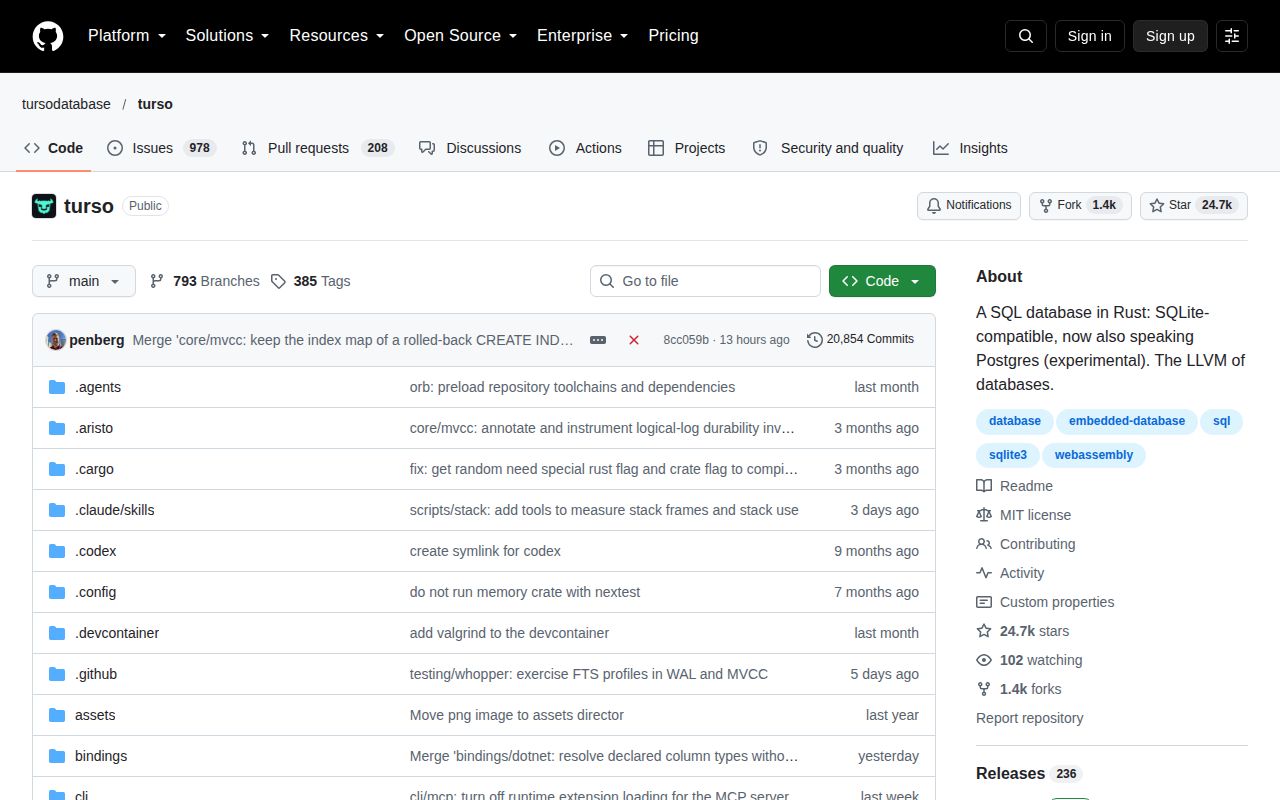
Turso is not merely a hosted service client or a thin wrapper around SQLite. The repository describes an in-process database written in Rust, with its own virtual machine that compiles SQL into bytecode and executes it. SQLite is the primary frontend, while a Postgres dialect and wire protocol are being developed as another frontend. The long-term idea is unusually ambitious: one database core that can accept multiple SQL languages, much as a compiler infrastructure can serve several programming languages.
That ambition matters because the practical baseline is already substantial. Turso tracks SQLite 3.50.4 for the SQL dialect, file format, and C API, and it publishes a separate compatibility document rather than pretending the job is finished. The README says the engine is in production at multiple organizations. It also supports Linux, macOS, Windows, and browsers through WebAssembly, so this is intended as a portable database component, not a single-platform research project.
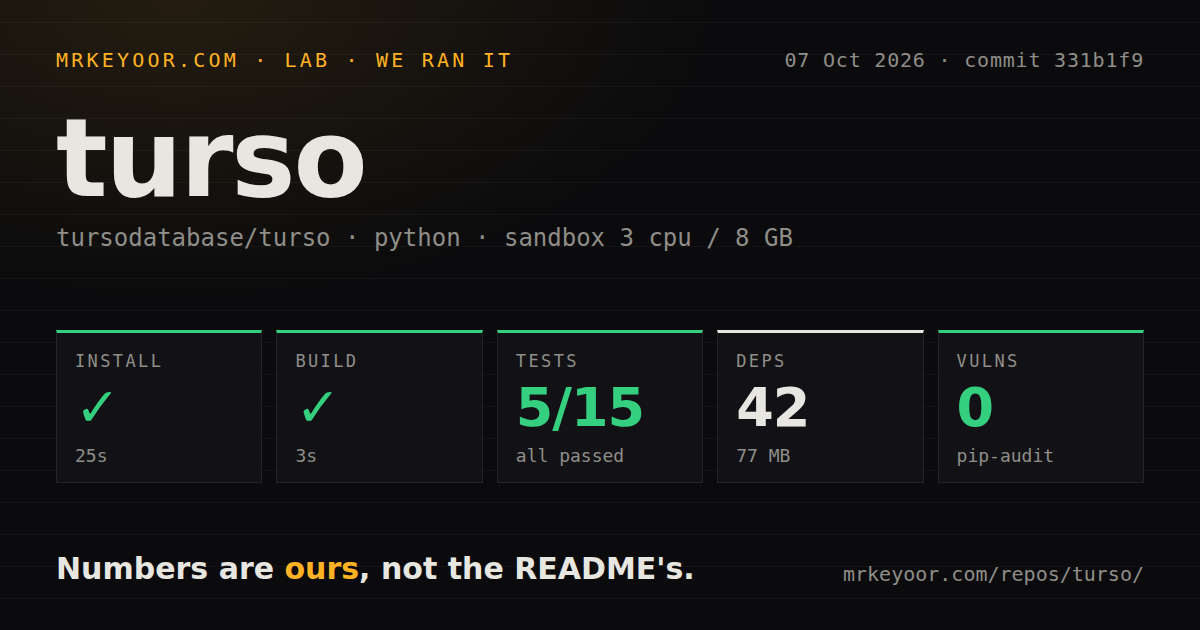
Our build passed, but the test environment did not
In our run at commit fb7c20b, installation succeeded in 42 seconds, bringing in 42 packages and consuming 75 MB on disk. The build then completed successfully in 5 seconds. We ran this in a fresh, unprivileged Debian container with 3 CPUs and 8 GB of RAM, without secrets. The repository was sizeable: 3,997 files, about 791,174 lines of source, and a 75.1 MB checkout.
The test result was the warning sign. Pytest exited after 8 seconds with 5 tests passed, 3 skipped, and 8 collection or setup errors out of 13 items. The errors covered four Python database test modules, an interrupt test, two serverless areas, and a CLI test. The provided tail does not expose the underlying exception, so it would be irresponsible to blame a missing package or a code defect. What we can say is that a fresh checkout was not test-ready in our sandbox.
The strongest features address real SQLite limits
The most compelling addition is BEGIN CONCURRENT, backed by multi-version concurrency control. SQLite's write behavior is often the point where otherwise excellent embedded designs become awkward, so improved write throughput is a concrete reason to evaluate a newer engine. Change data capture is another practical feature, allowing downstream systems to react to database changes without treating the database file as an opaque endpoint. Extended ALTER support and faster schema changes target another familiar operational pain.
The language coverage is broad for a project at v0.7.2. The README lists Go, JavaScript, Java, .NET, Python, Rust, and WebAssembly bindings, and gives short examples for several of them. Linux users can use asynchronous I/O through io_uring. Exact vector search and vector manipulation are present, while approximate vector indexing remains on the roadmap, an honest distinction that prevents readers from assuming production-grade vector retrieval is already complete.
Several experimental features are technically interesting but should be treated as evaluation material. Encryption at rest, incremental computation using DBSP, query subscriptions, Tantivy-powered full-text search, and multi-process WAL coordination all expand the possible use cases. The Postgres frontend is the boldest item, but its experimental label matters. Compatibility with a dialect and wire protocol is not the same thing as matching the full behavior, extensions, operations, and tooling of a mature Postgres server.
Compatibility and scope are the main risks
A database replacement carries a higher switching cost than a utility library. Turso's stated compatibility with SQLite 3.50.4 spans SQL, files, and the C API, but the existence of COMPAT.md signals that adopters must check the exact surface they use. Applications with unusual pragmas, extensions, locking assumptions, or recovery procedures need targeted tests. The same caution applies to every binding, because a JavaScript API example says little about parity with Python or .NET behavior.
The project is also clearly before 1.0, and its most distinctive direction is still moving. Release v0.7.2 was published on July 30, 2026, while the repository was pushed again on September 1, 2026. That combination is evidence of current development, not abandonment. However, one known release date is not enough to claim a predictable cadence, and 876 open issues represent a large review burden even for a repository with 24,112 stars.
It fits as an embedded component with an exit plan
Turso makes the most sense inside an application that wants local SQL storage and can benefit from MVCC, CDC, or one of the 7 supported language targets. Put it behind a small data-access layer, retain migrations and representative compatibility fixtures, and test real database files before committing. For a browser application, WebAssembly support is notable; for a Linux service, io_uring and concurrent transactions may be the more relevant reasons to experiment.
For ordinary embedded CRUD, SQLite remains the calmer default after more than 3 decades of ecosystem hardening. DuckDB is a better-shaped alternative when the work is analytical rather than transactional. A real PostgreSQL server remains the safer choice when Postgres behavior is the requirement, because Turso's matching frontend is explicitly experimental. Turso earns a trial when its added capabilities solve a measured constraint, not when novelty alone is the goal.
The right verdict is promising, with mandatory verification
Our run proved that the project can install and build quickly on a modest box, but it did not prove a clean development setup. A 5-second successful build is encouraging; 8 test collection or setup errors are enough to block an automatic production recommendation. The repo's MIT license, active same-day push, multi-language reach, and unusually clear separation of supported, experimental, and roadmap features all count in its favor.
Adopt it only after your own SQLite compatibility suite, crash and recovery checks, concurrency tests, and binding-specific tests pass. If BEGIN CONCURRENT or CDC removes a real architectural bottleneck, the extra validation may be worthwhile. If standard SQLite already meets your needs, Turso's broader surface and pre-1.0 status add risk without a guaranteed return.