PostgreSQL is infrastructure, not a plug-in
PostgreSQL is the source tree for a full database management system, not a small library that an application casually bundles. Its README describes an object-relational database supporting transactions, foreign keys, subqueries, triggers, user-defined types, and user-defined functions. With about 1,813,561 lines of source in our measured checkout, this is infrastructure whose behavior and operating model deserve deliberate attention.
The repository also includes C language bindings, while the database exposes an extended subset of the SQL standard. That combination makes it useful as a durable system of record behind web services, internal tools, reporting pipelines, and packaged software. The better reason to choose it than its 21,989 stars is that PostgreSQL gives an application one place to enforce relationships and transaction boundaries instead of recreating those guarantees in application code.
What happened when we ran it
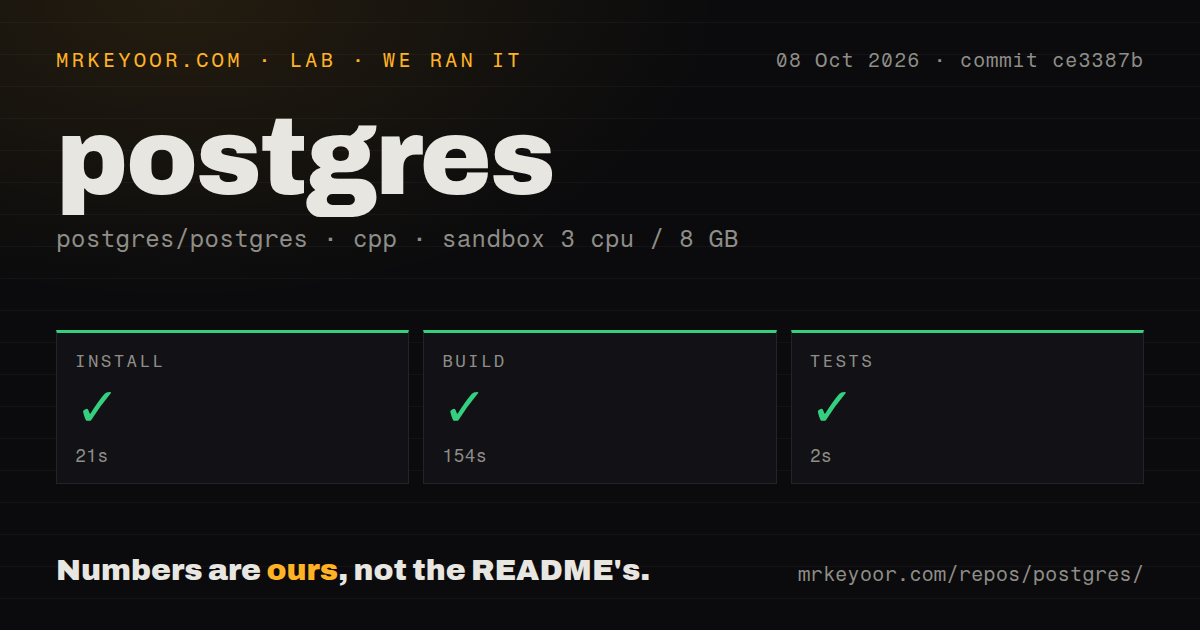
Our run used commit ad4b80b in a fresh, unprivileged Debian container with 3 CPUs and 8 GB of RAM. Installation succeeded in 47 seconds. The build then succeeded in 142 seconds, and the test step succeeded in 46 seconds. These are workflow timings, not database performance benchmarks. They show that this exact checkout could be prepared, compiled, and tested from a clean sandbox without a hidden credential or privileged host setup.
The checkout occupied 147.2 MB and contained 7,700 files. We measured one CI workflow file, no Dockerfile, and no top-level tests directory. None of those signals makes the project incomplete, because large C projects often organize testing and build logic differently from application repositories. A contributor expecting a visible tests folder or a repository-provided container recipe will need to follow PostgreSQL's own build conventions rather than assumptions from a typical web project.
The strongest features live at the data boundary
Transactions and foreign keys are the practical center of the offer. A payment update, inventory change, or permissions edit often spans more than 1 row, and partial completion can leave an application in a state that is hard to repair. PostgreSQL lets the database treat connected changes as a unit and reject relationships that violate declared rules. Subqueries and triggers add expressive tools near the data, while user-defined types and functions let experienced teams model behavior the built-in vocabulary does not cover.
That flexibility can simplify services above the database, but it also creates governance work. A team with 10 application services can share one PostgreSQL installation, yet triggers and custom functions may hide behavior from developers who inspect only service code. The sensible pattern is to version schema changes, review database-side logic, and keep ownership clear. PostgreSQL supplies the mechanisms; it does not decide how a company should manage migrations, capacity, backups, or access.
Source setup is documented elsewhere
The README is unusually short for a system of roughly 1.8 million source lines. It identifies the project and its major SQL capabilities, then directs readers to the development documentation for source installation instructions. That is defensible for a mature project with a separate manual, but it makes the repository landing page a signpost rather than a working quick start. Someone cloning from GitHub should expect to move immediately to the linked installation guide before compiling.
Our successful 47-second installation does not prove that every workstation already has the required toolchain, nor does the 142-second build predict another machine's result. The supplied evidence records success in one specific lab-cpp:1 sandbox. There is no Dockerfile to standardize a local environment, so contributors remain responsible for matching documented prerequisites. For application users, operating-system packages or official downloads are likely a more appropriate entry point than compiling from a source mirror.
Activity is visible, but GitHub tells only part of the story
The repository was pushed on September 2, 2026, one day before this review date, which is strong evidence of current code activity. It reports 0 open issues and no latest release in the supplied GitHub data. Those fields need careful interpretation: zero issues can reflect disabled or externally managed issue tracking, and an absent GitHub release does not establish a slow release cadence. This data cannot measure response time, maintainer workload, or how frequently official PostgreSQL releases ship.
Community interest is easier to see than repository issue handling. The supplied list includes a 103-point thread about running PostgreSQL without PgBouncer, a 52-point discussion of change data capture, and an 87-point discussion of parallel backups. Another analytics-related thread drew 243 points and 118 comments. These are not product tests, but they show practitioners debating operations, data movement, backup design, and specialized workloads around software used beyond toy projects.
It belongs behind applications with an operating plan
In a real stack, PostgreSQL normally sits behind an application or data-access service, with 1 clearly managed route for credentials, migrations, monitoring, and backups. Connection pooling may become relevant as concurrency grows, while replicas, archival, and recovery procedures depend on availability goals. None of that operational layer appears in the short README, and the source repository is not a complete production deployment recipe. Teams still need to design how the database is secured and maintained.
Choose PostgreSQL when the data is relational, correctness rules belong close to that data, and the team is prepared to operate a server. Choose SQLite when a single local file is enough, MySQL or MariaDB when compatibility or existing tooling dictates that family, and a distributed SQL system when multi-machine distribution is the core requirement. Our 46-second successful test step makes this checkout encouraging for contributors, but the buying decision should follow workload shape, operational skill, and recovery needs rather than popularity alone.