Verification separates live credentials from suspicious strings
Most secret scanners ask whether text resembles a credential. TruffleHog can also classify the provider and, for supported types, contact that provider to check whether the credential still works. A verified result is more urgent than a placeholder or expired key. For selected common types, analyzers make further requests to identify ownership, accessible resources, and permissions, giving responders more context for rotation and containment.
The README says the engine classifies more than 800 secret types. Verification returns verified, unverified, or unknown states; unknown covers attempts blocked by network or API errors. This model reduces some false-positive work, but it does not make every unverified result safe. Custom formats, generic passwords, offline keys, and providers without validation still need policy and human review.
Provider checks make rollout a security decision
Validation sends a candidate credential to the service believed to have issued it. That request can appear in provider logs, trigger rate limits, or violate a rule against moving secrets outside an approved boundary. Teams should decide which detectors may verify, where scans run, how egress is restricted, and who can read output before enabling the feature across repositories.
The output itself is sensitive. JSON can carry the raw finding and provider metadata, while terminal and CI logs may be retained or copied. Restrict artifact access, redact downstream notifications, set deletion periods, and connect a verified result to an owner and revocation procedure. TruffleHog finds exposure; it does not rotate every supported credential automatically. Open issue 4171 still requests broader revocation functionality.
What happened when we ran it
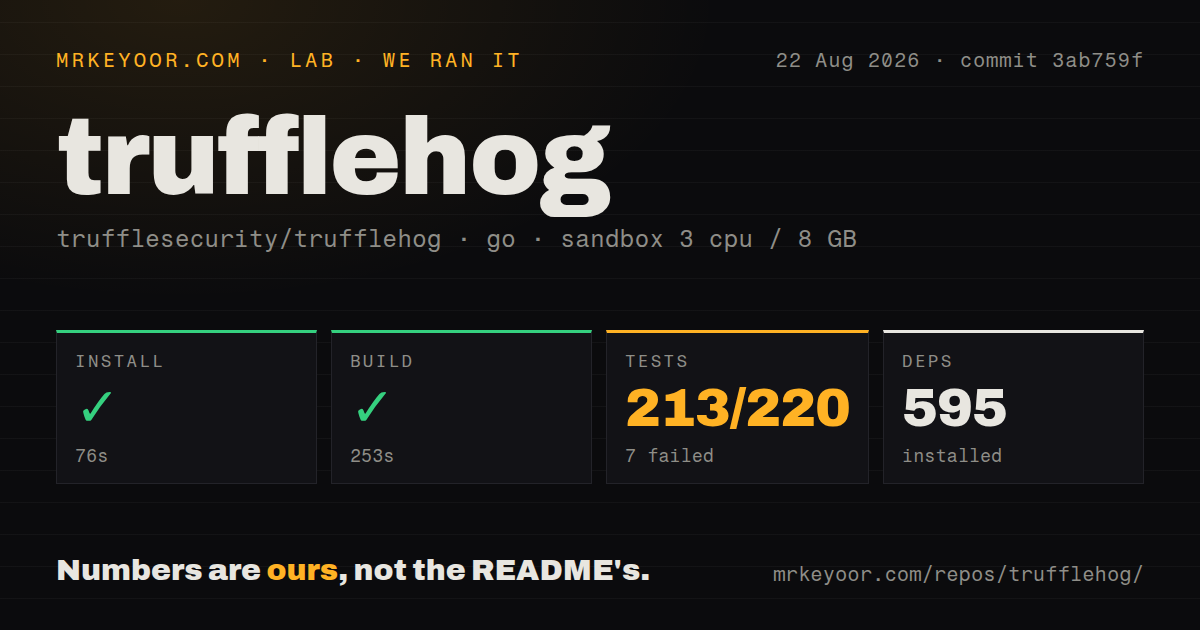
Our sandbox installed 595 Go packages in 76 seconds and built TruffleHog in 253 seconds. The test step lasted 521 seconds and exited with code 1. Go test reported 213 passed and 7 failed out of 220. The supplied tail shows later packages completing or having no test files, followed by a final FAIL. It does not show the seven failing names or their error messages.
We therefore cannot attribute the failures to networking, credentials, timing, or a particular package. The exact finding is that commit 3ab759f did not pass its full measured suite in our unprivileged 3-CPU, 8 GB Go 1.24 container. The checkout had 3,488 files, about 469,074 source lines, and 21.7 MB, with a Dockerfile and 10 CI workflow files but no tests directory.
Git and cloud coverage goes beyond a pre-commit hook
TruffleHog scans Git repositories and organizations, issue and pull-request comments, filesystems, stdin, Docker images, S3, GCS, Postman, Jenkins, Elasticsearch, Hugging Face, and other sources documented in the CLI. That matters because secrets leak through build output, image layers, state files, copied conversations, and object storage as well as committed source. Private sources need credentials with enough read access.
Coverage still has boundaries. Open issue 5205 says the GitHub scanner does not download Actions artifacts, even though those archives can contain Terraform state and other sensitive output. Scan that store separately if it is in scope. Experimental cross-fork object discovery reaches deleted and hidden commits, but the README says enumeration can take 20 minutes to several hours and writes cache files unless cleanup is requested.
CI output is useful, while default pinning needs attention
The CLI emits streaming JSON and can fail CI with exit code 183 when valid credentials appear. SARIF integrates with GitHub code scanning and tracks findings on pull requests, but the README notes that SARIF buffers the whole result set before writing one document. Large finding sets therefore use more memory than streaming JSON. Base commit, branch, fetch depth, authentication, and history scope also affect runtime and coverage.
Release artifacts include checksums and Cosign signatures, with the expected workflow identity and OIDC issuer documented. That is good supply-chain practice. The official GitHub Action has a separate open concern: issue 4857 says its version input defaults to latest, so pinning the Action wrapper by commit does not automatically pin the scanner image. Set an explicit version and digest if immutable CI execution is required.
Git safety and repository edge cases need testing
Local Git scans copy a repository into a temporary directory by default to avoid trusting a malicious local Git configuration. The README ties this behavior to CVE-2025-41390 and offers a flag to scan directly only when the repository is trusted. That default is sensible for a tool that parses attacker-controlled history. Custom clone paths are available when system temporary storage is unsuitable.
Open issue 5232 reports that a malformed binary-diff line can panic the Git parser in v3.97.1. Issue 5181 reports that pre-commit mode fails in repositories using Git worktree configuration because of an upstream go-git limitation. Neither issue erases the broader Git support, but both justify regression cases for the exact repository shapes your organization uses before making the scanner a blocking check.
Current releases are active, and AGPL remains a boundary
GitHub recorded 27,595 stars, 524 combined issues and pull requests, and a push on August 25, 2026. Release v3.97.1 arrived August 24 with a go-git security update, detector work, GitHub Enterprise data-residency support, timeout changes, and fixes. The dates show active maintenance; the combined open number is not a confirmed bug count.
The open code is AGPL-3.0, while Truffle Security sells an enterprise monitoring product. Internal command-line use and vendor embedding create different legal questions, so product teams should have counsel review modifications, distribution, and network-service use. Operationally, TruffleHog earns its complexity when verified status changes response priority. If every scan must stay offline, Gitleaks or detect-secrets is the cleaner fit.